LIVING WITH THE FLOOD: Bamboo-Hybrid Amphibious Housing for the Hue Citadel, Vietnam


Project idea
Hue, Vietnam's imperial heritage city, faces intensifying seasonal floods — driven not only by rising rainfall (annual rainfall in Hue rose roughly 25% after 1999), but by the gradual loss of the Citadel's historic water system, as the Ngu Ha canal and its network of lakes and moats were progressively infilled. This project proposes an amphibious housing model for the Hue Citadel: dwellings that rest on the ground in the dry season and rise with the water during floods, guided by fixed posts. Rather than resisting the flood or abandoning the land, the design allows residents to remain rooted to their heritage ground while adapting to seasonal water. The goal is twofold: to provide flood-resilient housing that preserves daily life, and to reconnect building-scale design with the urban-scale restoration of Hue's water system — turning each house from an obstruction into a contributor to the city's hydrological function.
Project description
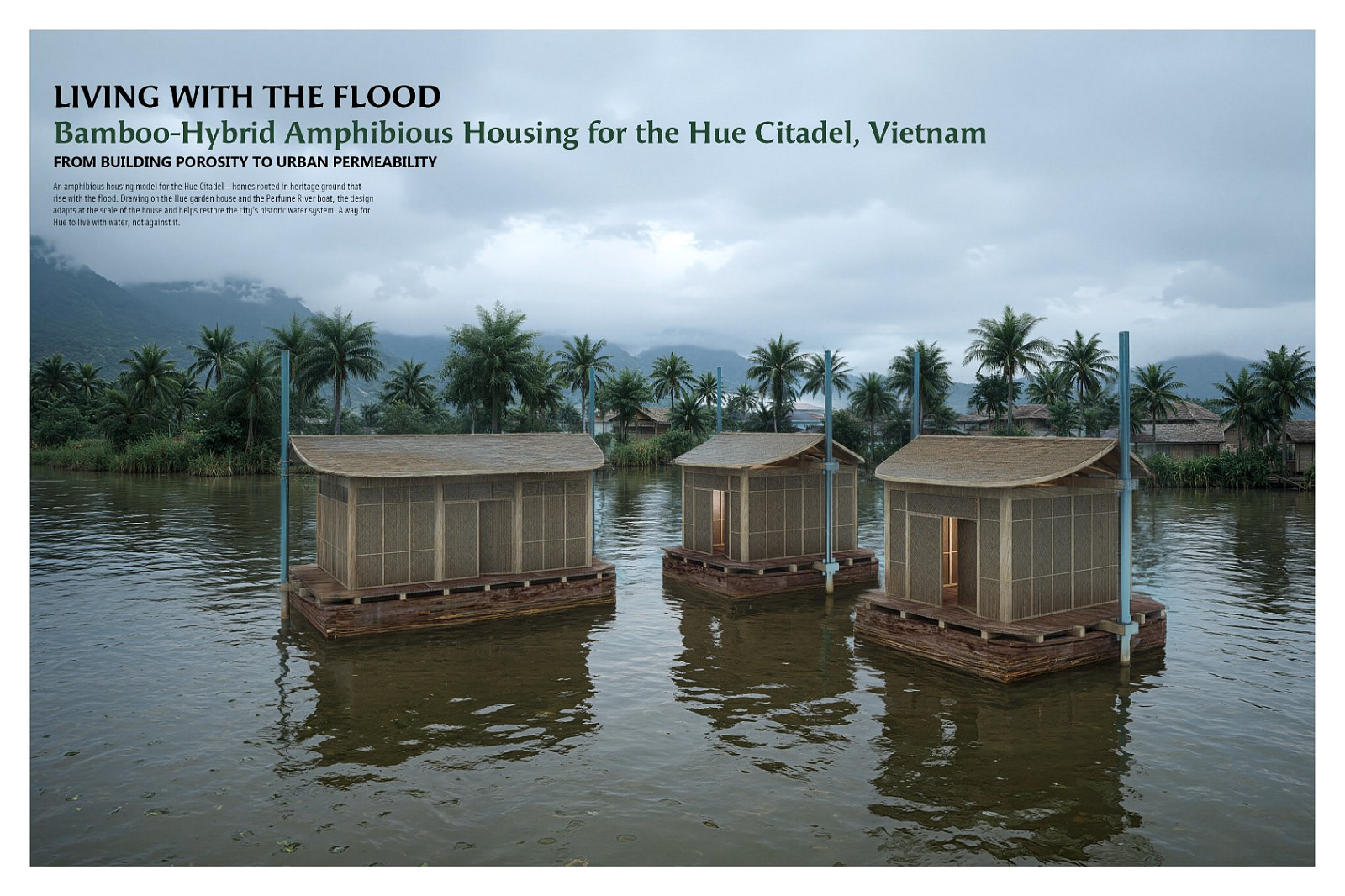
The project develops a household cluster of three independent amphibious modules — a main house, a kitchen, and a sanitation unit — reflecting the traditional Hue garden house, where domestic functions are distributed across separate buildings. Each module sits on a flat-bottom, boat-form platform that rests on a concrete ground-beam in the dry season and floats on sealed HDPE drums during floods, sliding vertically along fixed steel guide-posts. The architectural form draws on two heritage sources: the spatial organization of the Hue garden house, and the single-curvature vaulted form of the Perfume River boat, which shapes the roof and hull. At flood peak, three neighbouring households may pool their specialized modules into a shared cluster connected by temporary walkways, so that all three families gain access to all functions; when the water recedes, the cluster disperses. At the urban scale, the porous, water-permeable design aligns with the city's restoration of the Ngu Ha waterway, allowing water to flow beneath and between the houses rather than being obstructed. The project does not claim to be the first floating housing in Vietnam — it builds on proven precedents (Nhà Chống Lũ, Nguyen & Vukorep 2017, H&P Architects 2022) and extends them into a heritage-urban context.
Technical information
Each module is a flat-bottom, free-draining timber hull with limber holes, buoyed by sealed 200-litre HDPE drums arranged in removable cassettes (main house: 42 drums in a 6×7 grid; kitchen: 23; sanitation: 21). The main house measures 6.0 × 4.5 m. Vertical guidance is provided by two Ø219 mm steel guide-posts per module at bow and stern, each with two collars (at +2.70 m and +3.70 m) fitted with UHMW-PE sliding pads. A longitudinal concrete ground-beam (6.0 × 0.8 × 0.6 m) serves simultaneously as guide rail, overturning resistance, and dry-season bearing surface. The timber frame is sized from traditional joinery: main posts 150 × 150 mm, beams 120 × 220 mm, girders 120 × 180 mm, ribs 100 × 150 mm. The roof is a single-curvature vault of woven bamboo mat (cót tre) finished with dầu rái oil. Materials are locally sourced (Hue-region timber and bamboo) and built using local crafts — boat-building (timber bending for hull and roof), rường-house carpentry, and bamboo weaving.
Documentation

Copyright © 2026 INSPIRELI | All rights reserved. Use of this website signifies your agreement to the Terms of Use, Privacy Policy, and use of cookies.