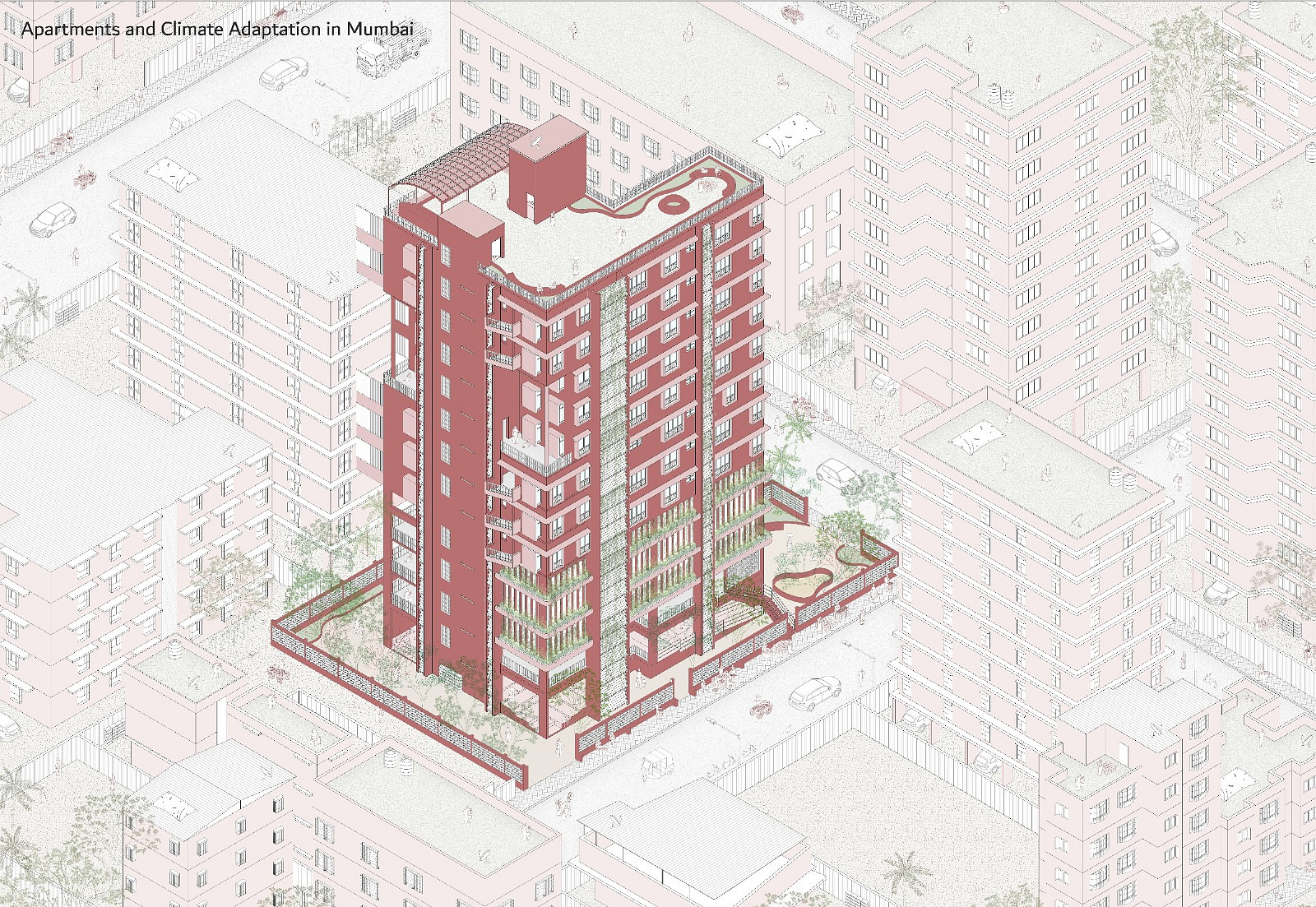
Apartments and Climate Adaptation in Mumbai


Project idea
Mumbai’s apartment housing is increasingly challenged by rising temperatures, prolonged humidity, extreme rainfall, and recurrent flooding. Apartments are often retrofitted with temporary coverings, altered layouts, or rebuilt entirely through redevelopment. While climate change is often addressed through technology and infrastructure, this thesis argues that the spatial design of housing itself plays a critical role in adaptation.
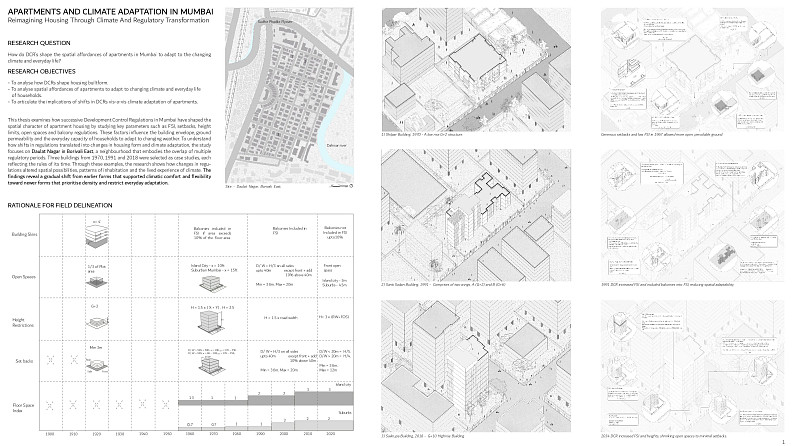
The thesis investigates how successive Development Control Regulations (DCRs) have transformed apartment housing in Mumbai and how these regulatory shifts have influenced residents’ ability to respond to changing climatic conditions. Through the study of buildings constructed under the 1967, 1991, and 2034 DCR frameworks, the research reveals a gradual reduction of climatic interfaces such as balconies, permeable grounds, setbacks, and adaptable spatial edges.
The project proposes a new model of climate-adaptive apartment housing that integrates environmental responsiveness with everyday cultural practices. Rather than treating climate as a problem to be resisted through mechanical systems, the design reimagines housing as an active climatic instrument capable of adapting to heat, flooding, humidity, and changing patterns of inhabitation.
Project description
The project is located in Daulat Nagar, Borivali East, Mumbai, a neighbourhood vulnerable to recurrent flooding, rising temperatures, high humidity, and rapid redevelopment. Developed as a response to research on the relationship between Development Control Regulations (DCRs), housing form, and climate adaptation, the project proposes a climate-responsive model for apartment housing that addresses environmental resilience and everyday living simultaneously.
The scope of the proposal extends across multiple scales. At the site level, the ground is reimagined as a permeable and flood-adaptive landscape that accommodates seasonal water flows while remaining an active community space. The stilt and first-floor levels provide shared social infrastructure, recreation spaces, and refuge areas that strengthen community resilience during extreme weather events.
At the building level, the proposal rethinks the apartment typology through climate-responsive design strategies that improve daylight, ventilation, thermal comfort, and environmental performance. Adaptability is embedded within both the building envelope and the housing units, enabling residents to respond to changing climatic conditions as well as evolving household needs. Shared terraces, green edges, and communal spaces further enhance environmental quality and collective use.
Beyond the architectural intervention, the project proposes a climate-responsive framework for future housing development in Mumbai. It advocates for permeable grounds, adaptive balconies, climatic building skins, accessible terraces, and environmental performance as key parameters within housing regulations. While developed for a specific site in Mumbai, the framework is scalable and can be adapted to redevelopment projects across flood-prone and high-density urban areas, enabling context-specific yet climate-responsive housing solutions.
Technical information
The proposal combines passive climatic strategies with flood-responsive infrastructure to improve environmental performance while reducing dependence on mechanical systems. Design decisions were informed by detailed studies of seasonal solar exposure, prevailing wind patterns, rainfall, flooding conditions, and patterns of inhabitation within Mumbai’s apartment housing.
The building envelope is developed as a climate-responsive system informed by seasonal studies of solar exposure, wind patterns, and rainfall. Orientation-specific facade elements optimise environmental performance across the building. Large north-facing openings maximise daylight and natural ventilation, while east-facing windows integrate louvers and sliding panels to filter low-angle sunlight while maintaining airflow. The south facade is selectively recessed to minimise heat gain and reduce the need for additional shading devices. On the west facade, balconies vary in depth according to solar exposure, creating a double-skin climatic buffer that reduces heat gain, improves ventilation, moderates daylight, and protects interiors from monsoon rain. Together, these strategies ensure that each apartment receives optimised daylight and cross-ventilation while responding to its specific environmental conditions.
Flood resilience is achieved through a permeable stepped ground plane, elevated community spaces, and rainwater management strategies that improve water infiltration and reduce surface runoff. The ground is conceived as climatic infrastructure capable of accommodating seasonal flooding while remaining an active public realm throughout the year.
Adaptability is integrated within the housing units through sliding and folding partitions that allow spaces to expand, contract, merge, or become private according to changing household needs. A puzzle parking system accessed by a car lift minimises the ground-level parking footprint, allowing the site to prioritise permeability, community use, and climatic performance.
Together, these technical strategies support thermal comfort, daylight access, natural ventilation, flood adaptation, and long-term environmental resilience while demonstrating how apartment housing can function as an active climatic system rather than a static built form.
Documentation

Copyright © 2026 INSPIRELI | All rights reserved. Use of this website signifies your agreement to the Terms of Use, Privacy Policy, and use of cookies.