The Rincón Square Heights - Civic and mixed-use mission driven affordable housing project


Project idea
PROJECT IDEA
English Entry
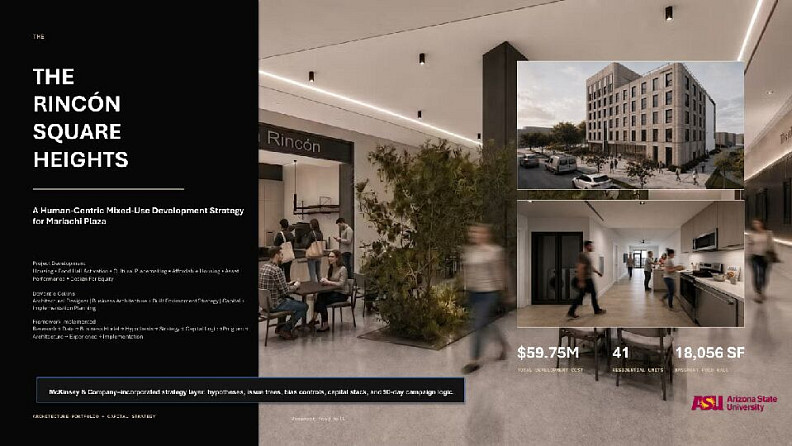
The Rincón Square Heights is a human-centric mixed-use development proposal for Mariachi Plaza in Boyle Heights, Los Angeles. The project is conceived as more than an apartment building: it is a civic platform where architecture, housing affordability, cultural identity, food entrepreneurship, public life, and implementation strategy operate together. Its central idea is that a building can become a community asset when its physical design, social purpose, financial logic, and operational systems are designed as one integrated framework.
The project responds to the urgent need for affordable and dignified housing in a culturally significant, transit-connected urban neighborhood. Located near Mariachi Plaza and the Metro E Line, the proposal uses transit adjacency as a foundation for mixed-income housing, reduced car dependency, public accessibility, and community-serving development. The site is not treated as a neutral parcel. It is understood as part of a larger cultural, economic, and neighborhood system connected to music, food, small business, public space, mobility, and Latino cultural memory in Boyle Heights. The project narrative treats Mariachi Plaza as a civic and economic anchor connected to transit, housing, and public life.
The project’s core thesis is that architecture, capital, culture, and affordability must work together rather than remain separate disciplines. The residential portion provides 41 income-averaged homes, while the lower public levels activate the building with a cultural food hall, public lobby, café, vendor incubation, digital/community lounge, event programming, and small-business infrastructure. The food hall is not treated as retail filler. It is designed as a platform for local vendor launch, commercial kitchen access, pop-ups, community events, meal programs, job postings, workforce training, and emergency support.
The design goal is to produce a project that protects resident dignity while also expanding public value. Instead of sacrificing quality to achieve affordability, The Rincón Square Heights uses efficient unit planning, shared infrastructure, cultural programming, and a layered capital strategy to support both livability and feasibility. The proposal argues that affordable housing can be beautiful, urban, strategic, financially structured, and socially ambitious at the same time.
The project also challenges the traditional boundary between architectural design and development strategy. The proposal includes not only renderings, plans, interiors, and public-space ideas, but also rent logic, AMI distribution, development cost modeling, funding strategy, public-benefit framing, and a phased capital campaign. The design is therefore presented as a business case, a civic case, a cultural case, and a funding case.
At its highest level, The Rincón Square Heights is a model for mission-driven, for-profit social-impact development. It asks how one building can deliver multiple forms of value: affordable homes, cultural continuity, small-business opportunity, food access, public gathering, workforce development, wellness, safety, and long-term neighborhood resilience. The project is conceptual, but it is intentionally developed with the depth of an implementable development framework.
Project description
PROJECT DESCRIPTION
English Entry
The Rincón Square Heights is a six-story mixed-use residential and cultural infrastructure project located beside Mariachi Plaza in Boyle Heights. The building is organized as a vertical civic ecosystem. Housing is placed above a public-facing ground plane and a large basement food hall, creating a layered relationship between private residential life, semi-public amenities, and public community activation.
The residential portion contains 41 income-averaged units. The affordability strategy includes a mix of 40%, 50%, 60%, and 80% AMI units, averaging 60% AMI across the full residential program. The unit mix includes studios, one-bedrooms, two-bedrooms, and three-bedrooms, allowing the project to serve different household types while maintaining efficient planning. The rent strategy is designed to support affordability while also creating a realistic repayment and funding story.
The lower portion of the project is designed as the public and economic heart of the building. The basement contains an 18,056 SF food hall and commons. This space is imagined as a cultural food hall, ghost-kitchen platform, small-business incubator, event space, meal-program hub, and community resilience asset. It provides infrastructure for local vendors, chef incubation, commercial kitchen access, pop-up markets, sports/community events, workforce training, job postings, and emergency support staging. The food hall is therefore not only a commercial amenity; it is a community-support system and an economic mobility platform.
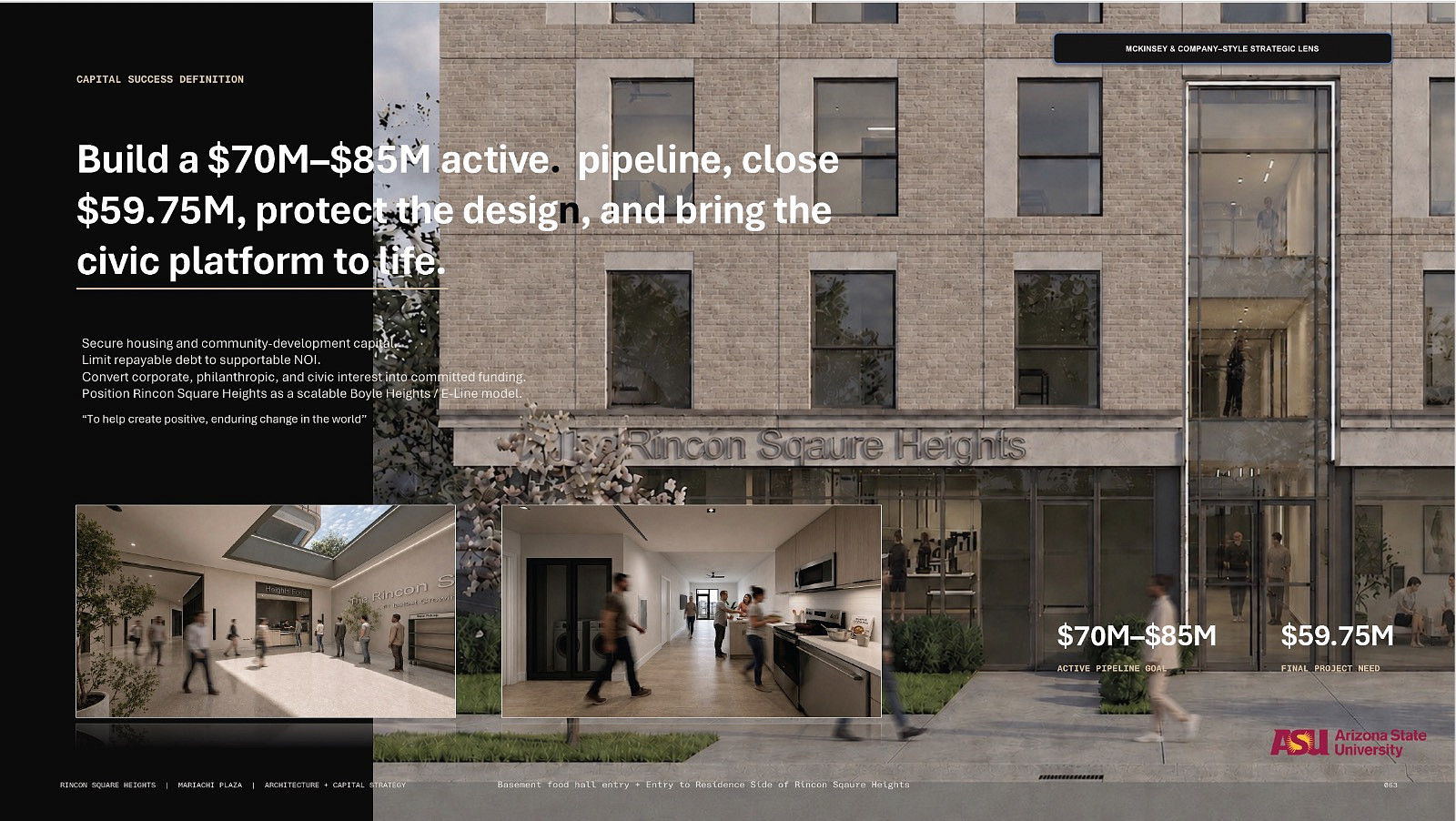
At the ground level, the project creates a public-facing entry sequence that connects the building to Mariachi Plaza. The ground plane includes lobby functions, café/public activity, residential access, and visual connections between public and private spaces. The project uses this threshold to make the building feel active, safe, and culturally connected instead of sealed off from the neighborhood. The public entry, food hall entry, residence lobby, and circulation areas are designed to read as one connected civic interior, using disciplined frames, consistent ceilings, light slots, dark sign bands, pale walls, wood counters, stone floors, and planted social edges.
The upper amenity strategy includes wellness and rooftop programming. The sixth-floor wellness and event terrace is positioned as a premium civic and investor-facing amenity. Instead of using the roof only as a passive outdoor deck, the project treats rooftop space as part of the building’s public-value and asset-performance strategy. It supports resident wellness, social gathering, views, events, and a stronger identity for the overall development.
The design scope includes exterior architecture, interior public spaces, residential units, food hall environments, lobby and circulation spaces, rooftop and amenity areas, public-realm relationships, affordability strategy, cost strategy, and implementation logic. The project combines architecture and business planning by translating spreadsheets and technical data into graphic dashboards, range bars, funding ladders, unit/rent matrices, and source notes.
Urbanistically, the project responds to the Boyle Heights planning context through transit-oriented housing, calibrated urban density, and small-business infrastructure. The planning context around the E-Line corridor supports the argument for housing near transit, while the Mariachi Plaza location supports a culturally rooted public program. The project uses the site as a bridge between housing production, local commerce, food access, cultural programming, and public space.
The proposal also includes a financial and operational scope. The deck frames the project as a financeable civic development model rather than a conventional single-use apartment project. Its capital logic recognizes that the housing, food hall, cultural commons, public realm, and small-business components can each attract different funding sources. This expands the project beyond residential rent alone and positions it for housing capital, community-development capital, food-system funding, sponsorship, philanthropy, CDFI/NMTC support, public-realm funds, and institutional partnerships.
In summary, the project solution is a mixed-use, mixed-income, transit-oriented, culturally grounded development that combines 41 affordable residential units with an 18,056 SF basement food hall and community commons. It uses architecture as a physical, social, and economic platform for housing stability, vendor incubation, public gathering, food access, wellness, cultural identity, and long-term neighborhood resilience.
Technical information
TECHNICAL INFORMATION
English Entry
The Rincón Square Heights is modeled as a six-story transit-oriented mixed-use building over a 20-foot-deep basement food hall. The planning gross area is approximately 89,794 SF. The project contains 41 residential units and an 18,056 SF basement food hall and commons. The building’s roof datum is approximately 73 feet, with a full vertical stack of approximately 93 feet from basement to roof datum. The basement is designed with a 16-foot clear height, allowing it to function as a food hall, cultural commons, event space, vendor platform, and community infrastructure level.
The current total development cost is modeled at $59.75M. The project snapshot identifies a $48.79M hard cost pool, $4.50M land acquisition, $4.00M soft costs, $2.46M financing/reserves, and $3.85M builder/GC protection. These figures position the proposal not only as a design project, but as a development study with cost, delivery, and risk-control logic.
The basement food hall and commons are one of the most technically important parts of the project. The basement priority package is identified at $16.9M, supporting excavation, shell, MEP/life-safety infrastructure, finishes, food hall equipment, and activation-related costs. Programmatically, the basement is designed to support local vendor incubation, commercial kitchen access, meal programs, community events, job postings, workforce training, pop-up markets, and emergency support staging.
The residential affordability model is organized around a 41-unit AMI mix. The project includes 13 units at 40% AMI, 6 units at 50% AMI, 6 units at 60% AMI, and 16 units at 80% AMI, producing a 60% average AMI across the full residential program. The unit mix includes 17 studios, 13 one-bedroom units, 7 two-bedroom units, and 4 three-bedroom units. This unit distribution supports efficient residential planning while preserving a range of household options, including family-sized units.
The rent strategy uses tenant rent targets after utility allowances. The rent model is structured through affordability layers and unit types, with different rent limits for studio, one-bedroom, two-bedroom, and three-bedroom units at each AMI band. The project’s rent summary identifies approximately $69,658 in monthly tenant rent and approximately $835,896 in annual tenant rent. The 80% AMI units strengthen repayment capacity, while the 40%–60% AMI units strengthen the public-benefit and affordability case.
The project’s technical approach is also operational. The food hall is designed as a hybrid cultural, commercial, and resilience platform. It can support hot food vendors, cold mercado concepts, meal kits, subscriptions, food rescue, SNAP-aligned food access, community meals, cultural events, and recurring institutional demand. This operational model allows the building to function beyond traditional rent collection. It creates a broader revenue and impact framework based on food, culture, events, sponsorship, partnerships, and community-serving programming.
The capital strategy is organized as a layered funding model. Housing capital supports the 41-unit residential tower. Food-system, NMTC, CDFI, sponsorship, and philanthropic capital support the 18,056 SF basement platform. Public realm, culture, tourism, and city/county funds support the Mariachi Plaza-facing components. Corporate, sports, church, university, hospital, and employer partnerships are identified as potential sources of recurring food hall demand, social impact, sponsorship, and donations.
The project also includes a problem-solving and implementation framework. The strategic deck uses a seven-step structure: define, structure, prioritize, plan, analyze, synthesize, and recommend. The purpose is to turn an ambitious civic development into fundable decisions, analyses, findings, and recommendations. The project is therefore technically specified not only through dimensions and cost, but through an implementation logic that connects design evidence to capital readiness, stakeholder alignment, and public-benefit measurement.
The final capital success definition is to build a $70M–$85M active funding pipeline, close the $59.75M project need, protect the design, and bring the civic platform to life. The project’s financial logic is to secure housing and community-development capital, limit repayable debt to supportable operating income, convert corporate/philanthropic/civic interest into committed funding, and position The Rincón Square Heights as a scalable Boyle Heights / E-Line model.
Architecturally, the technical scope includes housing, a public lobby/office layer, cultural food hall, small-business incubation, wellness amenity, rooftop civic landscape, transit adjacency, and Mariachi Plaza activation. The project’s technical identity is therefore not only its building size or cost. It is the integration of structure, program, affordability, public space, operations, capital stack, urban context, and long-term community impact.
Documentation

Copyright © 2026 INSPIRELI | All rights reserved. Use of this website signifies your agreement to the Terms of Use, Privacy Policy, and use of cookies.
