S, M, L, XL


Project idea
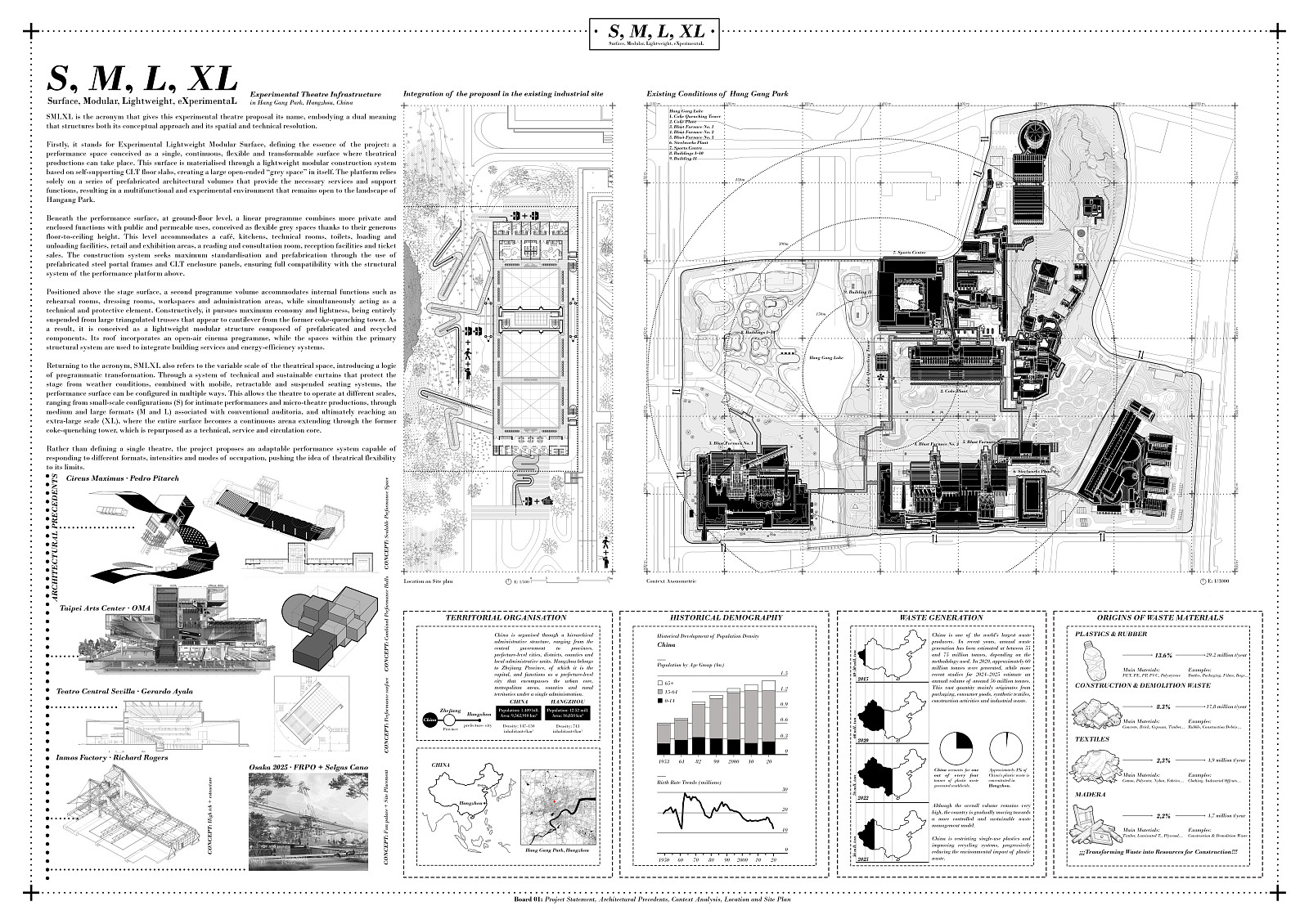
The project is framed within the transformation of Hang Gang Park in Hangzhou, China, a former industrial steel complex that has progressively been converted into a new cultural, ecological and urban destination. The brief addresses the revitalisation of this industrial heritage site through the introduction of a performing arts centre linked to leisure, culture, commerce and public life.
The proposal responds to the need for new cultural infrastructure in the northern districts of Hangzhou, where a growing urban population contrasts with a limited provision of public spaces dedicated to performing arts. In particular, the brief focuses on small-format performances, such as experimental theatre, dance-theatre, musicals, opera, stand-up comedy and intimate concerts, whose flexibility, economic efficiency and immersive character have made them increasingly relevant for younger audiences.
The main challenge lies in working with the existing coke-quenching tower and its surrounding industrial landscape, transforming them into an active cultural focus without erasing their historical and technological memory. The project must therefore negotiate a complex condition between the “old” and the “new”: preserving the physical presence and identity of the former steel plant while introducing contemporary uses, technical systems and public programmes capable of generating new urban vitality.
At the same time, the brief requires a flexible and integrated functional organisation, able to combine performance spaces, rehearsal and training areas, cultural facilities, commercial activities, public circulation and technical rooms. The intervention must also respond to the constraints of the site, including existing routes, open spaces, the nearby lake, the elevated visitor walkway, the surrounding park facilities and the industrial architectural language that defines the character of Hang Gang Park.
Project description
SMLXL is the acronym that gives this experimental theatre proposal its name, embodying a dual meaning that structures both its conceptual approach and its spatial and technical resolution.
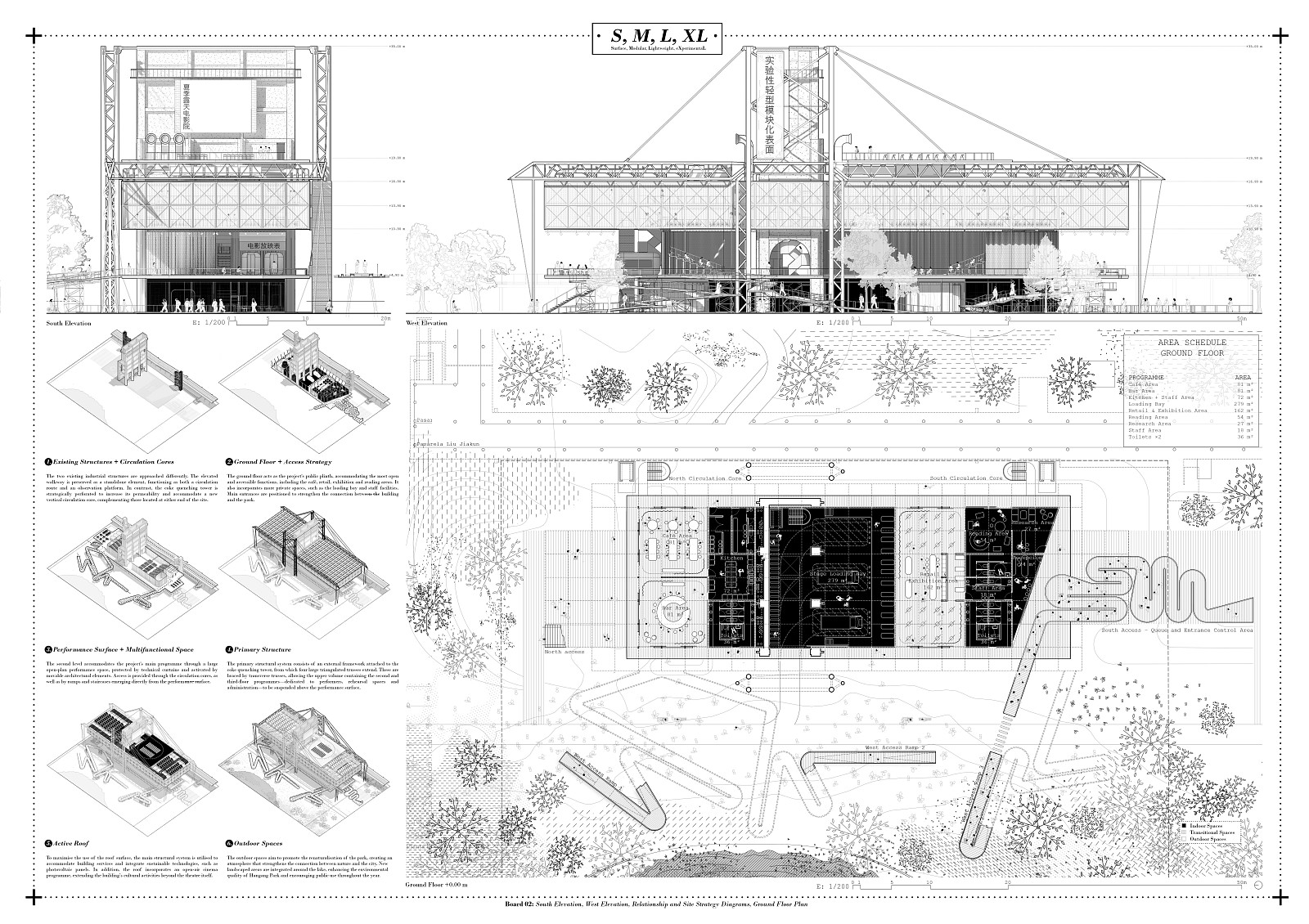
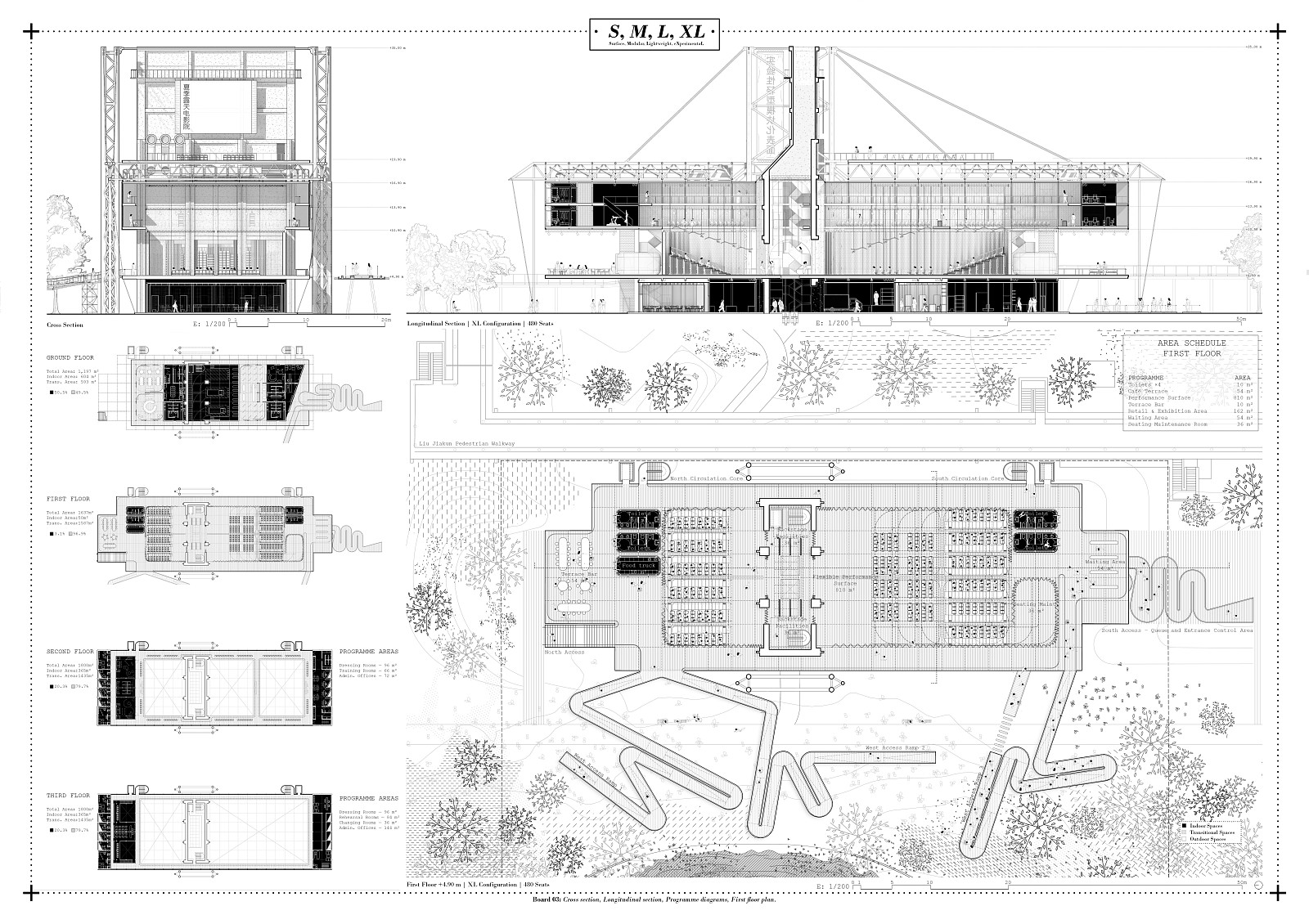
Firstly, it stands for Experimental Lightweight Modular Surface, defining the essence of the project: a performance space conceived as a single, continuous, flexible and transformable surface where theatrical productions can take place. This surface is materialised through a lightweight modular construction system based on self-supporting CLT floor slabs, creating a large open-ended “grey space” in itself. The platform relies solely on a series of prefabricated architectural volumes that provide the necessary services and support functions, resulting in a multifunctional and experimental environment that remains open to the landscape of Hangang Park.
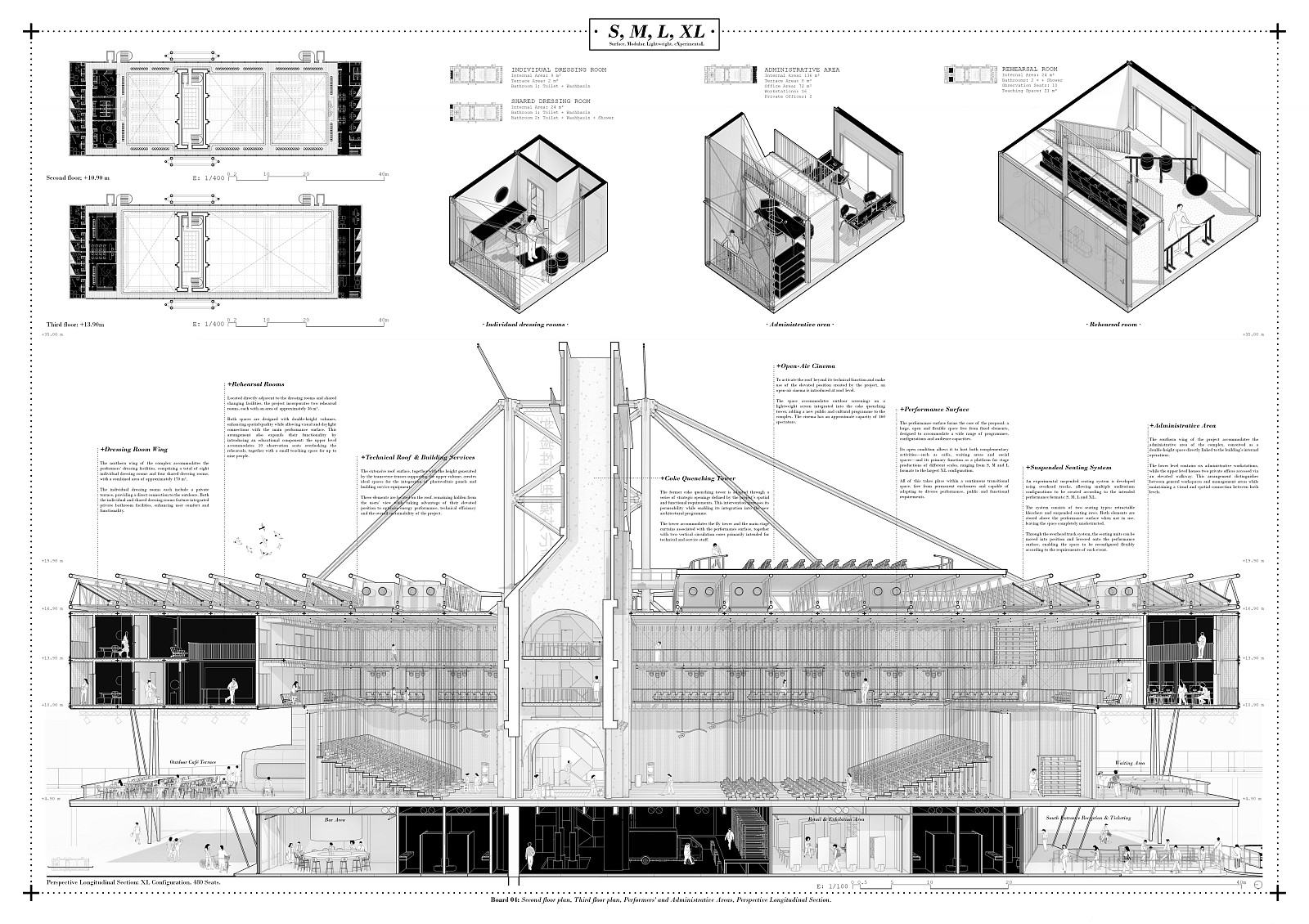
Beneath the performance surface, at ground-floor level, a linear programme combines more private and enclosed functions with public and permeable uses, conceived as flexible grey spaces thanks to their generous floor-to-ceiling height. This level accommodates a café, kitchens, technical rooms, toilets, loading and unloading facilities, retail and exhibition areas, a reading and consultation room, reception facilities and ticket sales. The construction system seeks maximum standardisation and prefabrication through the use of prefabricated steel portal frames and CLT enclosure panels, ensuring full compatibility with the structural system of the performance platform above.
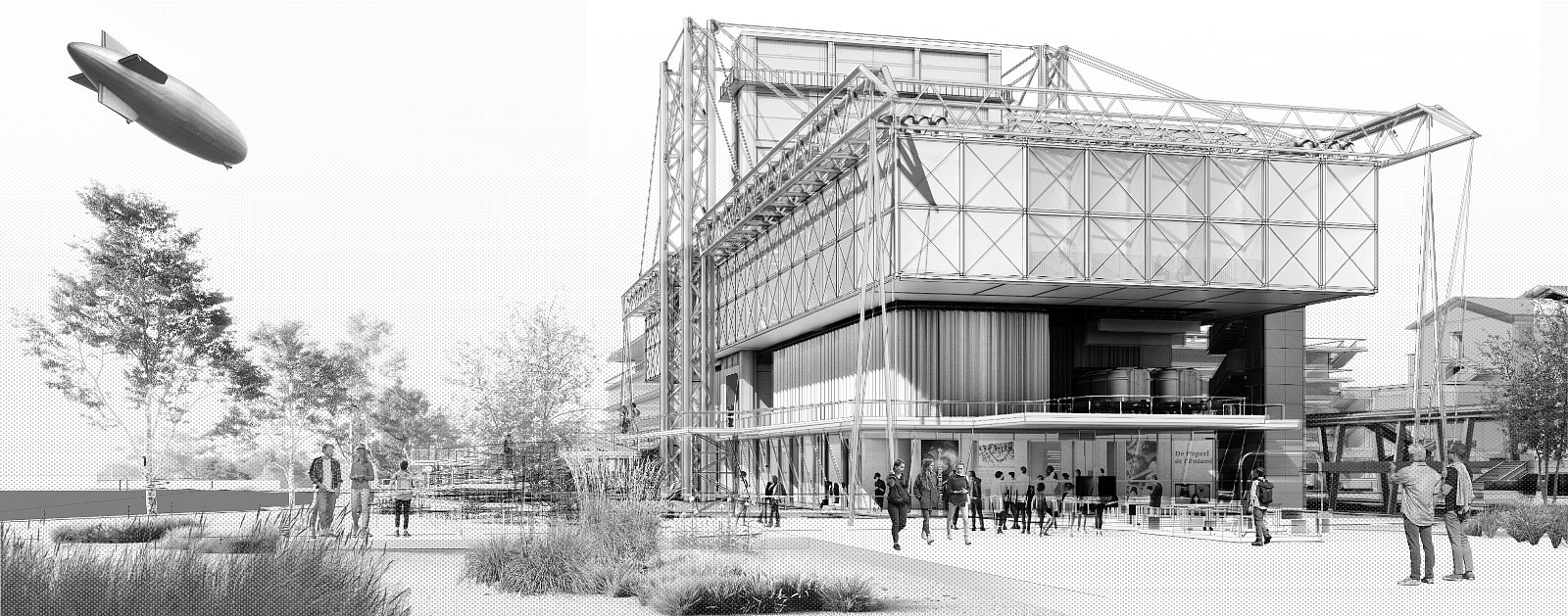
Positioned above the stage surface, a second programme volume accommodates internal functions such as rehearsal rooms, dressing rooms, workspaces and administration areas, while simultaneously acting as a technical and protective element. Constructively, it pursues maximum economy and lightness, being entirely suspended from large triangulated trusses that appear to cantilever from the former coke-quenching tower. As a result, it is conceived as a lightweight modular structure composed of prefabricated and recycled components. Its roof incorporates an open-air cinema programme, while the spaces within the primary structural system are used to integrate building services and energy-efficiency systems.
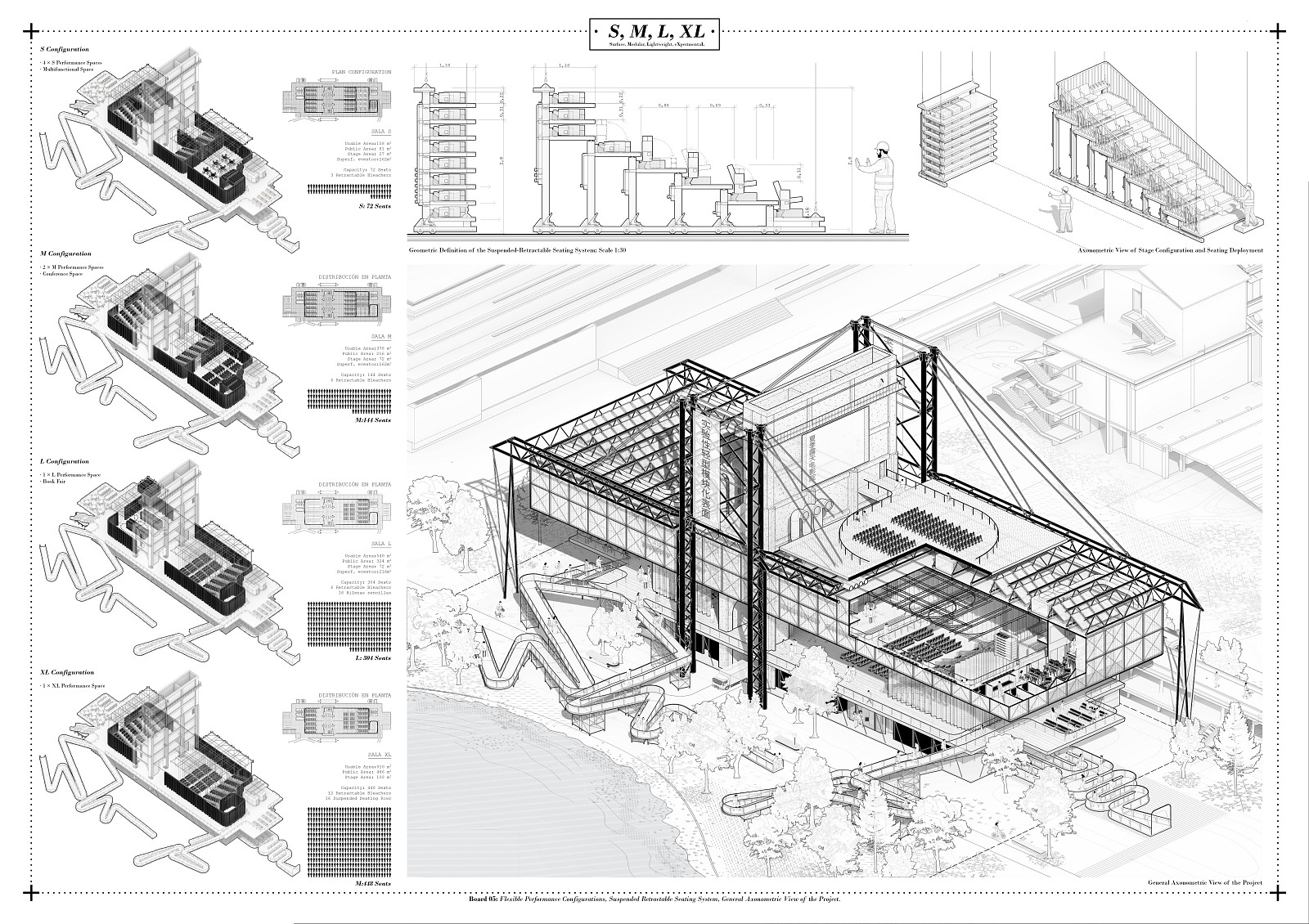
Returning to the acronym, SMLXL also refers to the variable scale of the theatrical space, introducing a logic of programmatic transformation. Through a system of technical and sustainable curtains that protect the stage from weather conditions, combined with mobile, retractable and suspended seating systems, the performance surface can be configured in multiple ways. This allows the theatre to operate at different scales, ranging from small-scale configurations (S) for intimate performances and micro-theatre productions, through medium and large formats (M and L) associated with conventional auditoria, and ultimately reaching an extra-large scale (XL), where the entire surface becomes a continuous arena extending through the former coke-quenching tower, which is repurposed as a technical, service and circulation core.
Rather than defining a single theatre, the project proposes an adaptable performance system capable of responding to different formats, intensities and modes of occupation, pushing the idea of theatrical flexibility.
Technical information
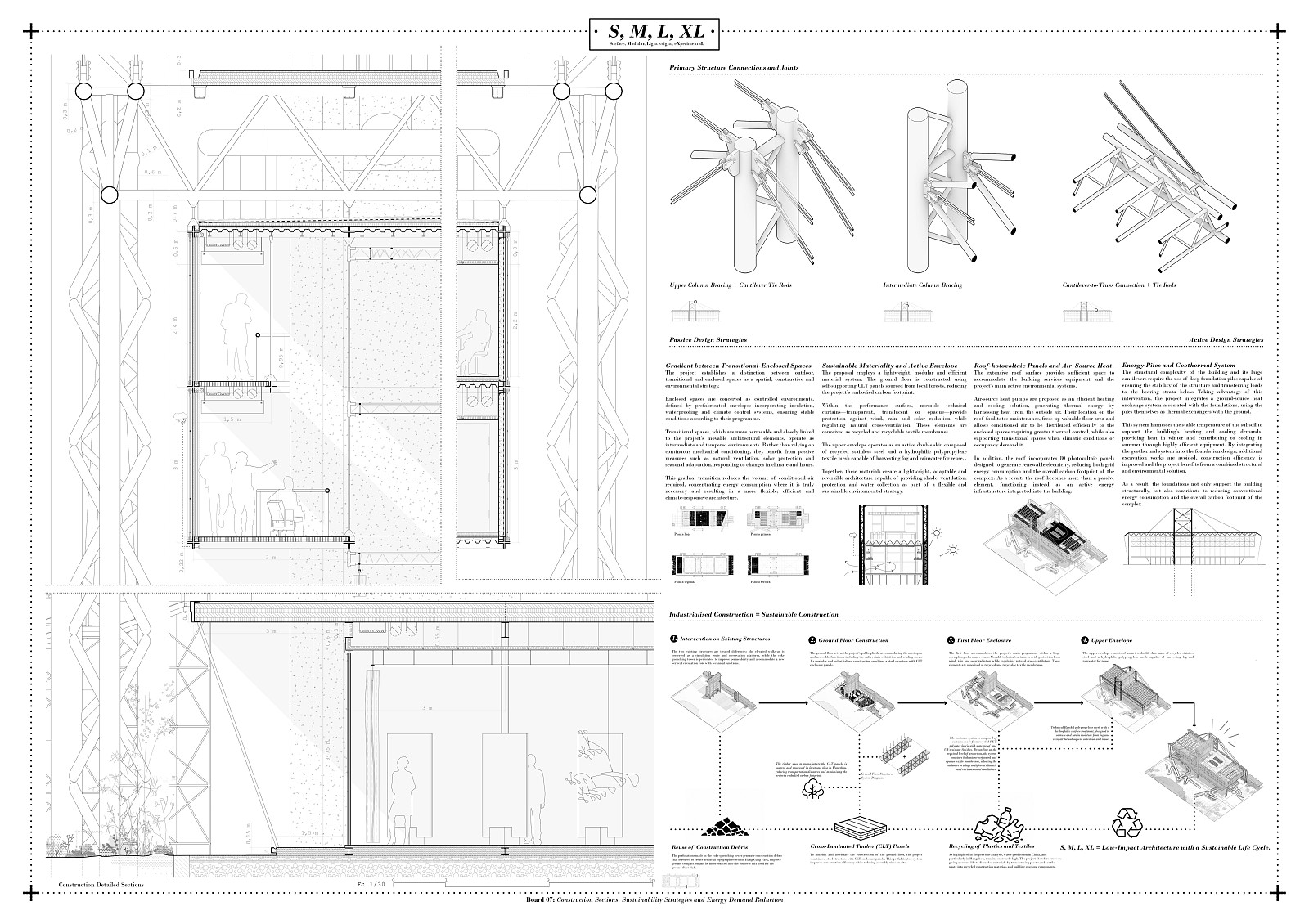
Beyond its programmatic flexibility, SMLXL is conceived as a technically lightweight and environmentally responsive system. The project seeks to transform the former coke-quenching tower into an active architectural infrastructure while minimising the physical and carbon impact of the new intervention. Instead of relying on a massive permanent building, the proposal is developed through prefabricated, modular and reversible components that allow the theatre to operate as an adaptable construction system.
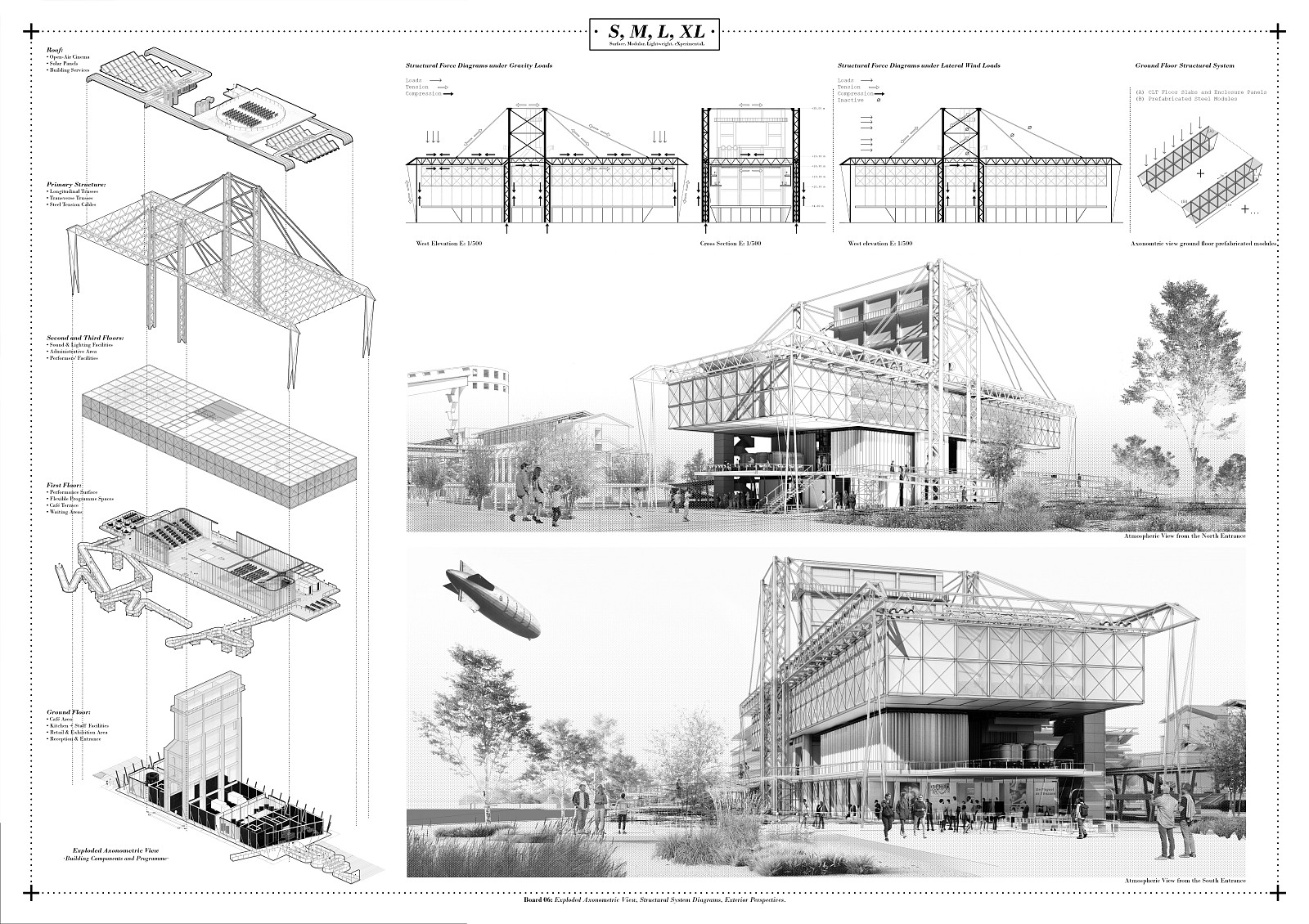
The structural strategy combines the permanence of the existing industrial tower with a new lightweight framework. At ground-floor level, the project uses prefabricated steel portal frames and CLT enclosure and floor panels, generating a dry, standardised and efficient construction process. Above the performance platform, the main volume is suspended from large triangulated steel trusses, transverse frames and tension elements, which resolve the long spans, cantilevers and wind loads while keeping the architectural language close to the industrial character of Hang Gang Park. The structural system is therefore not only a technical solution, but also a continuation of the site’s infrastructural identity.
The material strategy is based on lightness, prefabrication and circularity. CLT panels are used as a low-carbon structural and enclosure material, while recycled steel, textile membranes, acoustic curtains and recyclable polymer meshes form the active envelope of the building. The upper skin works as a double environmental layer, combining recycled stainless steel with a hydrophilic polypropylene sub-mesh capable of filtering, shading and collecting moisture or rainwater for reuse. Recycled textile elements are also integrated as acoustic and climatic devices, reinforcing the idea of a flexible architecture made from industrialised and reusable components.
Bioclimatically, the project is organised through a gradient between exterior spaces, grey spaces and fully conditioned interiors. The most enclosed rooms are climatised only where stable environmental conditions are required, while the large performance areas operate as intermediate, adaptable spaces. Mobile technical curtains, translucent or opaque textile layers and retractable systems protect the stage from rain, wind and solar radiation, while allowing cross ventilation, shading and seasonal adjustment. This reduces the volume of air that needs to be mechanically conditioned and concentrates energy demand only in the areas that truly require it.
The roof is treated as an active technical surface rather than a passive covering. It concentrates the main building services, aerothermal equipment and photovoltaic panels, reducing the visual and spatial impact of installations while improving maintenance and performance. The photovoltaic system contributes renewable electricity to the building, while aerothermal units provide efficient heating and cooling support. In parallel, the foundation system is understood as an opportunity for energy exchange: the required deep piles can operate as geothermal exchangers, using the stable temperature of the ground to support the building’s environmental performance.
The construction process is therefore understood as part of the sustainable strategy of the project. Existing industrial elements are preserved and reactivated, rubble and residual materials can be reused, and prefabricated CLT and steel components reduce waste, construction time and on-site impact. In this way, SMLXL proposes a low-impact and sustainable-cycle building, where structure, envelope, climate control and programme work together as a single adaptable architectural system.


Copyright © 2026 INSPIRELI | All rights reserved. Use of this website signifies your agreement to the Terms of Use, Privacy Policy, and use of cookies.