Understanding nature and pattern by implementing in design


Project idea
I have always been fascinated by how nature effortlessly solves complex spatial problems. The core inspiration for this project comes from swarm intelligence, specifically the foraging behavior of ants. In nature, ants deposit pheromone trails on the ground to mark favorable paths, creating a dynamic, self-optimizing network for the rest of the colony. This project translates the Ant Colony Optimization (ACO) algorithm into an architectural and spatial study. My goal was to explore how this biological mechanism of finding the most efficient route can be applied to architectural design. By mapping these shortest path determinations, my ambition is to eventually scale this concept up to urban design and complex residential circulation. I believe that if we can harness these algorithmic nature studies, we can design future cities and buildings with highly organic, perfectly optimized movement networks that adapt to human behavior just as a colony adapts to its environment.
And by that, I think I can also solve many problems with it, like traffic jams in cities, congestion, urban efficient mapping, and so on. The possibilities are endless
Project description
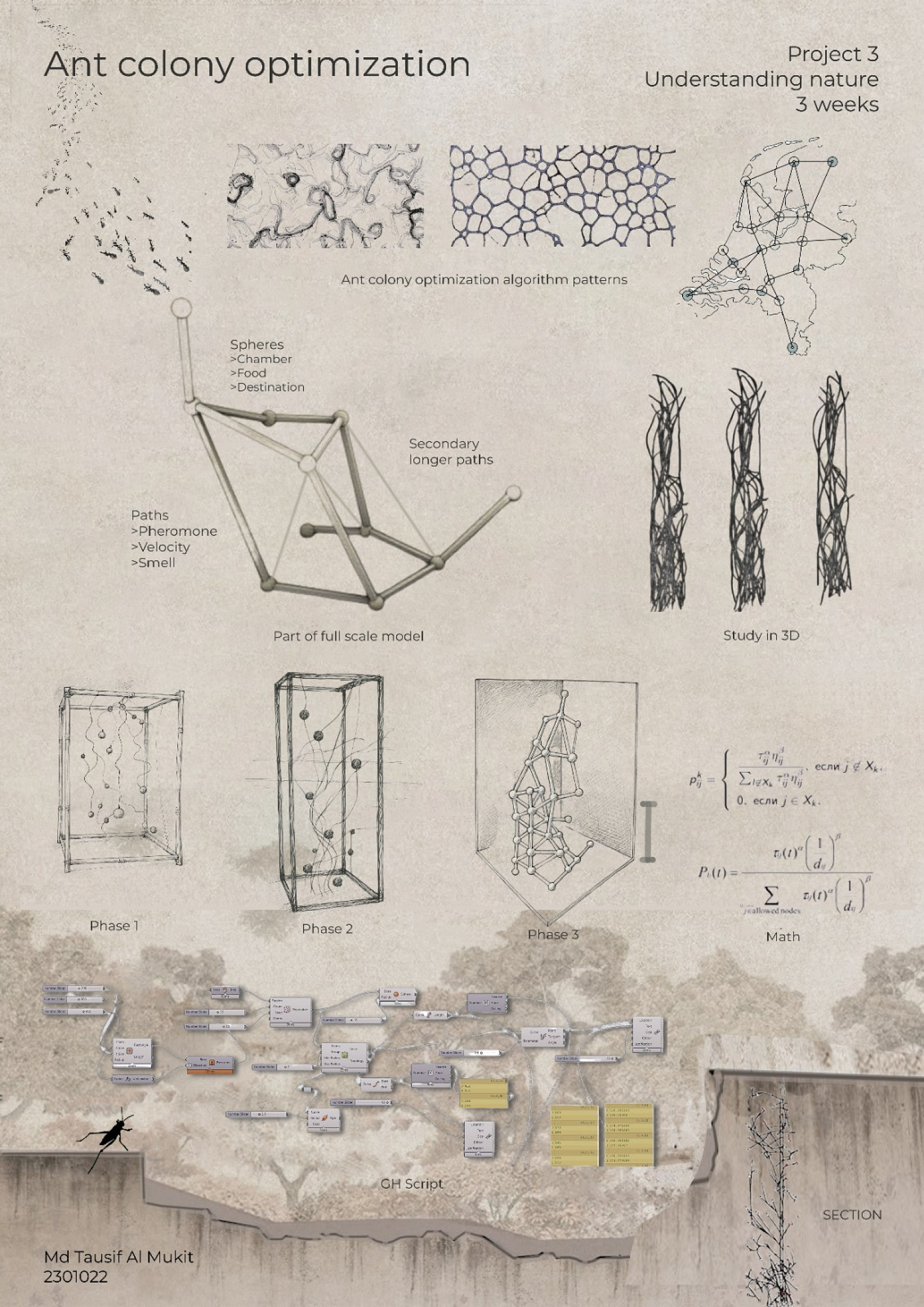
This project translates the abstract mathematical principles of swarm intelligence into a tangible, 3D spatial network. The design consists of a structural system of interconnected nodes and paths that map an optimized movement system. In this physical translation, the spheres act as primary zones—representing the chamber, food sources, and ultimate destinations. The connecting elements represent the paths, which are defined by theoretical parameters like pheromone density, velocity, and smell. The scope of the project evolved through three distinct phases of 3D study, moving from early 2D pattern analysis to a full-scale spatial model. The final output demonstrates how secondary, longer paths eventually streamline into a primary optimized route. While this is currently an academic study of nature, it serves as a foundational blueprint for how we can lay out efficient, living circulation systems in large-scale architectural projects.
Technical information
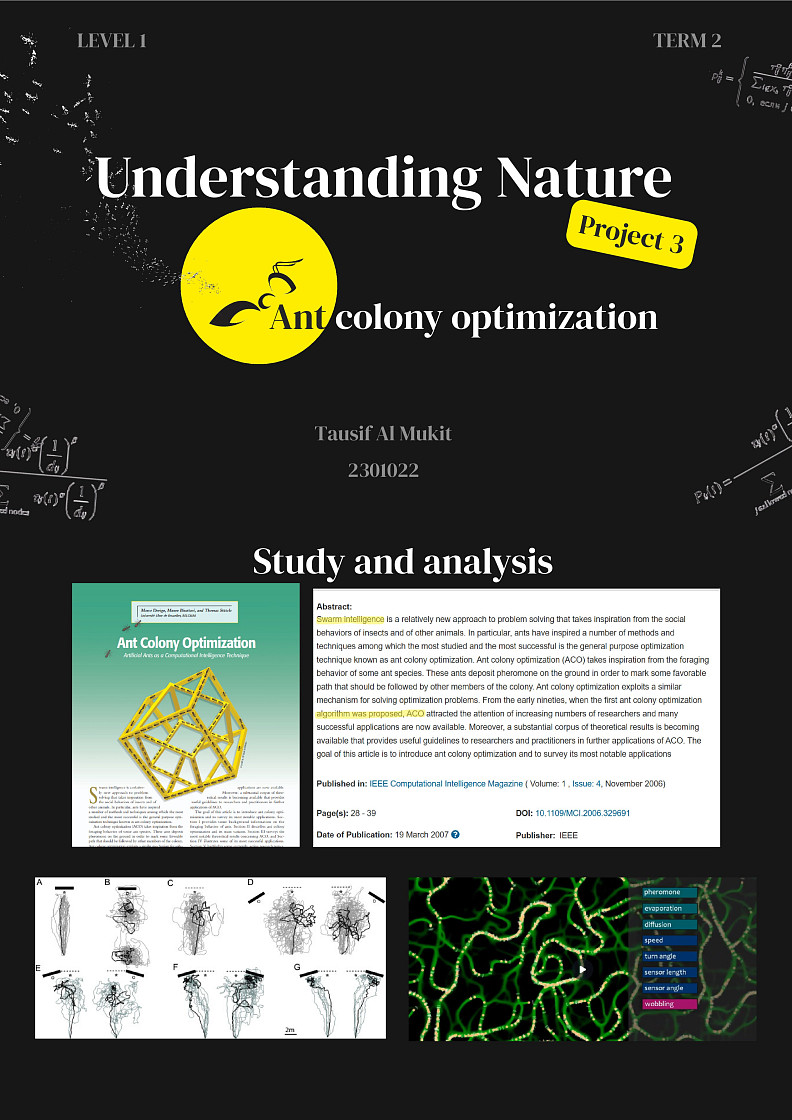
The technical execution of this project bridges computational analysis with hands-on experimentation to manifest biological logic directly in three dimensions. I began by breaking down the mathematical probability formulas that govern ant foraging—specifically tracking variables like pheromone evaporation, diffusion speed, and turn angles. Using Grasshopper and Blender, I digitally simulated these algorithmic behaviors to isolate the exact shortest route determinations within the system. To translate this complex data into a physical model, I developed a deliberate material hierarchy where these spatial combinations exist completely in 3D. The most suitable, optimized paths are structurally rendered much thicker than the secondary, less-frequented ones. This three-dimensional contrast between thick primary routes and thinner secondary paths creates a clear visual and structural map of efficiency. This workflow proves that abstract computational behaviors can be materialized into physical, load-bearing circulation frameworks.
Documentation

Copyright © 2026 INSPIRELI | All rights reserved. Use of this website signifies your agreement to the Terms of Use, Privacy Policy, and use of cookies.
