
Tiffany & Co.


 Prof. Dr. Osama Hassan
Prof. Dr. Osama Hassan
Prof. Dr. Osama Hassan
Project idea
Tiffany & Co. has always been about more than jewelry , it is about the moment raw material becomes something extraordinary. This project takes that transformation as its spatial premise: the journey of a stone from its raw, grounded state into a faceted crystal, brilliant with internal light.
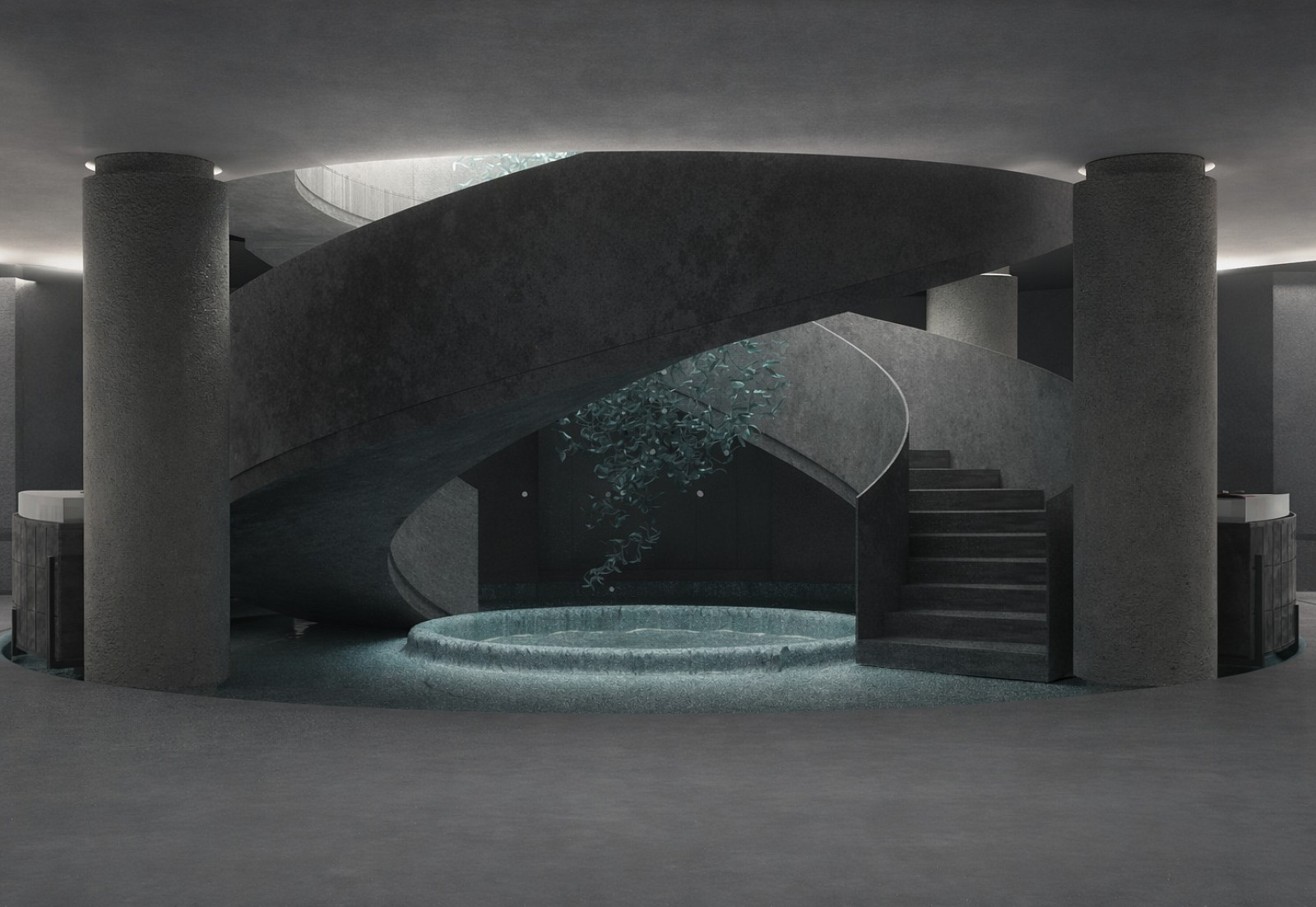
The boutique is not designed to feel bright. It is designed to feel like a gem in the process of becoming , dark at its edges, dense with material weight, and gradually revealing a single concentrated source of brilliance at its core. That core is not a light fixture. It is a moment: the point where pressure, time, and craft converge to produce something luminous from something solid.
The concept, "Submerged in Light," describes this condition , not a space flooded with illumination, but one where light is earned, emerging from within matter rather than imposed upon it.
Project description
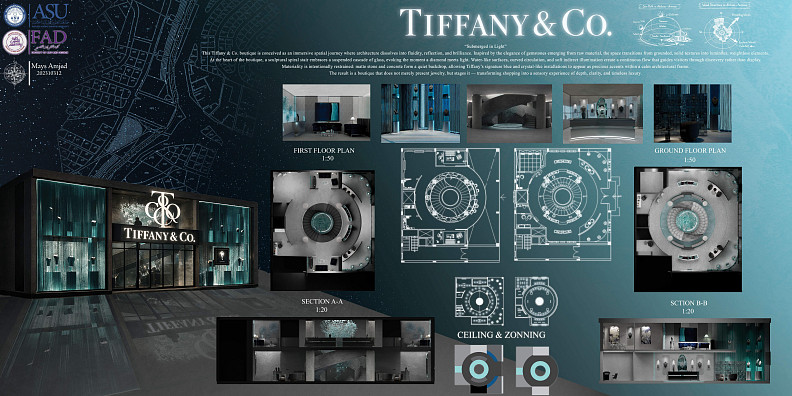
The boutique occupies two floors organized around a central void , a deliberate absence that acts as the spatial equivalent of a gem's hollow core before it is cut. Circulation moves in a continuous loop around this void, gradually drawing visitors inward and upward, mimicking the layered crystalline structure of a gemstone being revealed facet by facet.
At the heart of the space, a sculptural spiral staircase embraces a suspended glass installation , the moment the stone fractures into light. This is not primarily a circulation element; it is the spatial climax of the narrative. Every other zone , the display counters, the VIP room, the gallery wall, the floating jewelry showcase , exists in deliberate tension with this focal point: grounded, material-heavy, and dark by contrast, so that the central brilliance reads as emergence rather than decoration.
Materials are sequenced to reinforce the journey. Entry surfaces are dense and tactile ,microcement, brushed steel, textured glass blocks, progressively giving way to reflective, transparent, and finally luminous elements: acrylic panels, crystal sculpture, silk thread cascades that dissolve solid walls into filament. The exterior elevation maintains the same logic: an opaque frame around a transparent core, so the interior light is visible from outside only as a concentrated glow ,a rough stone with something luminous trapped inside.
Technical information
The project is documented at 1:50 (plans) and 1:20 (sections), with ceiling and zoning plans produced separately. The material palette is structured as a gradient from mass to translucency, specified to international standards throughout.
Primary materials: Brushed Stainless Steel AISI 304, No. 4 satin finish (ASTM A240 / EN 10088-2); Anodized Aluminum 6063-T5, Type II Dark Graphite, 15–25 µm (AAMA 611); Cast PMMA, 92% light transmission, UV-stabilized (EN 13501-1 Class B); Textured Glass Mosaic, 50×50 mm mixed-finish tiles on mesh, epoxy-grouted (EN 12004 C2 TE); K9 Optical Crystal Glass ,bespoke faceted sculpture, CNC-milled and hand-polished; Midnight Blue Velvet, 420 gsm, 100,000+ Martindale cycles, Crib 5 fire rated (EN ISO 12947-2 / BS 5852); Silk Thread Installation, Grade 6A, factory FR-treated (Pyrovatex), tension-railed floor-to-ceiling; Polished Microcement, 3–4 mm trowel-applied, R10 slip resistance (DIN 51130).
Ceiling systems include a suspended anodized aluminum tile grid (NRC 0.70 acoustic performance), DALI-dimmable backlit PMMA panels (ambient target 200–300 lux, feature zones 400 lux), and a structural silk thread cascade coordinated with MEP clearances. All materials comply with EN 13501-1 fire classifications. Lighting is intentionally restrained , low ambient levels with concentrated accent sources , to preserve the contrast between material mass and focal luminosity that drives the spatial concept.
Documentation


Copyright © 2026 INSPIRELI | All rights reserved. Use of this website signifies your agreement to the Terms of Use, Privacy Policy, and use of cookies.
