
Centro de Justicia con Interés Intercultural


Project idea
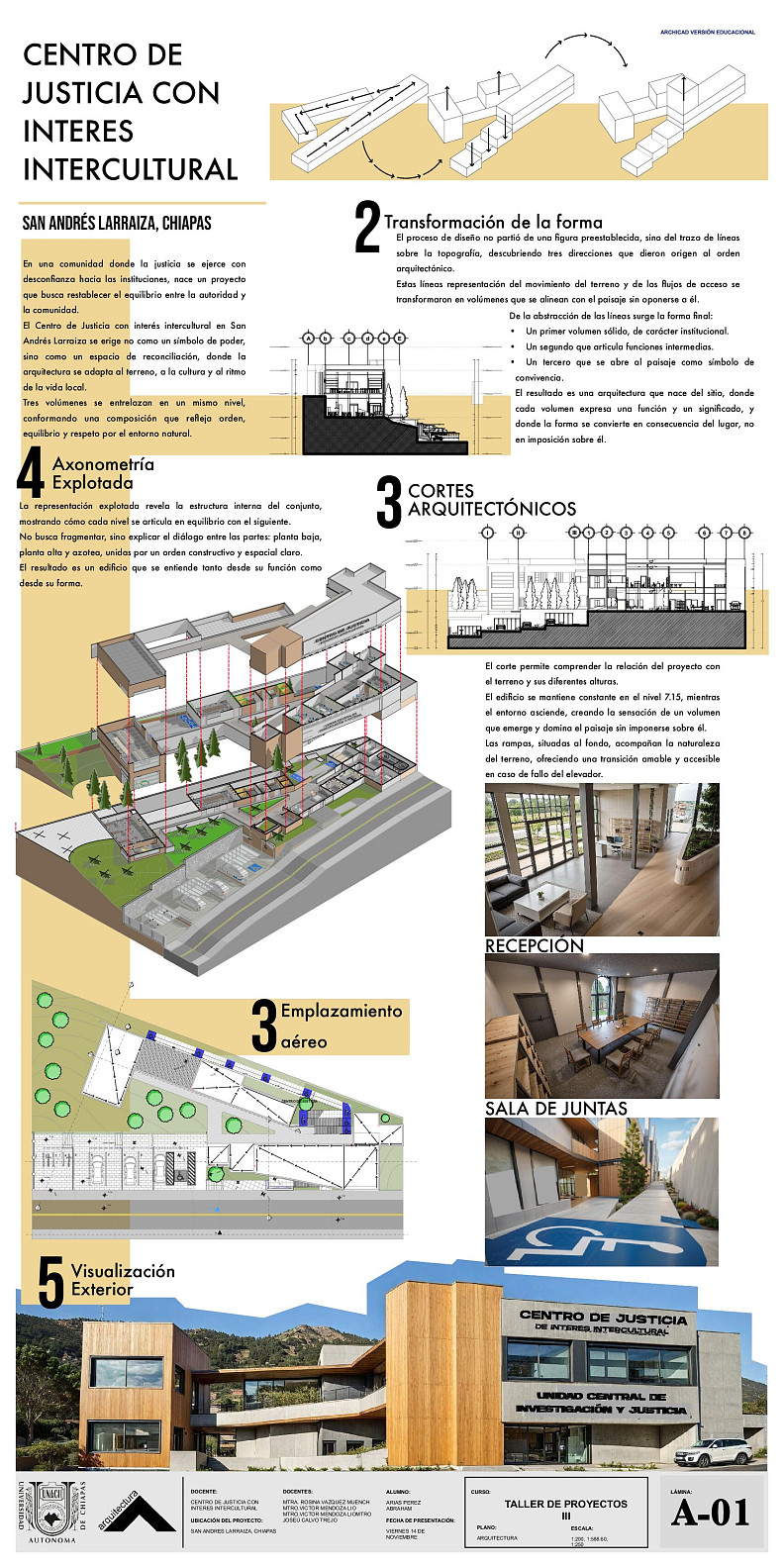
In a community where justice is exercised with distrust toward institutions, a project is born that seeks to restore the balance between authority and the community. The Intercultural Justice Center in San Andrés Larraiza is established not as a symbol of power, but as a space of reconciliation, where architecture adapts to the terrain, the culture, and the rhythm of local life.
Project description
Three volumes interweave at the same level, forming a composition that reflects order, balance, and respect for the natural environment. The design process did not start from a preestablished figure but from tracing lines over the topography, discovering three directions that gave rise to the architectural order. These lines represent the movement of the terrain and access flows, transforming into volumes that align with the landscape without opposing it. From the abstraction of lines, the final form emerges: a first solid volume of institutional character, a second that articulates intermediate functions, and a third that opens to the landscape as a symbol of coexistence. Each volume expresses a function and meaning, where form becomes a consequence of place rather than an imposition upon it.
Technical information
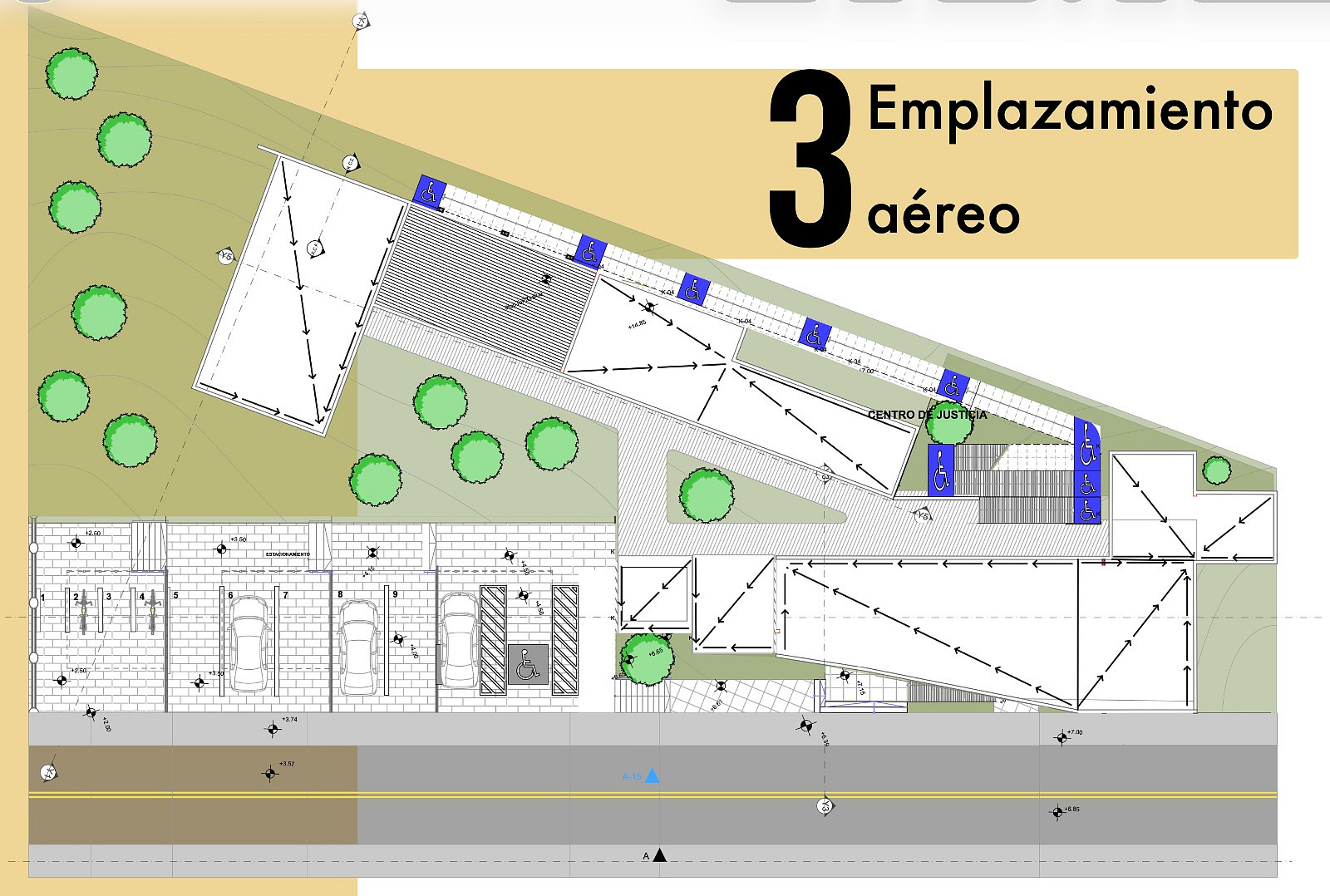
The building maintains a constant level at 7.15, while the surroundings ascend, creating the sensation of a volume that emerges and dominates the landscape without imposing itself. Ramps located at the back accompany the natural terrain, offering a friendly and accessible transition in case of elevator failure. The exploded axonometry reveals the internal structure of the ensemble, showing how each level articulates in balance with the next: ground floor, upper floor, and rooftop, united by a clear constructive and spatial order. The project is located in San Andrés Larraiza, Chiapas. Scale 1:200, 1:500.
Documentation
Created in:


Copyright © 2026 INSPIRELI | All rights reserved. Use of this website signifies your agreement to the Terms of Use, Privacy Policy, and use of cookies.
