
New Old Identity of Belgrade


 Hristina Meseldžija
Project idea
Abstract & Identity Context
Within the studio project an interesting fact related to the identity of Belgrade was found. This paper will analyze some historical facts that may have influenced the current situation. It will partly analyze the assumption that historical and political instability, global and internal twists and turns may have caused the fragmentation of the city's identity. Of course, the phenomenon of identity itself will be analyzed, and in particular its manifestation in contemporary Belgrade. The fundamental ideas of the National museum project, which served as its basis, will be analyzed.
Throughout its history, Belgrade has been a tidbit of many states. This could not but influence its complicated history, and also could not but influence its architectural embodiment. The architecture of this city is diverse and heterogeneous. The adjoining of buildings from completely different eras is a common situation. We cannot ignore this multi-layering because it gives us a very specific context. We have a wide range of diversity in which it is very difficult to identify a single leitmotif. The absence of a single architectural embodiment directly affects the integrity of the image of the city. In such a situation, it is very difficult to distinguish the image of the city.
The identity of Kalemegdan
The history of Kalemegdan is even more complicated and tragic than the history of Belgrade itself, although of course the fortress was the entire city at some periods. Here, the layering of different eras is even stronger. Passing from empire to empire, the fortress has accumulated a baggage of completely different characteristics, which are now difficult to separate from each other. They create an amazing, but difficult to realize image.
Speaking about the history of Kalemegdan, it is impossible not to emphasize the fact that it came into Serbian possession only in the second half of the 19th century. But even after that, it was bombed and occupied twice. This is important for us, because the frequent change of state ownership, although it has made Kalemegdan a hidden place in Belgrade, still casts a shadow on the awareness of this place. This is not helped by its diverse architectural heritage, parts of which are not always perceived positively.
Project description
The Problem of the Lost Symbol
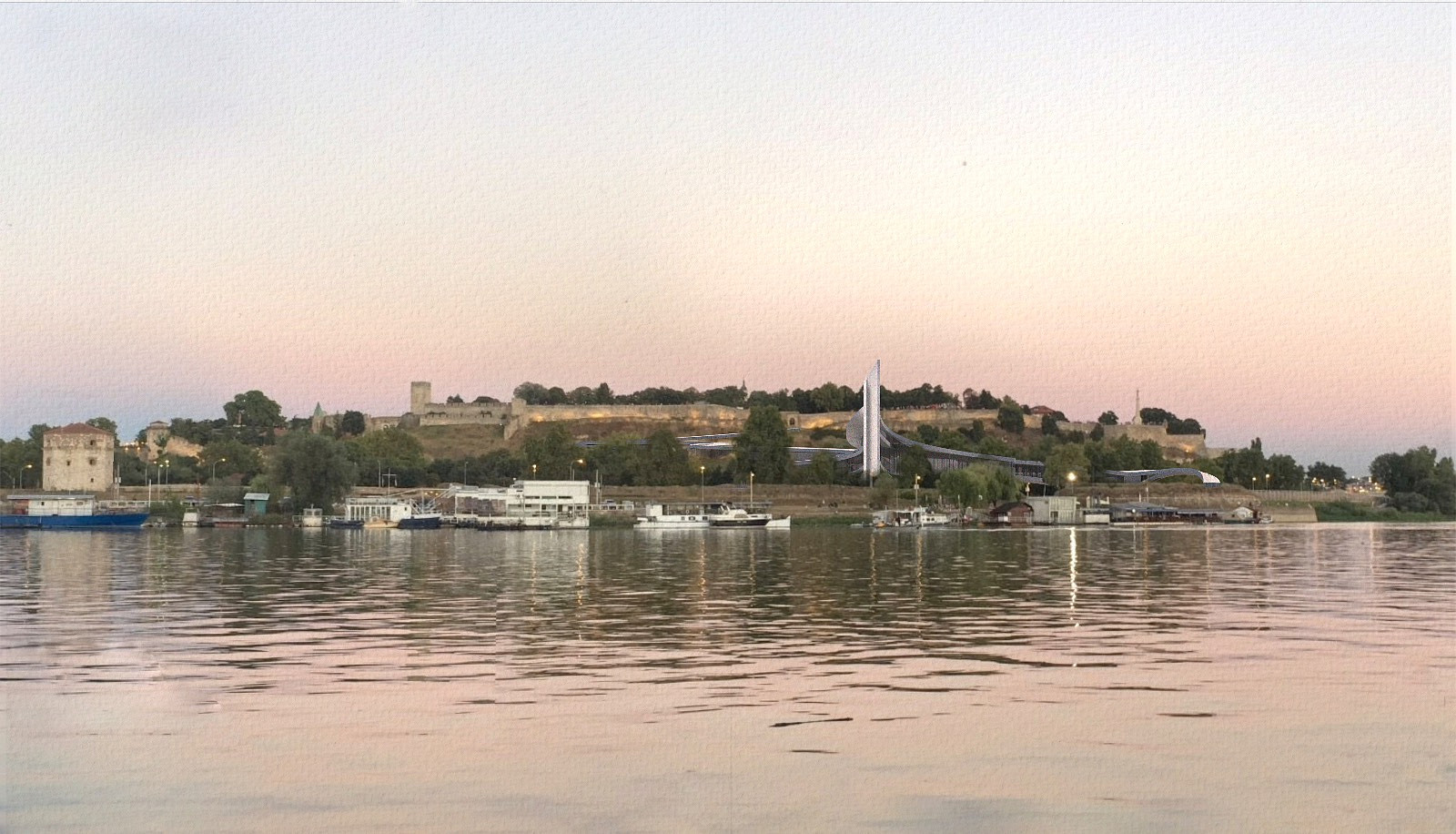
By studying historical maps, old engravings and images, it was found that Kalemegdan used to be always depicted from the river. The city several centuries ago had a clear image, which is now lost. We will not look for the exact reasons why this happened, but simply note the fact that it happened. Now if you want to find modern photos of Kalemegdan from the river, you will find literally one panorama on Google maps and that's it. Being quite large, the fortress is not visible in the city as a whole. The park and the river literally hide the fortress and the only places where you can get a glimpse of Kalemegdan are Branko's Bridge and the opposite bank of the Sava River in New Belgrade, but from there we can only see it from the side or in the gap between the rafts. Kalemegdan has literally disappeared as an image or as a symbol.
This assumption is supported by the research presented in the article "Urban Identity of Belgrade: perfect chaos, imperfect balance" (Spasic & Backović). The material manifestation of identity is the geographical location of Belgrade at the junction of two rivers. This unique natural environment has always influenced the city and is still perceived as significant. Kalemegdan is also included in this material identity, they are perceived as a whole and the fortress is as if inextricably linked to the confluence of the rivers.
The image of Kalemegdan seems to be expressed more when we are in it and see that confluence of rivers mentioned above. It is the identity of Belgrade as a place. But Kalemegdan does not have the meaning of a symbol, it has lost it. In the survey by Spasic and Backović, the most potential candidate was the Pobednik monument. And it is very fascinating that it is located in Kalemegdan. Compared to its complex historical component, Kalemegdan Pobednik is a very understandable symbol. It represents victory over those powers that have taken over Kalemegdan. It symbolizes the strength and formation of the new Serbia.
The Architectural Intervention
The National museum project has more of an urban planning sense and its architectural realization is more of a tool. The main idea was to return Kalemegdan to its visual image, to give Belgrade back its symbol of identity.
Of course the main goal can only be achieved if people can see Kalemegdan from the water, if they want to see it from the water. And in order to achieve this goal it was decided to go a bit contradictory and create a new symbol to help Kalemegdan become a symbol. In order to make people want to see Kalemegdan from the river it was decided to put a vertical element. In order to have a unidirectional relationship with it, this element is an architectural sculpture. That is, we cannot climb to the top of this element. The other two elements are "ribbons" that descend from the top of the fortress to the waterfront, connecting them. This solution was necessary to unite the Donji Grad structure cut by the road, as well as to connect Kalemegdan with the river, bringing back the original integrity.
Technical information
Methodology: Critical Regionalism & Urban Identity
In a scientific context, the term "urban identity" has many similarities with "social identity". This identity has not only a social denominator, but also a spatial one. In this respect, urban identity is very similar to geo-cultural space, which is understood as the outcome of the joint creative process of nature and the individual, i.e. a unique artistic work that has been shaped by multiple generations and interpreted by them as their own place of development (Ermakova & Sukhovskaya).
The architectural realization of this project functions as a strategic tool based on the principles of Critical Regionalism, which directly relies on national and spatial characteristics to re-establish the lost cultural justification of the site.
Design Elements & Material Tectonics
- The Vertical Element (Architectural Sculpture): Designed as a non-accessible landmark, its primary function is visual re-orientation from the river. Its design is explicitly inspired by the Spomenik aesthetics of the post-World War II period, utilizing strong, expressive structural forms to affinity the fortress with modern society and symbolize the resilience of the new cultural dimension.
- The Connectivity Ribbons: Two structural "ribbons" serve as infrastructural and landscape links. They descend from the top of the fortress directly to the waterfront. This tectonic solution physically reunites the Donji Grad structure, which was historically cut by the modern road, effectively bridging the fortress back to the river and restoring its original spatial integrity.
Conclusion & Professional Ethics
The identity of a city is a dynamic phenomenon, it changes from generation to generation and from era to era. Having the opportunity to influence we should remember our responsibility. In this sense, architects can act as psychologists in a kind of capacity and help urban society solve their pressing issues, always guided by the principle: "do no harm".
Documentation


Copyright © 2026 INSPIRELI | All rights reserved. Use of this website signifies your agreement to the Terms of Use, Privacy Policy, and use of cookies.