The Inherited Link


Project idea
Old Nubia once flourished along the Nile between Aswan and the Sudanese border, forming a unique cultural
landscape shaped by the river, the desert, and centuries of craftsmanship, community, and heritage. Yet the
construction of the Aswan High Dam in 1965 submerged this homeland, displacing thousands of Nubians and
leaving behind scattered monuments and nearly empty shores around Lake Nasser. Today, the region stands as a
silent archive of memories, its temples relocated, its villages gone, and its people awaiting the fulfillment of their
constitutional right to return.
This project responds to that absence.
By studying the history of Nubian displacement, the cultural identity of its people, and the geographical
significance of the monuments rescued by UNESCO, the research seeks to reestablish a meaningful architectural
presence in Old Nubia. The aim is not only to preserve heritage, but to reconnect people, landscape, and memory,
transforming the untouched desert around Lake Nasser into a cultural renaissance corridor.
The proposed Nubian Renaissance Cultural Hub emerges from this context as an architectural link, a new
landmark that rises from the mountain itself, symbolizing the return of life, identity, and continuity to a land once
submerged.
Vision
The site sits at the center of the Nubian monuments, linking them into one cultural network.
Transforming scattered temples into a unified story marks the start of a new revival era for Old Nubia.
Objectives
• To preserve and promote Nubian cultural identity through architecture, storytelling, and spatial
design that reflects traditional practices and aesthetics.
• To design a new landmark that connects modern functionality with historical significance, serving as
a symbol of Nubian resilience and heritage.
• To integrate the temple remains as a focal point within the site, enhancing their visibility, accessibility,
and narrative role in the visitor experience.
• To empower local Nubian communities by creating employment opportunities, fostering
entrepreneurship, and encouraging local involvement in tourism and cultural initiatives.
Goals
• Preserve and celebrate Nubian heritage.
• Connect between monuments and community to strengthen cultural identity and foster a sense of
ownership and pride among locals.
Project description
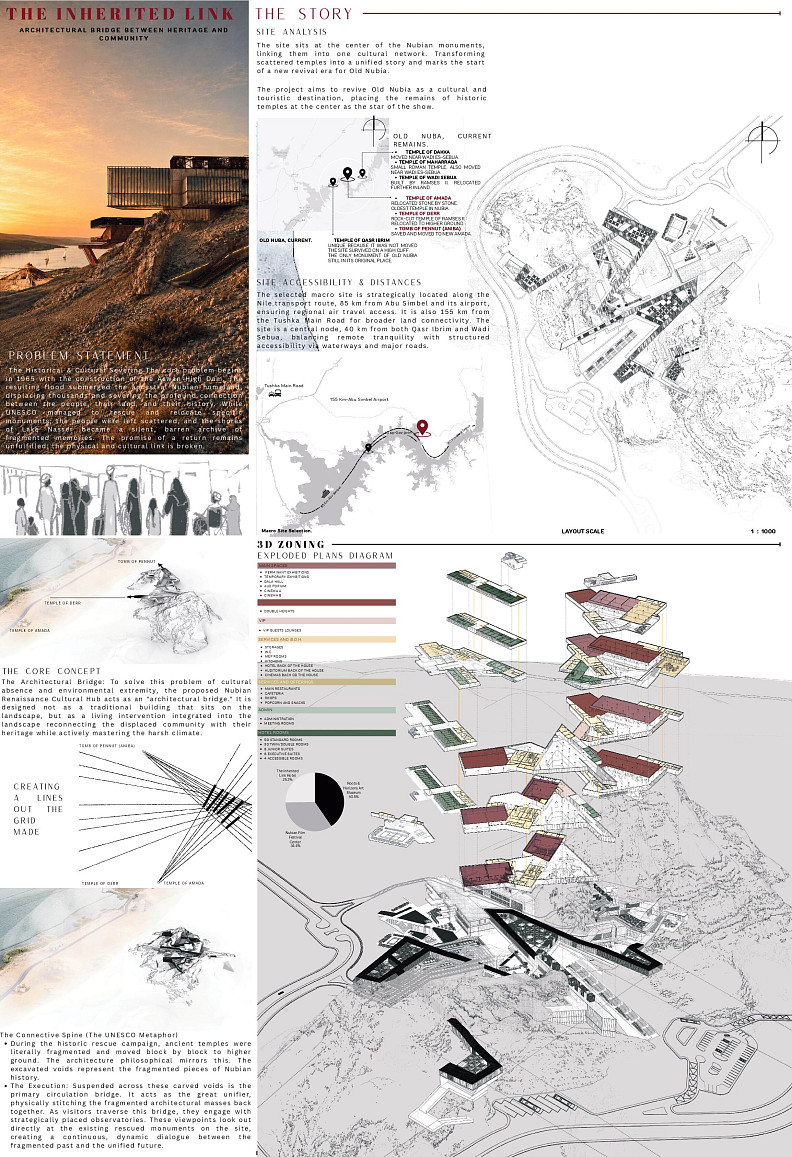
The Inherited Link is a Nubian Renaissance Cultural Hub located in Old Nubia, along the western bank of Lake Nasser in Aswan, Egypt. The project responds to the historical displacement of Nubian communities after the construction of the Aswan High Dam, and to the cultural fragmentation left behind by relocated monuments, empty shores, and interrupted memory.
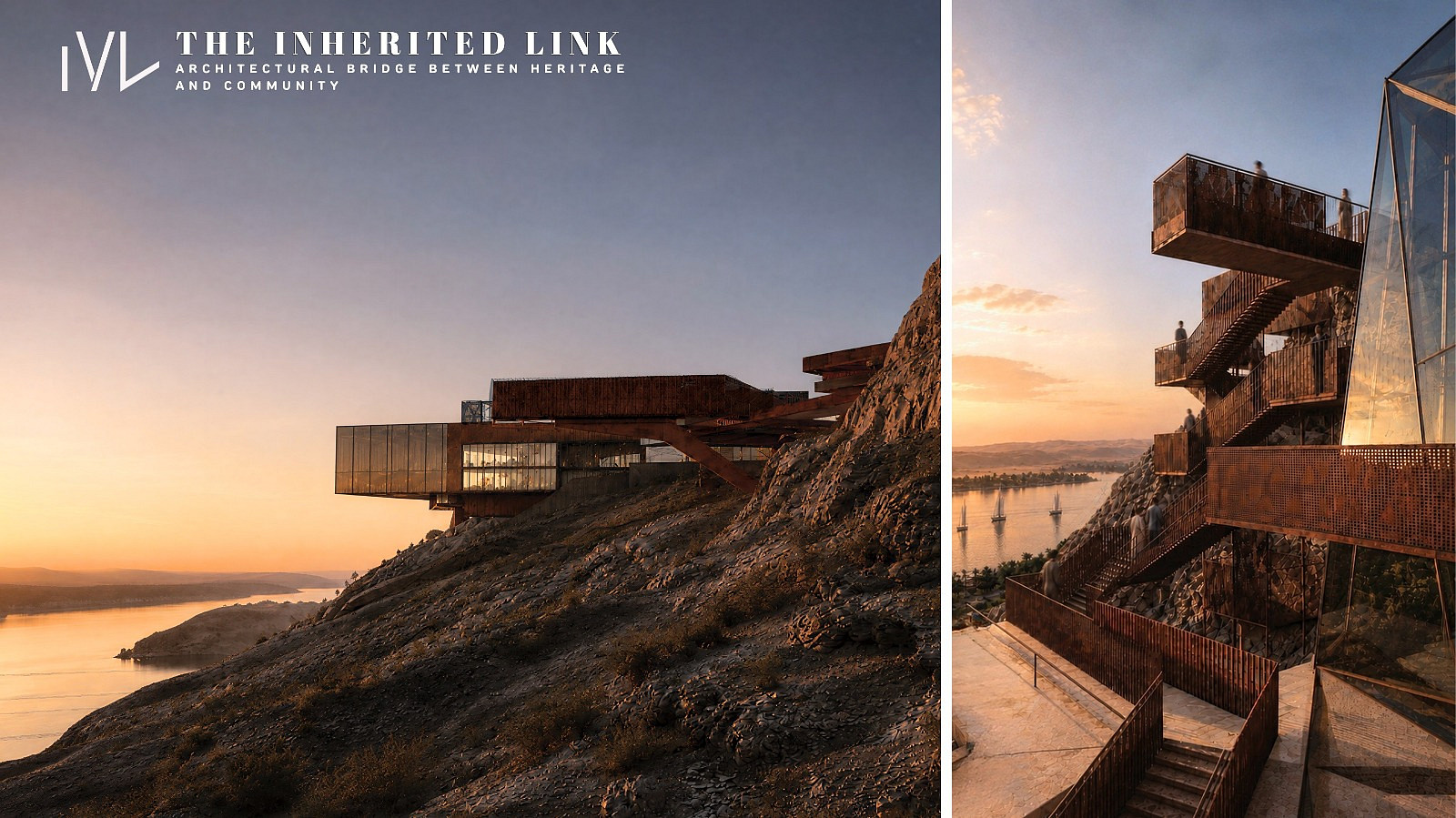
The design acts as an architectural bridge between heritage and community. It reconnects the Temple of Amada, Temple of Derr, and Tomb of Pennut through a spatial journey carved into the mountain and extended through bridges, terraces, observatories, courtyards, and framed views. The project emerges from the contours of the mountain, transforming movement into a cultural hike through memory, nature, and identity.
The complex includes Roots & Horizons Art Museum and Gallery, a Nubian Convention Center, and The Inherited Link Hotel. Together, they create a living cultural destination that preserves Nubian heritage, supports tourism, celebrates storytelling, and symbolizes revival, continuity, and the long-awaited dream of return.
The solution also includes a connective spine that links the main functions together through bridges, outdoor platforms, shaded routes, and observatories. Visitors experience the site through a gradual sequence of arrival, excavation, enclosure, exposure, water, light, framed monument views, and a final panoramic viewpoint over Lake Nasser and the surrounding heritage landscape. The project therefore transforms the site into a cultural destination, a community anchor, and a contemporary landmark for Nubian identity.
Technical information
The project is 60,000 m², a mountain-integrated cultural and hospitality complex composed of the Roots & Horizons Art Museum and Gallery, the Nubian Convention Center, and The Inherited Link Hotel. It includes exhibition spaces, auditoriums, cinemas, hospitality facilities, restaurants, shops, services, bridges, terraces, and outdoor landscape activities.
The project organizes three main components: an art museum and gallery dedicated to Nubian history, crafts, exhibitions, and storytelling; a film festival and convention center containing an auditorium, cinemas, gala hall, VIP areas, meeting spaces, and event facilities; and a hotel that supports cultural tourism through rooms, suites, restaurants, terraces, pools, recreational areas, and hospitality services.
The design uses a subtractive strategy by carving spaces into the mountain to benefit from natural thermal mass and protection from Aswan’s harsh desert climate. A solar chimney supports passive cooling by drawing hot air upward and encouraging cooler air movement through shaded courtyards and carved voids. The material palette includes earth-toned concrete, limestone, Corten steel, and solar-control Low-E glass. In response to Aswan’s high annual solar radiation, the project integrates double-skin façades, deep shading, natural ventilation, photovoltaic canopies, and drought-tolerant landscape to reduce heat gain and improve environmental performance.
Documentation

Copyright © 2026 INSPIRELI | All rights reserved. Use of this website signifies your agreement to the Terms of Use, Privacy Policy, and use of cookies.