The Mispriced Body - A Spatial-Economic Framework for Aging in the Mainstream


Project idea
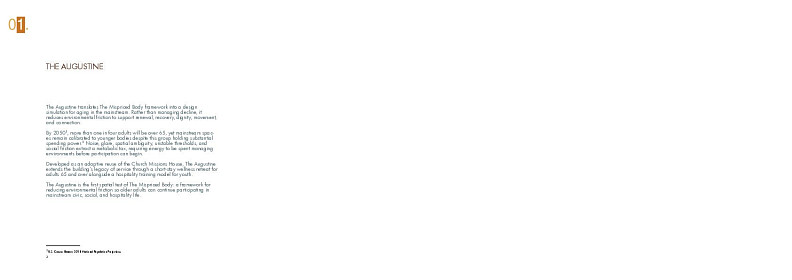
The Mispriced Body is a spatial-economic framework for aging in the mainstream. It argues that technical accessibility alone is insufficient, and that rooms must address the sensory, cognitive, thermal, haptic, navigational, and social loads they impose on aging bodies. The framework is tested through The Augustine, a Research through Design simulation in Manhattan's Church Missions House.
The work focuses on adults in the renewal window, ages 65 to 78, whose sensory, cognitive, and physical processing may have shifted but who remain active in mainstream life. It shifts aging-focused design from reactive accommodation toward capacity protection, reducing unnecessary environmental cost before withdrawal becomes the default response.
Project description
Its operative tool, the Friction Atlas, translates evidence about aging into room-level spatial decisions. It works at room level through six strategies: acoustic calibration, lighting and visual legibility, thermal regulation, wayfinding and spatial sequence, material haptics, and social geometry. It distributes support across the room so that no single intervention, and no single body, carries the full burden of participation. A threshold can sequence visual, thermal, acoustic, haptic, and social adaptation; a ceiling can support speech clarity, lighting, social scale, and orientation at once. When strategies compete, arbitration gives priority to the condition whose failure would impose the greatest metabolic tax for that room's purpose.
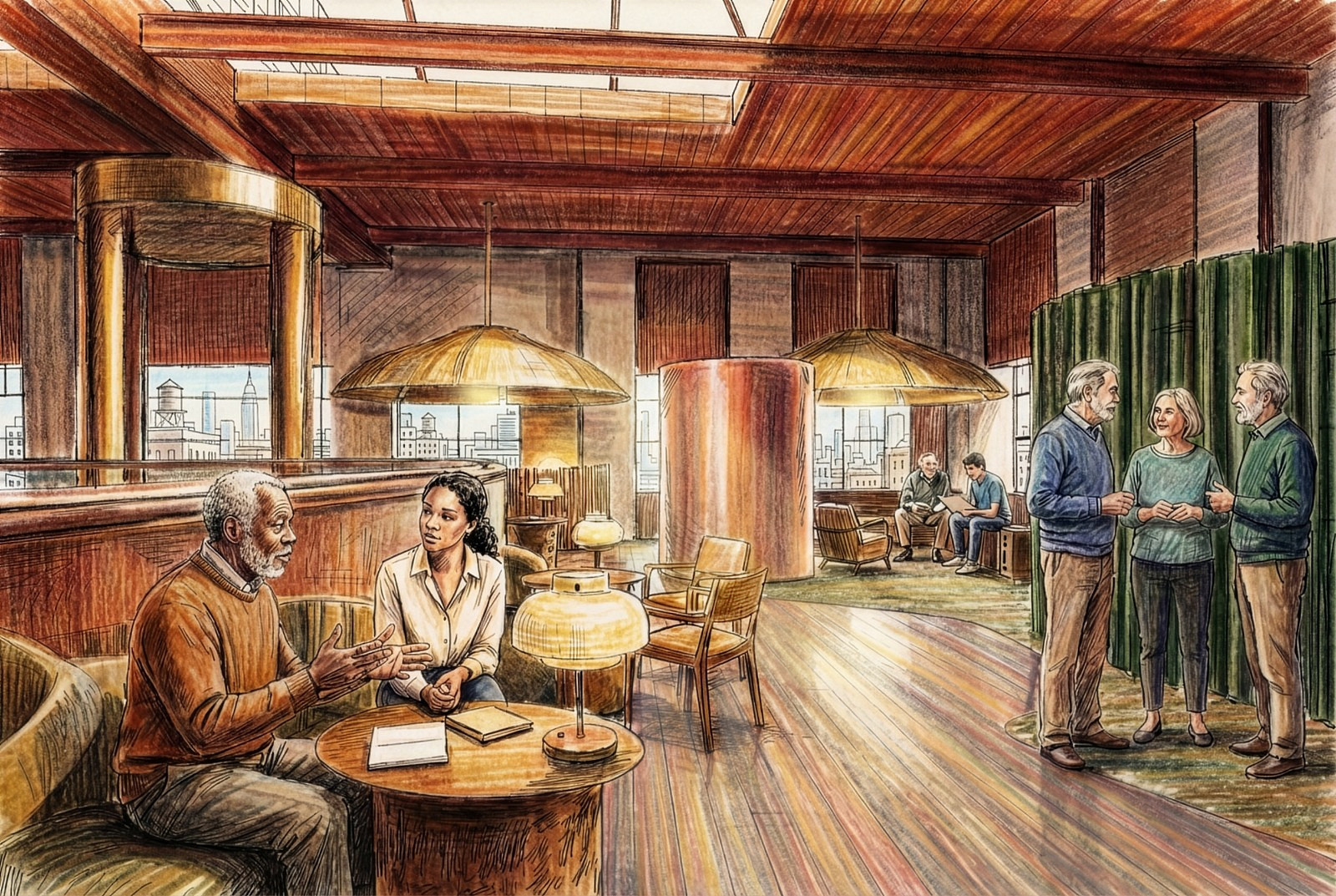
The Augustine, a short-stay wellness retreat for adults 65 and over paired with a hospitality training school for youth, applies this across recovery, arrival, hospitality, private rest, and social co-presence.
The framework carries two economic arguments. At the macro level, decisions across new construction, renovation, adaptive reuse, hospitality renewal, and operational change determine how much environmental demand the room absorbs rather than the body. At the room level, spatial friction produces hidden asset underperformance, where activation cost exceeds expected return.
Technical information
he Augustine is an adaptive reuse of the Church Missions House, an 1894 landmarked Flemish Revival building at 281 Park Avenue South. The interior is organised as a vertical sensory gradient across six tiers, from a subterranean wellness spa through a street-level lobby and sunken bar to a daylit rooftop conservatory. A central vertical void draws daylight into the deep floor plates to support orientation and reduce reliance on text signage.
Room-level resolutions include radiant-heated stone and continuous handrails at wet-dry thresholds, carved acoustic panels and a wood canopy for speech clarity and reverberation control, low-level amber guidance for edge reading, circadian-tuned lighting for day-night orientation without glare, a bar floor dropped two steps to preserve eye-level exchange without raised stools, and north-facing glazing that delivers daylight without thermal overload.
Documentation

Copyright © 2026 INSPIRELI | All rights reserved. Use of this website signifies your agreement to the Terms of Use, Privacy Policy, and use of cookies.
