Pr.Ba

Project idea
Pr. Ba: The House of Your Soul
Derived from the hieroglyphic phrase meaning "The House of the Soul," this conceptual origin served as the driving design motive, guiding the spatial and philosophical evolution of the entire architectural system.
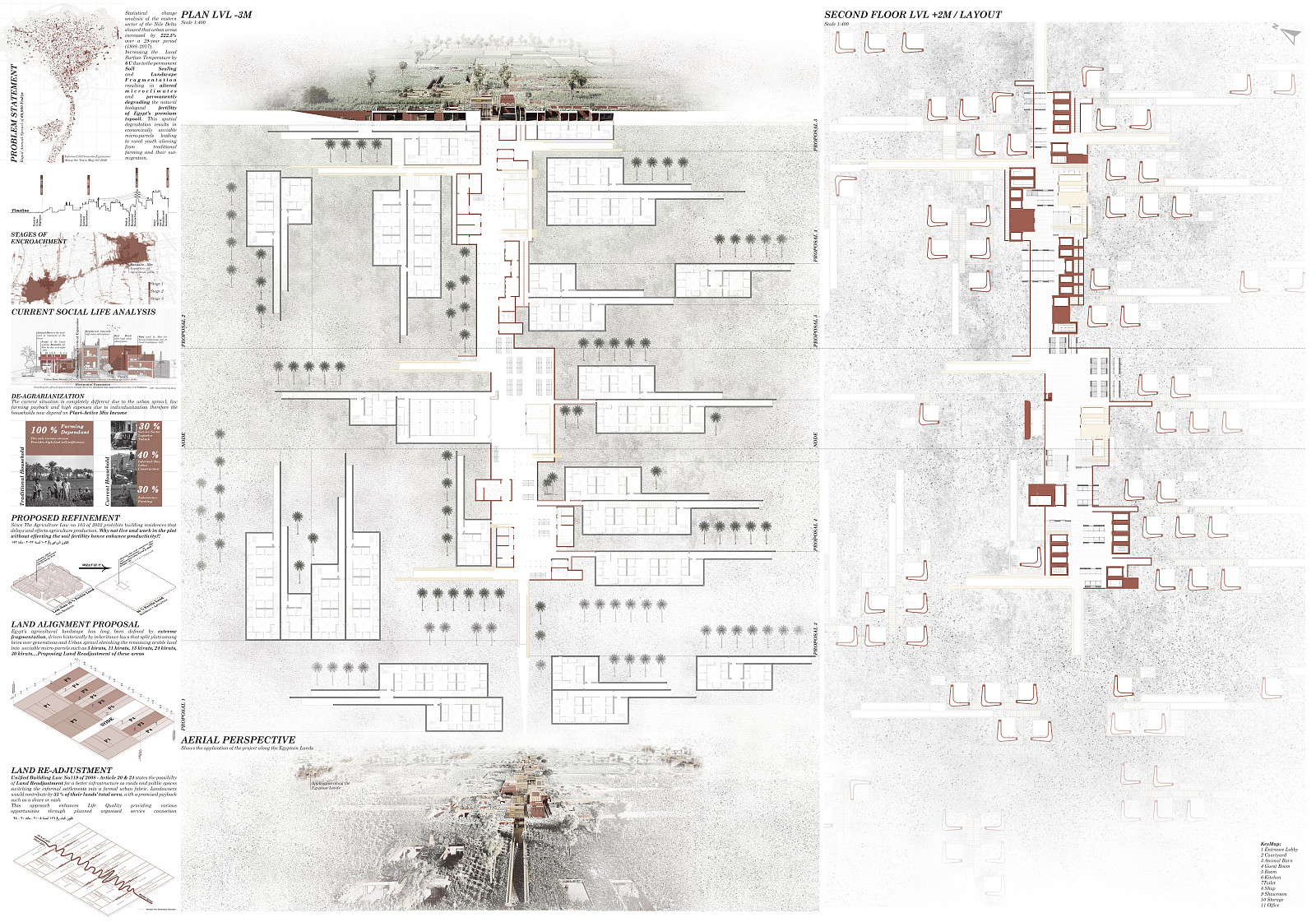
The project responds directly to a critical contemporary crisis in rural Egypt. Following 2011, a lack of local regulatory oversight triggered an unprecedented surge in informal settlements. Agricultural landowners began building encroaching concrete structures directly onto their own fertile plots, resulting in an aggressive sprawl that has swallowed huge parcels of the Nile Delta and Valley at a staggering rate of 60,000 feddans per year. This unplanned urbanization fundamentally altered both the microclimate and the socioeconomic fabric of the Egyptian countryside. Traditional modern peasant housing relies heavily on exposed red brick and concrete. These high-solar-absorption materials trap intense heat, raising local temperatures within building clusters by roughly 6°C (Urban Heat Islands), forcing domestic life outward to rooftops or front yards. As arable land decayed, historic dependence on farming plummeted from 100% down to just 40%, with households shifting to pluri-active models dominated by logistics and construction labor. Under Unified Building Law No. 119 of 2008 and Agriculture Law No. 103 of 2022, any unauthorized constructive addition results in complete demolition, severe fines, and the revocation of state agricultural subsidies, driving peasants to abandon agriculture entirely due to skyrocketing costs.
Project description
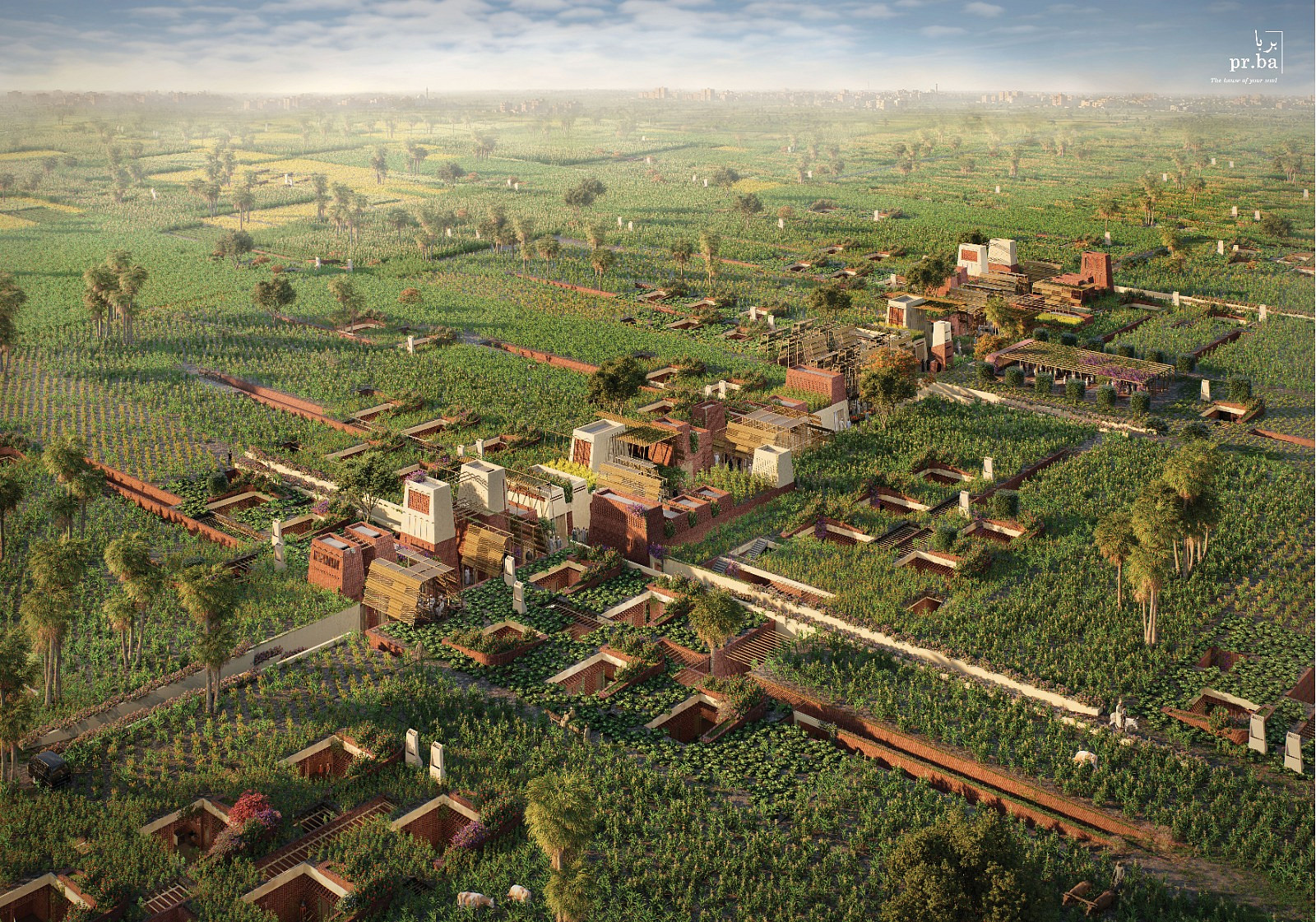
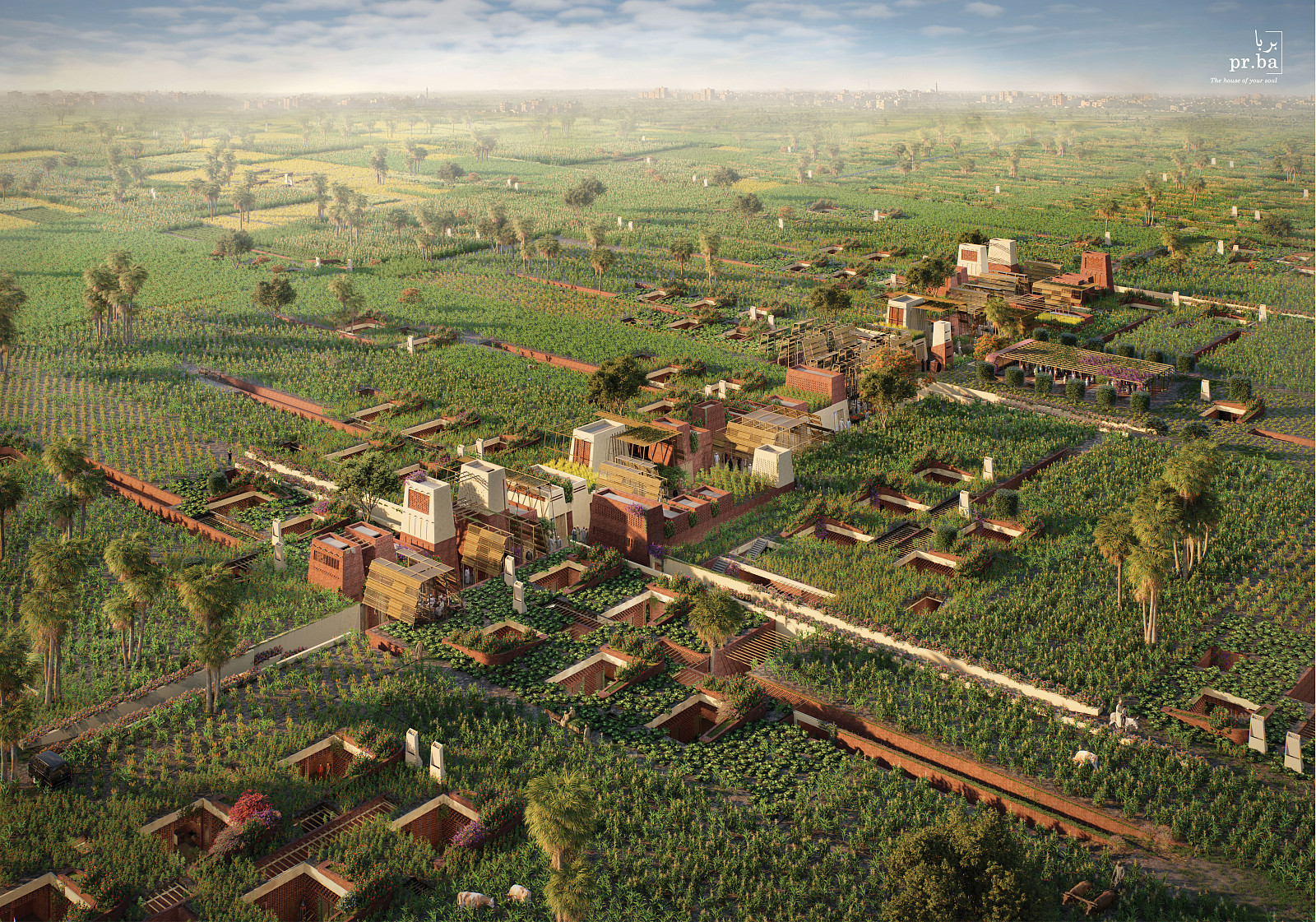
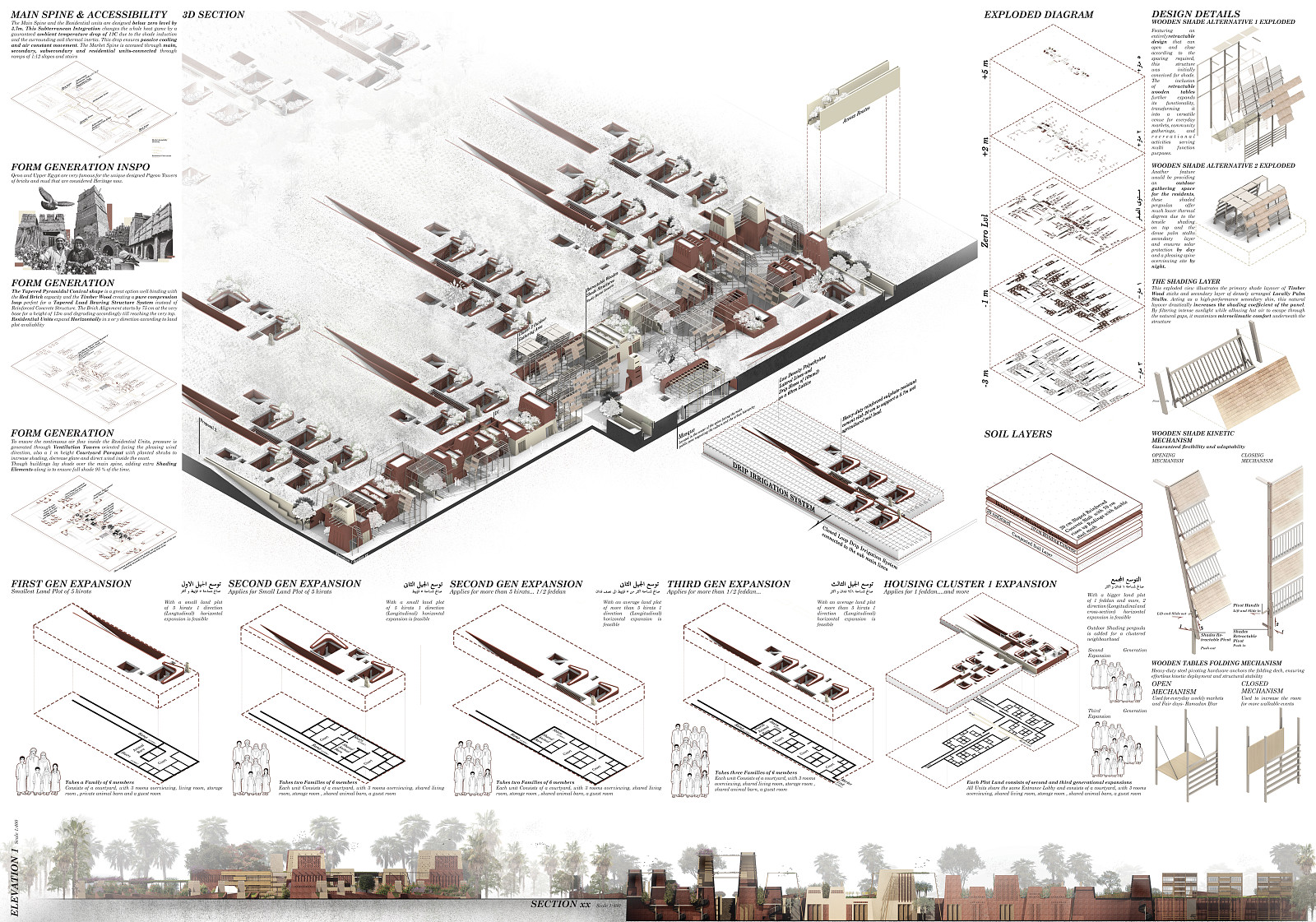
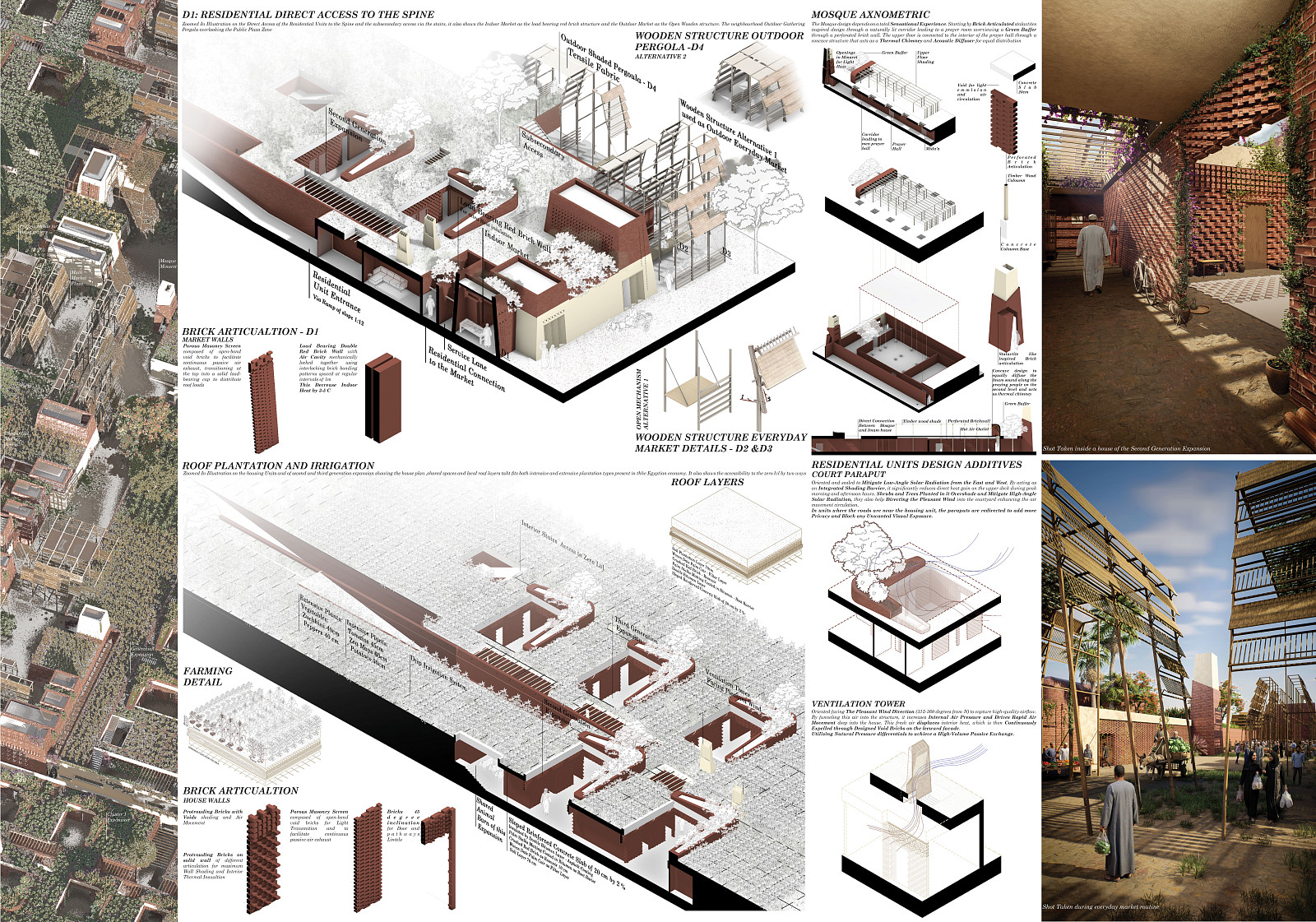
To reverse this crisis, the proposal introduces a paradigm shift: maximizing land utility so that 96% of the plot is concurrently utilized for both agriculture and housing, up from less than 10%. Each residential unit is integrated completely below grade, featuring its own dedicated animal barn, descending access ramp, and private, open-air courtyard. To accommodate various scales, a land alignment matrix handles plot sizes from 5 Kirats to 2 Feddans. Leveraging Articles 20 and 24 of Law No. 119 of 2008, landowners contribute 33% of their total plot area for legal land readjustment in exchange for compensation for public spaces and quality of life increase, creating a continuous public market spine. The typology balances subterranean logic with vertical drama rising a maximum of 9 meters above grade, inspired by the unique heritage pigeon towers in Qena of pyramidal conical tapered shape. Utilizing double-wall load-bearing red brick masonry, the project eliminates reinforced concrete frameworks. Retractable wooden structures along the spine serve as kinetic shading and market tables for everyday life, while residential outdoor pergolas offer solar protection. For the residential units, Thermal mass achieves an 11°C decrease in indoor temperatures. Passive control includes ventilation towers oriented towards prevailing winds and courtyard parapets with integrated brick planters for shading, privacy and wind directing inside the house and ensuring the air continuous movement. The market spine would include a village mosque that is isolated by a green buffer and features an upper concave roof structure to project sound acoustically and function as a heat chimney.
Technical information
Buildings in the market are made of load bearing double wall red bricks with air cavity spaced at regular interval of 1m to decrease indoor heat. The residential units are made of red bricks and concrete, the locally used materials
The rooftops double as productive fields using a six-layer system:
1. 70 cm Fertile Nile Soil (Top): Deep topsoil for intensive plantings (zea mays, tomatoes, vegetables).
2. Woven Date Palm Coir: Natural bio-filter layer preventing soil migration.
3. Crushed Red Brick: Structural reservoir layer for water retention and drainage.
4. Palm Stalks Matting: Organic root barrier protection coated in bitumen.
5. Double Bitumen Layer: Primary waterproofing membrane with asphalt coating.
6. 20 cm Sloped Concrete Slab (Base): Structural sub-base sloped to direct runoff water.

Copyright © 2026 INSPIRELI | All rights reserved. Use of this website signifies your agreement to the Terms of Use, Privacy Policy, and use of cookies.