Fiber/Ground Innovation Complex


Project idea
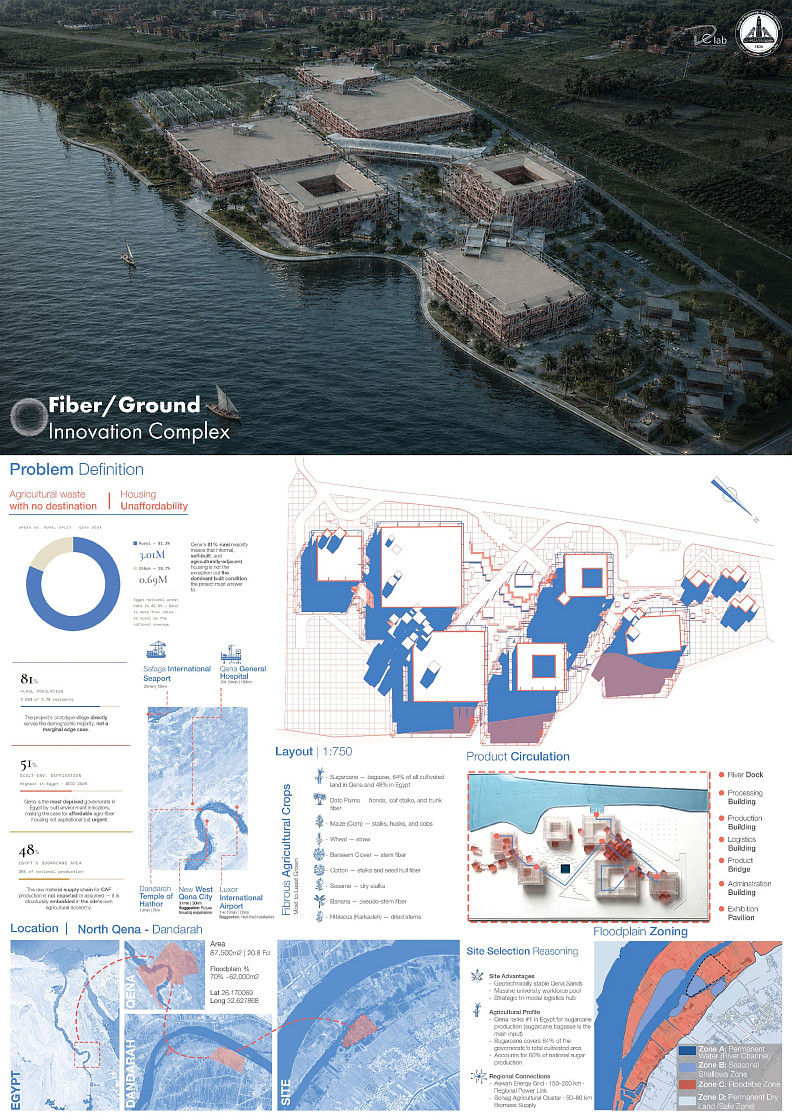
An innovation complex in North Qena, Egypt that addresses the dual problems of agricultural waste with no destination and housing unaffordability by utilizing locally available fibrous agricultural crops, particularly sugarcane bagasse, to create affordable agro-fiber building materials.
Project description
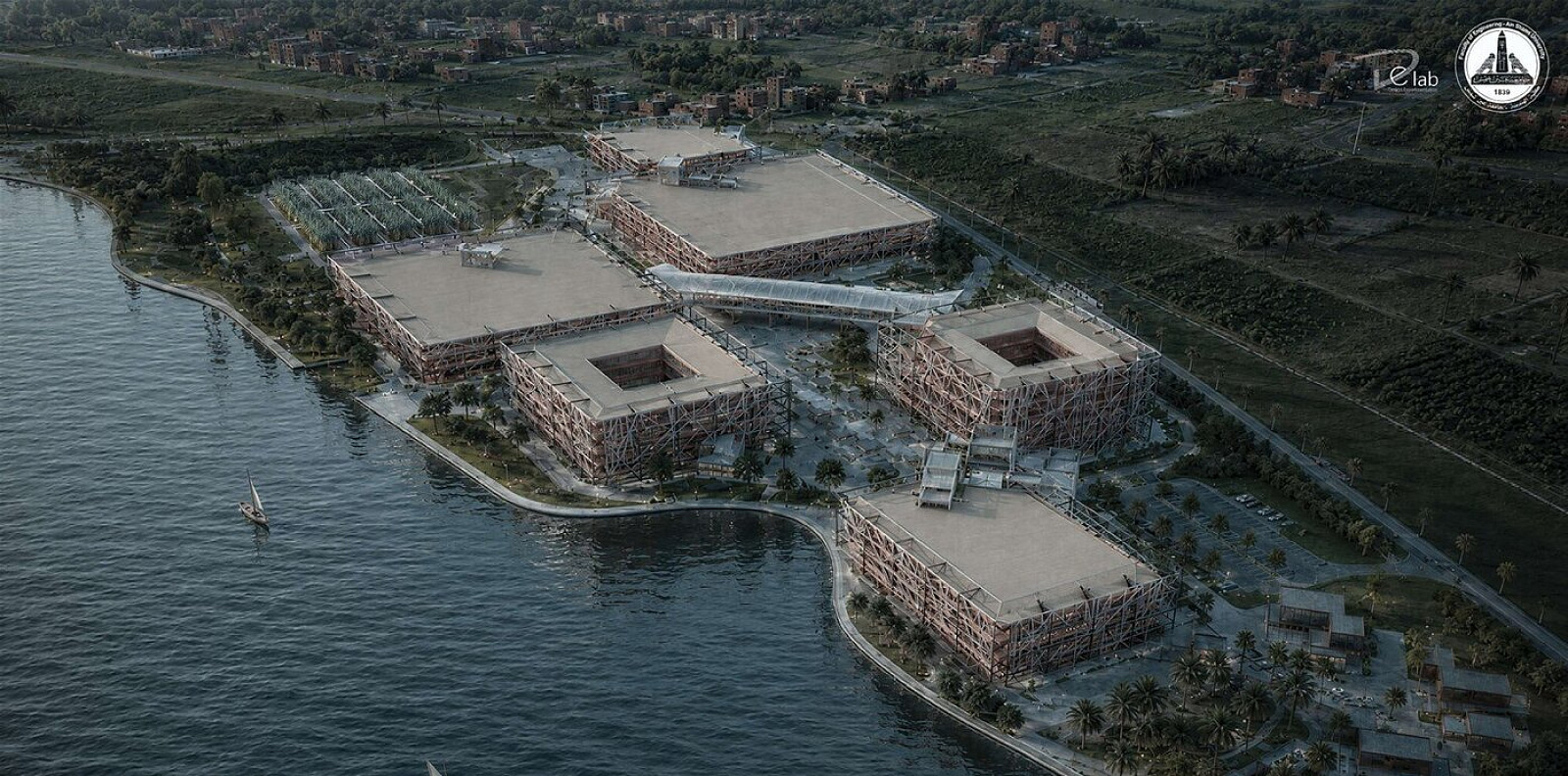
Located in Dandarah, North Qena, Egypt, the project sits on an 87,500m² site along the Nile with 70% floodplain coverage. The complex serves Qena's 81% rural population (3.01M residents) where built environment deprivation is 51%, the highest in Egypt. The design directly addresses the demographic majority rather than treating it as a marginal edge case. The raw material supply chain for compressed agricultural fiber production is structurally embedded in the site's own agricultural economy, with sugarcane covering 64% of all cultivated land in Qena and 48% of Egypt's total. The complex includes processing, production, logistics, and administration buildings, an exhibition pavilion, a product bridge, and a river dock. The layout responds to floodplain zoning with permanent dry land, floodable zones, seasonal shallows, and permanent water zones.
Technical information
Site area: 87,500m² (20.8 Fd). Floodplain percentage: 70% (~62,000m²). Coordinates: Lat 26.170069, Long 32.627868. Layout scale 1:750. The project processes fibrous agricultural crops including sugarcane bagasse, date palm fronds and trunk fiber, maize stalks and cobs, wheat straw, berseem clover stem fiber, cotton stalks and seed hull fiber, sesame dry stalks, banana pseudo-stem fiber, and hibiscus dried stems. Product circulation flows from river dock through processing building, production building, logistics building, across a product bridge, with administration building and exhibition pavilion. Floodplain zoning divides into Zone A (permanent water), Zone B (seasonal shallows), Zone C (floodable zone), and Zone D (permanent dry land/safe zone). Regional connections include Aswan Energy Grid (150-200 km), regional power link, and Sohag Agricultural Cluster (50-80 km biomass supply).
Documentation

Copyright © 2026 INSPIRELI | All rights reserved. Use of this website signifies your agreement to the Terms of Use, Privacy Policy, and use of cookies.