Bordado de Memoria


Project idea
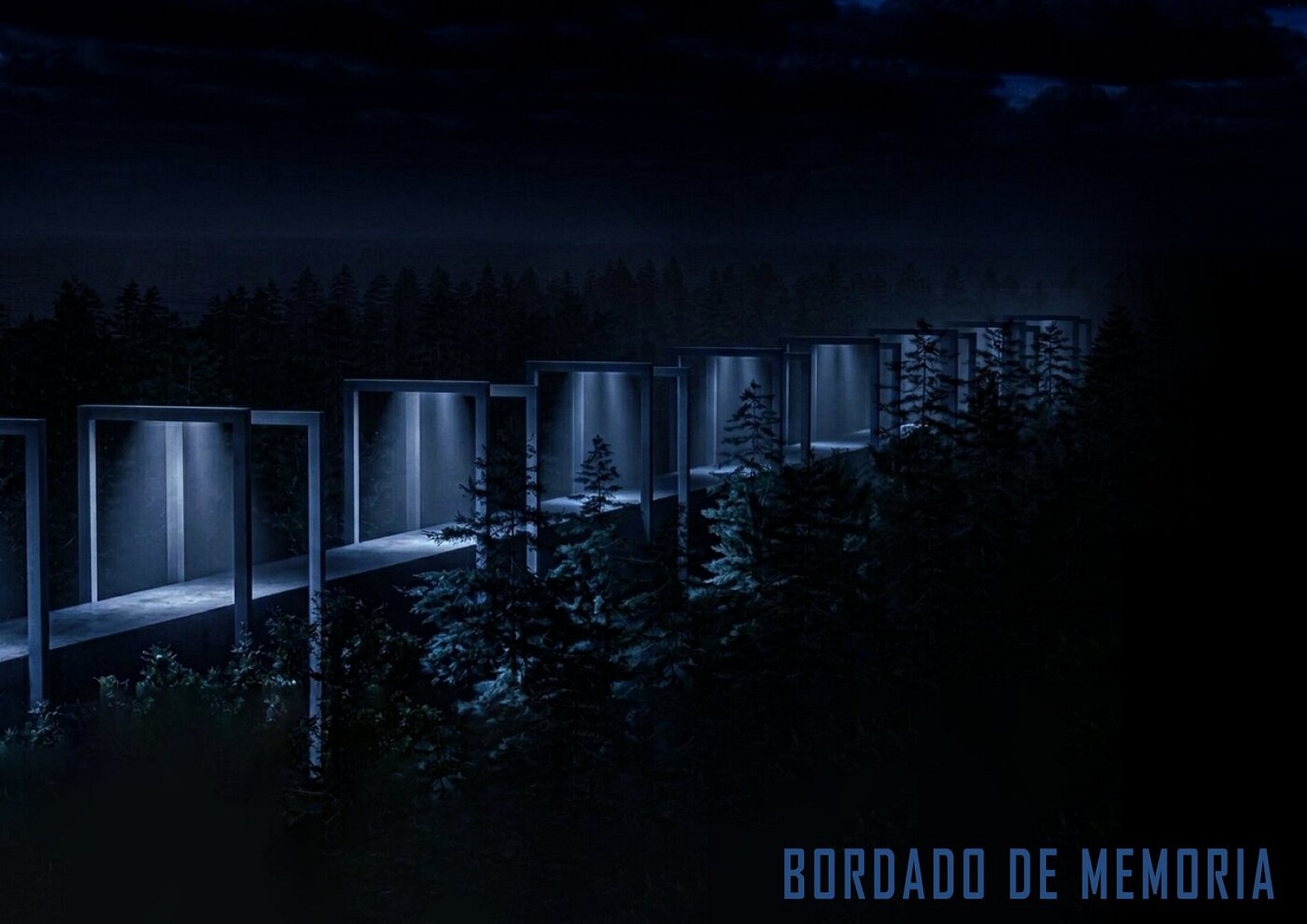
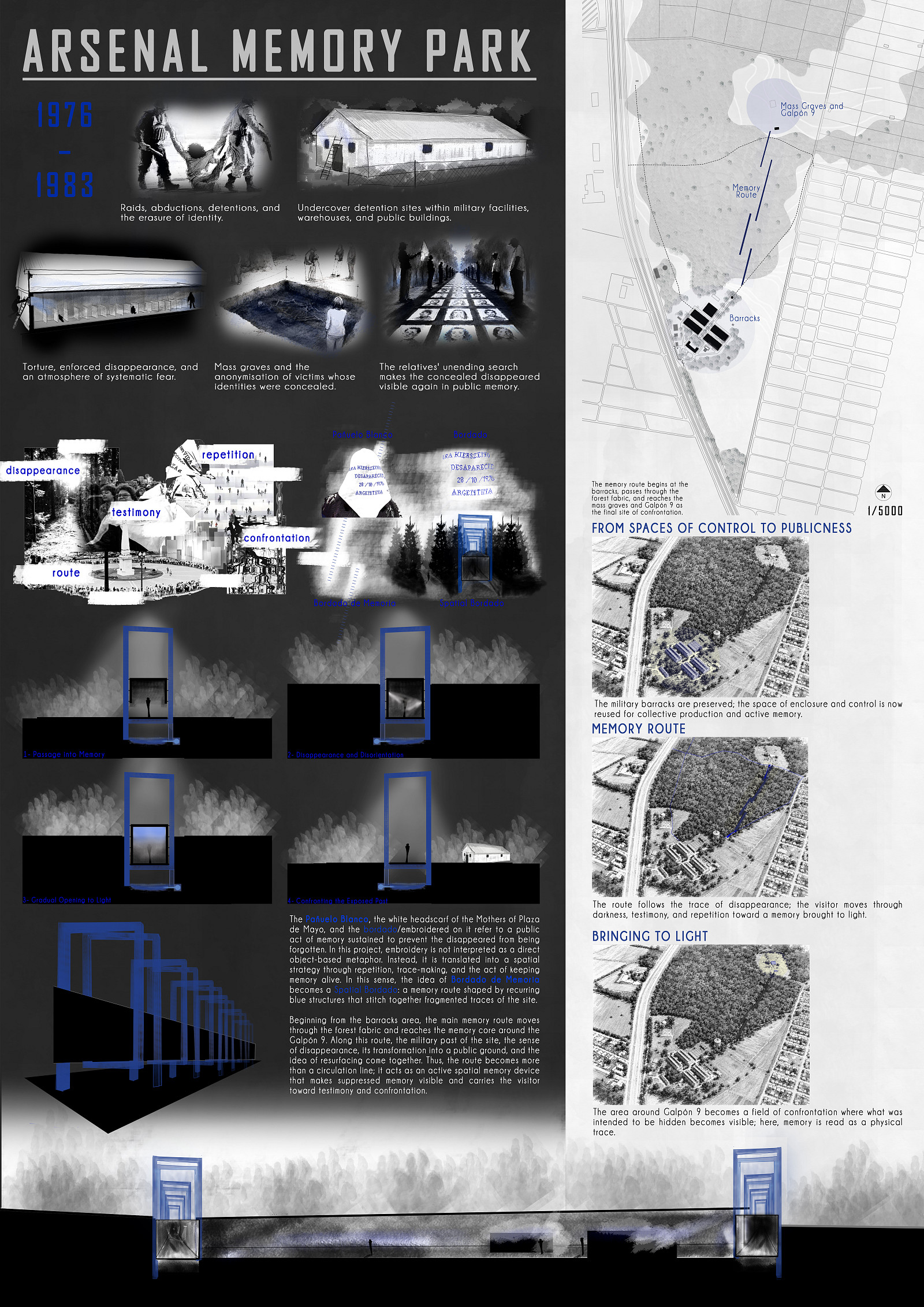
The main concept of the project is Bordado de Memoria. This concept is based on the Pañuelo Blanco, the white headscarf of the Mothers of Plaza de Mayo, and the repetitive and collective nature of embroidery. In the project, however, embroidery is not treated as a direct object or decorative symbol. Instead, it is transformed into a spatial strategy through repetition, trace-making, reproduction, and keeping memory alive. Therefore, Bordado de Memoria becomes a spatial embroidery in the project. The repeating blue structures along the route function like memory stitches that stitch together the fragmented traces of the area. The main memory route starts from the preserved barracks, moves through the forest texture, and reaches the memory core around Galpón 9 and the burial areas. In this process, the military past of the area, the feeling of disappearance, its transformation into a public space, and the re-emergence of what was hidden come together.
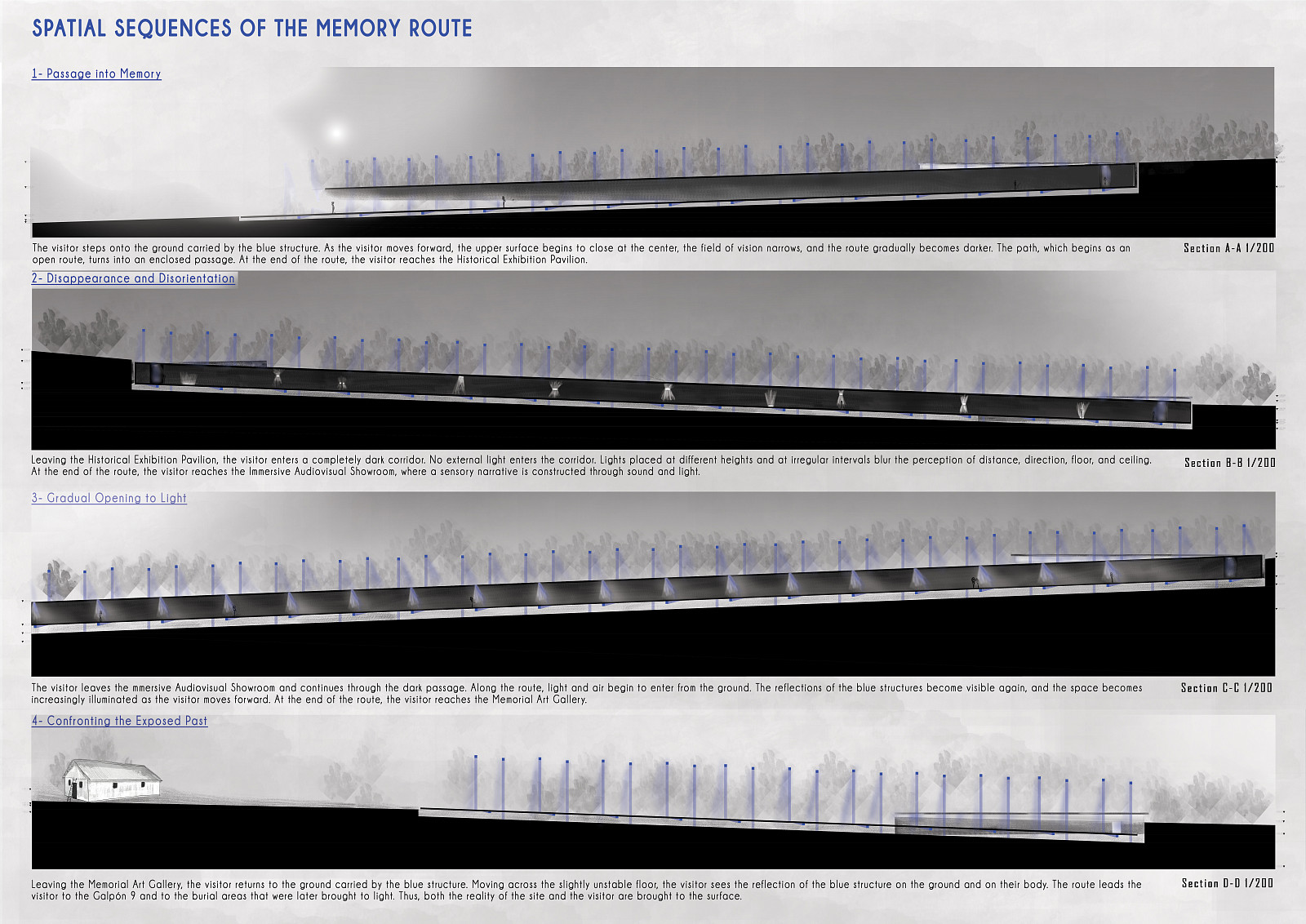
The main aim of the project is to create a symbolic journey that immerses the visitor physically and spatially in memory. Along the route, the visitor passes through sequences of darkness, directionlessness, light, reflection, and confrontation. Thus, the memory route ceases to be merely a circulation line; it transforms into an active spatial memory tool that makes repressed memory visible and leads the visitor to witness.
Project description
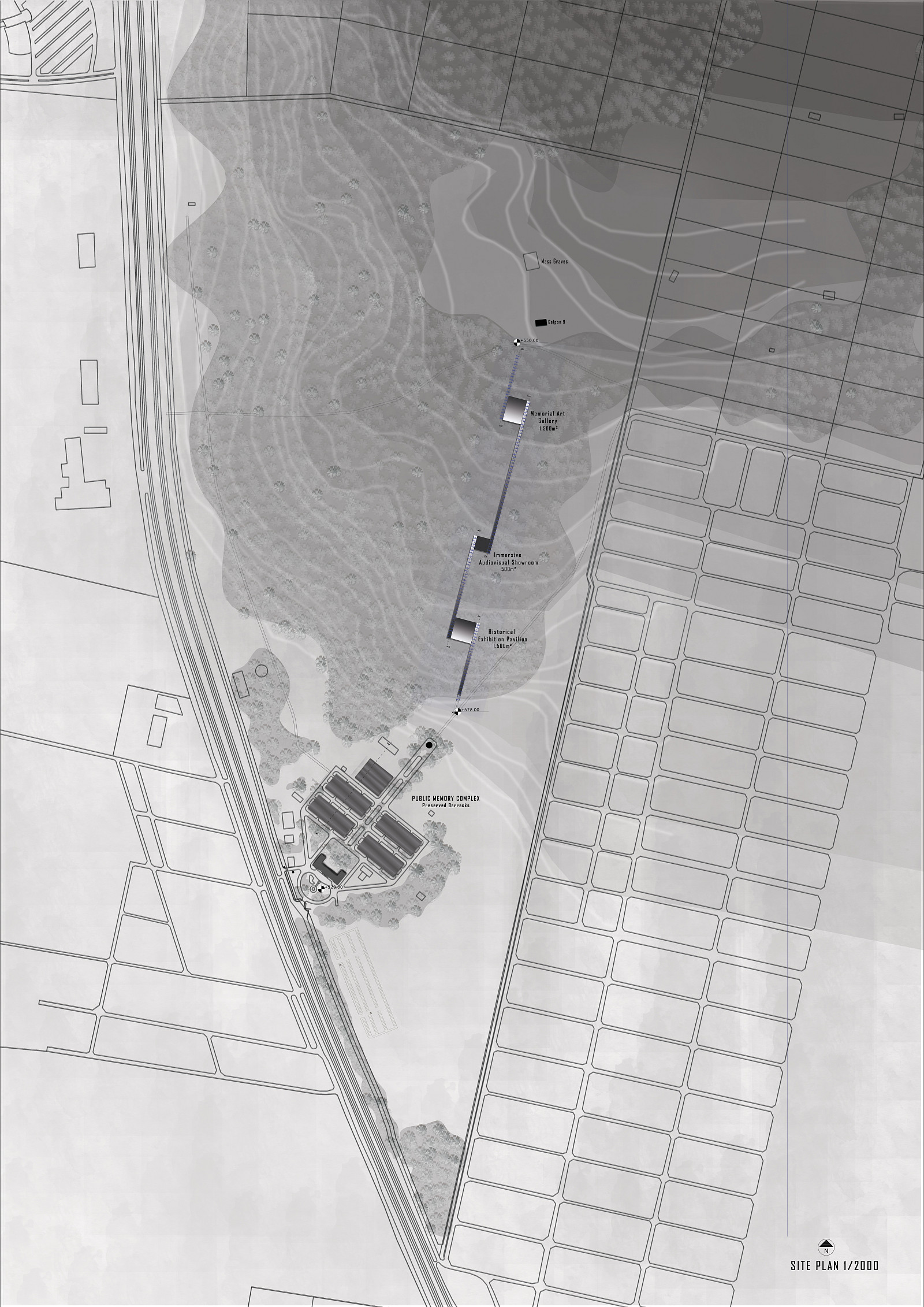
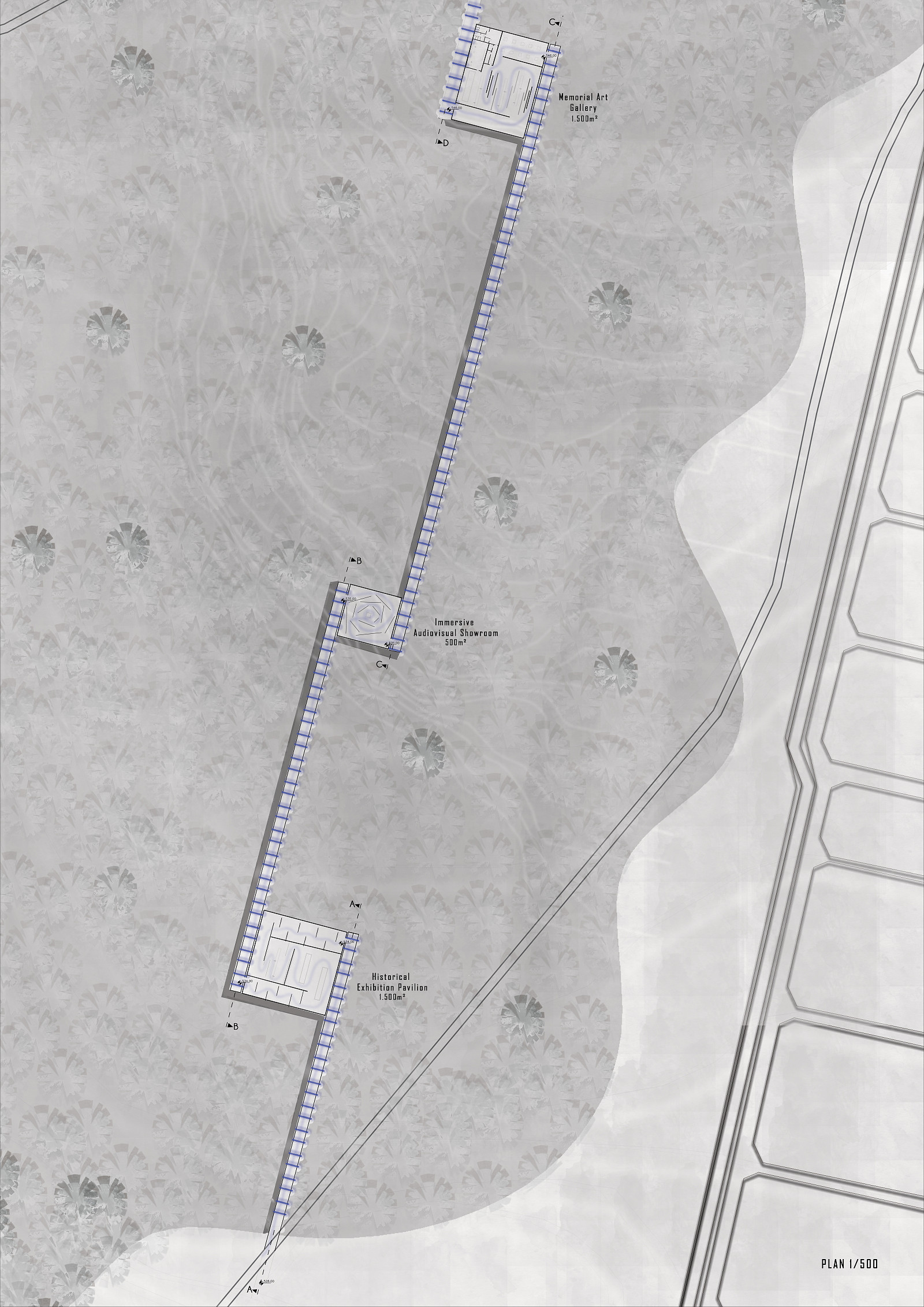
Within the content of the project, a main memory route has been designed between the preserved barracks in the former Arsenal area and the Galpón 9 and mass grave area. This route is not only a circulation line; it is the main design connecting exhibition, experience, transition, and confrontation spaces.
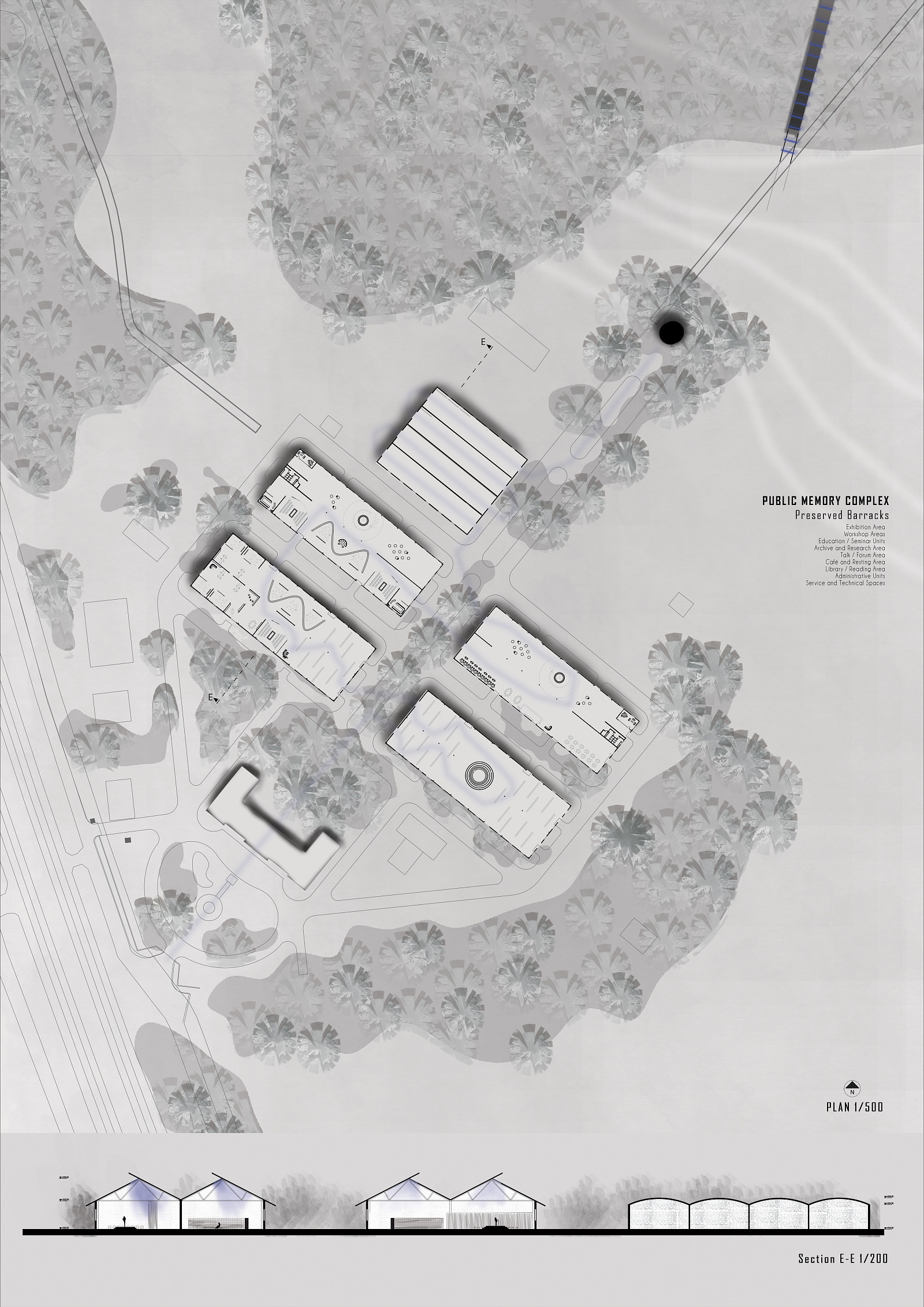
The preserved barrack structures are re-functionalized as a Public Memory Complex. This complex includes exhibition spaces, workshop areas, training and seminar units, an archive and research area, a discussion/forum area, a café and rest area, a library/book collection area, administrative units, and service and technical spaces. Thus, structures that were once part of the military system are transformed into public spaces for production and sharing. Three new programs are proposed along the memory route: a Historical Exhibition Pavilion, an Immersive Audiovisual Showroom, and a Memorial Art Gallery. Starting from the barracks, the visitor first encounters historical information, then passes through an experiential area creating a sense of darkness and disorientation, and finally reaches the art gallery through a transition where light and blue reflections increase. In the final section, the route concludes at a point of confrontation with Galpón 9 and the burial grounds. The project creates a public memory park that makes the hidden past visible again by using architectural structures, landscape, light, shadow, sound, and the walking experience together.
Technical information
The technical design of the project is based on the main memory route, the blue steel structure system, and the reuse of the preserved barracks. The memory route is designed as a linear circulation system extending from Galpón 9 and the mass graves’ site. This route guides the visitor within the area while simultaneously connecting different experiential spaces. Repeating blue steel frame structures are used along the route. These structures support the walkway, define transitional spaces, and create an easily distinguishable path within the wooded landscape, allowing visitors to clearly follow the route. The transparent blue glass surfaces used in the structures produce blue reflections with both natural and artificial light. These surfaces both increase the visibility of the route and enhance the spatial atmosphere through light, shadow, and reflection effects. The preserved barracks structures are strengthened with steel structure interventions and reopened for use. While the original spatial character of the structures is preserved, the interiors are rearranged according to new public functions. Blue light filters into the interior through controlled slits in the roof surfaces of the barracks. This intervention allows the blue memory route from the outside to continue into the existing structures.

Copyright © 2026 INSPIRELI | All rights reserved. Use of this website signifies your agreement to the Terms of Use, Privacy Policy, and use of cookies.