Re Oasis


 Mohamed Noeman
Project idea
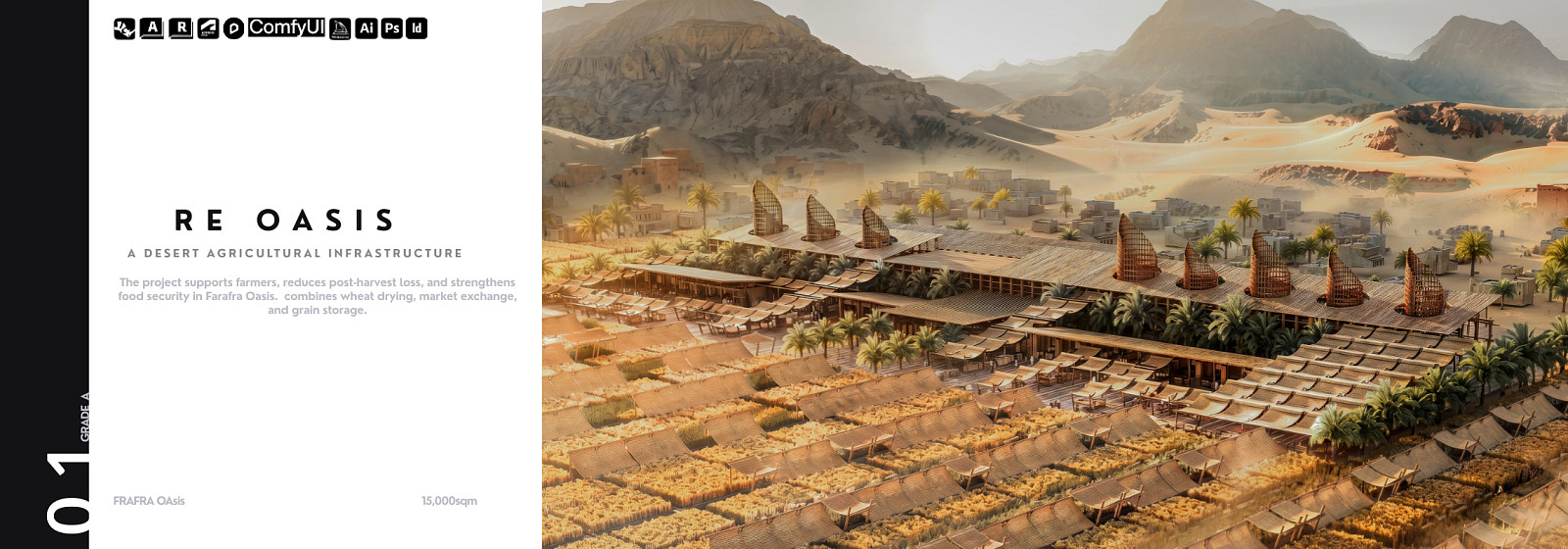
Re Oasis is a post-harvest agricultural infrastructure located in Farafra Oasis, Egypt. The project begins from a critical problem: Farafra is an agricultural community, yet its stability, income, and productivity are threatened not only by how crops are grown, but by what happens after they are harvested.
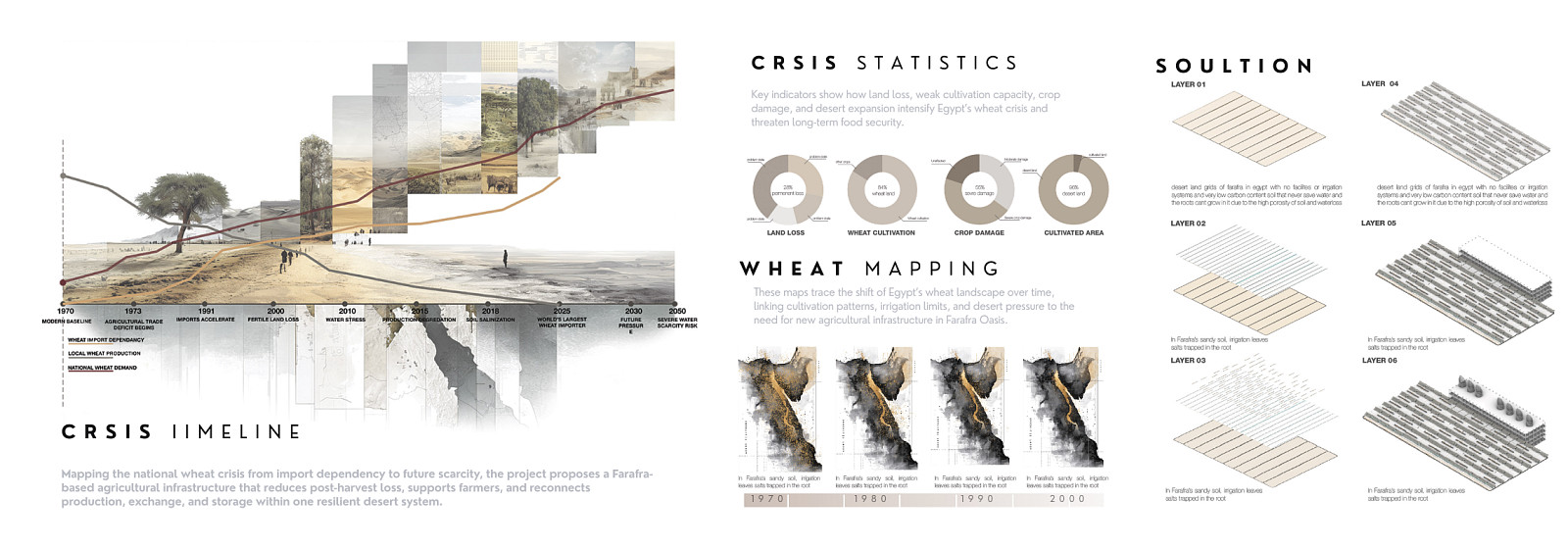
Farmers in Farafra face a chain of connected environmental and economic challenges. Sandstorms damage and bury crops before collection. Extreme desert temperature differences between day and night threaten the quality of stored grain. The absence of local storage facilities, processing spaces, and nearby markets forces farmers to sell their harvest immediately, often at the lowest price, instead of storing it safely and selling it under better conditions. At the national scale, Egypt continues to suffer from a major wheat production gap, depending on imported wheat for more than half of its needs, while productivity in desert-reclaimed soil remains limited.
The idea of Re Oasis is to transform this broken post-harvest cycle into a regenerative architectural system. Instead of designing a building that only stores grain, the project proposes an integrated infrastructure that protects the crop, stores it, connects farmers to the market, supports agricultural research, and regenerates the soil for future seasons.
The project combines three main functions: a grain market, a grain bank, and an agricultural research center. The grain market gives farmers a direct place to sell their products close to where they are grown. The grain bank allows them to store wheat safely and decide when to sell, withdraw, or exchange it according to better market conditions. The research center studies soil improvement, crop protection, storage performance, and the future of agriculture in desert land.
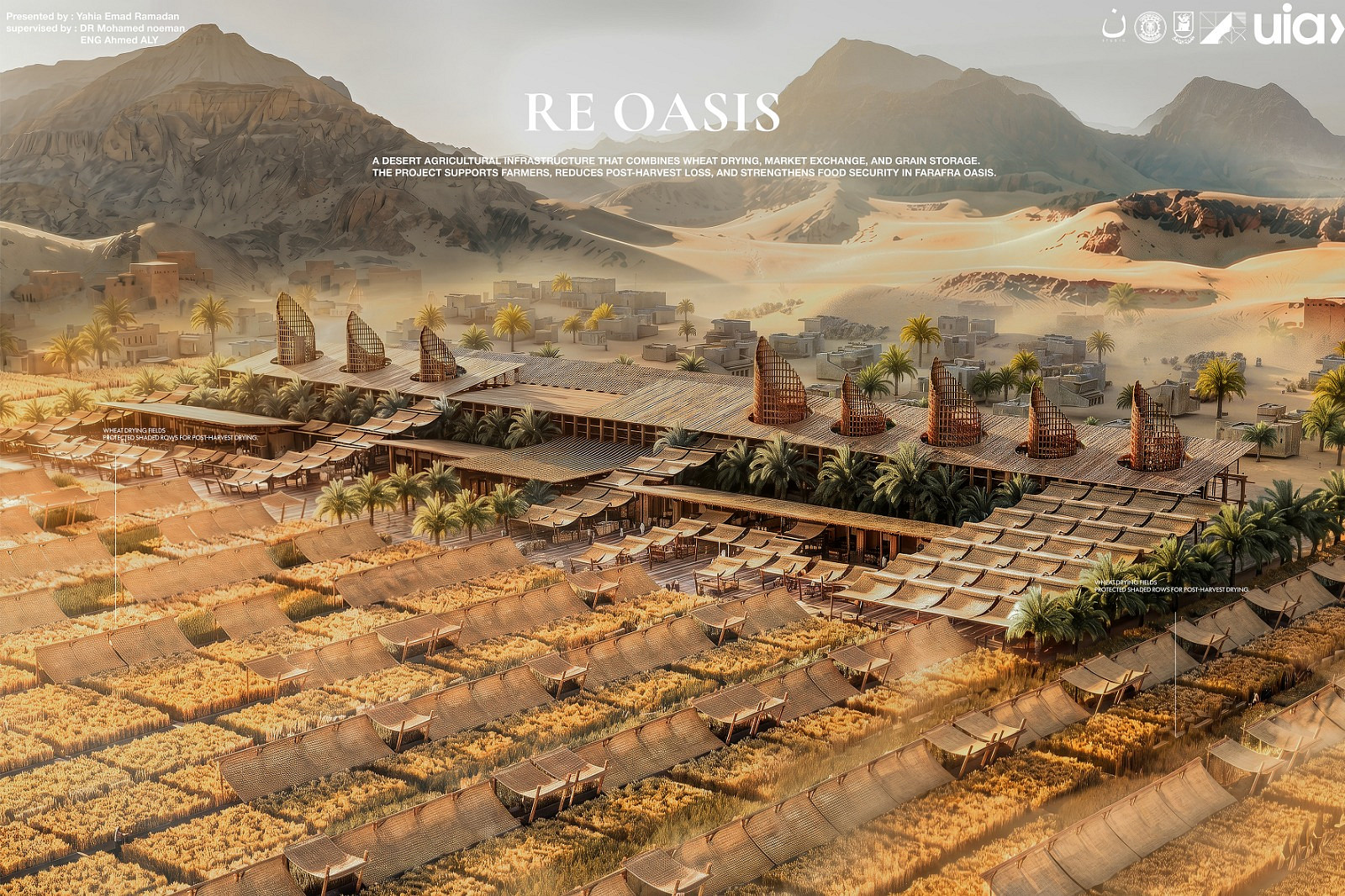
The main architectural concept is that every element of the project is generated directly from a problem. The silo becomes a windcatcher to cool the stored grain and the building. The movable field sheds respond to sandstorms by protecting the crops. The pyrolysis system converts wheat straw into biochar to improve weak desert soil. The palm buffer reduces heat around the storage zone. Re Oasis therefore proposes architecture as a productive environmental mechanism, not only as a shelter.
The goal of the project is to create a new typology for arid agricultural communities: a post-harvest infrastructure where storage, market, research, protection, and regeneration work together as one system. In this sense, Re Oasis becomes a tool for stabilizing farmers’ income, reducing crop loss, improving land productivity, and strengthening the future of Farafra’s agricultural community.
Project description
Re Oasis consists of three integrated programs: a grain market, a grain bank, and an agricultural research center. These functions are organized as one continuous post-harvest system, beginning from the cultivated field and ending with storage, trade, research, and soil regeneration.
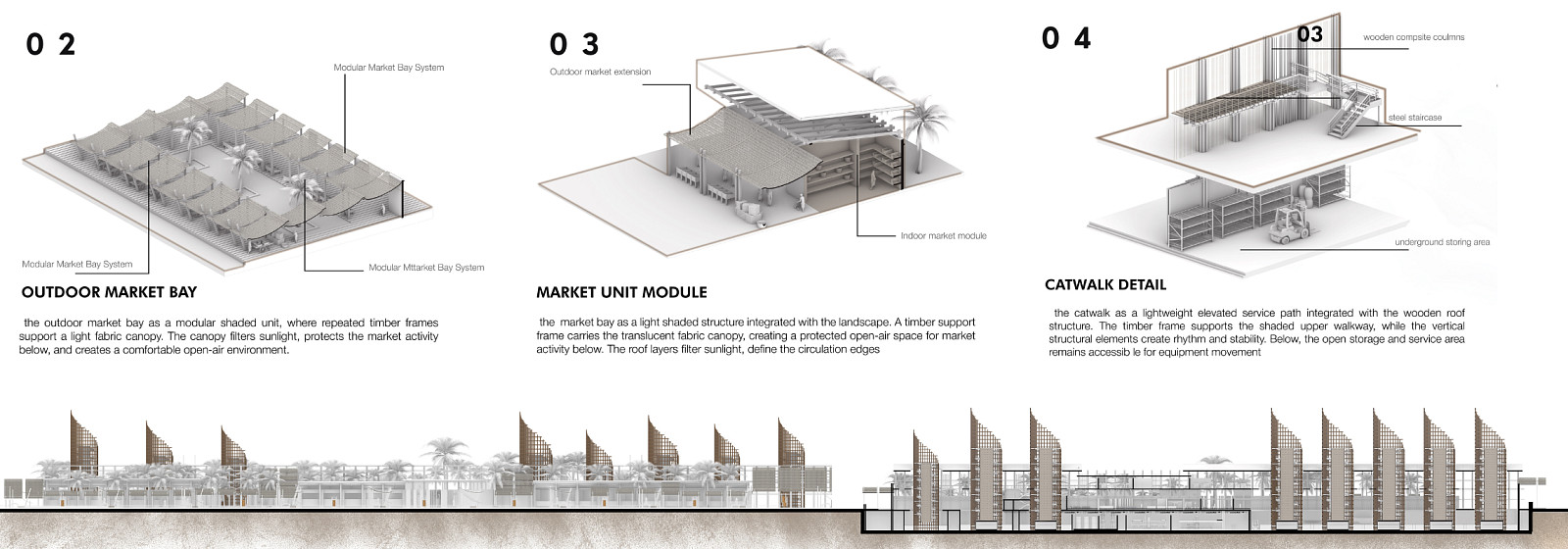
The grain market is the public and economic part of the project. It provides farmers with a direct selling platform inside Farafra, reducing their dependence on distant markets and middlemen. Instead of being forced to sell their harvest immediately after collection, farmers can display, trade, and negotiate the value of their products within a local agricultural marketplace. This part of the project is designed to be accessible, shaded, and connected to the movement of farmers, buyers, and visitors.
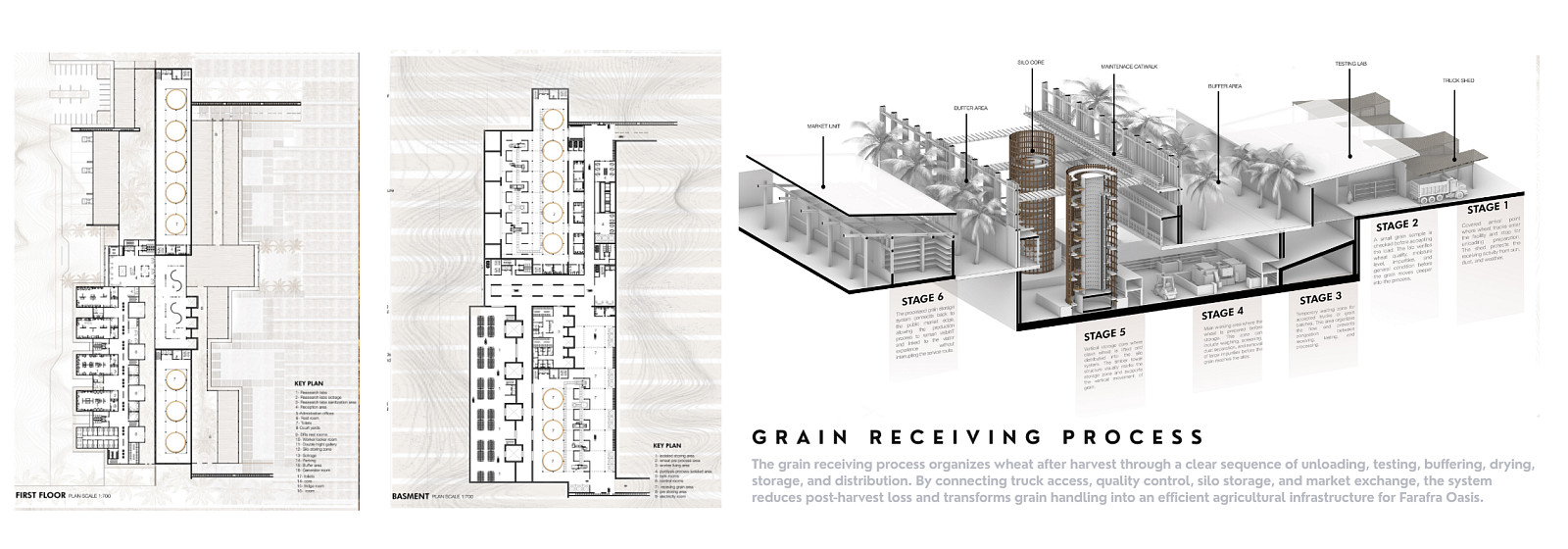
The grain bank is the protective core of the project. It allows farmers to deposit their wheat after harvest, store it safely, and withdraw or sell it later when market conditions are more favorable. This transforms storage into an economic tool. The grain bank protects the harvest not only physically, but financially, by giving farmers time and control over the value of their crops.
The agricultural research center forms the long-term knowledge component of the project. It includes spaces for testing soil quality, monitoring grain storage performance, studying crop protection strategies, and developing methods suitable for agriculture in desert-reclaimed land. The research center connects the daily needs of farmers with scientific improvement, making the project a platform for both immediate support and future development.
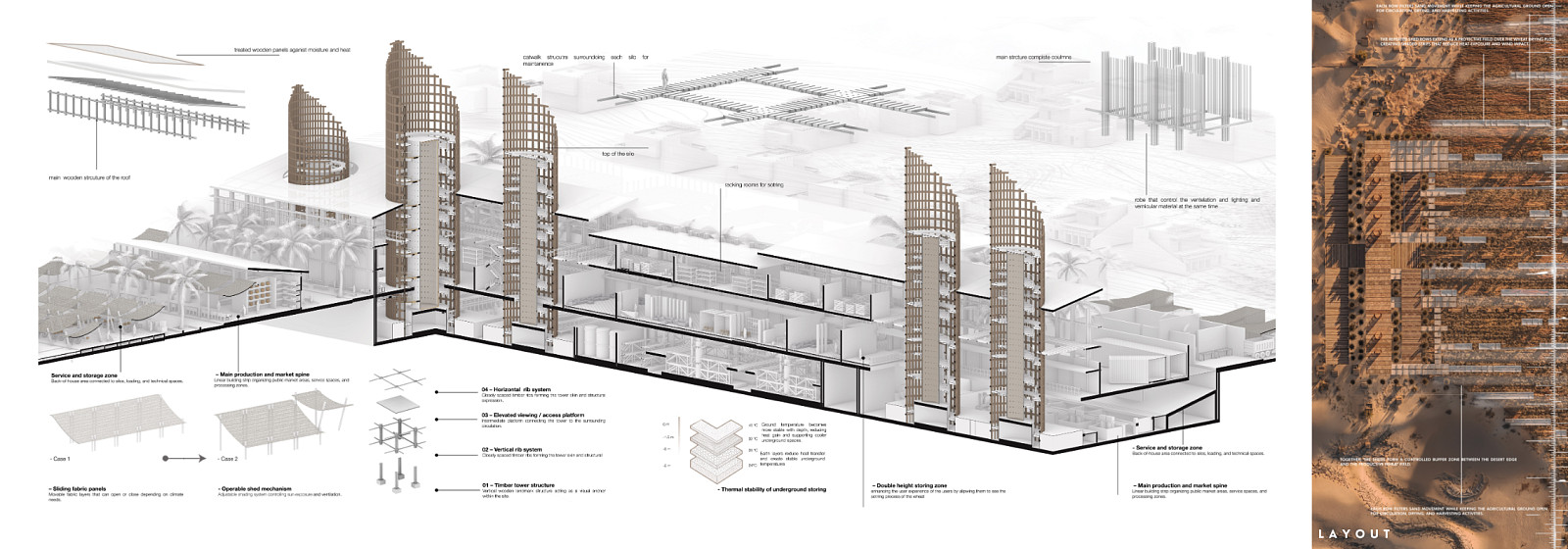
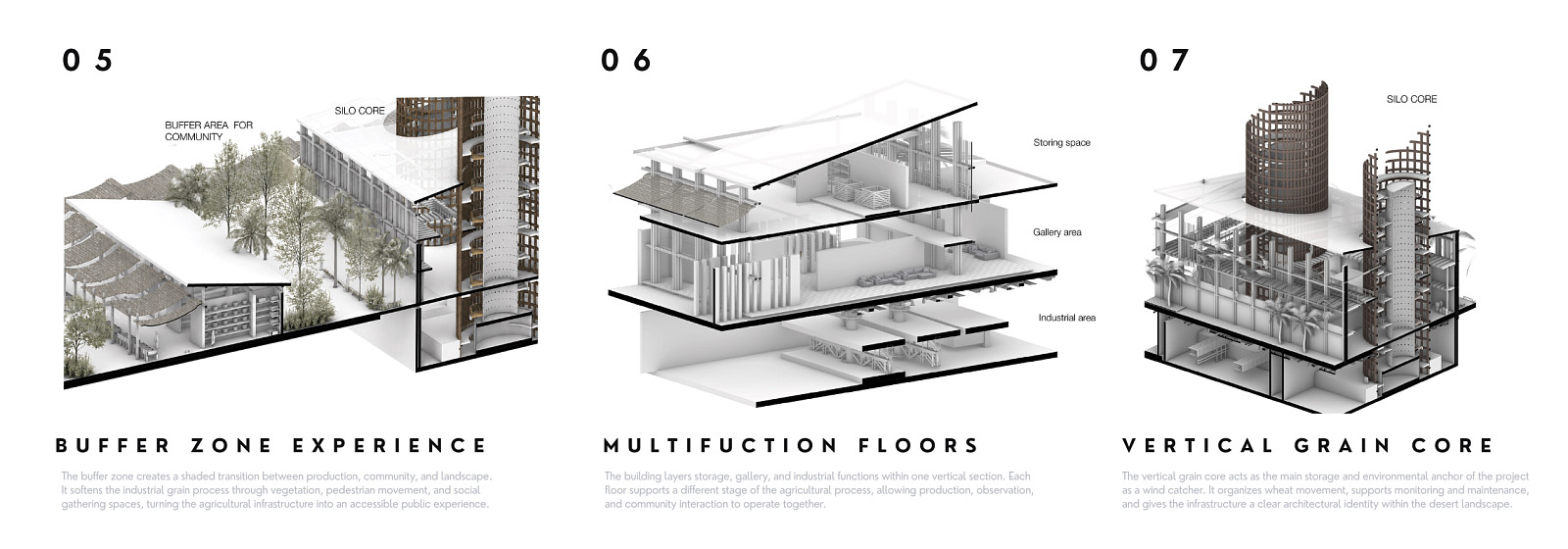
The most important environmental strategy is the redesign of the grain silo as a windcatcher. Farafra’s desert climate has a strong difference between hot daytime temperatures and cooler night temperatures. Re oasis uses this natural condition as a passive cooling system. The silo form captures cool night air and guides it downward through the grain storage chambers, helping to reduce heat inside the silos and improve the internal climate of the building. During the day, the system helps release accumulated heat. This solution protects the stored grain from spoilage, reduces dependence on mechanical cooling, and creates a direct sensory experience for the users moving through the project.
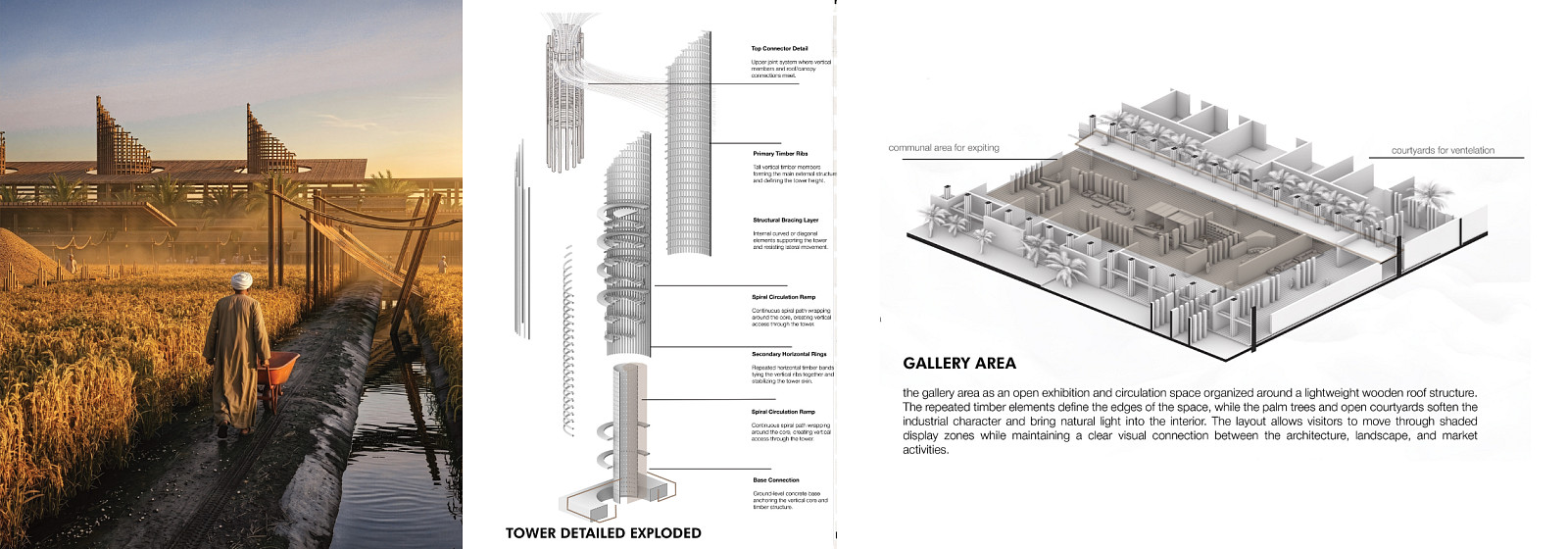
To address sandstorm damage, the project extends into the fields through a system of movable shed structures. These are responsive agricultural devices that can be deployed during sandstorm hours. When closed, they create protected coverage zones behind them, reducing the direct impact of wind and sand on the crops. When the storm passes, the sheds can be retracted, allowing the land to remain open and productive. This makes the agricultural field itself adaptive, rather than passive.
The project also introduces a pyrolysis loop to address the low productivity of desert soil. Wheat straw, which is usually treated as agricultural waste, is collected and processed on site through pyrolysis. The process converts the straw into biochar, which is returned to the soil to improve water retention, fertility, and long-term productivity. In this way, the project closes the agricultural cycle: the harvest produces waste, the waste becomes a regenerative material, and that material improves the next harvest.
The building is organized into thermal zones. Storage, market, and research areas are not treated as one identical volume; each function has its own environmental requirements. The storage zone is protected and passively cooled. The market zone is shaded and naturally ventilated. The research zone is more controlled and focused on testing and observation. Around the storage area, a buffer of palm trees reduces solar exposure, creates shade, and softens the transition between the building and the cultivated landscape.
Re Oasis is therefore not a single-function building. It is a complete post-harvest ecosystem that protects crops, stores grain, supports farmers economically, produces knowledge, and regenerates the soil.
Technical information
The technical strategy of Re Oasis is based on integrating environmental performance, agricultural infrastructure, and user experience into one architectural system. The project is designed for the harsh desert conditions of Farafra Oasis, where high temperatures, sandstorms, low rainfall, and weak desert soil directly affect agricultural production and post-harvest safety.
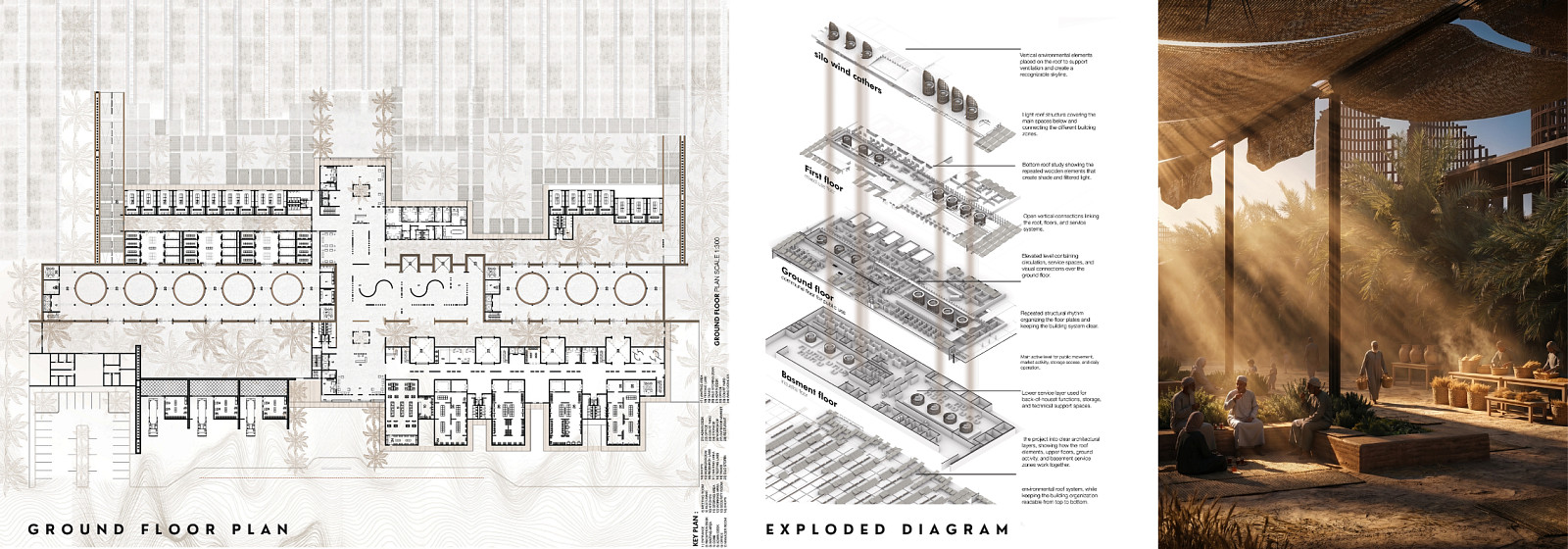
The main technical element is the windcatcher silo system. The grain silos are not designed as conventional closed storage containers; they are reshaped as passive environmental devices. Their form captures cooler night air and directs it downward through the storage chambers. This air movement helps cool the stored wheat, reduce internal heat accumulation, and improve the thermal comfort of adjacent spaces. The same element therefore performs three roles: grain storage, passive cooling, and architectural experience.
The project uses thermal zoning to separate functions according to their environmental needs. The storage zone requires the highest level of protection from heat and direct solar gain. The market zone requires shaded public circulation and natural ventilation. The research center requires more stable and controlled spaces for testing, analysis, and monitoring. This zoning allows each part of the building to perform efficiently instead of forcing all functions into one uniform climatic condition.
Around the storage zone, a palm tree buffer is used as a passive landscape strategy. The palms provide shade, reduce direct solar radiation on the silo structures, filter dust, and create a cooler microclimate around the most sensitive part of the project. The landscape is therefore part of the environmental system, not only a visual addition.
The project also includes a system of movable field sheds designed to protect crops during sandstorms. These structures are positioned within the cultivated fields and can be deployed when wind and sand conditions become dangerous. Their purpose is to create protected zones behind them, reducing sand abrasion, crop burial, and harvest loss. When protection is not required, the sheds retract to keep the field open for normal agricultural activity.
The pyrolysis system is the productive technical component of the project. Wheat straw is collected after harvest and processed in a controlled pyrolysis unit. Instead of being wasted, the straw is converted into biochar. This biochar is then returned to the agricultural soil to improve moisture retention, increase fertility, and support better productivity in future planting seasons. This creates a closed-loop system between harvest, waste, soil, and future production.
The circulation of the project is designed to reflect the post-harvest journey. Farmers move from the field toward weighing, sorting, storage, selling, research, and regeneration. Visitors and buyers experience the project through market spaces, shaded circulation, and views toward the silos and agricultural landscape. The environmental systems are visible and understandable, allowing users to experience how the building responds to climate, agriculture, and economy.
Technically, Re Oasis can be understood as a hybrid between agricultural infrastructure and climate-responsive architecture. Its main systems include passive cooling through windcatcher silos, adaptive sandstorm protection through movable sheds, thermal zoning, palm-shaded buffers, grain banking, market infrastructure, research facilities, and biochar production through pyrolysis. All these components work together to reduce crop loss, protect stored wheat, support farmers’ income, and regenerate the desert soil of Farafra.
The project’s technical value lies in the fact that its environmental systems are not separate from the architecture. The silo, the field shed, the palm buffer, the market, and the pyrolysis loop are all architectural responses to measurable problems. Together, they transform Re Oasis into a resilient post-harvest infrastructure for arid agricultural regions.

Copyright © 2026 INSPIRELI | All rights reserved. Use of this website signifies your agreement to the Terms of Use, Privacy Policy, and use of cookies.