Astronomy Museum Ufuc Al-Ubour


Project idea
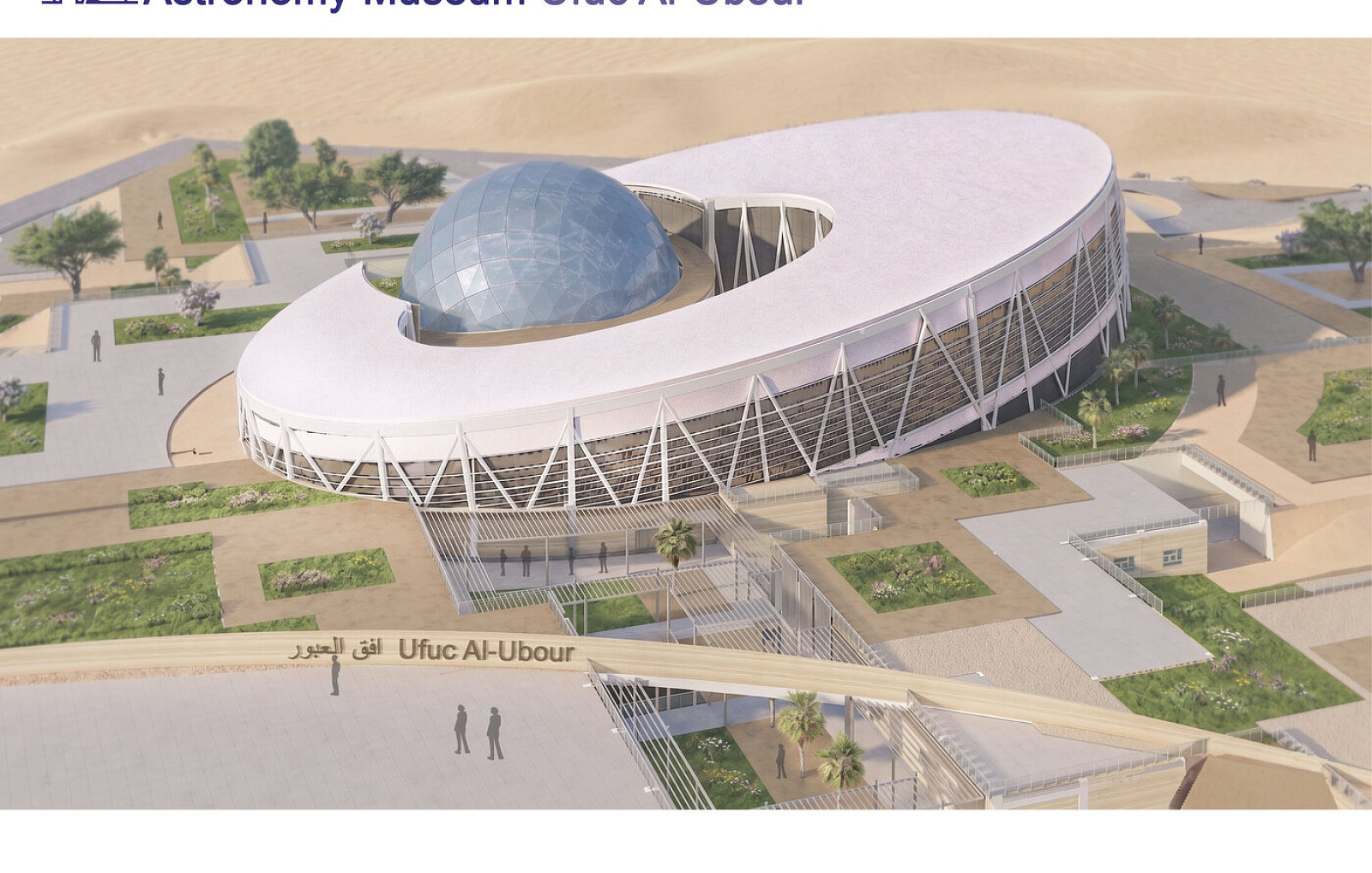
"The project concept is inspired by cosmic orbits, manifested in two distinct layers: an above-ground orbit where the architectural mass appears to float and dynamically rotate around the central dome, and an underground orbit where the structure gradually pixelates. This transition creates a powerful visual metaphor, as if the ground itself is splitting open to reveal and release the floating mass."
Project description
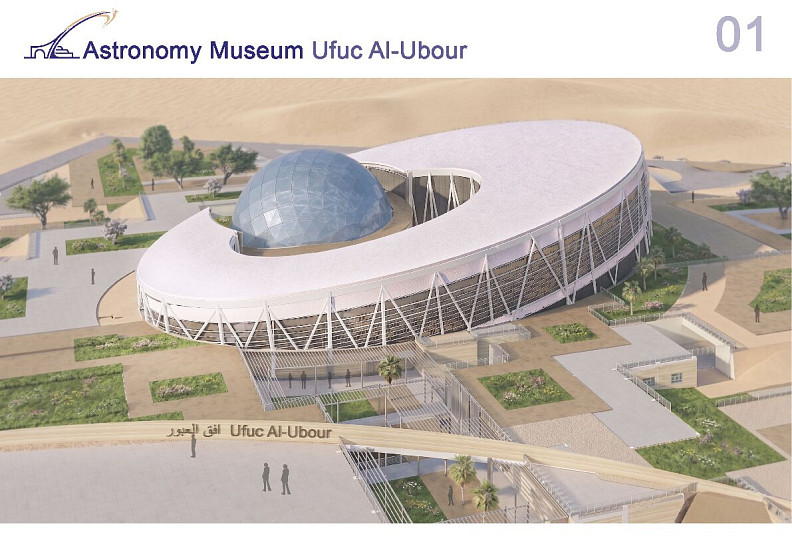
The Astronomy Museum Ufuc Al-Ubour is a large-scale cultural facility designed with a distinctive spiral or crescent-shaped plan that wraps around a central dome clad in aluminum composite panels (ACP), housing a planetarium. The building's form evokes astronomical and celestial imagery. The structure features an exposed structural system with V-shaped columns supporting a sweeping cantilevered roof. The facade incorporates extensive glazing with shading elements. The museum is situated in a desert environment with landscaped green areas, pathways, and an entrance bridge leading visitors into the complex.
Technical information
The structural strategy of 'Ufuq Al-Ubour' is precisely integrated with its architectural form. In the subterranean basement, a Flat Slab System with a regular column grid is implemented to maximize clear height and accommodate services. To maintain fluid, column-free exhibition spaces across large gallery spans, a Panel Beams system is deployed. Furthermore, the floating curves and bridges utilize a lightweight framework of Steel Frames and Trusses to achieve dramatic cantilevers, while the planetarium theater is structurally resolved using a Geodesic Dome."
Documentation

Copyright © 2026 INSPIRELI | All rights reserved. Use of this website signifies your agreement to the Terms of Use, Privacy Policy, and use of cookies.