
Living Gradient


Project idea
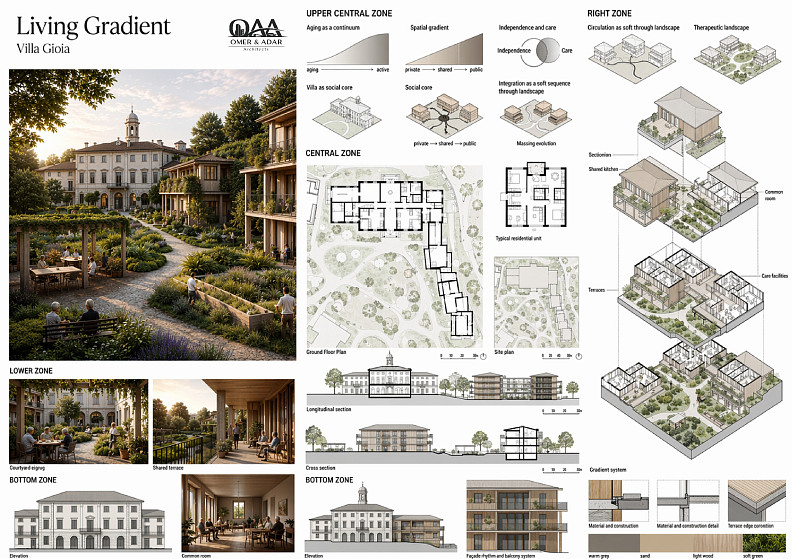
Living Gradient begins from a critique of conventional elderly housing, which often reduces aging to a fixed condition and separates care from everyday life. The project proposes a different architectural model in which aging is understood as a continuous and changing spectrum. Instead of designing for a single stage of dependency, the project creates a spatial gradient that accommodates different levels of independence, support, privacy, and social engagement over time.
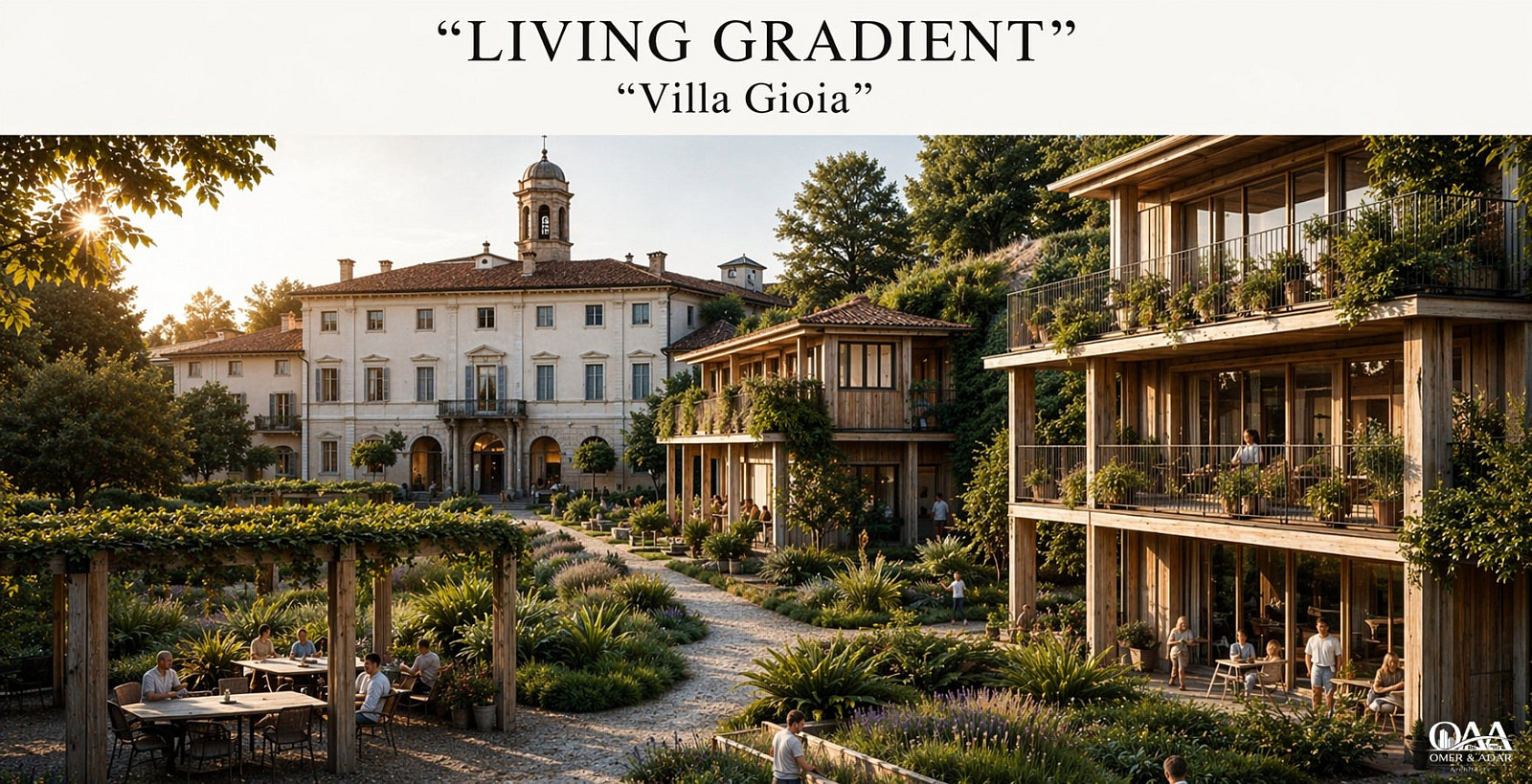
At the center of the proposal stands the existing historic villa, preserved not as an isolated monument but as a living social core. Around it, a new field of modular residential structures is introduced, forming a soft and adaptive environment where housing, care, and community are integrated. Landscape is treated as an active part of the architecture, shaping movement, encounter, rest, and therapeutic daily routines. The goal of the project is to create a dignified framework for living across time, where support is present but never dominant, and where architecture enables continuity rather than institutional separation.
Project description
The project is organized as a continuous spatial system composed of three interrelated layers: the preserved villa, the new residential clusters, and the therapeutic landscape that binds them together. The historic villa functions as a communal and cultural heart, hosting shared activities, gathering spaces, and daily rituals. It acts as a social condenser that gives identity and memory to the whole complex.
Surrounding this core, the new architecture is developed as a modular and adaptable residential system. The units are arranged in smaller clusters rather than in one large institution, allowing the project to support different living conditions and changing needs over time. Between the units, a network of intermediate spaces is created, including terraces, shared kitchens, gardens, shaded paths, and common rooms. These in-between spaces are essential to the project, as they encourage informal social interaction while preserving privacy and individual pace.
The landscape is designed as a therapeutic and spatial infrastructure rather than as a decorative background. Paths, planted courts, gardens, and resting areas create a gradual sequence between private, shared, and public conditions. The project avoids rigid zoning and instead builds a soft transition between autonomy and care, intimacy and community, memory and future life. Living Gradient therefore proposes not a home for a fixed user group, but an architectural framework that supports life as a process of continuous transformation.```
Technical information
The project combines adaptive reuse with new low-rise modular construction. The existing villa is preserved and integrated into the overall system as the central communal structure. The new residential buildings are designed as lightweight additions with a clear structural rhythm, allowing phased growth, adjustment, and future flexibility. Their organization supports multiple residential configurations and shared-support models.
The architectural language emphasizes environmental comfort, accessibility, and spatial clarity. Deep balconies, shaded transitional zones, operable openings, and planted edges improve natural ventilation, daylight control, and thermal comfort. The buildings are fully accessible and planned to allow step-free circulation between living units, communal areas, and landscape spaces. The material strategy combines the permanence of the historic villa with warm contemporary residential construction, using mineral surfaces, light wood elements, and integrated vegetation to create a calm and dignified atmosphere. The landscape operates as part of the technical and environmental strategy, assisting with microclimate, drainage, sensory orientation, and everyday well-being.
Documentation

Copyright © 2026 INSPIRELI | All rights reserved. Use of this website signifies your agreement to the Terms of Use, Privacy Policy, and use of cookies.