
Architecture of Negotiation Institute for Human Judgmen


Project idea
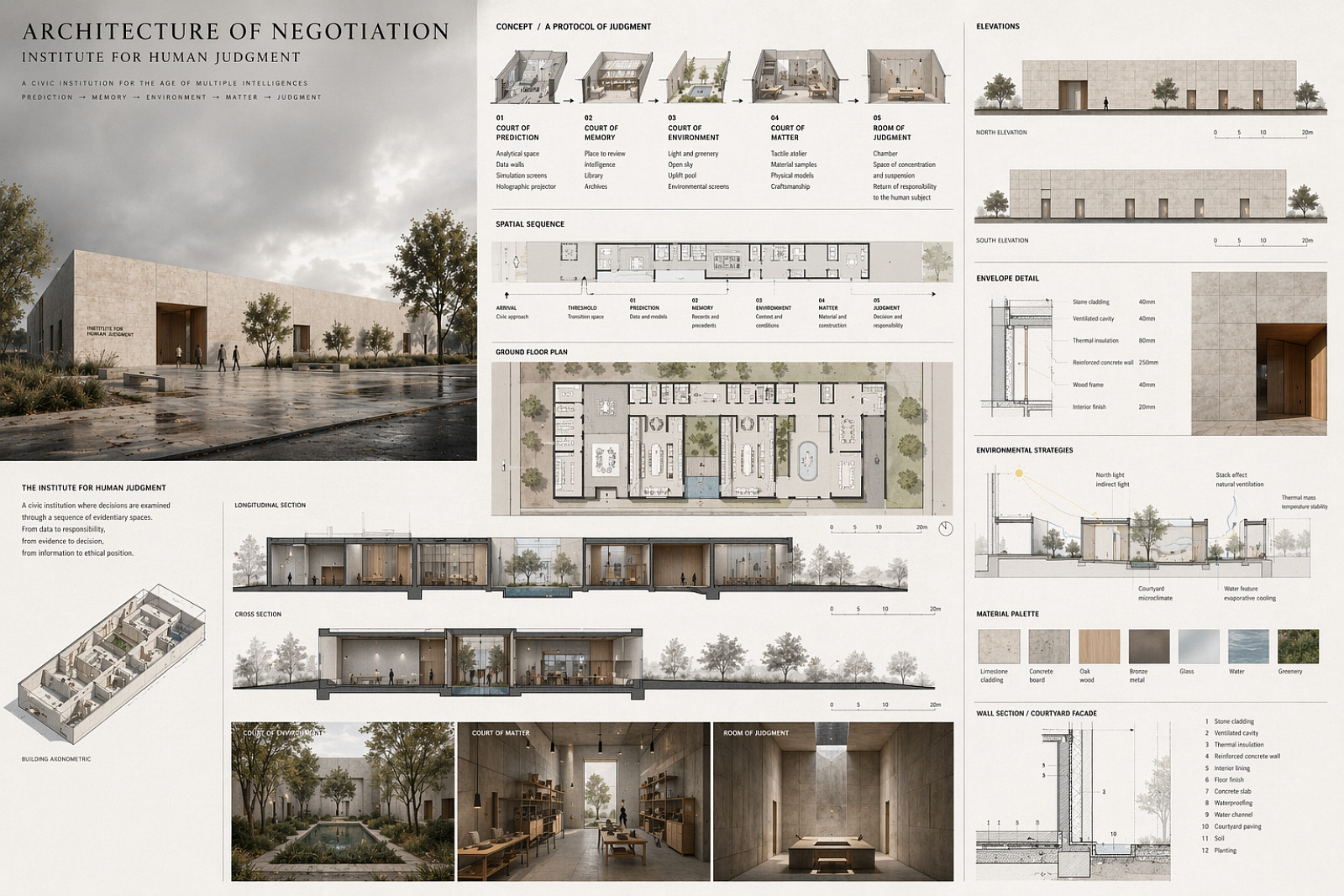
Architecture of Negotiation begins from the recognition that contemporary spatial decisions no longer emerge from a single authority. They are shaped by the interaction of computational prediction, cultural memory, environmental conditions, material behavior, and human interpretation. In this condition, architecture can no longer function as an instrument of unilateral control. It must become a framework in which different forms of knowledge are brought into relation, tested, and translated into responsible judgment.
The project proposes a new civic typology: the Institute for Human Judgment. Rather than designing a conventional public building, it constructs a spatial sequence in which evidence becomes architecture. A series of courts and chambers organizes the encounter between prediction, memory, environment, matter, and judgment, leading visitors through a process that transforms information into responsibility. The aim of the project is to redefine architecture as a civic structure for critical thought, ethical reflection, and human decision-making in an age of distributed intelligence.
Project description
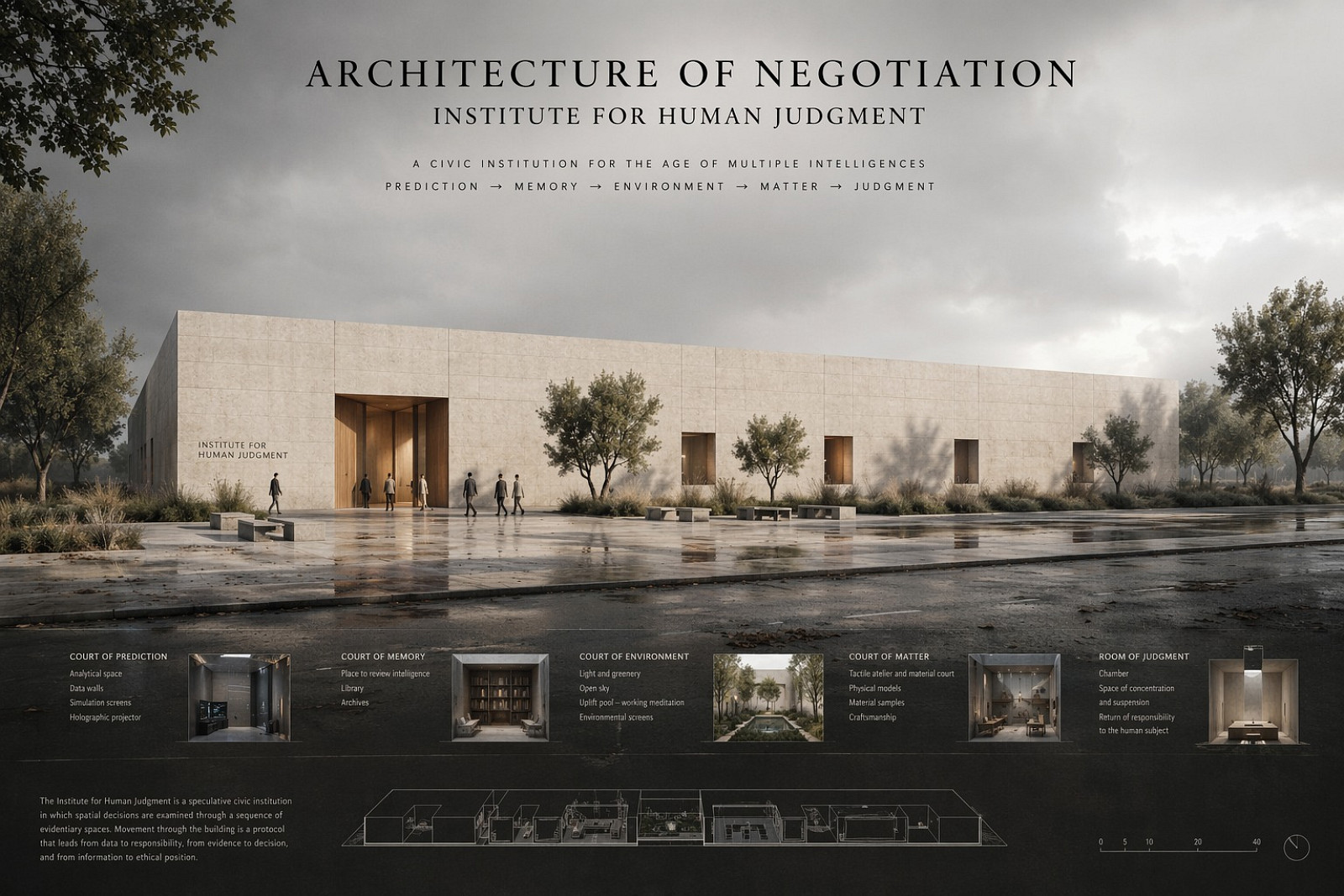
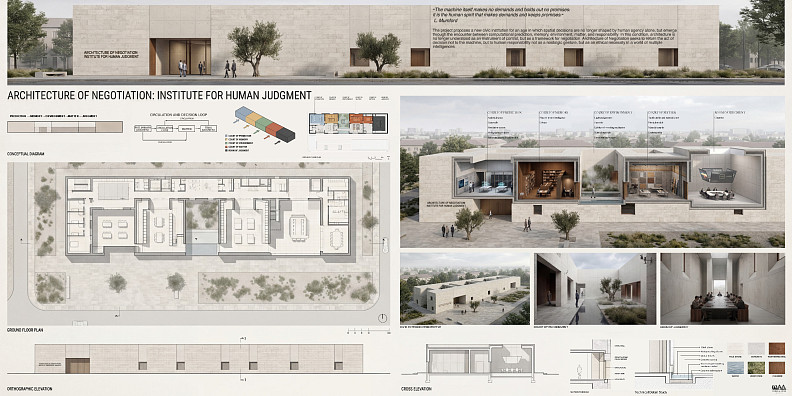
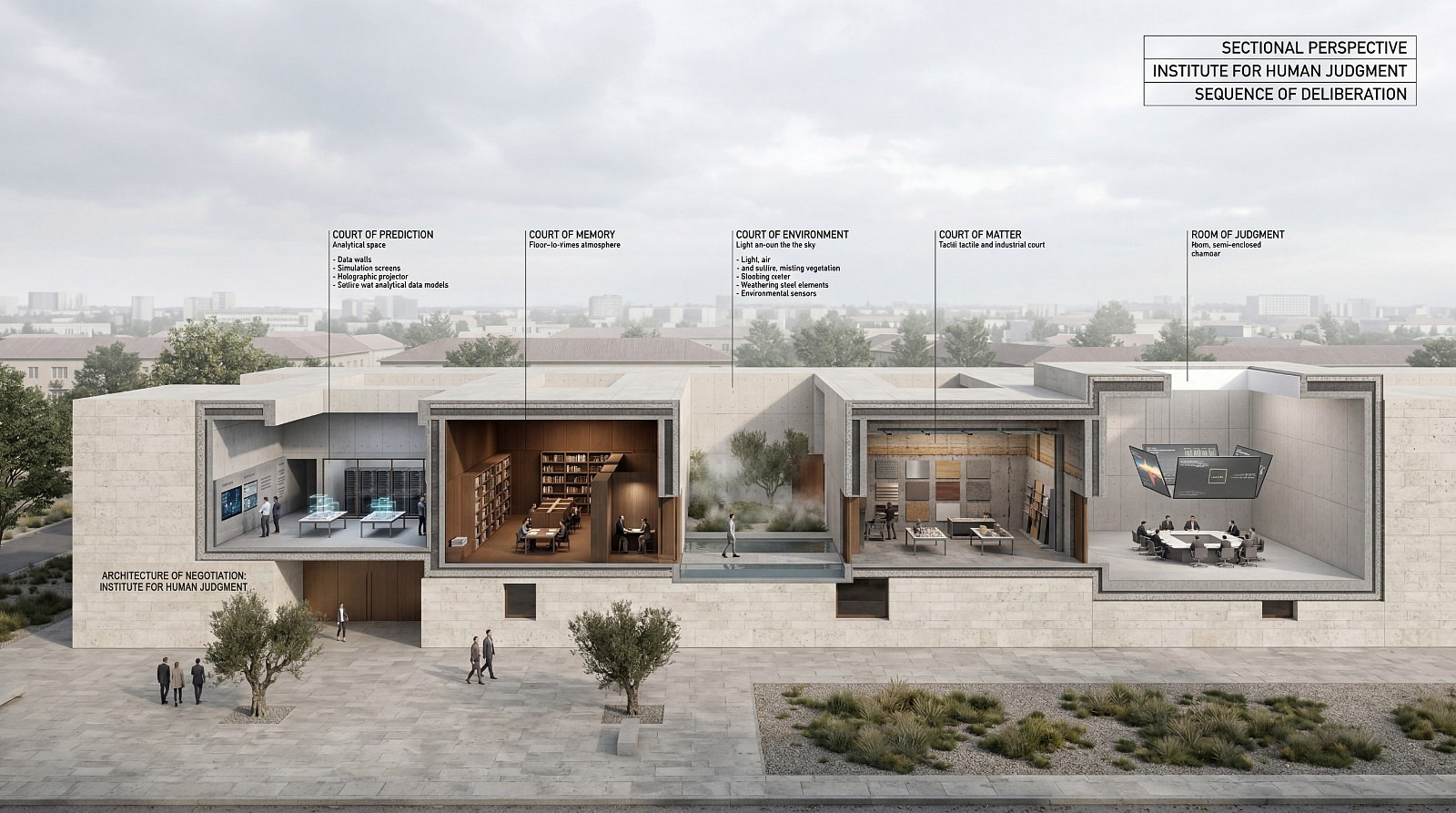
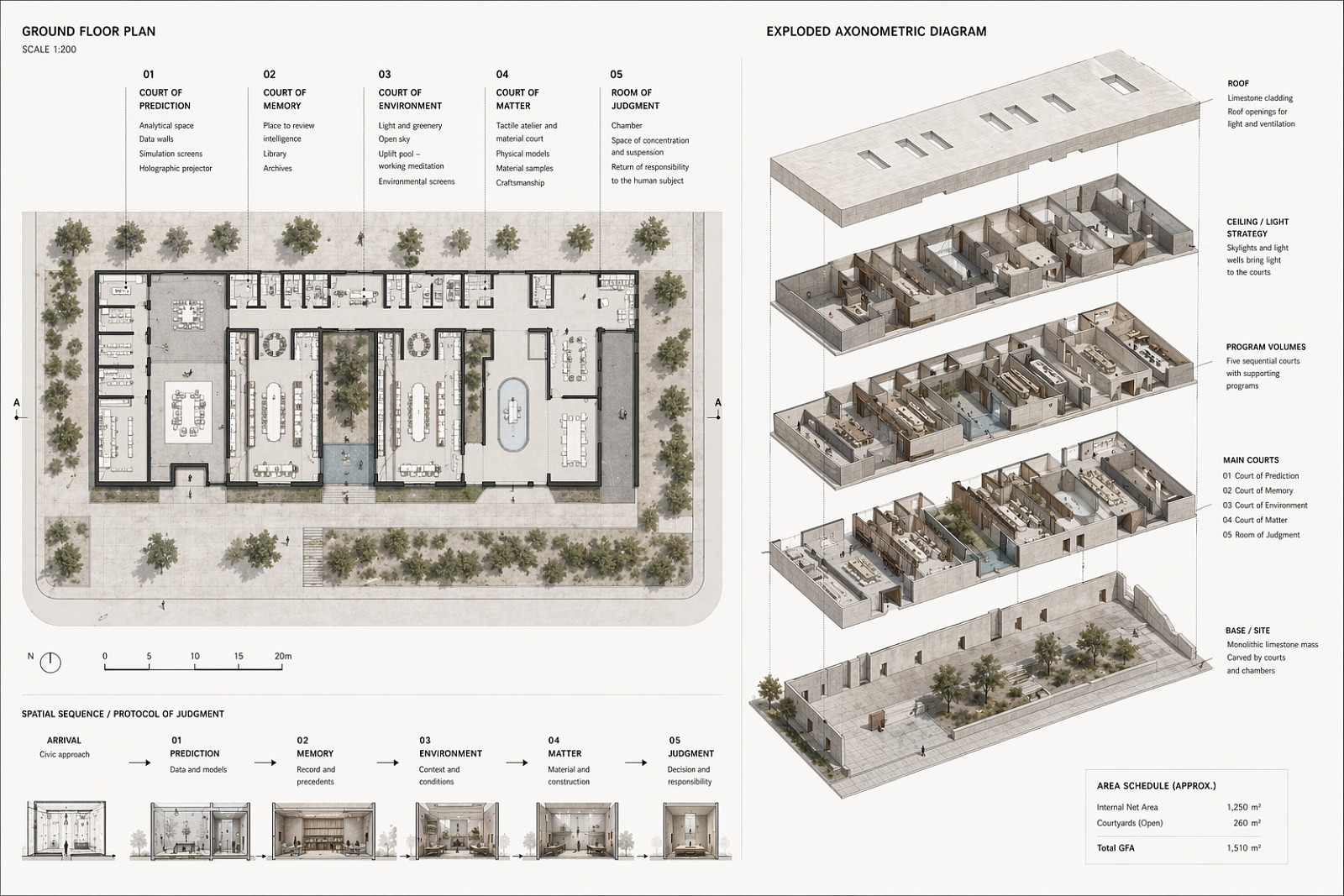
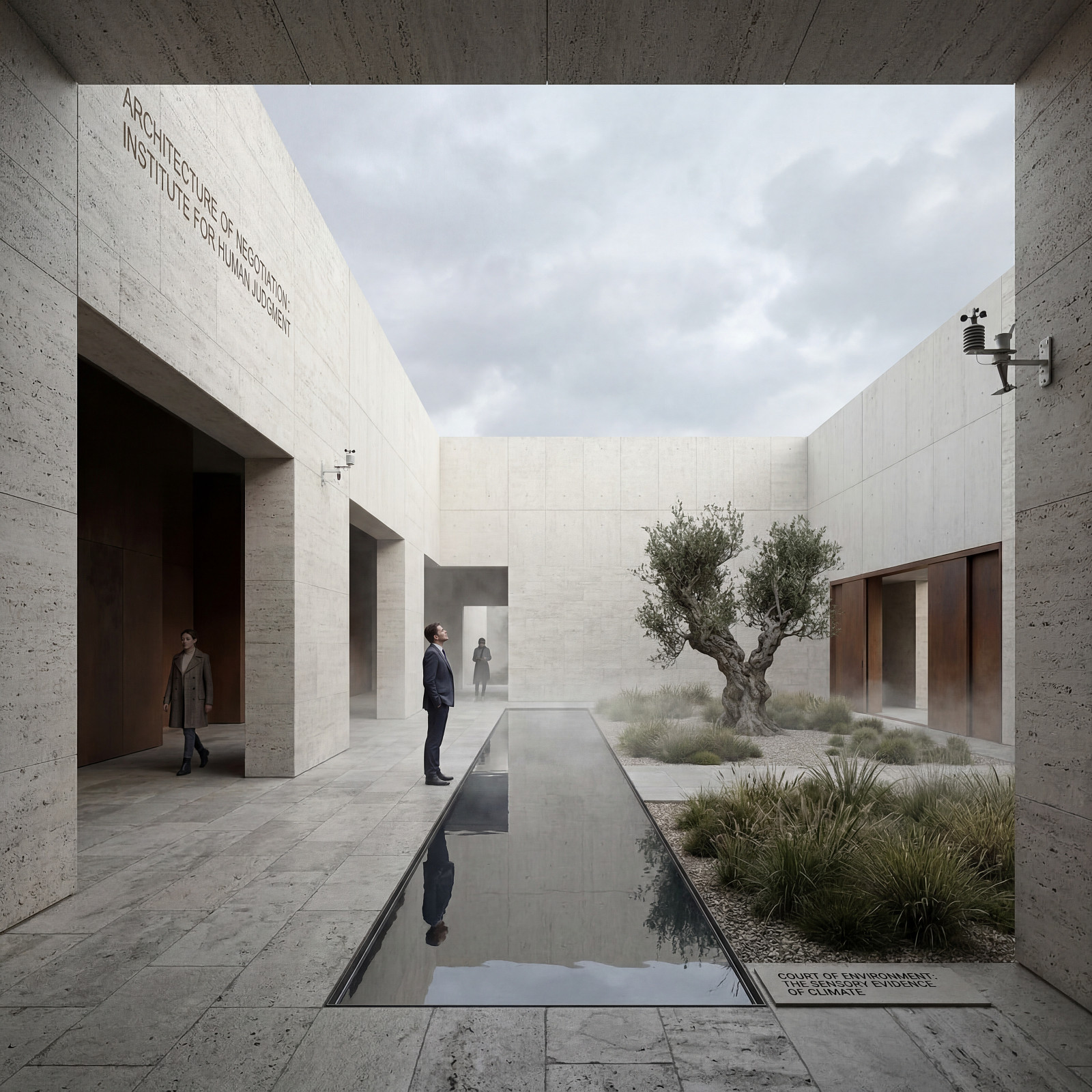
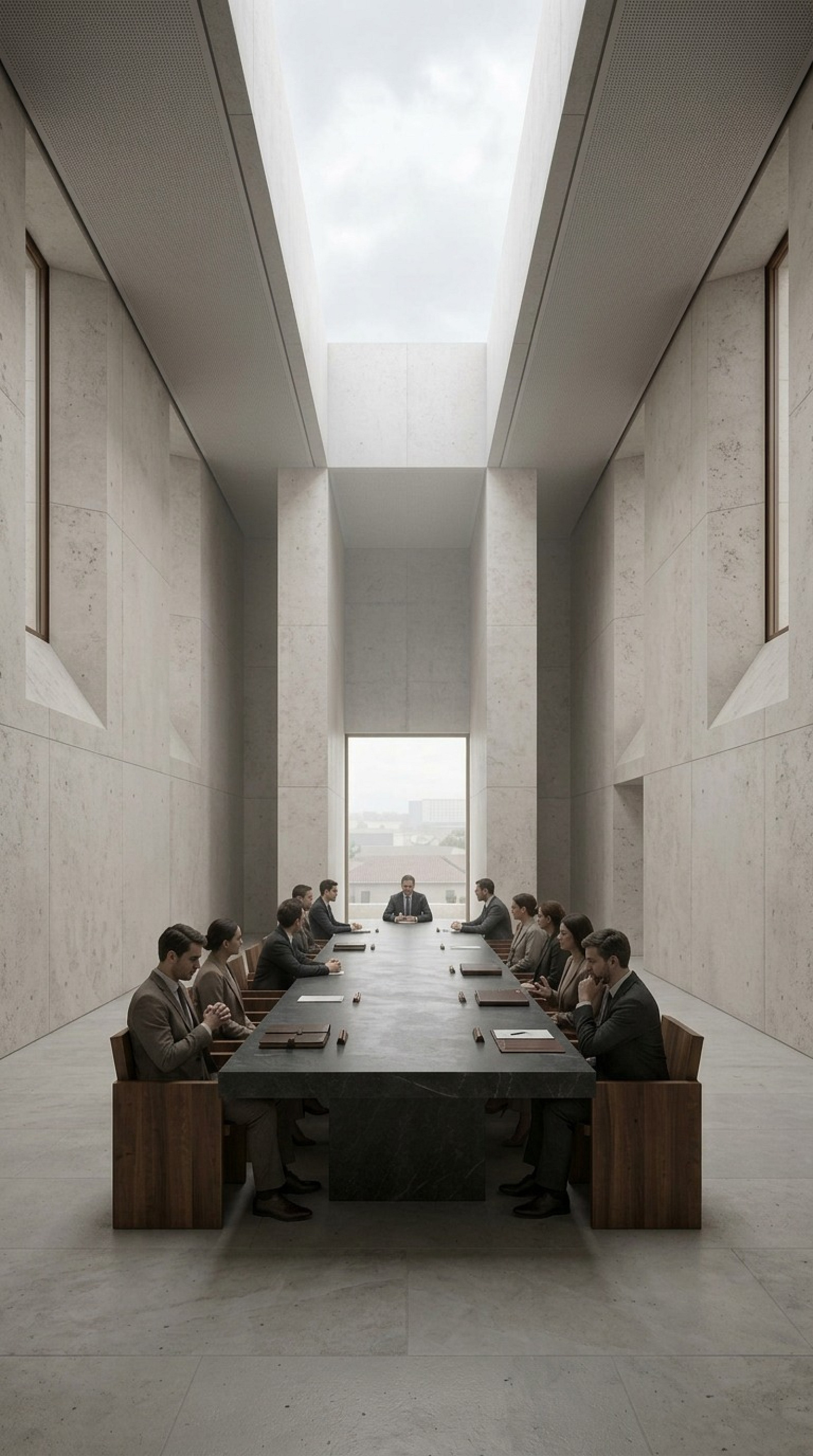
The project is conceived as a linear civic institution carved by a sequence of courtyards and interior chambers. Each spatial episode embodies a distinct mode of intelligence and a different form of evidence. The Court of Prediction presents simulation, analysis, and anticipatory data. The Court of Memory gathers historical, cultural, and archival knowledge. The Court of Environment brings light, air, vegetation, and climate into the process of reflection. The Court of Matter engages physical construction, material testing, and craftsmanship. The sequence culminates in the Room of Judgment, a concentrated chamber in which decision is no longer delegated to systems, but returns explicitly to the human subject.
Circulation through the building is not neutral movement but a spatial protocol. The project transforms progression into a civic and ethical experience, moving from information to interpretation, from interpretation to conflict, and from conflict to judgment. The architecture is restrained, precise, and monumental without becoming symbolic. Courtyards provide pause, orientation, and environmental depth, while the mass of the building gives coherence and civic presence. In this way, the institute becomes neither museum nor laboratory, but a public framework in which architecture organizes the conditions under which judgment can remain visible, deliberate, and human.
Technical information
The project is organized as a low-rise monolithic civic structure with a clear linear geometry articulated by courtyards, voids, and thick walls. Its spatial system combines enclosed chambers with open-air courts, allowing environmental conditions such as daylight, shade, air movement, and planted surfaces to become active components of the architectural experience. The tectonic strategy emphasizes mass, depth, and permanence, using a restrained material palette and precise openings to create a calm civic atmosphere.
The building envelope is designed to provide thermal stability, filtered light, and strong spatial legibility. Courtyards improve daylight penetration and natural ventilation while also structuring the internal sequence of use. The architectural organization supports exhibition, discussion, archival functions, material display, collective gathering, and contemplative decision-making. Construction is based on durable mineral surfaces, deep thresholds, integrated structural walls, and carefully controlled openings, allowing the building to express both institutional stability and spatial clarity.
Documentation

Copyright © 2026 INSPIRELI | All rights reserved. Use of this website signifies your agreement to the Terms of Use, Privacy Policy, and use of cookies.