
The Last Wall


Project idea
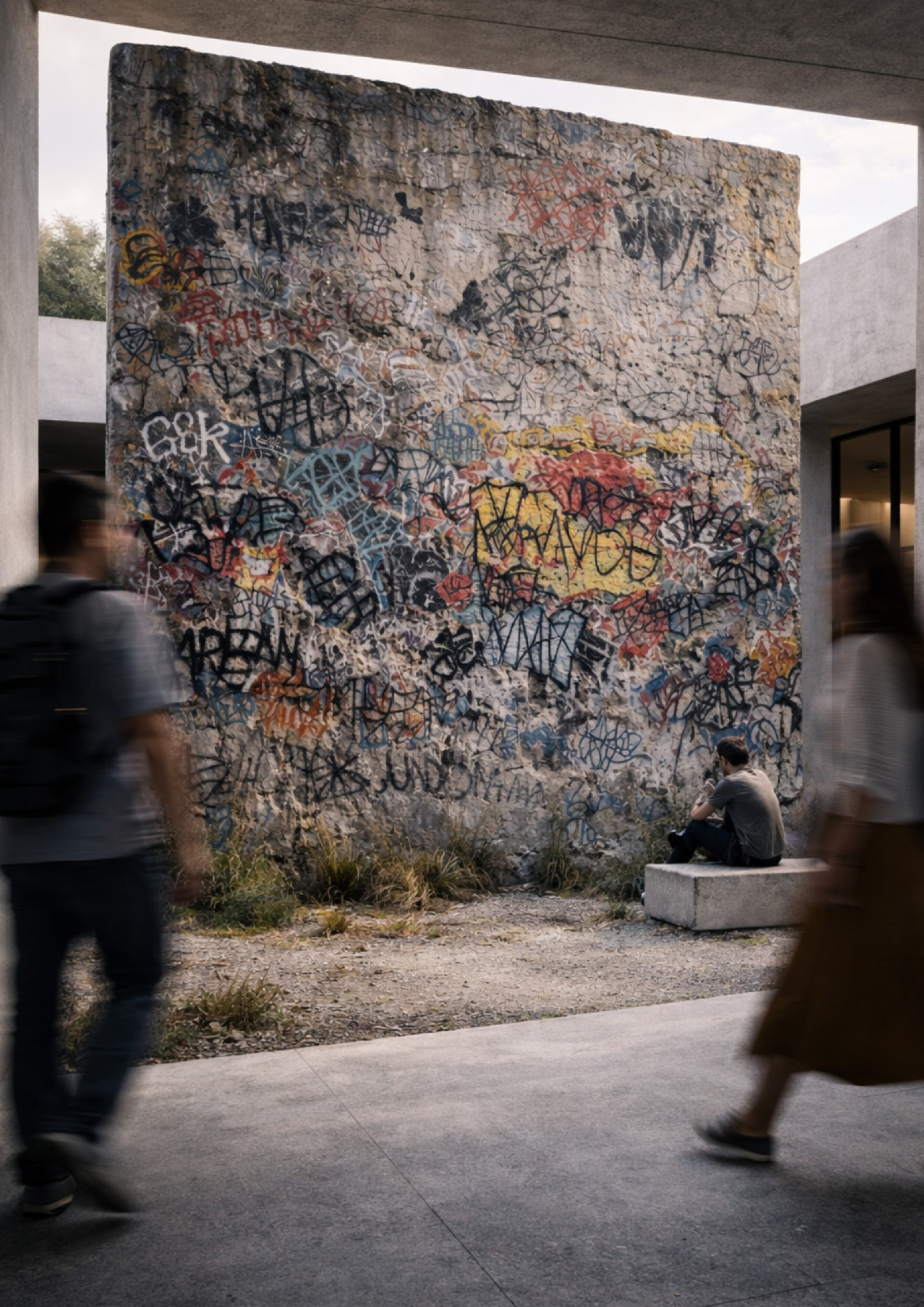
The Last Wall begins from the idea that cities are remembered not only through what is built, but through what remains. In the continuous cycle of demolition and renewal, urban fragments are usually erased, cleaned, and neutralized. This project starts from a single surviving wall covered with graffiti, layered inscriptions, and traces of public presence. Rather than treating it as damage to be removed, the project recognizes it as a living civic record.
The proposal creates a new pavilion around this wall, not to restore or monumentalize it, but to place it within a spatial framework of care, reflection, and public encounter. The architecture does not replace the relic; it makes space for it. The goal of the project is to transform a contested remnant into a civic interior in which memory remains visible, unresolved, and active within the city.
Project description
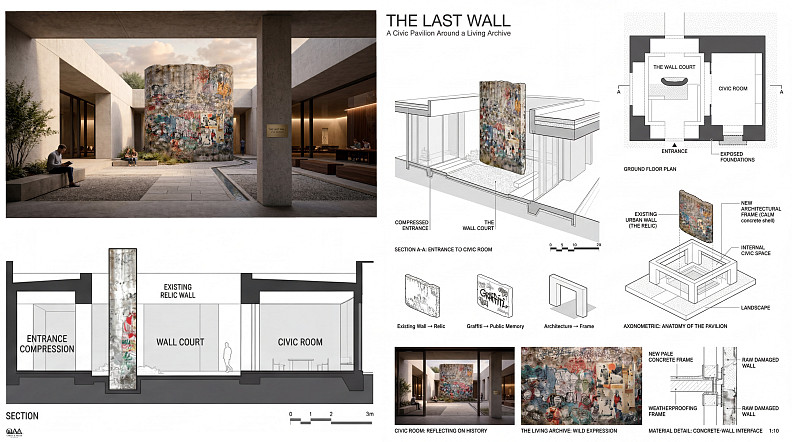
The project is organized around an existing urban wall positioned at the center of a new civic pavilion. Entry is compressed and restrained, delaying the full perception of the wall until the central court opens around it. In this space, the wall is not a backdrop but the core of the architecture. It is encountered as an object of presence, friction, and collective memory. Around it, a calm and precise architectural frame defines a sequence of court, civic room, and threshold spaces that allow the wall to be observed, approached, and inhabited without being absorbed into a fixed institutional narrative.
Rather than preserving the wall as an isolated artifact, the project creates a new relationship between the uncontrolled and the constructed. The graffiti-covered surface remains raw, layered, and unresolved, while the surrounding architecture is pale, restrained, and materially quiet. This contrast gives spatial dignity to what would otherwise be erased. The project does not complete the wall, nor does it resolve its meaning. Instead, it extends its life by placing it within a new civic and social framework.
The Last Wall therefore proposes a form of architecture that begins from what is already marked, contested, and incomplete. It suggests that public value can emerge not from purity or total control, but from friction, accumulation, and persistence. The pavilion becomes a place for gathering, reading, observing, and remaining, where architecture acts not as erasure, but as a frame that allows what already exists to continue speaking.
Technical information
The project combines an existing urban relic with a new low-rise civic pavilion organized through courtyards, thick walls, and precise structural framing. The retained wall remains materially untouched in its main body, while a new architectural envelope is constructed around it to provide protection, spatial definition, and public accessibility. The design is based on the contrast between the raw existing surface and the restrained tectonic language of the new intervention.
Construction is conceived through durable mineral materials, deep openings, and a simple structural system that allows the central wall court to remain open, visible, and protected. The pavilion includes a civic room, entrance compression space, open court, and transitional zones that support gathering, reflection, and interpretation. The project relies on spatial sequence, controlled light, and material contrast rather than technical complexity, creating a calm civic framework in which the preserved wall can retain its physical and symbolic intensity.
Documentation

Copyright © 2026 INSPIRELI | All rights reserved. Use of this website signifies your agreement to the Terms of Use, Privacy Policy, and use of cookies.
