
Tidal Commons


Project idea
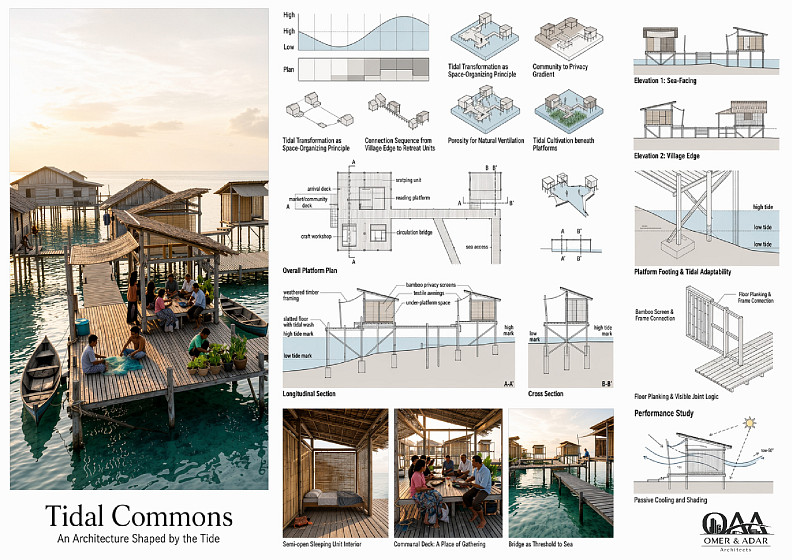
Tidal Commons begins from the recognition that in certain coastal communities, the sea is not a backdrop but a condition of life. It is time, labor, memory, language, and shared dependency. In such a context, architecture cannot arrive as a fixed and detached object that imposes order on a shifting environment. It must instead act as a framework that listens, adapts, and works within existing ecological, cultural, and temporal rhythms.
The project proposes an architecture shaped by the tide. Rather than separating dwelling from water, it creates a system of thresholds between land and sea, host and guest, observation and participation, permanence and change. The goal is not to aestheticize marine life or produce a place of escape, but to create a form of presence in which architecture supports attentiveness, reciprocity, and collective life within a tidal environment.
Project description
The project is organized as a network of elevated timber platforms and lightweight pavilions positioned above the water. These structures are connected through bridges, shared decks, and circulation paths that respond to tidal movement and changing relationships between access, gathering, privacy, and exposure. Rather than forming one singular building, the project operates as a distributed settlement in which communal and individual spaces are carefully balanced.
At its core, the project is structured through thresholds. Shared platforms support collective gathering, craft, exchange, and everyday interaction, while more private retreat units extend outward as quieter spaces for rest and reflection. Movement through the project is shaped by proximity to water, changing views, and the rhythm of transition between open communal life and more intimate occupation. In this way, circulation becomes a lived experience of the sea rather than a neutral connection between objects.
Tidal change is treated as a spatial principle rather than a technical constraint. The project allows architecture to remain open, breathable, and adaptable, while acknowledging the instability and temporality of the site. Tidal Commons therefore proposes a way of dwelling that does not claim ownership over the sea, but enters into relationship with it through attentiveness, participation, and shared use.
Technical information
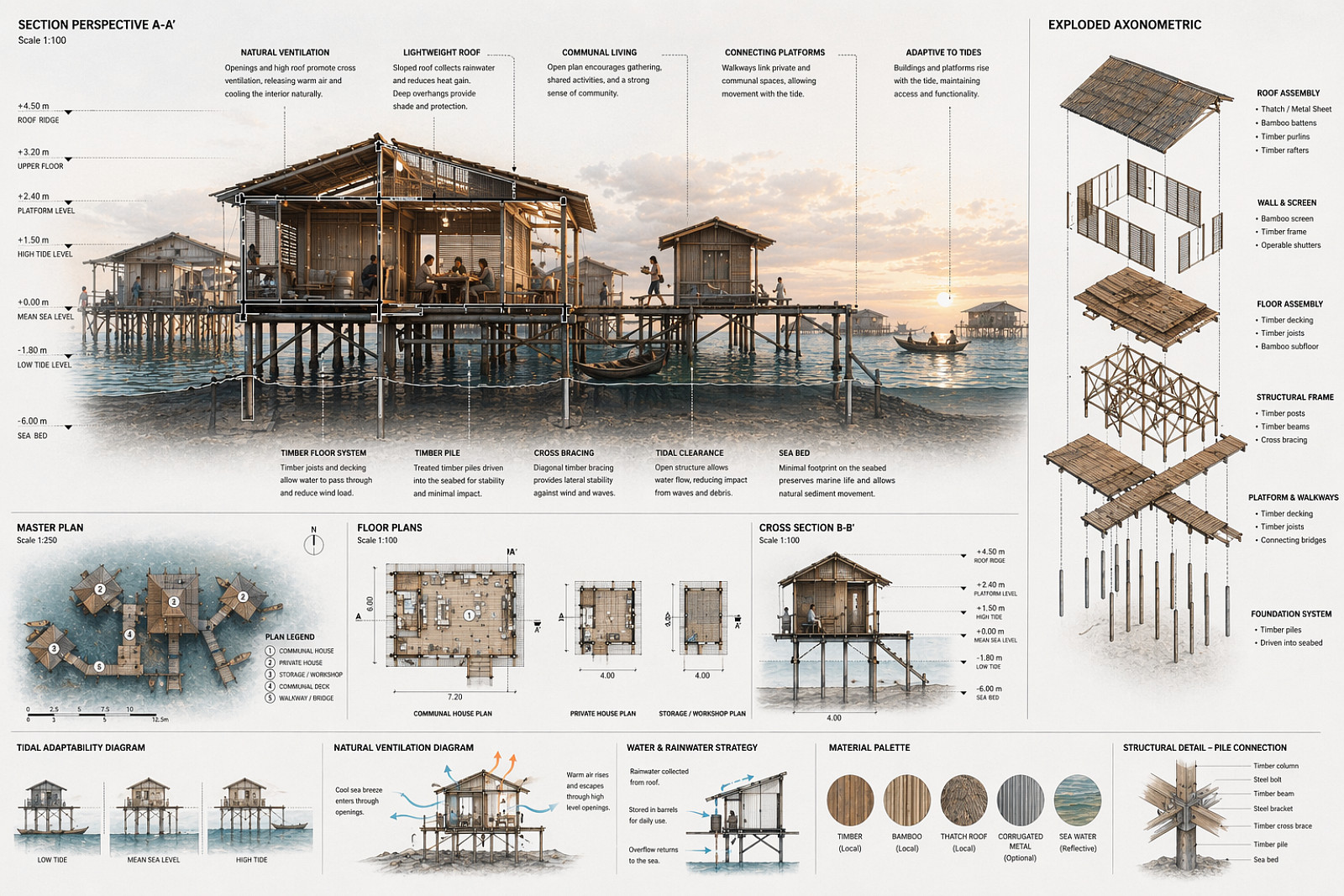
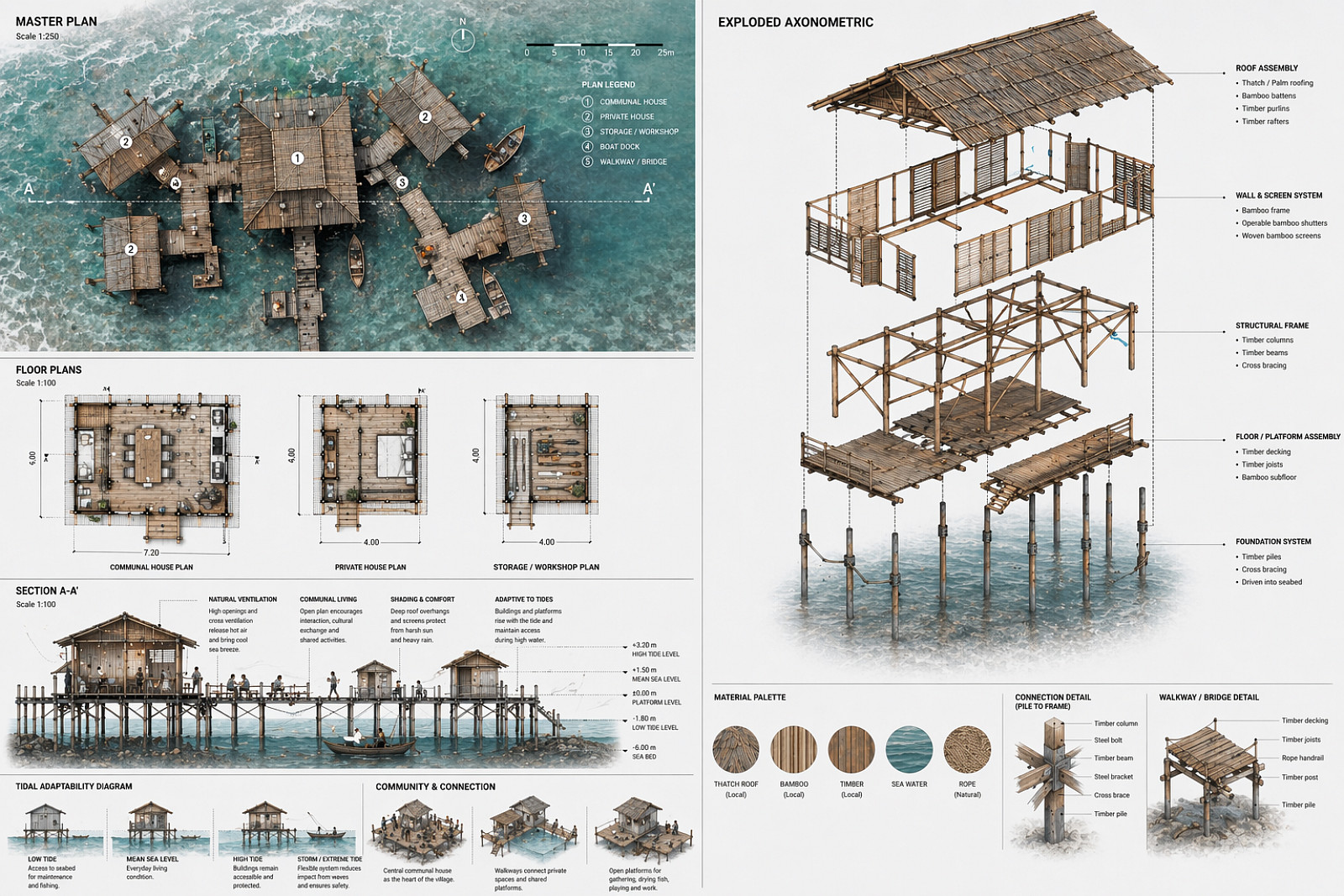
The project is designed as a lightweight stilt-based coastal structure composed of timber platforms, small pavilion units, and connecting bridges elevated above tidal water. The architectural system allows fluctuating water levels to pass beneath the inhabited surfaces, reducing direct impact on the site while maintaining permeability and adaptability. The structural logic is based on repetitive vertical supports, lightweight framing, and modular deck construction that can accommodate phased growth and variation in use.
Environmental performance relies on passive strategies suited to a humid marine climate. Open-sided and semi-open spaces support cross ventilation, while bamboo or woven screens provide shade, privacy, and filtered light. Raised floors, pitched roofs, and breathable material assemblies help manage moisture, heat, and airflow. The project uses weathered timber, lightweight cladding, and simple joint systems to create an architecture that is robust yet flexible, capable of responding to tidal cycles, salt air, and everyday communal occupation.
Documentation

Copyright © 2026 INSPIRELI | All rights reserved. Use of this website signifies your agreement to the Terms of Use, Privacy Policy, and use of cookies.