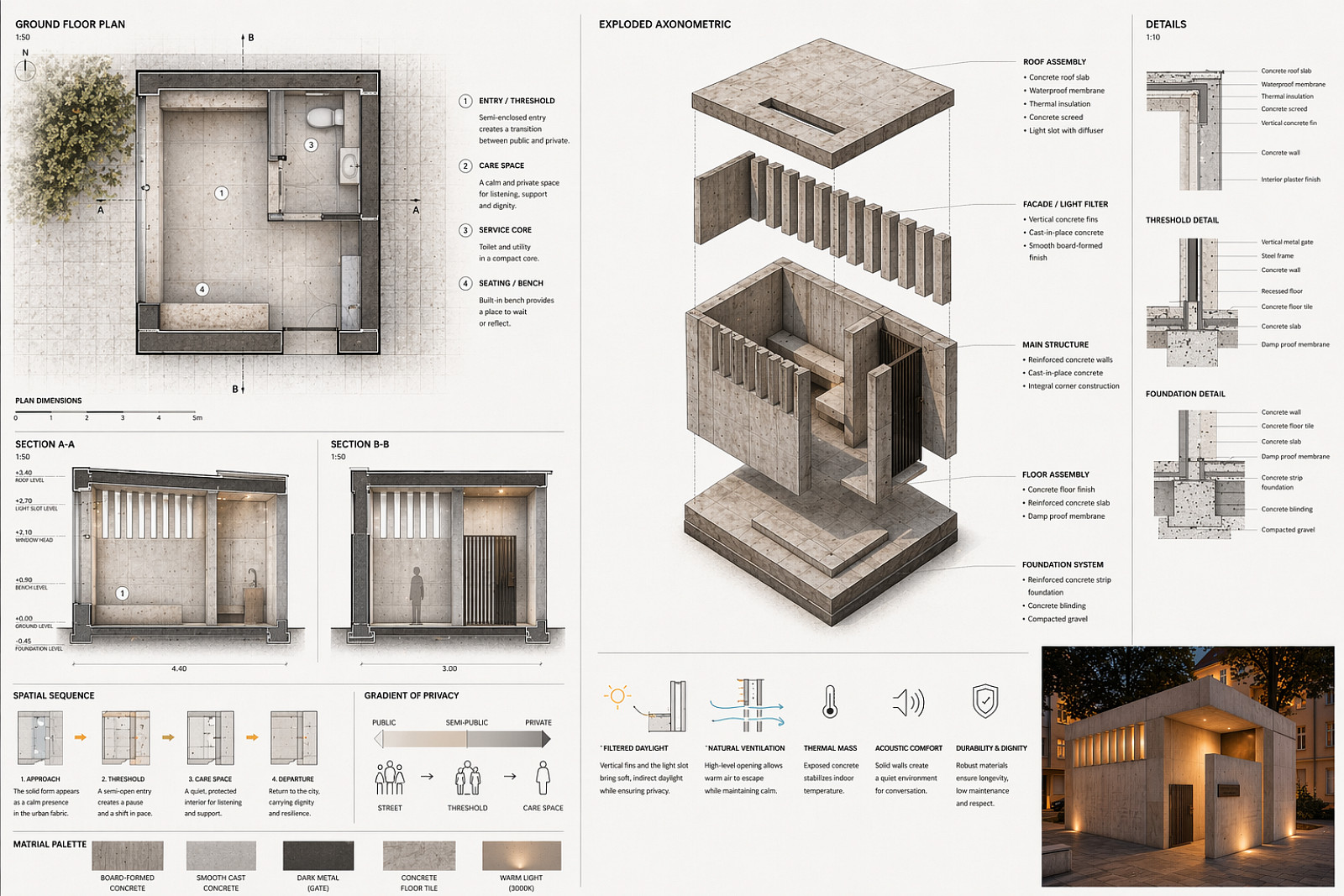

threshold of care


Project idea
Threshold of Care proposes a public toilet not as a hidden technical leftover, but as a civic threshold where the city acknowledges the body with dignity. In most urban environments, public space is designed for movement, visibility, and consumption, yet rarely for the fragile and ordinary needs that allow people to remain there in comfort and safety. The project begins with a simple claim: a truly public city must be able to host life not only in its collective rituals, but also in its most basic and intimate necessities.
Rather than treating the toilet as an embarrassing utility to be concealed, the project repositions it as a small public building of care. Its architecture is organized as a gradual passage from exposure to retreat, from the open city through a protected threshold into a quiet interior that supports bodily care with respect and restraint. The goal of the project is to redefine a basic urban service as an act of civic hospitality.
Project description
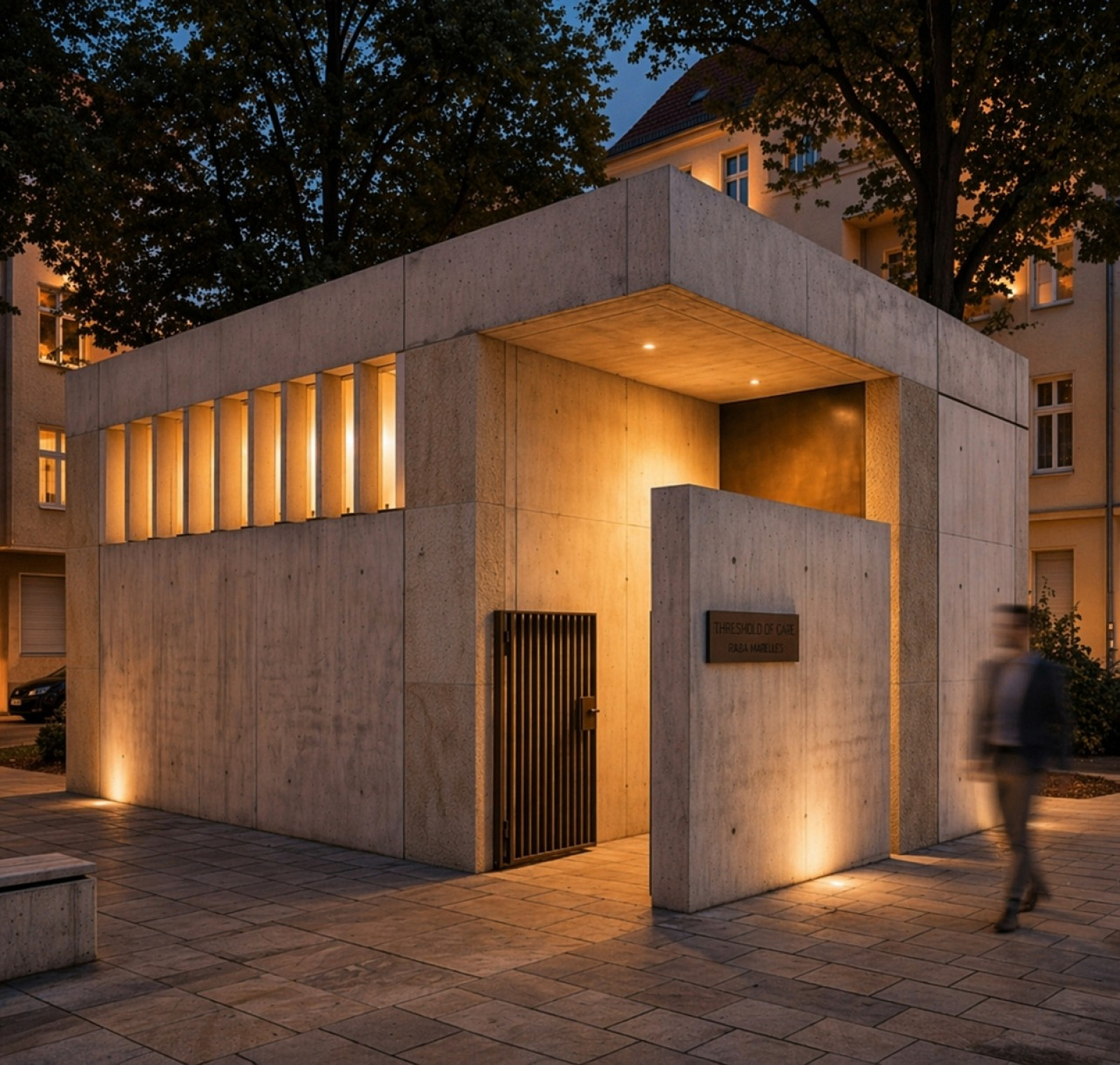
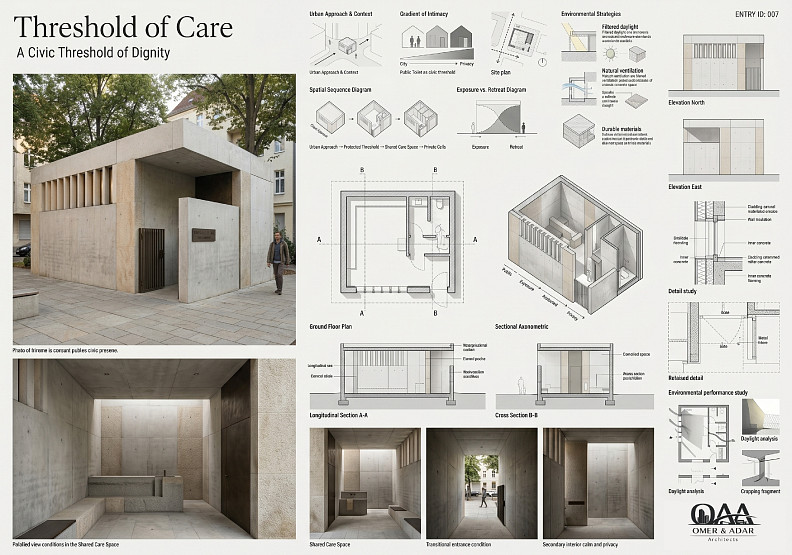
The project is conceived as a compact public building inserted into the urban fabric as a clear and calm civic presence. Its spatial organization is based on a sequence of thresholds that gradually transforms the experience of the user from public exposure to privacy and protection. Rather than entering directly into a service space, visitors pass through a protected architectural transition that slows movement and establishes dignity, orientation, and calm.
At the center of the project is a shared care space that functions as an intermediate civic interior. Around it, more private toilet cells are arranged with clarity and restraint, allowing the building to balance openness and retreat. The architecture relies on mass, enclosure depth, filtered daylight, and controlled views to create a spatial atmosphere that feels protected without becoming oppressive. Privacy is achieved not through concealment alone, but through the careful sequencing of approach, entry, and interior transition.
Threshold of Care therefore proposes a different understanding of public infrastructure. It suggests that the quality of the city is measured not only by how it gathers people, but by how it includes them, protects them, and supports their most ordinary needs. The project is not about monumentality, but about restoring civic value to what is usually overlooked.
Technical information
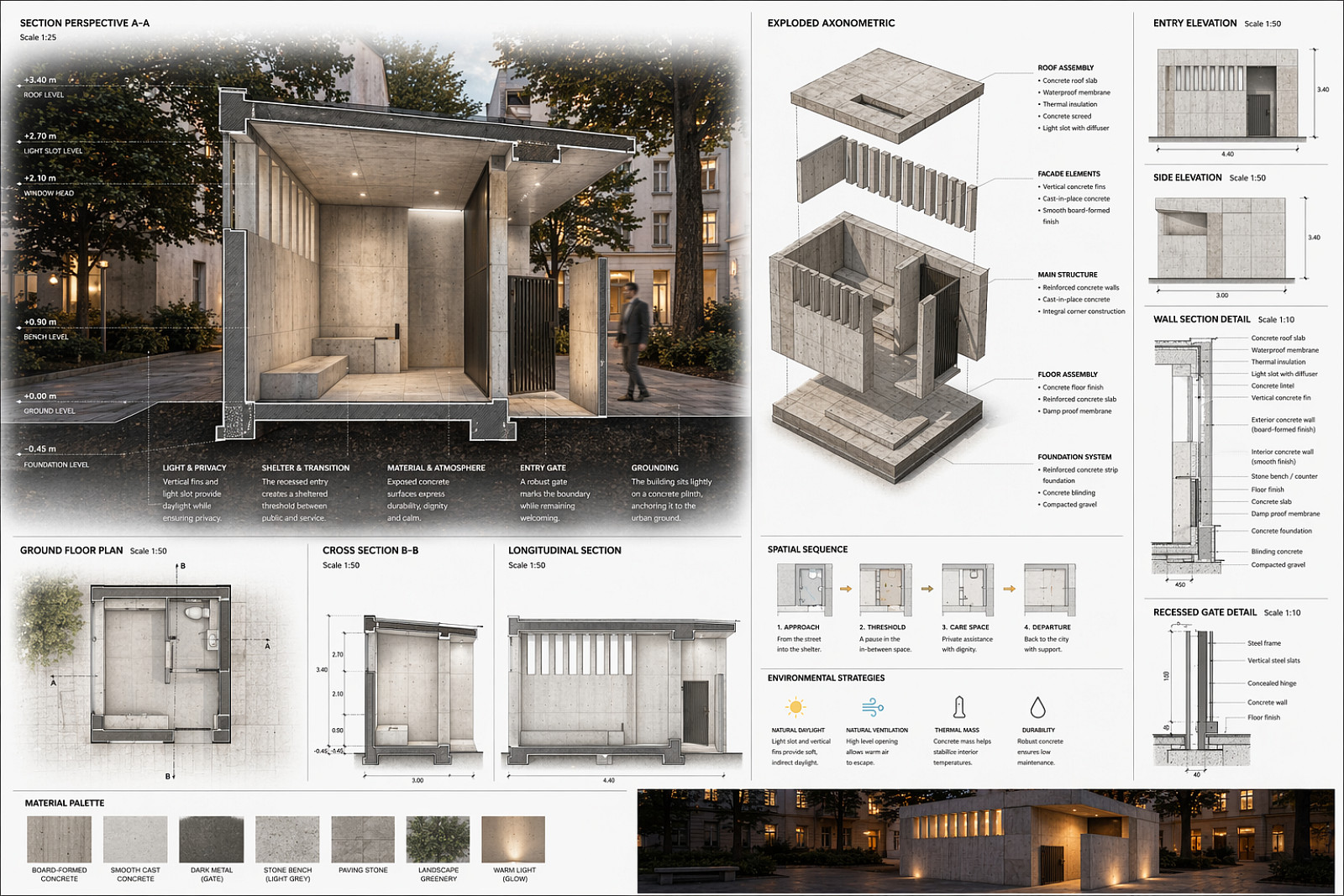
The project is designed as a small freestanding civic structure with a compact footprint, thick walls, and a clearly defined sequence of entry, shared space, and private service areas. The architectural system is based on durable mineral construction that provides robustness, privacy, and long-term public use. Openings are carefully controlled to allow daylight penetration, filtered ventilation, and spatial legibility without compromising intimacy.
Environmental performance is achieved through passive strategies integrated into the section and envelope. Filtered daylight enters through high openings and screened surfaces, reducing glare while supporting a calm interior atmosphere. Natural ventilation is encouraged through controlled air movement across the enclosure. The material strategy emphasizes durable, easy-to-maintain, and vandal-resistant surfaces, combining inner calm with civic permanence. Through its compact massing and precise detailing, the project transforms a technical service into a spatially dignified public building.
Documentation

Copyright © 2026 INSPIRELI | All rights reserved. Use of this website signifies your agreement to the Terms of Use, Privacy Policy, and use of cookies.