
The Line of Waiting


Project idea
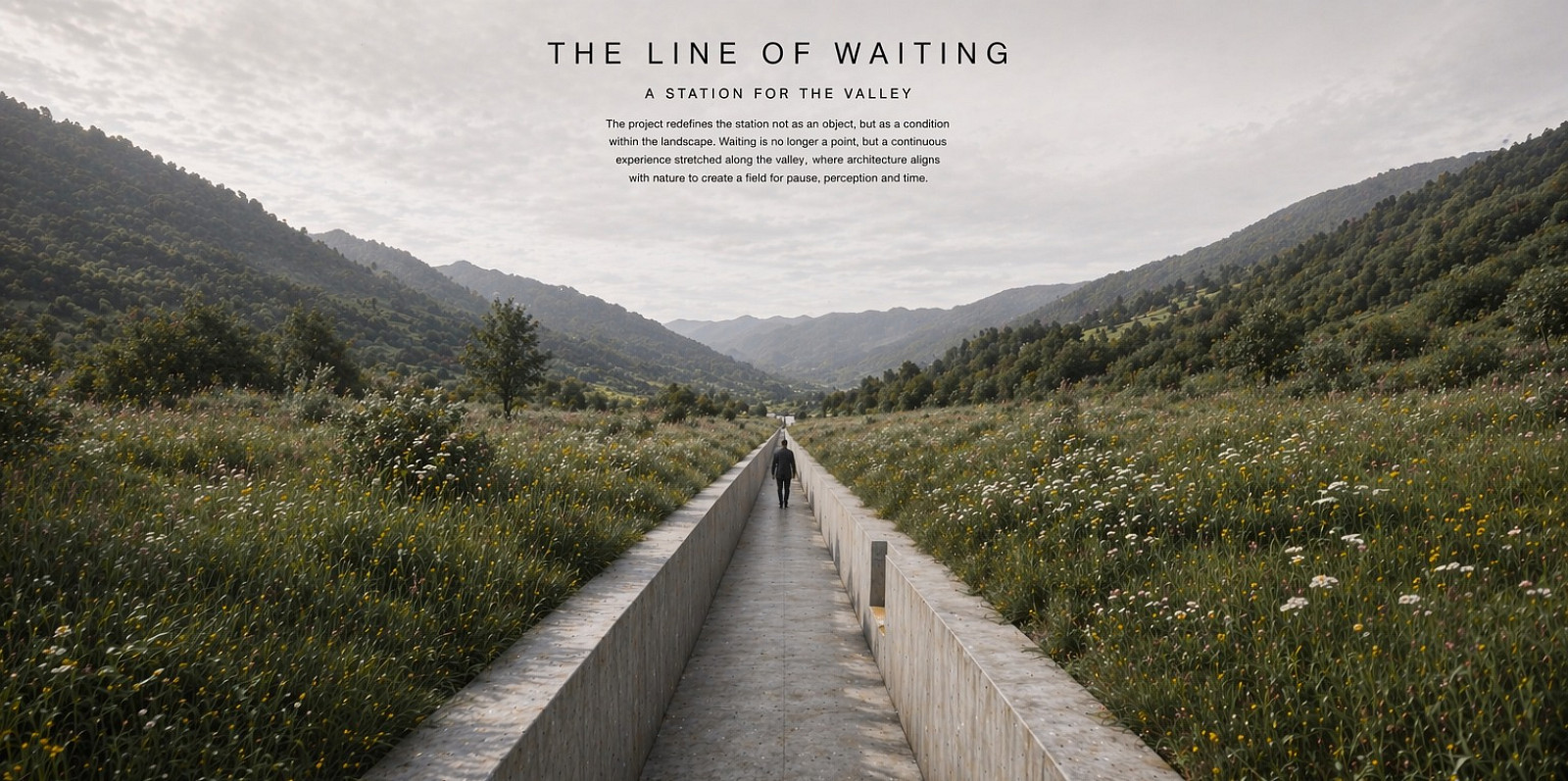
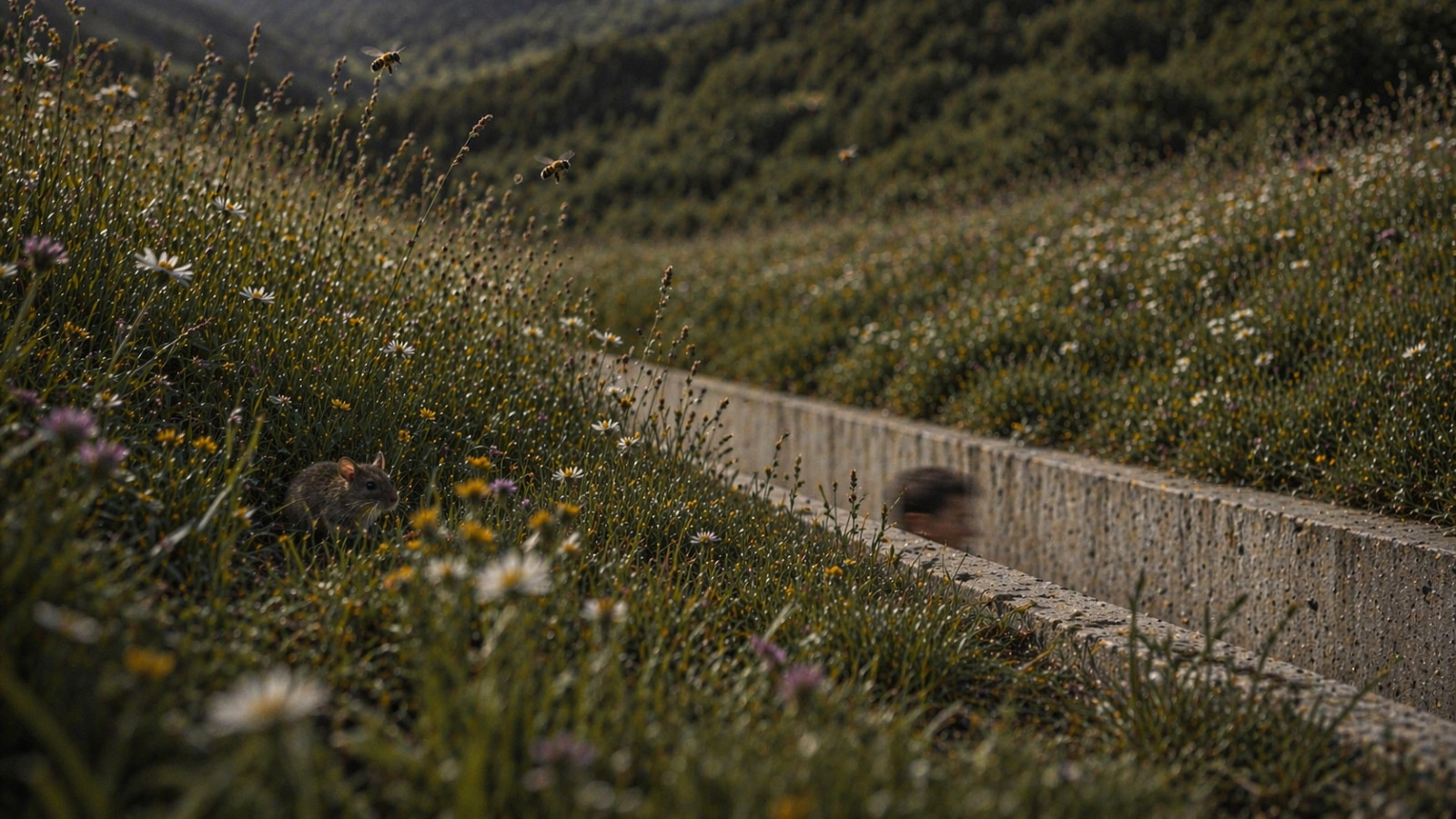
The Line of Waiting redefines the station not as an object, but as a condition inscribed within the landscape. In the valley, where movement is continuous and the horizon is always present, the project refuses to concentrate arrival and pause into a single point. Instead, it unfolds waiting as a linear spatial experience, gently carved into the ground and aligned with the natural contours of the terrain.
The intervention is not placed upon the site, but embedded within it. A narrow incision traces the land, allowing the body to move at the level of the earth, immersed within vegetation and framed by the immediate surroundings. The goal of the project is to transform waiting from an imposed interruption into a spatial field of perception, where time is experienced through movement, proximity, and the changing relationship between body and ground.
Project description
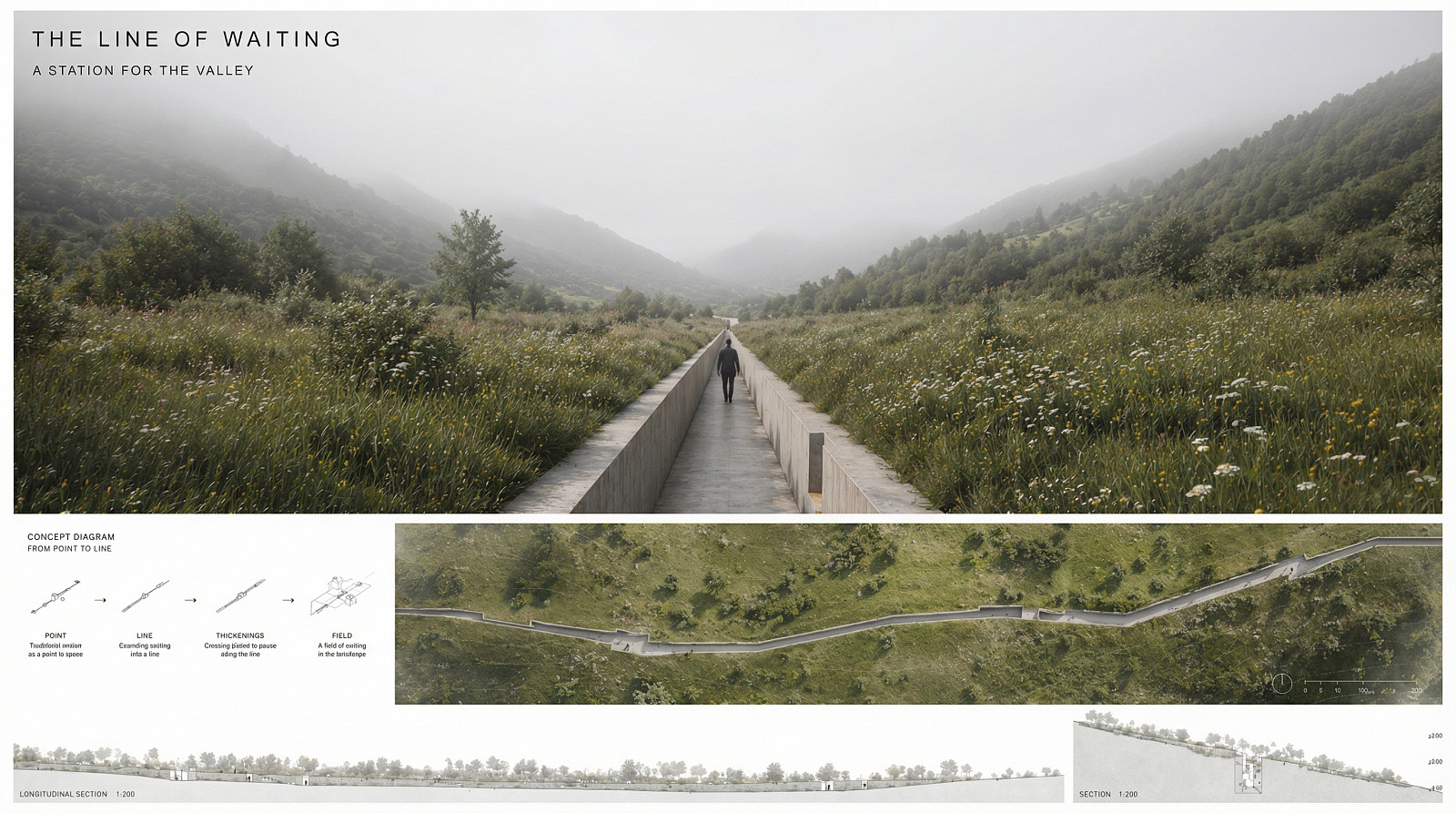
The project is conceived as a continuous linear intervention running through the valley landscape. Rather than creating a conventional station building with a defined center, the architecture takes the form of a sunken path inscribed into the site. This path allows movement, pause, and occupation to occur along its entire length, turning waiting into a dispersed and personal experience rather than a centralized one.
The architectural gesture is minimal but precise. A narrow cut in the ground creates a protected spatial condition in which the user moves at the level of the earth, surrounded by meadow planting and framed views. The horizon is not immediately given as a panoramic image, but revealed gradually through movement and subtle openings. Moments of pause emerge through slight widenings, integrated seating, and small spatial variations that allow the body to momentarily align with the landscape.
The Line of Waiting therefore transforms infrastructure into perception. It does not frame nature from a distance, but situates the observer within it. The project proposes a station as a field of time, slowness, and attentiveness, where architecture withdraws enough for the landscape to remain dominant while still creating a clear and meaningful experience of waiting.
Technical information
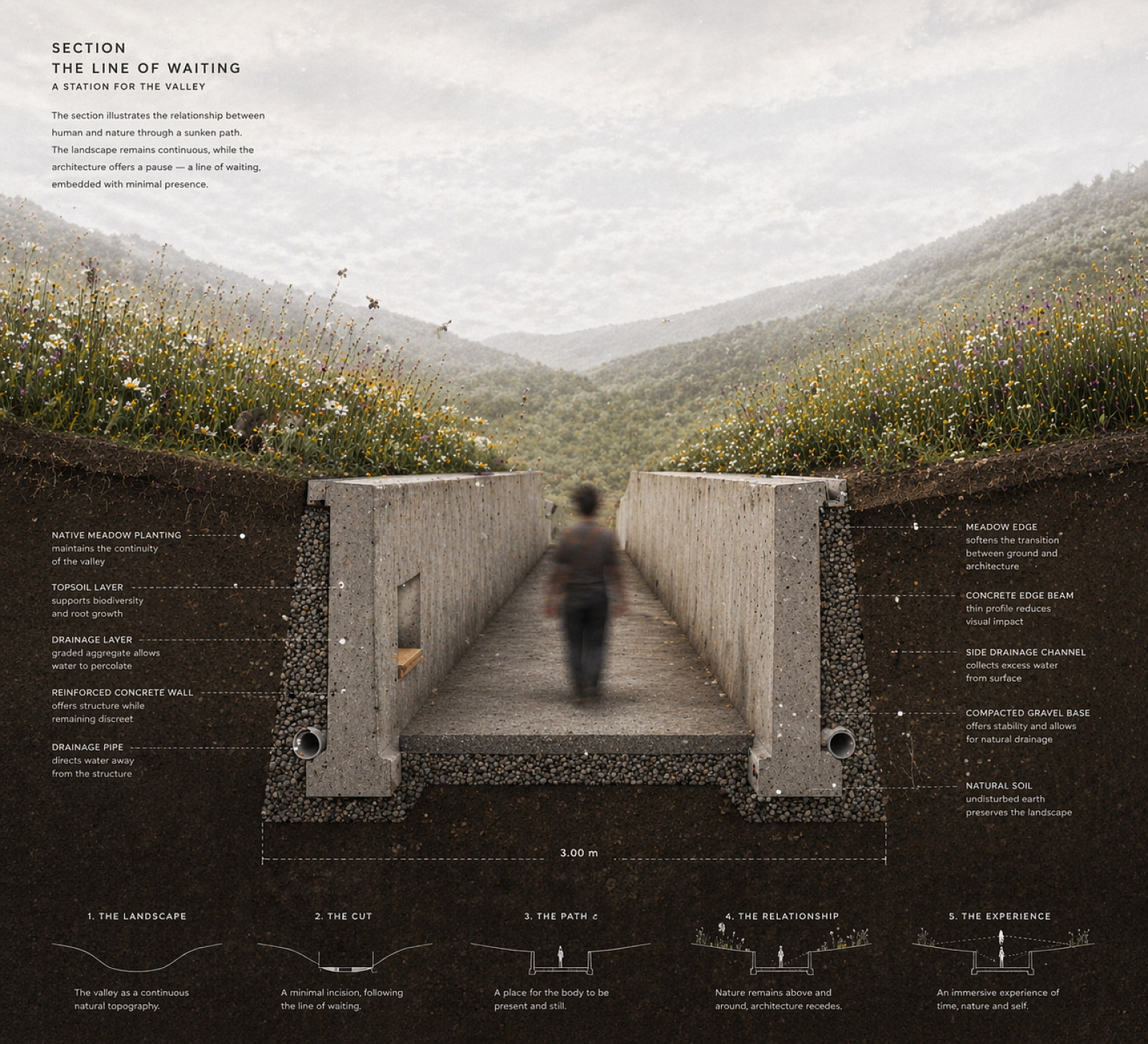
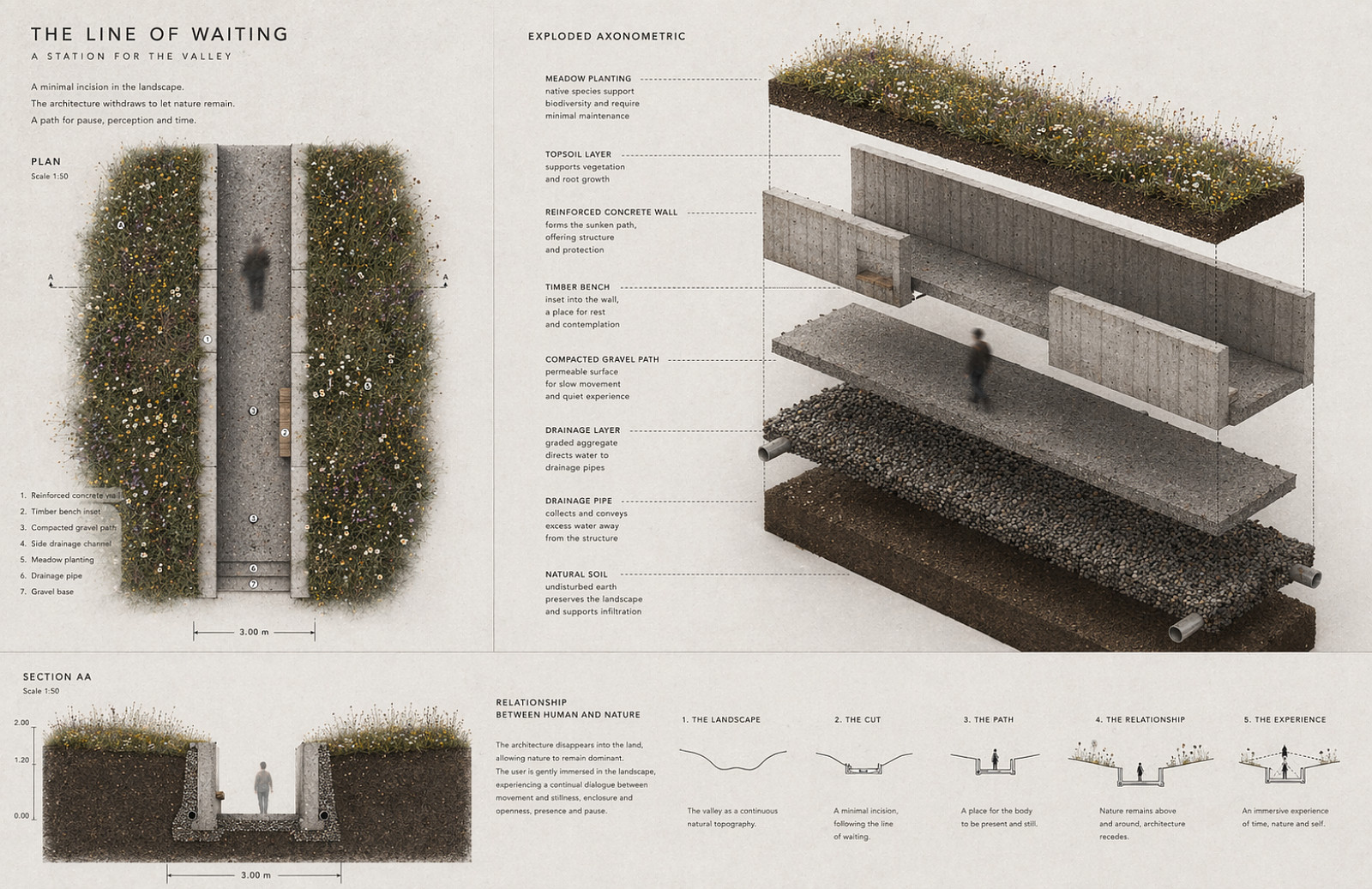
The project is designed as a minimal earth-integrated concrete intervention composed of a sunken linear path, retaining walls, integrated seating elements, drainage layers, and meadow restoration above and around the cut. The architectural system allows the landscape to remain continuous at the upper level while creating a protected spatial condition below. Its construction is based on durable reinforced concrete walls, compacted gravel walking surfaces, drainage pipes, and simple timber inserts for seating and moments of pause.
Environmental performance relies on integration with the terrain rather than formal enclosure. The sunken section reduces visual impact and wind exposure while allowing the user to remain immersed in the landscape. Native meadow planting restores continuity above the structure, supports biodiversity, and minimizes maintenance. Drainage layers and side channels direct water away from the path, ensuring long-term stability and permeability. The project combines infrastructural clarity with landscape sensitivity, creating an architecture that is quiet, robust, and deeply embedded in the site.

Copyright © 2026 INSPIRELI | All rights reserved. Use of this website signifies your agreement to the Terms of Use, Privacy Policy, and use of cookies.
