
MIERES AV — A Station for the Valley


Project idea
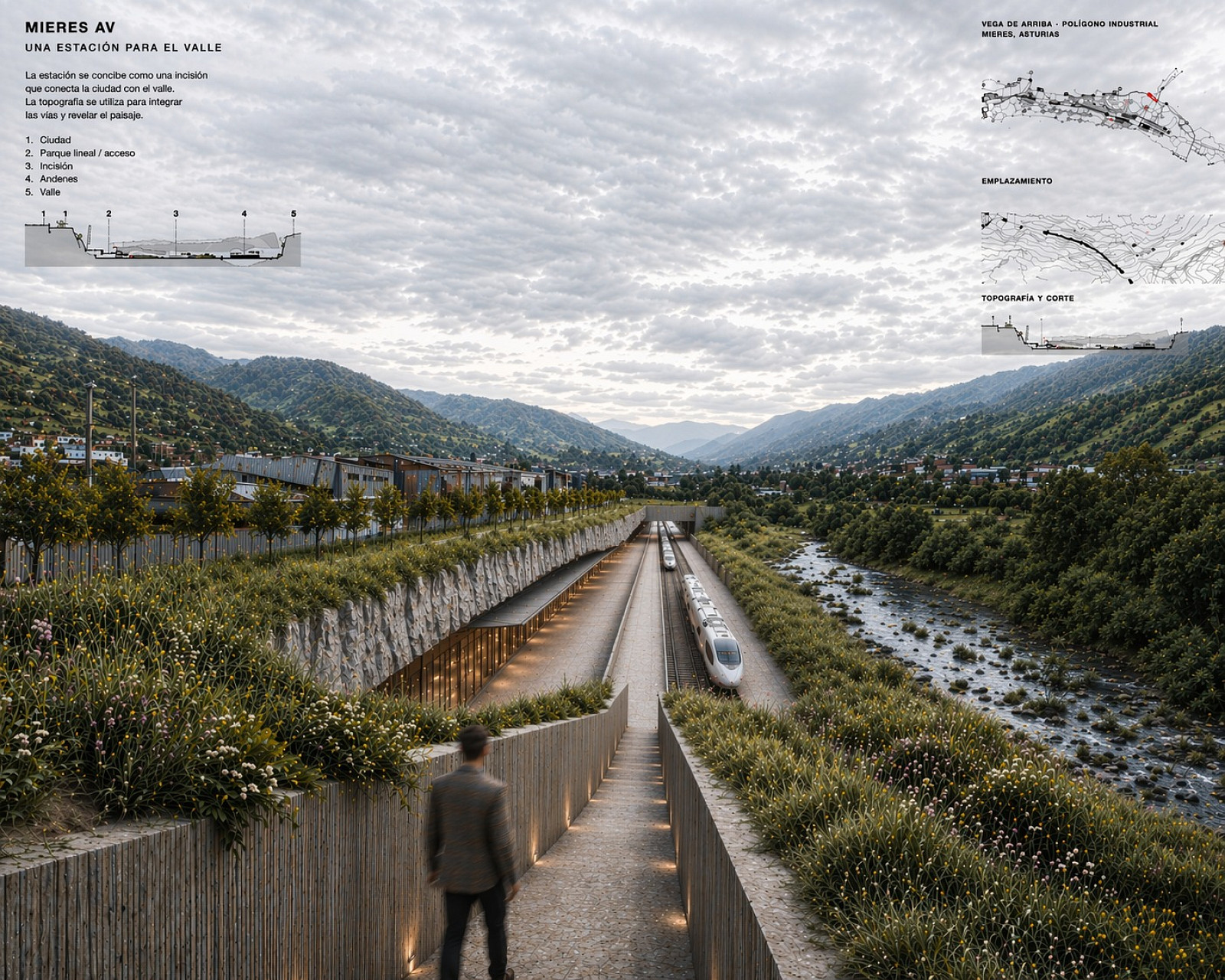
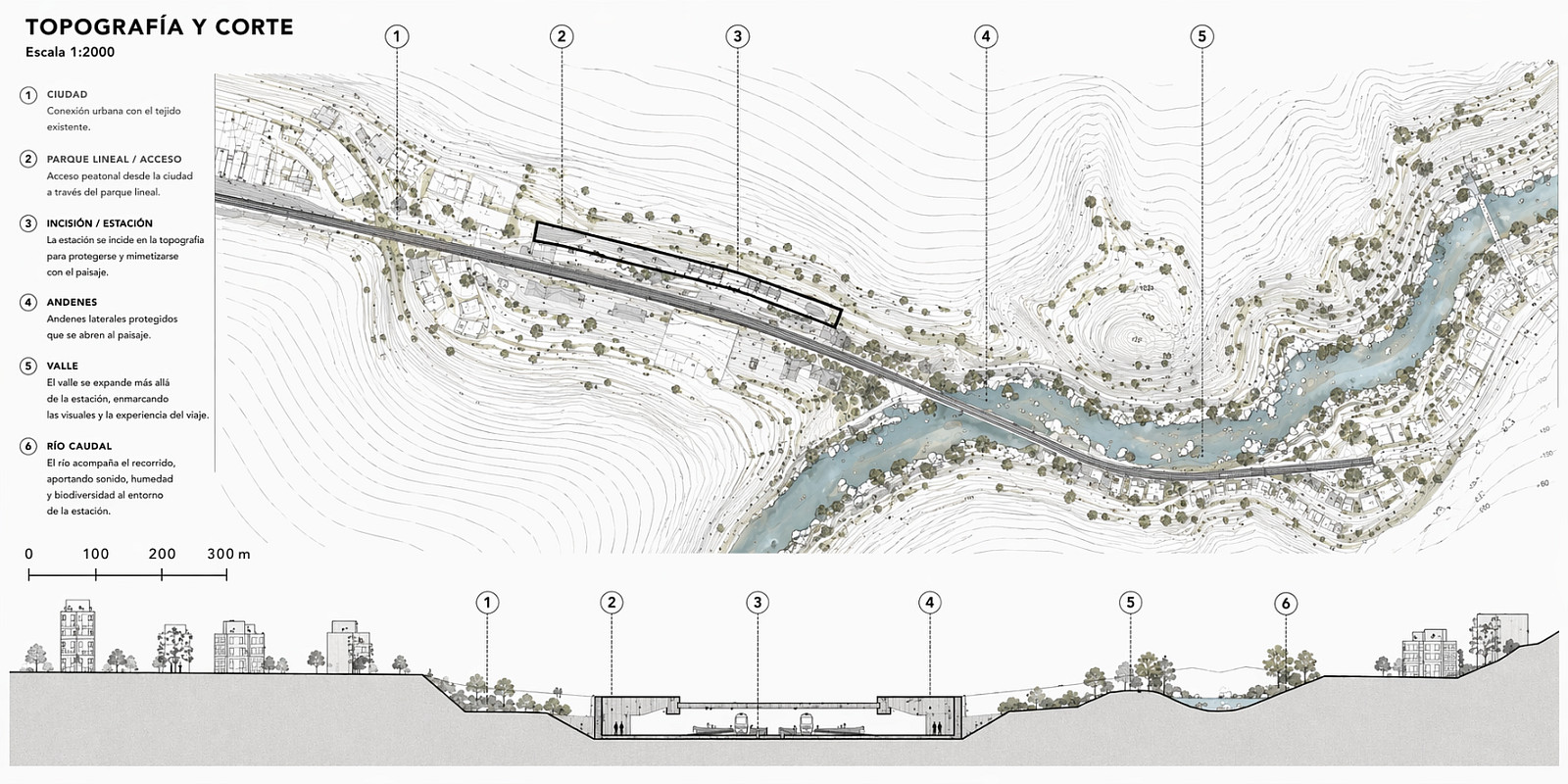
MIERES AV redefines the railway station not as an object placed within the landscape, but as an incision that reveals it. Instead of constructing a building, the project works with the existing topography, carving into the ground to create a spatial condition that connects the city to the river valley through movement, section, and continuity.
The station is conceived as a linear cut in the terrain. It is not perceived all at once, but gradually experienced through descent. As the ground deepens, the horizon shifts, and the landscape moves from distant scenery to immediate presence. The goal of the project is to transform the station from an isolated infrastructural object into a threshold between city and valley, movement and pause, architecture and landscape.
Project description
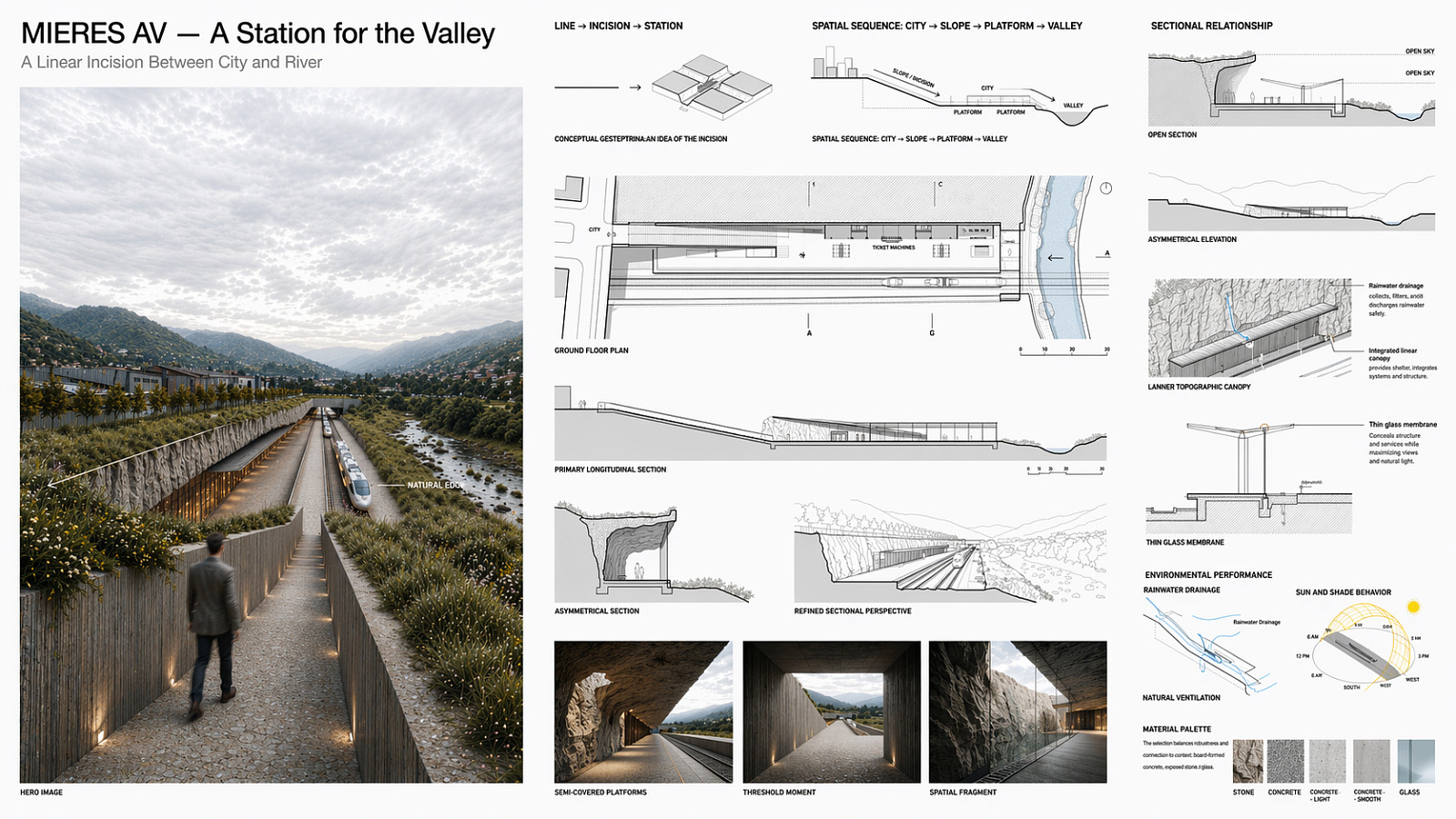
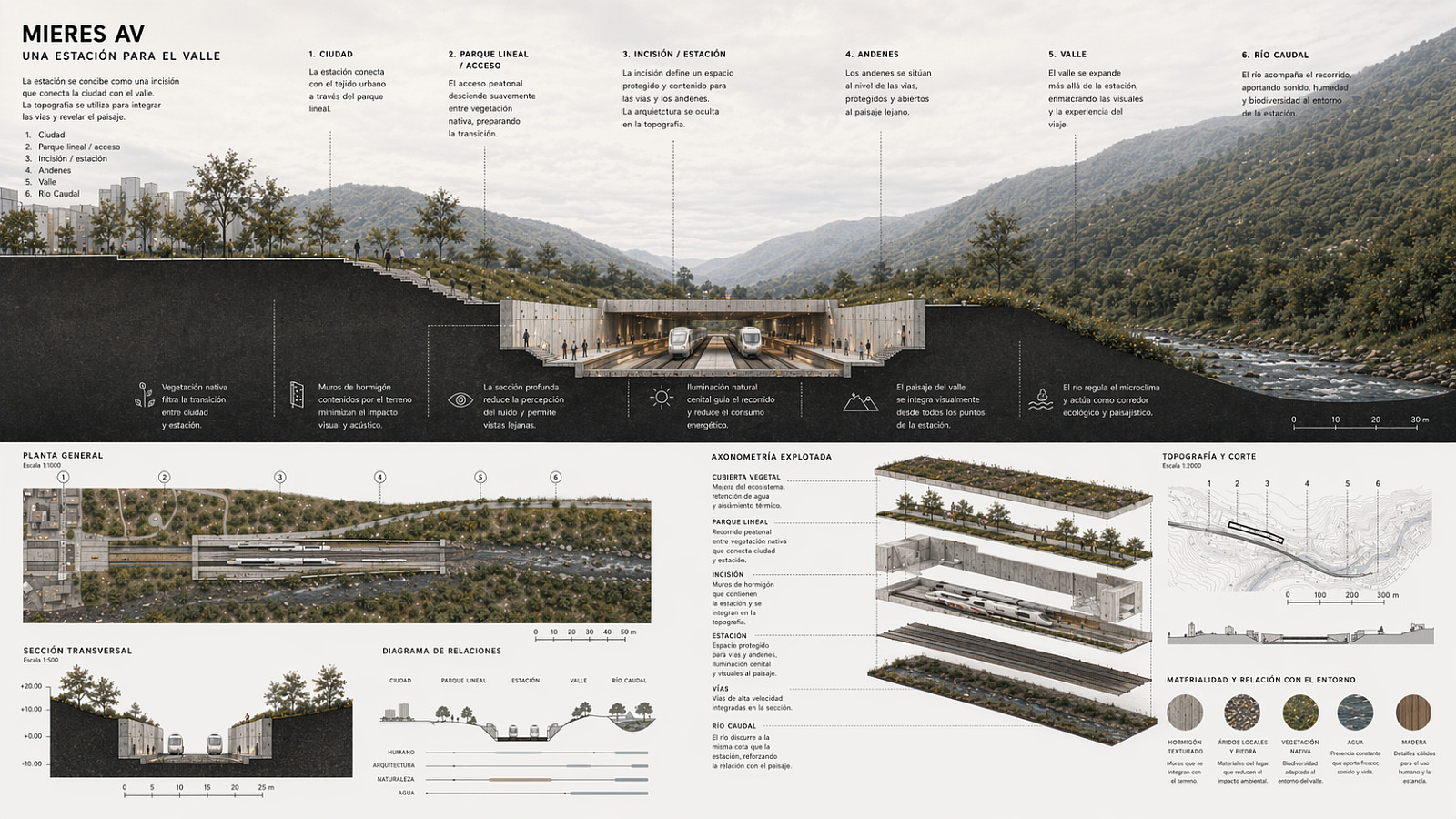
The project is organized as a linear intervention embedded within the topography of the valley. Rather than placing a conventional station building on the site, the proposal carves a protected section into the ground, allowing the architecture to emerge through subtraction rather than addition. The approach begins within the urban fabric and gradually descends toward the railway level, turning access into a spatial sequence in which the body, the horizon, and the ground are continuously recalibrated.
The architectural logic is defined by asymmetry. On one side, the terrain is excavated to form a thickened edge that provides shelter, thermal mass, and spatial protection. On the other side, the section opens toward the river valley, where landscape, vegetation, and water remain visually and spatially continuous with the platform. Between these two conditions lies the station itself: a linear, open, and exposed space in which waiting becomes part of a broader experience of movement through the site.
A minimal glass membrane defines the edge between platform and rail without interrupting the visual continuity of the landscape. The station therefore does not separate infrastructure from nature, but situates them within the same field. MIERES AV proposes a railway station as a condition of passage and perception, where architecture acts not as a dominant object, but as a precise transformation of ground, section, and atmosphere.
Technical information
The project is designed as an earth-integrated railway station formed through excavation, retaining walls, platform construction, linear canopies, and minimal enclosure elements. Its primary architectural system is based on carved topography, reinforced concrete retaining structures, integrated circulation paths, and a lightweight glass safety membrane along the rail edge. By embedding the station within the terrain, the project reduces visual impact while using the mass of the ground as a source of shelter, shading, and climatic stability.
Environmental performance is inherent to the geometry of the section. Rainwater is collected and guided along the incision toward the river through integrated drainage channels. The open section allows natural ventilation and reduces the need for mechanical climate control. Passive shading is achieved through depth, orientation, and the carved edge of the terrain, creating a microclimate shaped by mass and topography rather than by added technical devices. Materiality combines exposed concrete, stone, gravel, glass, native vegetation, and water, establishing a direct relationship between infrastructure and the natural character of the valley.

Copyright © 2026 INSPIRELI | All rights reserved. Use of this website signifies your agreement to the Terms of Use, Privacy Policy, and use of cookies.