THERMAL COMMONS


Project idea
THERMAL COMMONS begins from a simple urban fact: many public spaces are not empty because they are unnecessary, but because they are uninhabitable. In overheated cities, exposure dissolves public life before any lack of program does. The project responds by treating shade as the first act of civic architecture and comfort as a civic right.
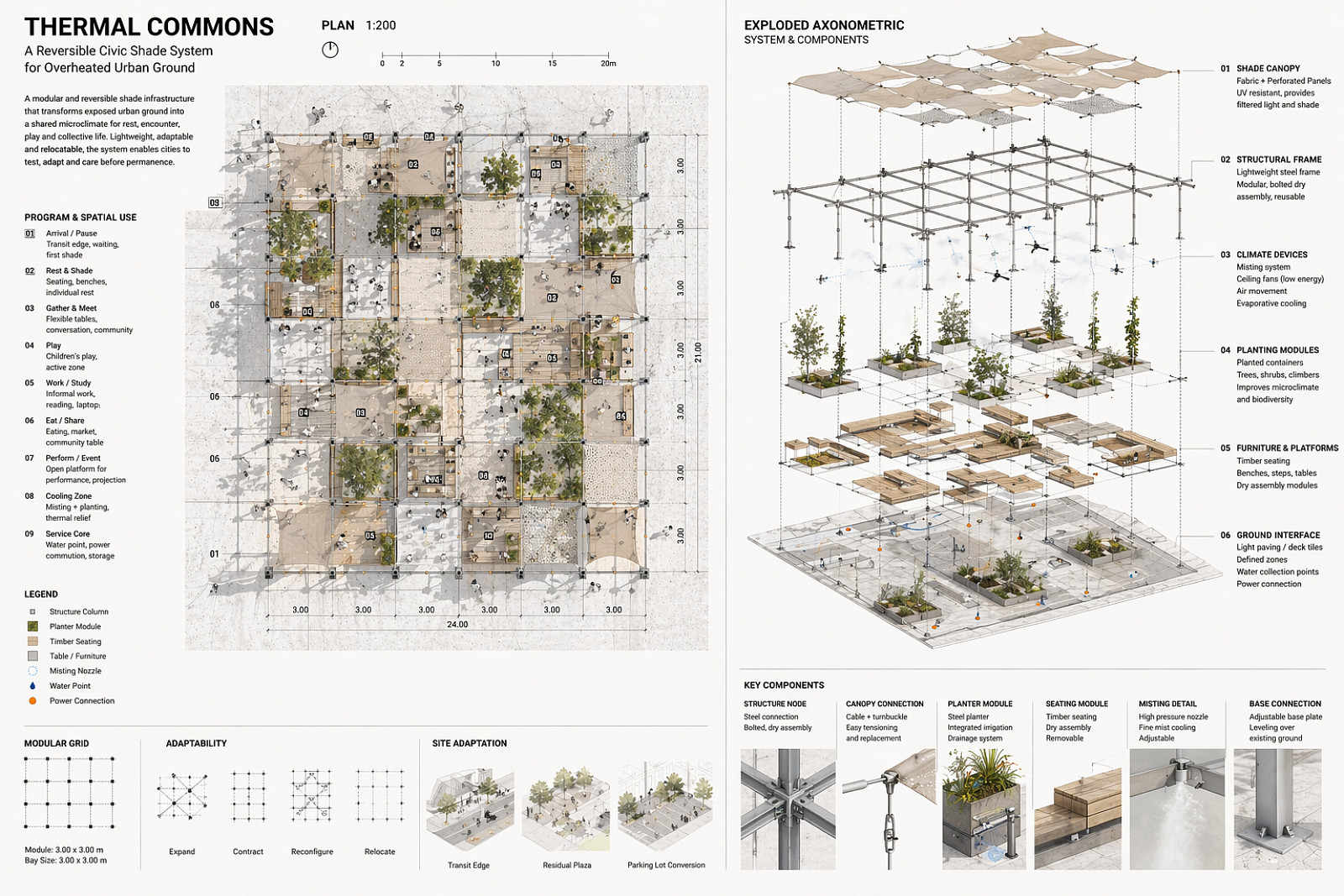
Rather than proposing a fixed building, the project introduces a reversible civic shade system that transforms hard residual urban ground into a shared microclimate for rest, encounter, play, exchange, and collective presence. A lightweight open framework of canopy, climate devices, planting, seating, and communal platforms can be assembled, adapted, expanded, and relocated over time. The goal of the project is to redefine temporary architecture as a tool of care and to create an infrastructure of belonging before permanence arrives.
Project description
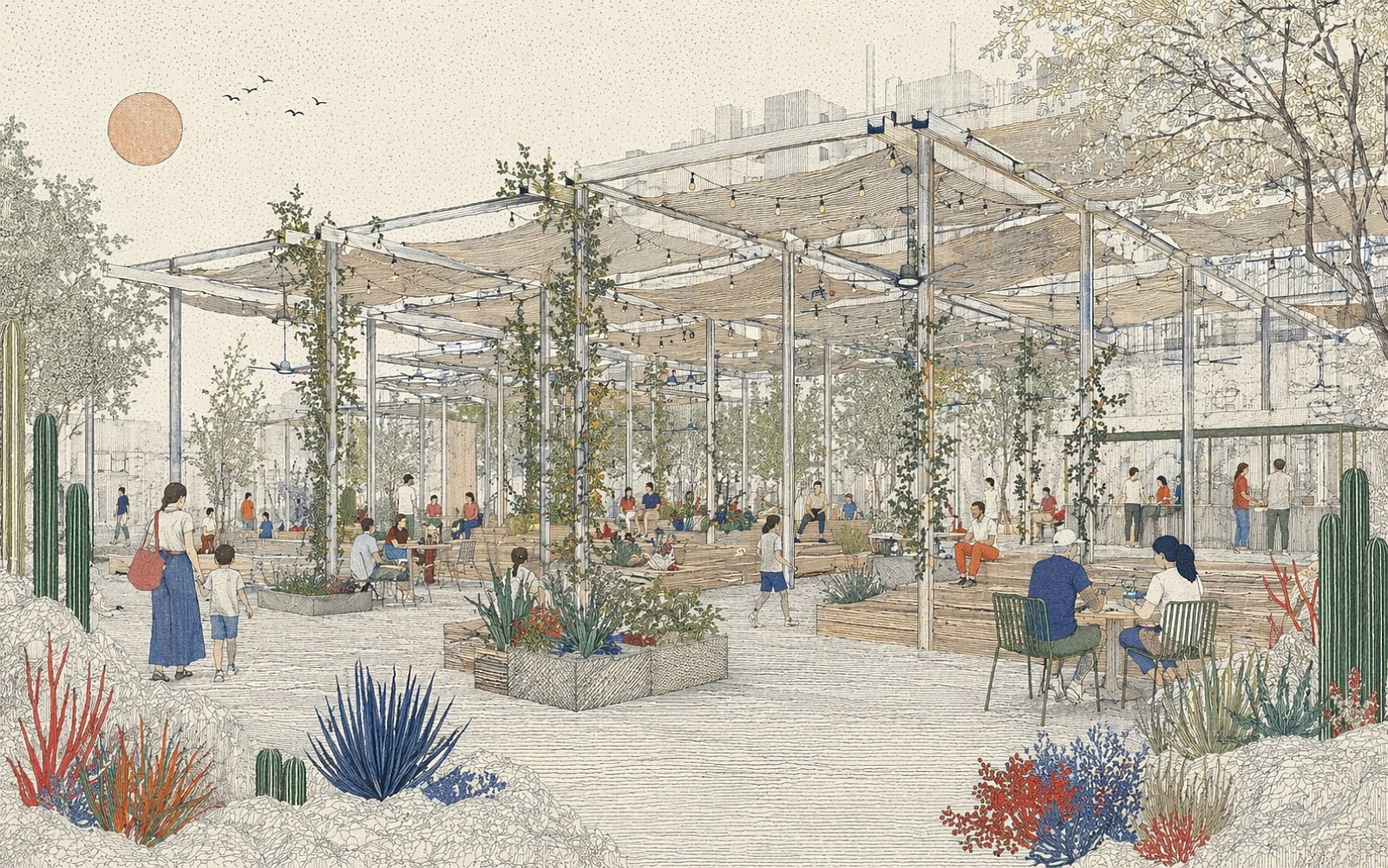
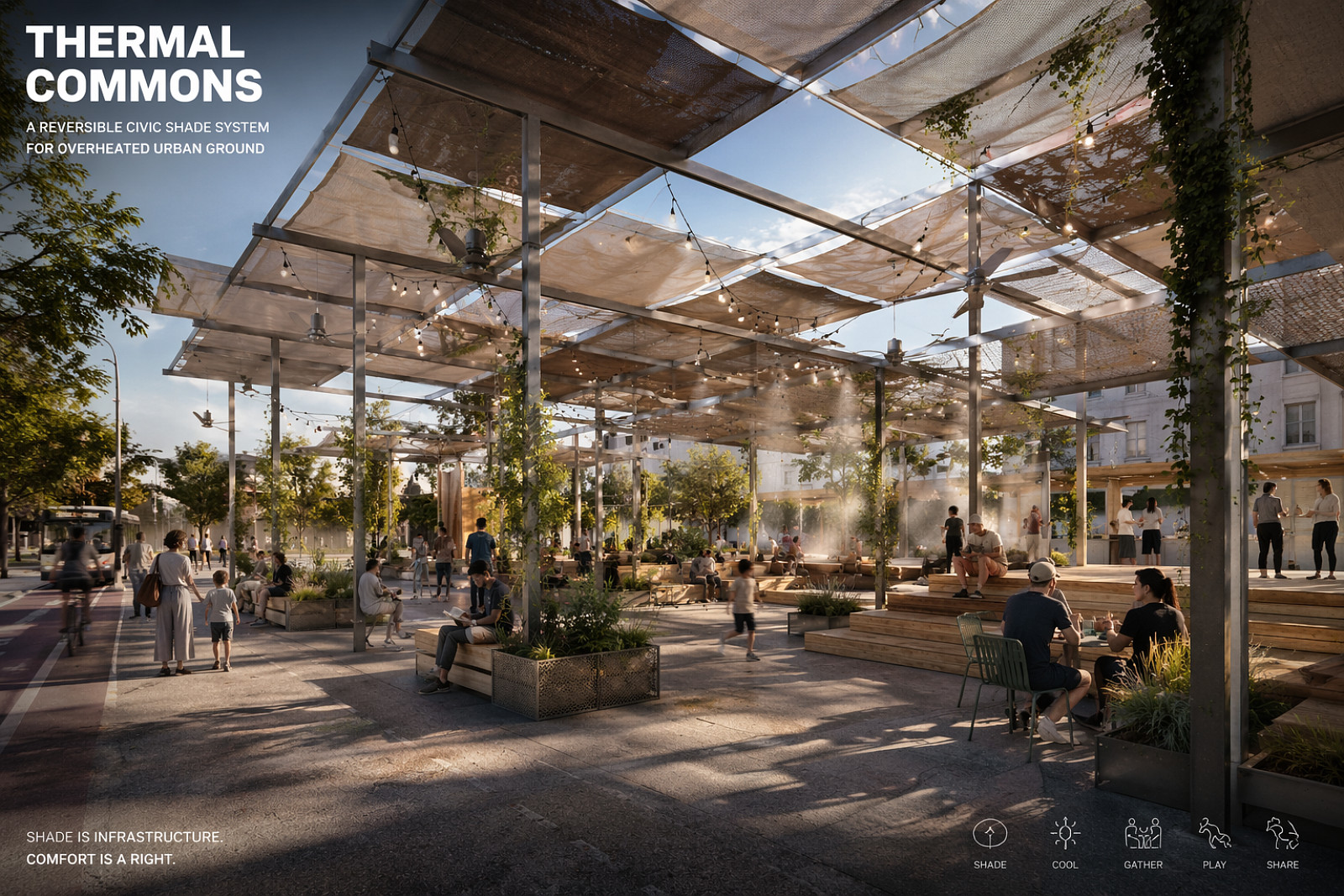
The project is organized as a modular open system positioned on exposed urban ground. Instead of occupying the site with a closed object, THERMAL COMMONS establishes a lightweight field of structure, shade, planting, seating, and shared platforms that can accommodate multiple forms of public life. Arrival, pause, gathering, play, eating, learning, and informal events are distributed across the system without rigid separation, allowing the space to remain open, flexible, and inclusive.
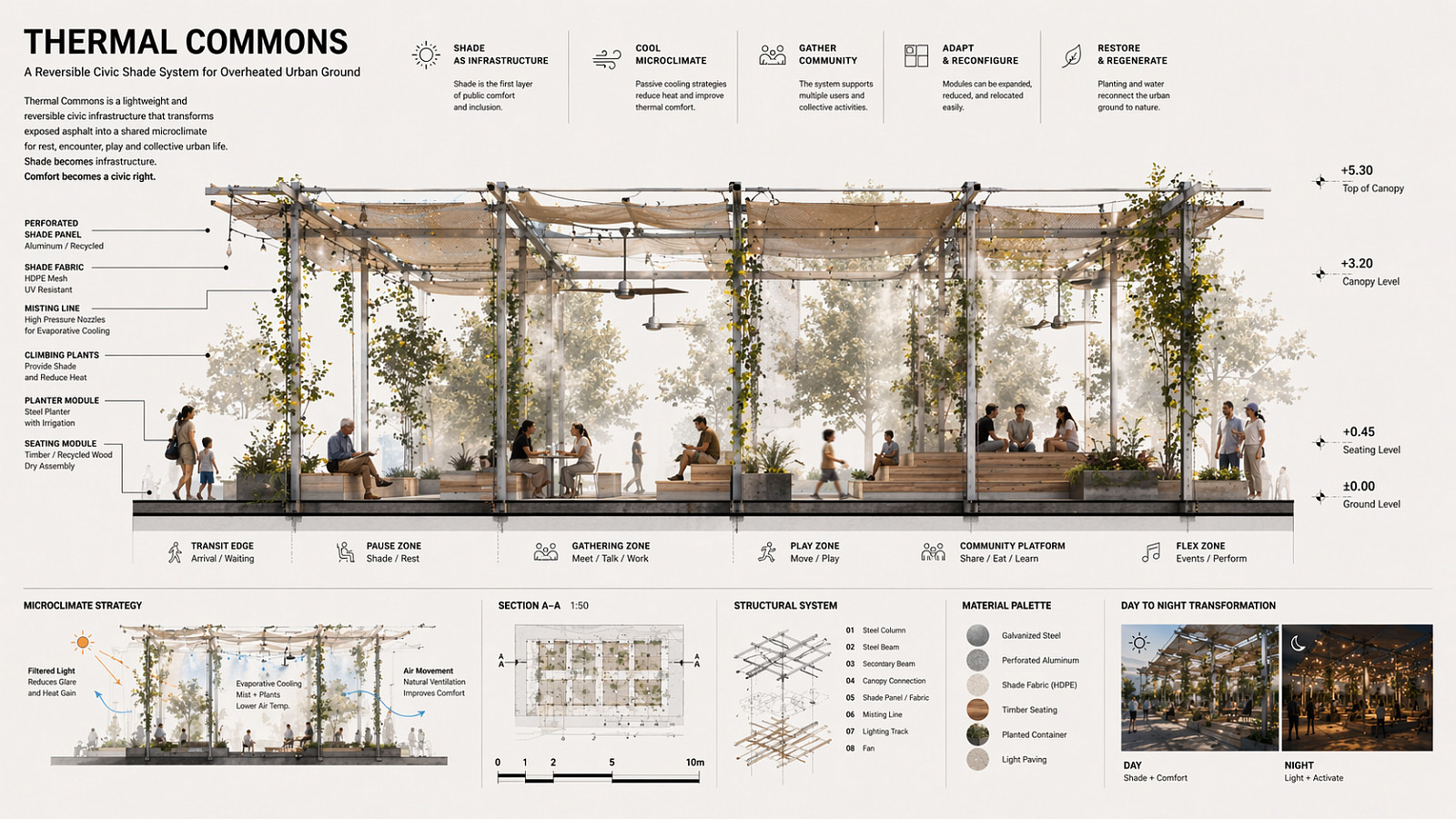
At the core of the project is the canopy. It acts simultaneously as environmental protection and social framework. By filtering sunlight, reducing heat gain, and enabling air movement, it creates a more habitable microclimate beneath it. At the same time, it defines a collective urban room without enclosing it. Beneath this elevated shade layer, smaller elements such as planting beds, misting devices, communal seating, and flexible platforms support different intensities of use and allow the space to evolve throughout the day.
THERMAL COMMONS therefore proposes public architecture as a reversible urban protocol rather than a finished monument. It enables cities to test how neglected or overheated sites can become places of belonging before long-term construction, budget, or bureaucracy arrive. Temporary architecture here is not a placeholder, but an active civic instrument that transforms exposed ground into shared life.
Technical information
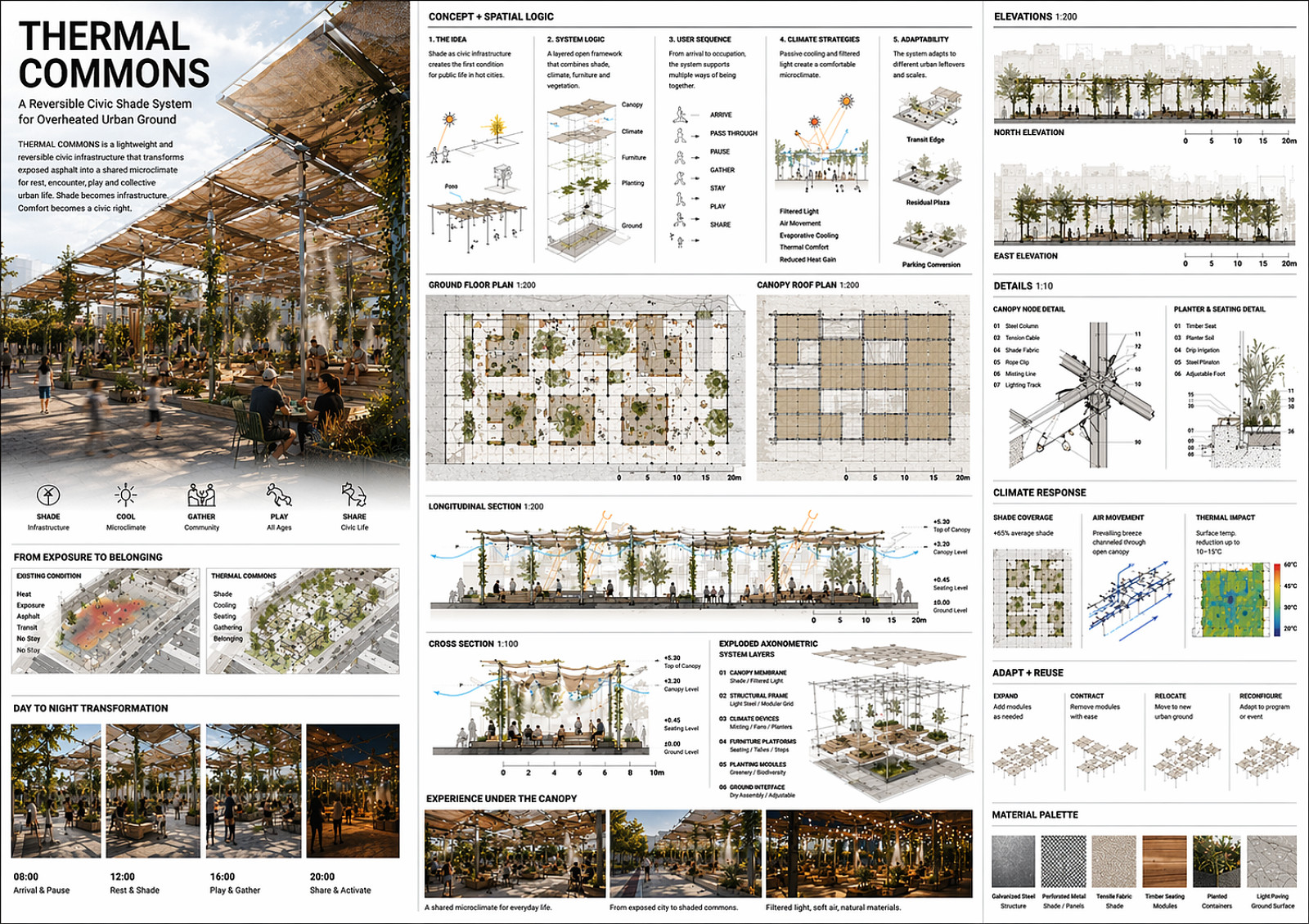
The project is designed as a lightweight modular civic system composed of a steel frame canopy, shade membranes, planting modules, seating platforms, misting devices, lighting tracks, and simple dry-assembly ground interfaces. Its structural logic is based on a repeatable grid that allows the system to expand, contract, reconfigure, relocate, and adapt to different urban leftovers such as transit edges, parking conversions, residual plazas, and underused paved sites.
Environmental performance is achieved through passive and low-energy climate strategies. Filtered shade reduces direct solar gain, open canopy geometry supports natural ventilation, and evaporative cooling through misting and planting lowers perceived temperature. Planters, climbers, and soft landscape inserts improve biodiversity and reconnect hard urban ground to ecological processes. Materials emphasize durability, reversibility, and ease of maintenance, combining galvanized steel, perforated metal, tensile shade fabric, timber seating, and planted containers. In this way, the project creates a robust yet adaptable infrastructure for everyday public comfort.

Copyright © 2026 INSPIRELI | All rights reserved. Use of this website signifies your agreement to the Terms of Use, Privacy Policy, and use of cookies.
