
THRESHOLDS OF LIFE


Project idea
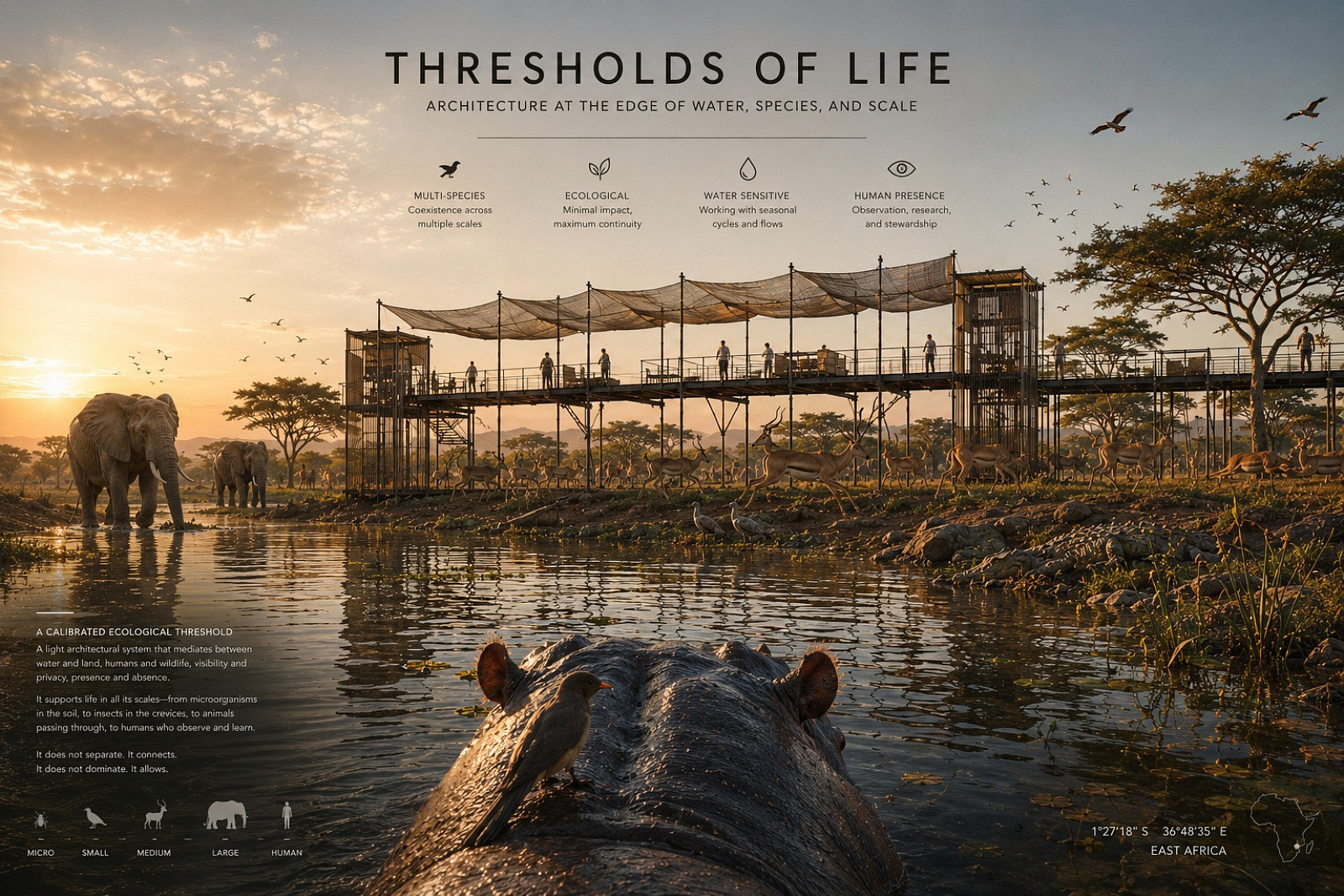
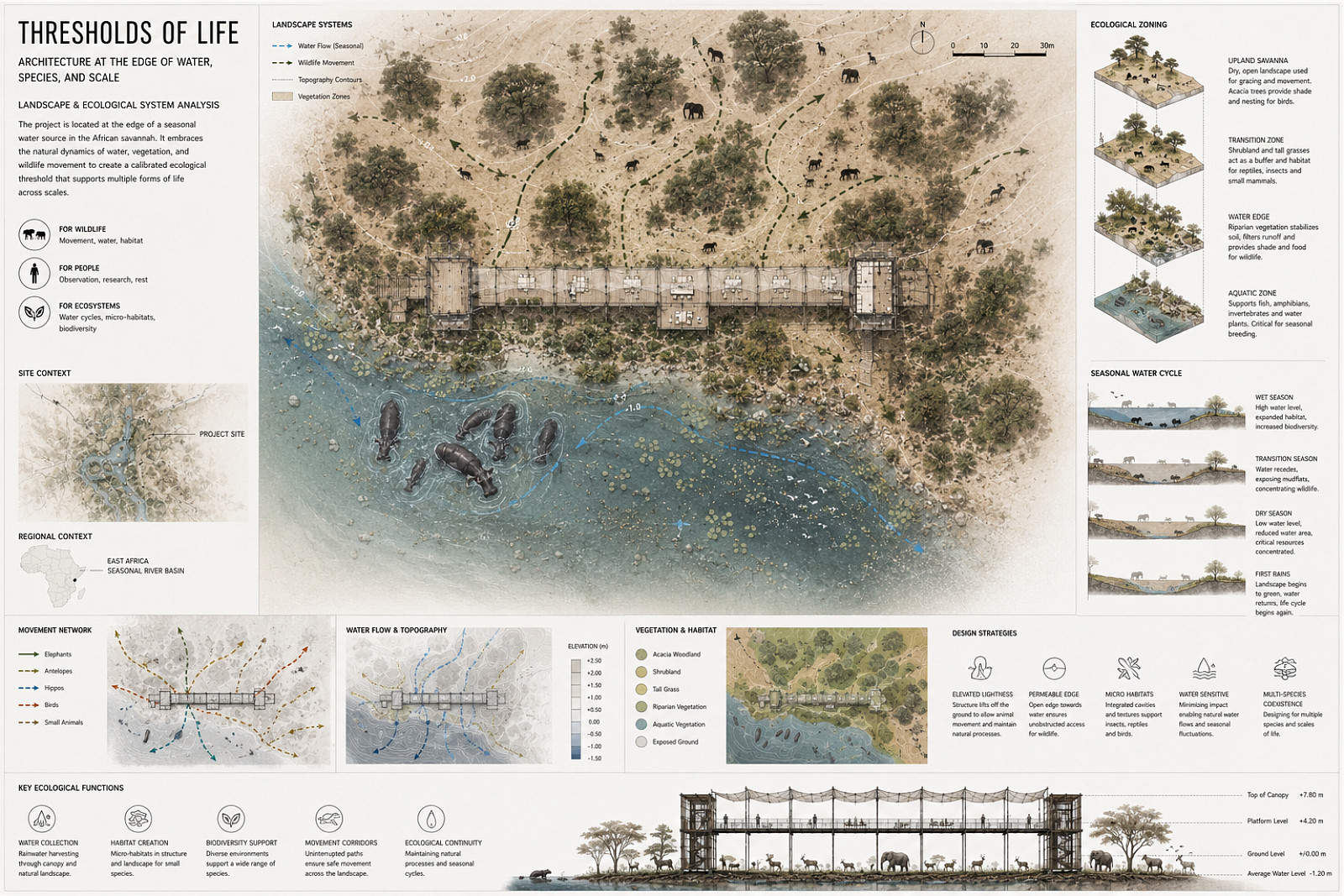
THRESHOLDS OF LIFE begins from the understanding that water is not a fixed place, but an event. It appears, disappears, expands, and contracts, continuously reorganizing life around it. At its edge, territories dissolve and reassemble, paths are remembered, and different species gather in shifting cycles of occupation. The project starts from this condition and asks how architecture can enter such a site without fixing what should remain dynamic.
Rather than defining space through control and separation, the proposal calibrates relationships between water, terrain, species, and human presence. It introduces a light architectural layer for observation, research, and temporary stay, while preserving the continuity of the ground and integrating micro-habitats within the building itself. The goal of the project is to propose an architecture of coexistence, where the most responsible act of design is not domination, but allowance.
Project description
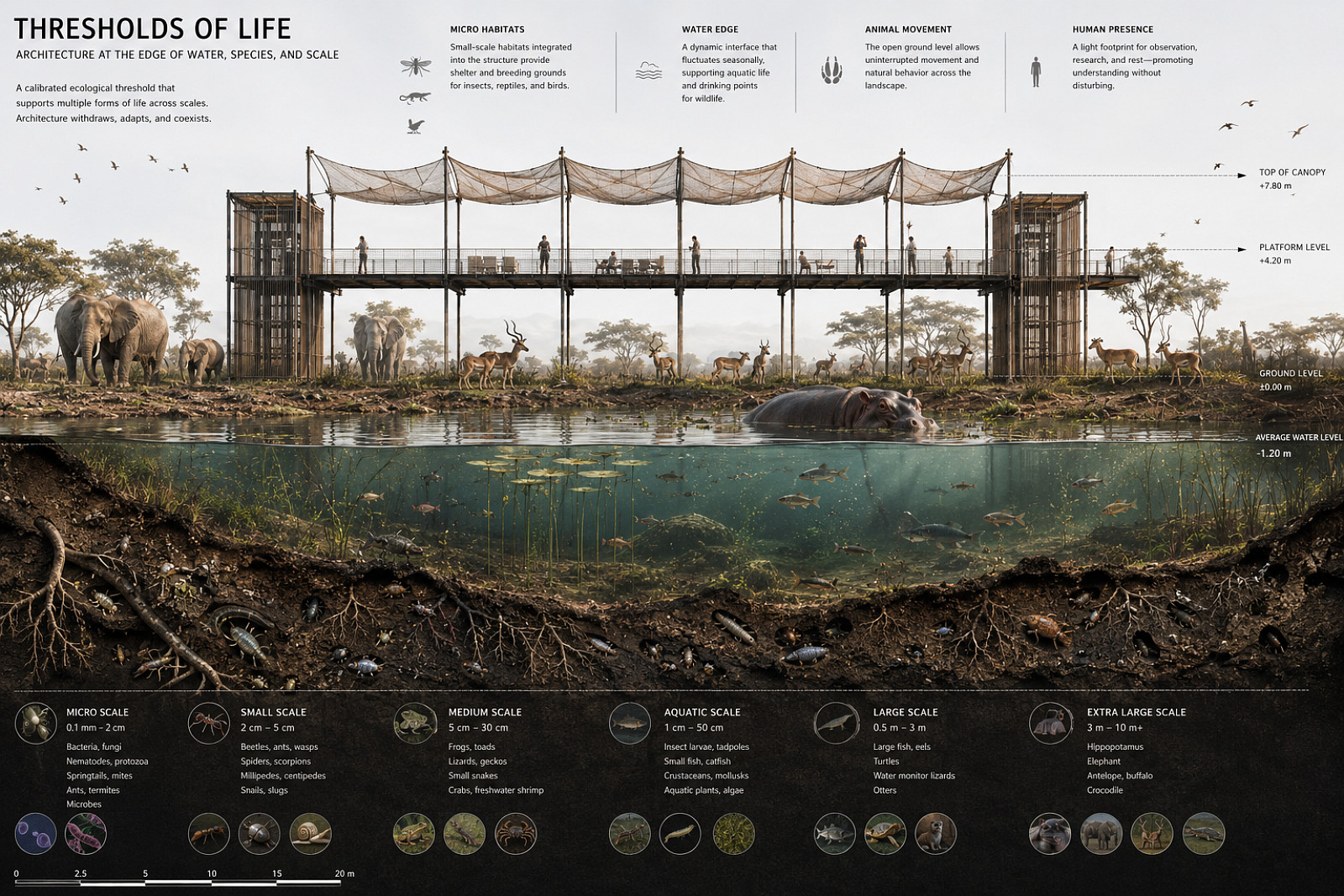
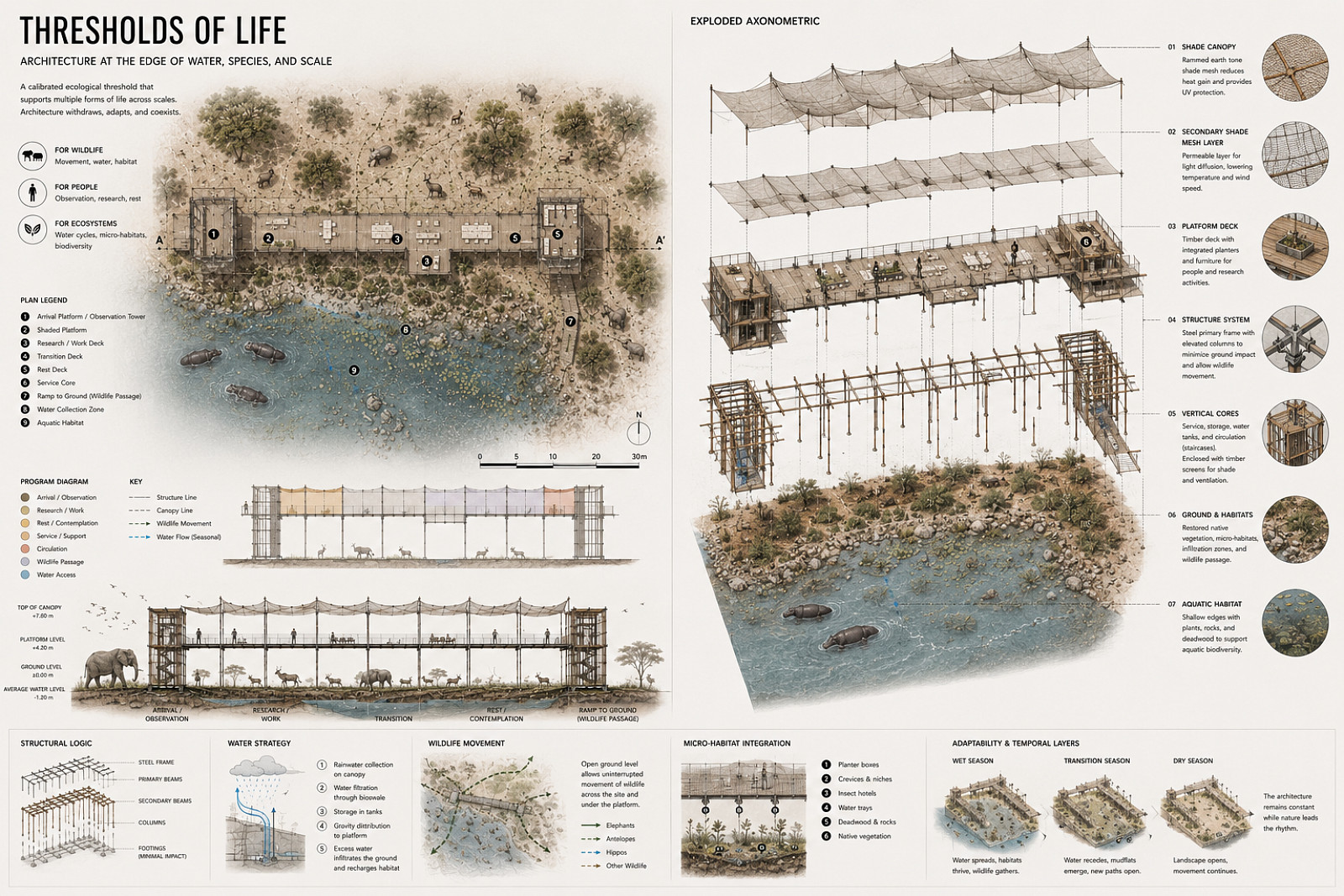
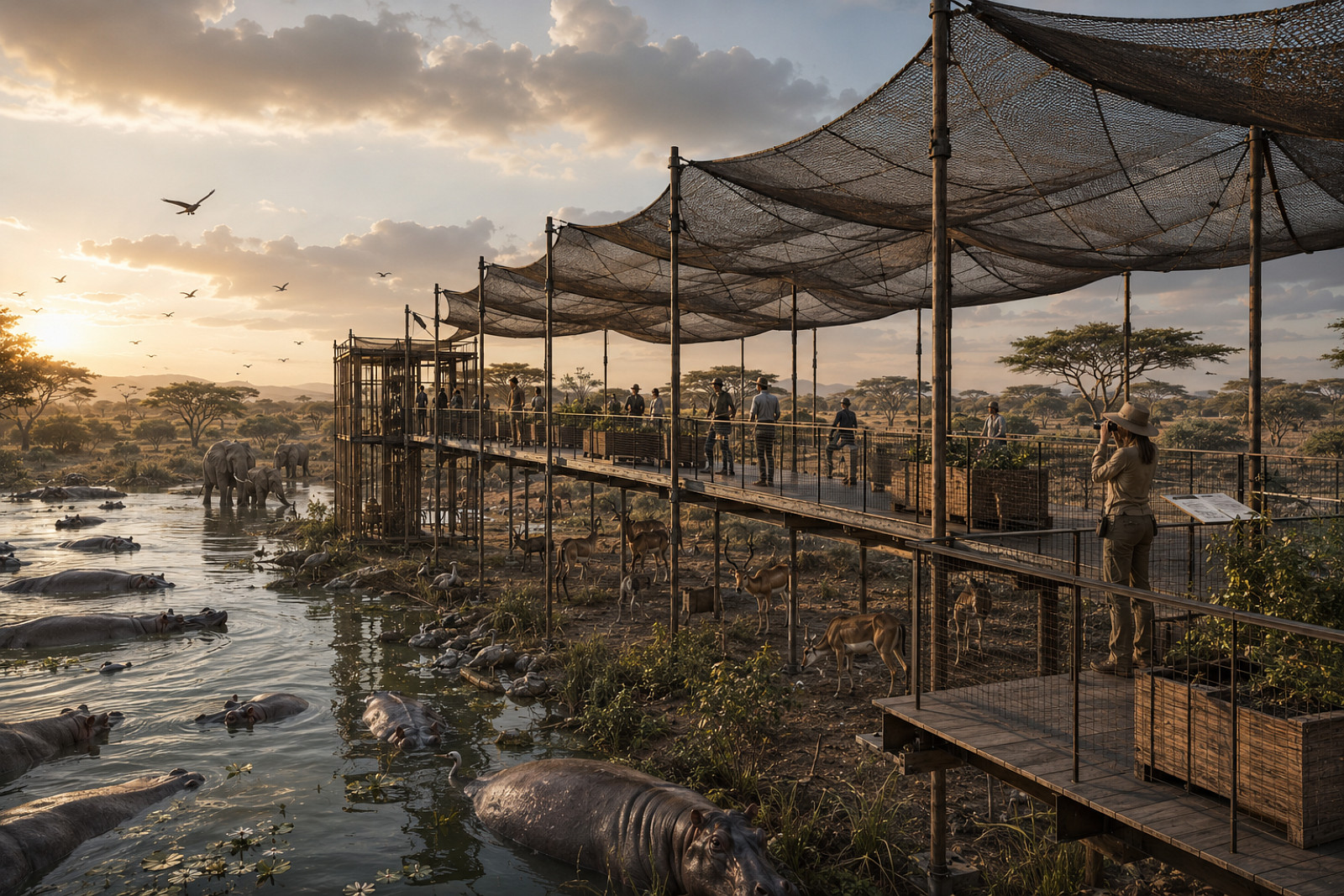
The project is conceived as a layered architectural system positioned at the edge of water, species, and scale. It begins from the recognition that the site is not empty, but already inhabited by multiple forms of life operating across different temporalities and spatial ranges. Large mammals move territorially and cyclically, birds navigate air and reflection, reptiles occupy the threshold between heat and shade, and insects respond to humidity and microclimate before these conditions become visible to the human eye.
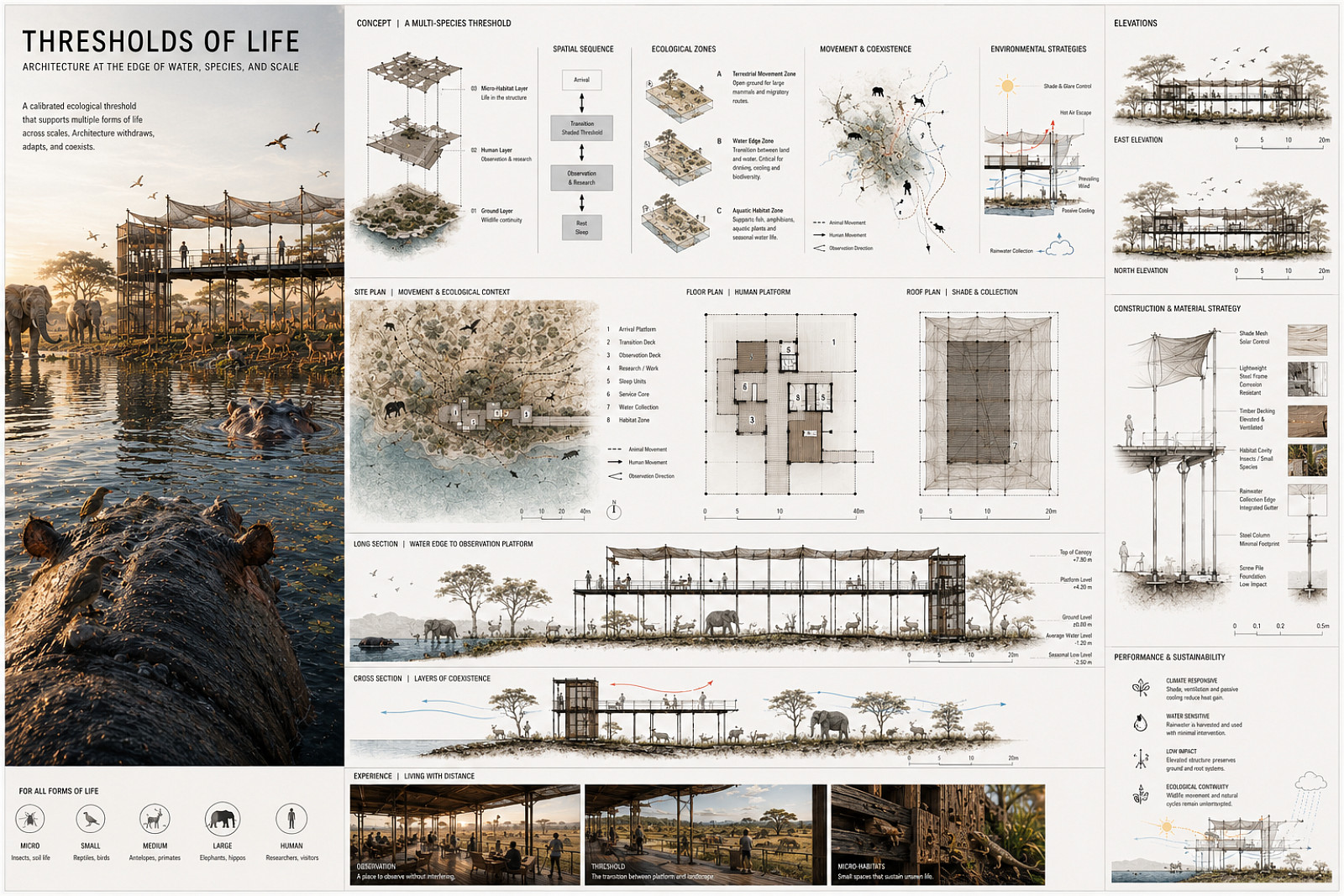
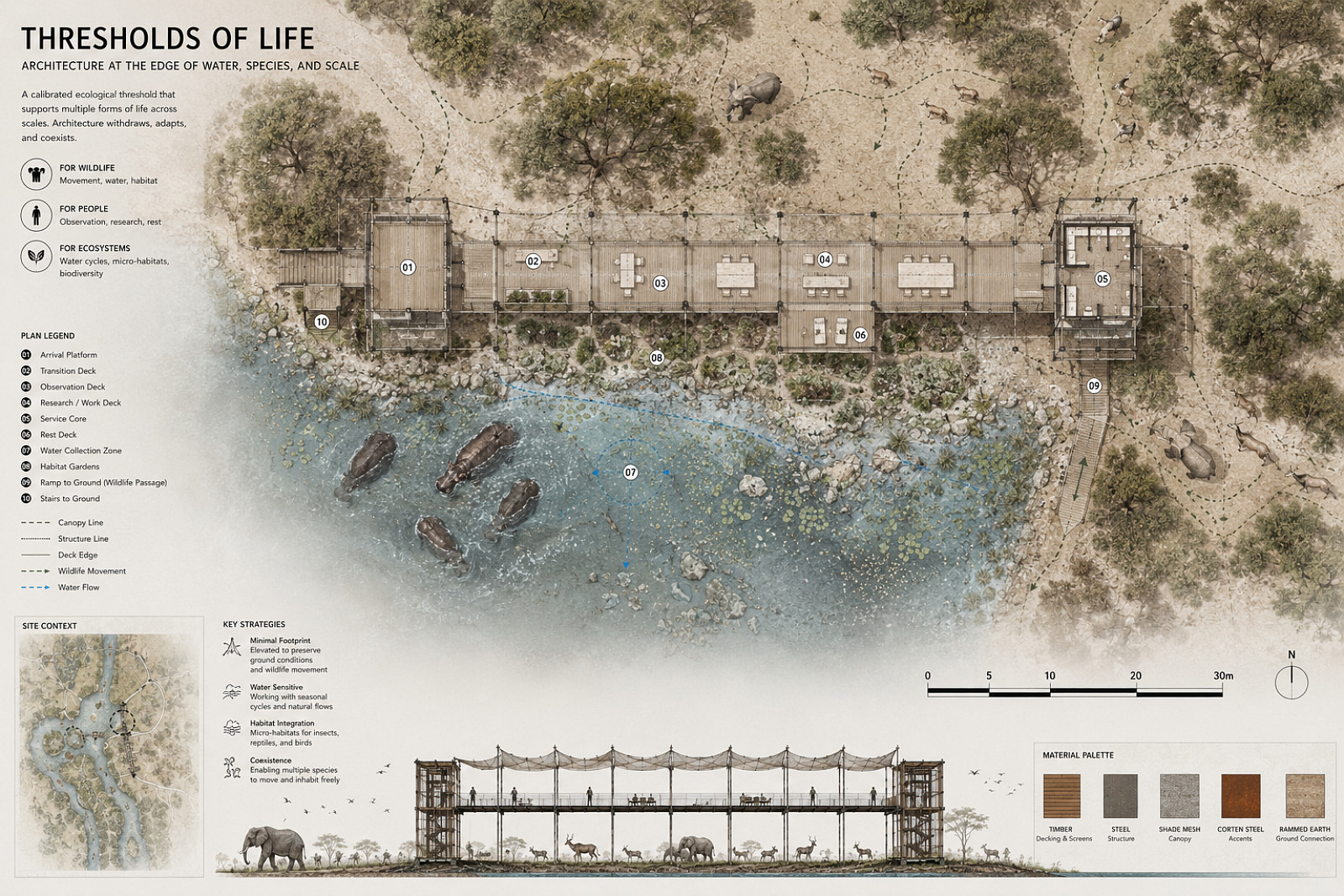
In response, the architecture does not occupy the ground as a fixed object. Instead, it lifts itself lightly above the terrain, allowing the earth to remain continuous, porous, and accessible to moisture, movement, and life. A restrained human layer is introduced above this living field, providing spaces for observation, research, and temporary stay without claiming dominance over the site. This human presence is intentionally limited, maintaining distance rather than producing spectacle.
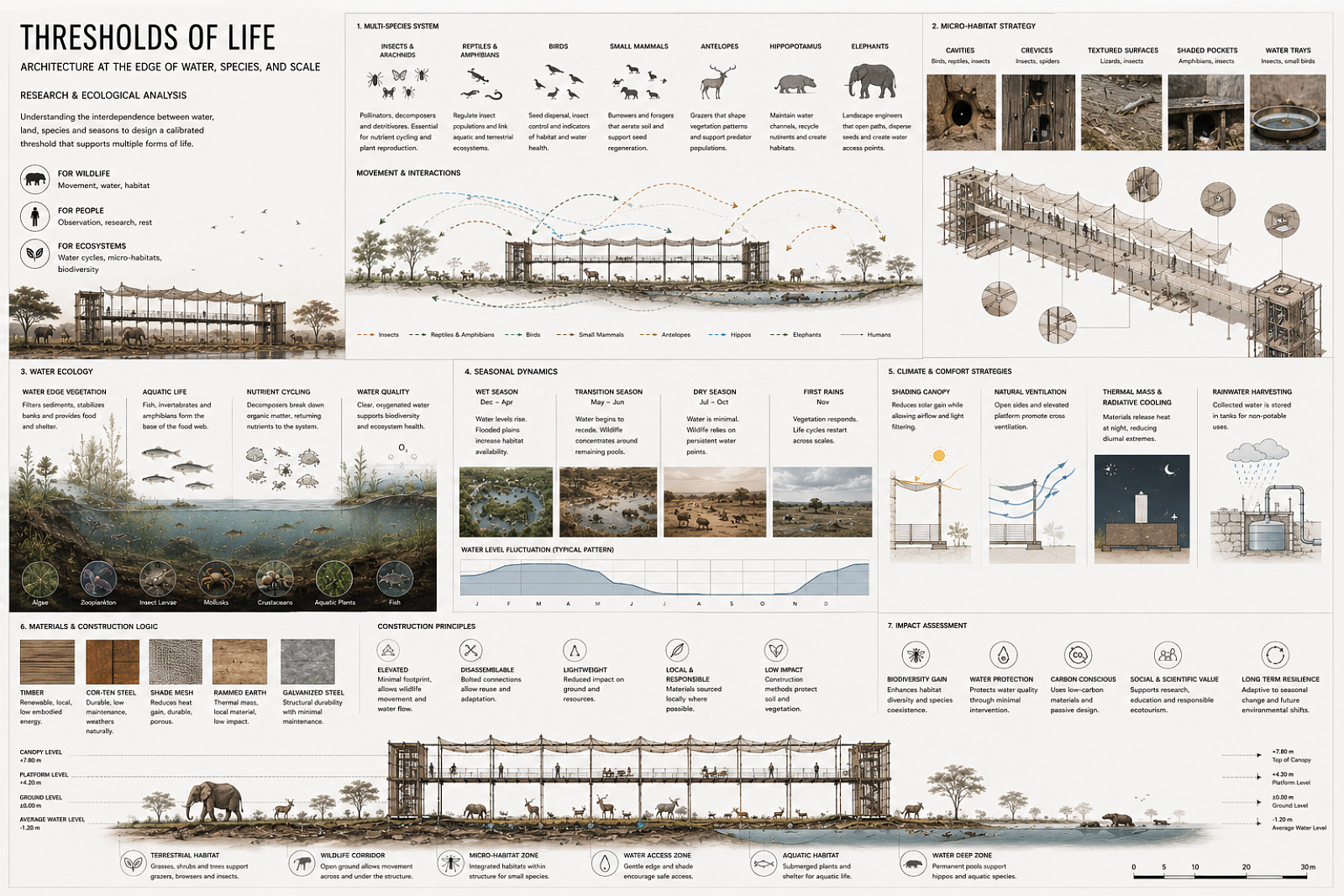
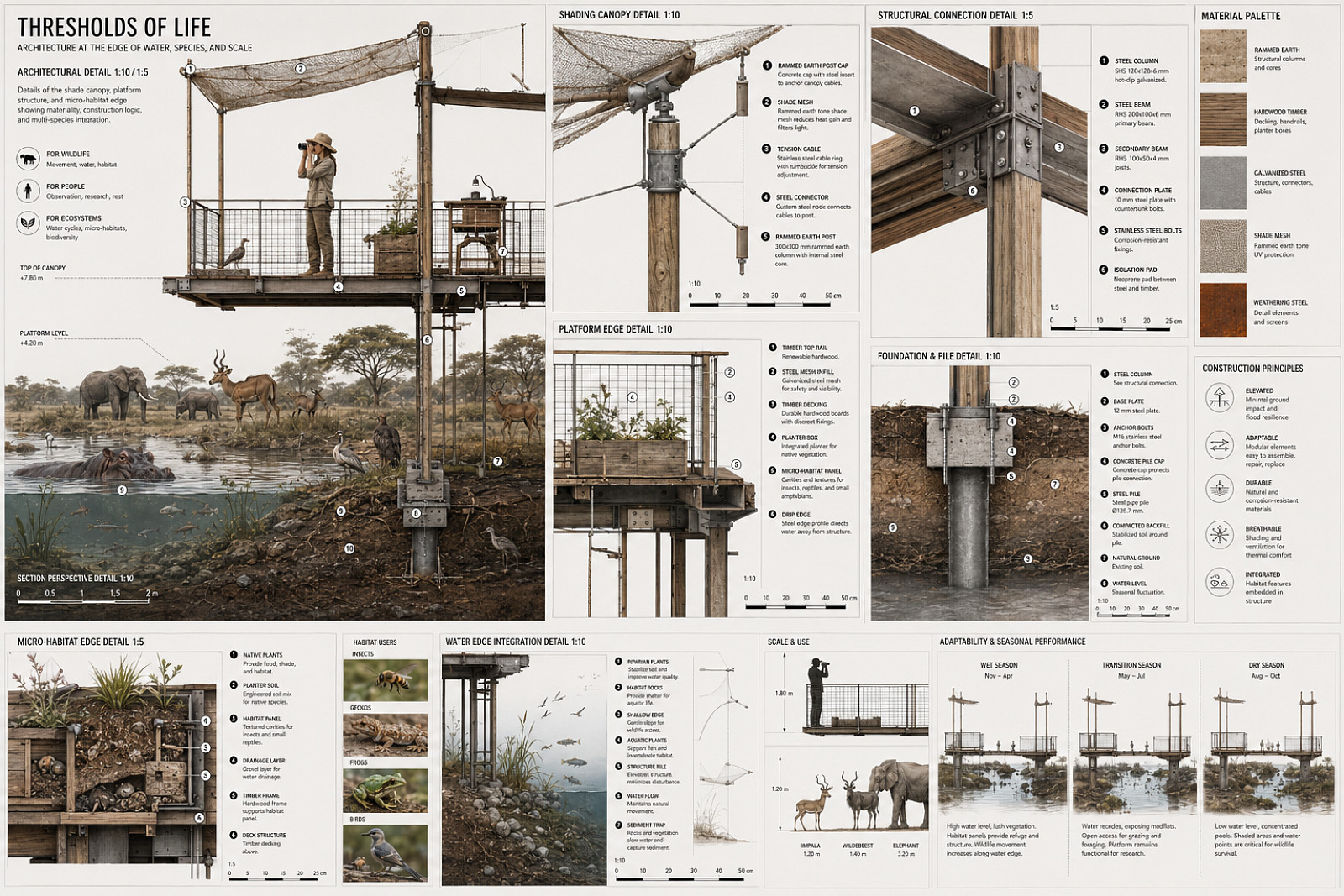
Between ground and occupation, a third domain emerges within the architecture itself. Cavities, textures, shaded thresholds, and embedded edges become micro-habitats for smaller species, integrating insects, reptiles, and birds into the building’s logic rather than excluding them from it. THRESHOLDS OF LIFE therefore proposes an architecture that mediates rather than controls: one that slows water instead of capturing it, filters light instead of blocking it, and guides movement without restricting it. The project is not about placing a building in nature, but about designing with limits and enabling coexistence across scales.
Technical information
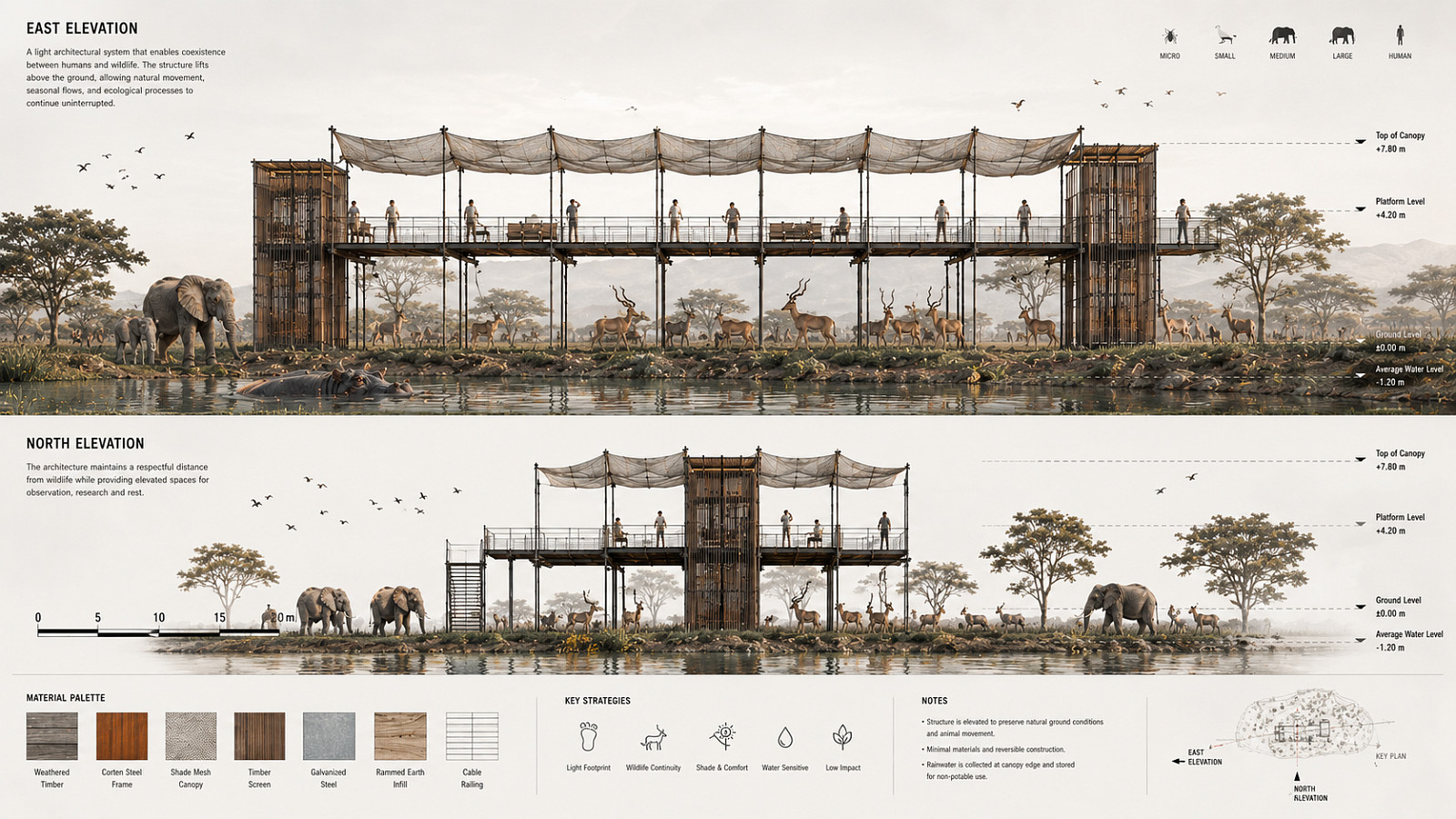
The project is designed as a lightweight elevated structure positioned above a sensitive ground condition shaped by water fluctuation, habitat movement, and ecological occupation. Its primary system combines minimal foundations, raised circulation and observation elements, shaded thresholds, and integrated micro-habitat components embedded within the architectural envelope. By lifting the main occupied layer above the terrain, the project preserves permeability, supports uninterrupted ground continuity, and reduces physical impact on the site.
Environmental performance is based on passive and site-sensitive strategies. The architecture allows water to move and slow naturally through the landscape rather than redirecting it aggressively. Light is filtered through layered surfaces and controlled openings, creating gradients of shade and exposure suited to both human use and non-human habitation. Materiality emphasizes durability, low impact, and textural variation, allowing the structure to host multiple forms of occupancy across scales. Cavities, edges, rough surfaces, and protected zones are incorporated as part of the building logic, enabling coexistence between research, temporary stay, and habitat support.

Copyright © 2026 INSPIRELI | All rights reserved. Use of this website signifies your agreement to the Terms of Use, Privacy Policy, and use of cookies.