
Slow Water / Living Terraces


Project idea
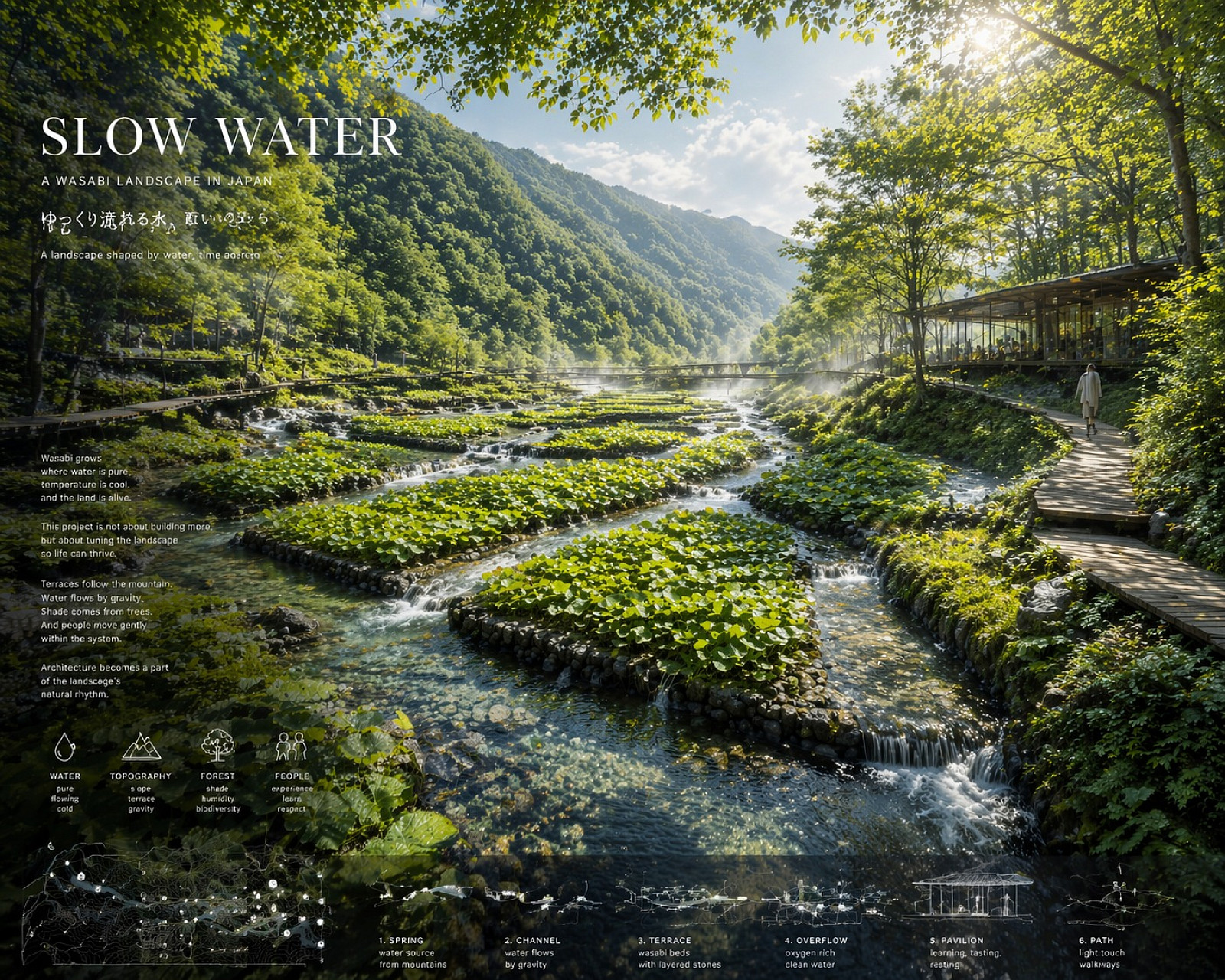
Slow Water / Living Terraces begins from the understanding that certain forms of life can only exist in conditions of balance rather than control. Wasabi does not grow where climate and water are forced. It requires a precise relationship between temperature, humidity, light, flow, and ground. The project takes this demand as its architectural starting point and asks how architecture can support life not by dominating a site, but by calibrating the conditions that allow it to emerge.
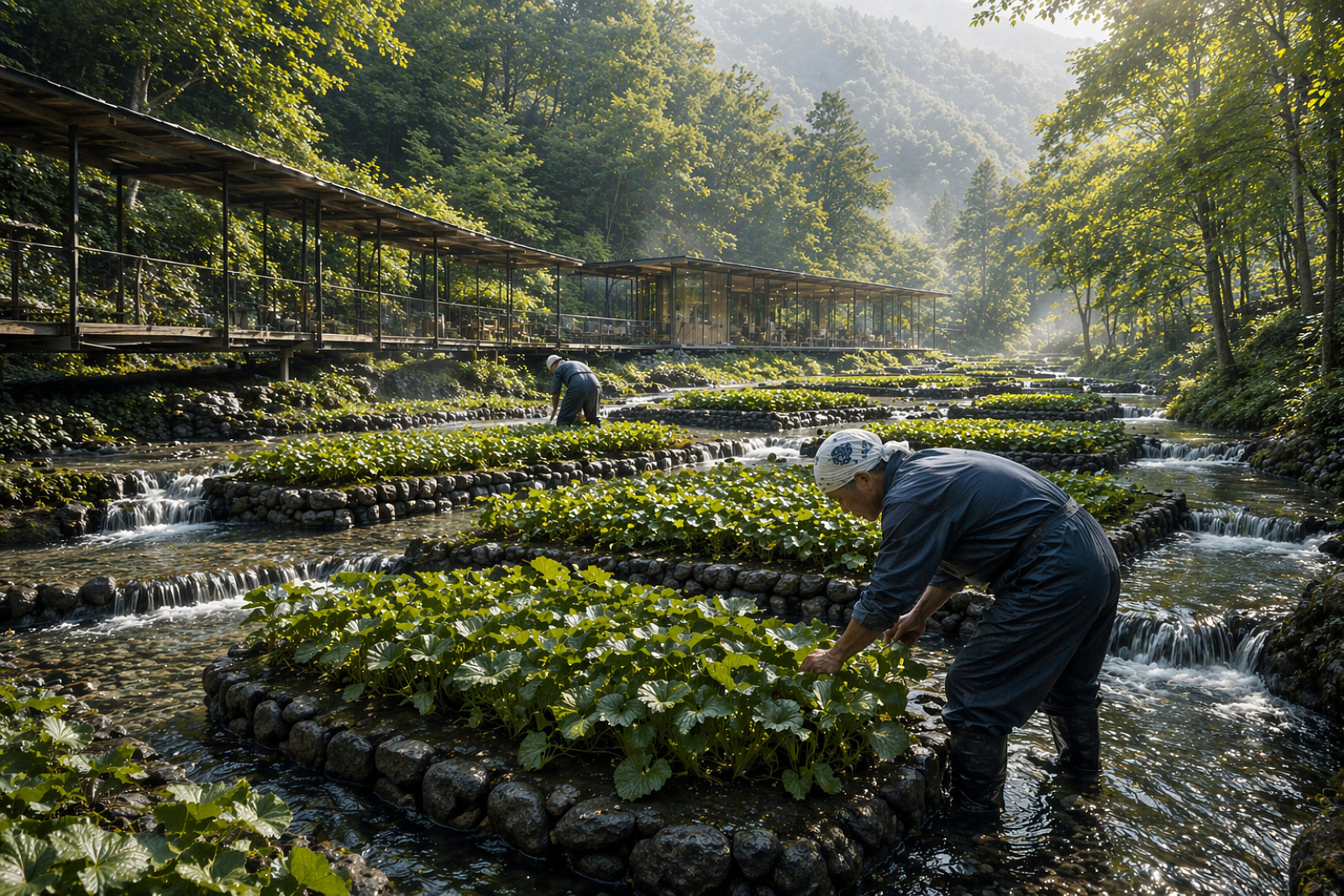
Set within the mountainous landscape of Japan, the proposal is conceived not as a building-object but as a system of relationships. Water is slowed, filtered, oxygenated, and distributed through a sequence of living terraces, while paths and moments of human presence are positioned lightly within the landscape. The goal of the project is to propose an architecture that works through alignment, restraint, and environmental continuity, making growth, climate, and time visible in space.
Project description
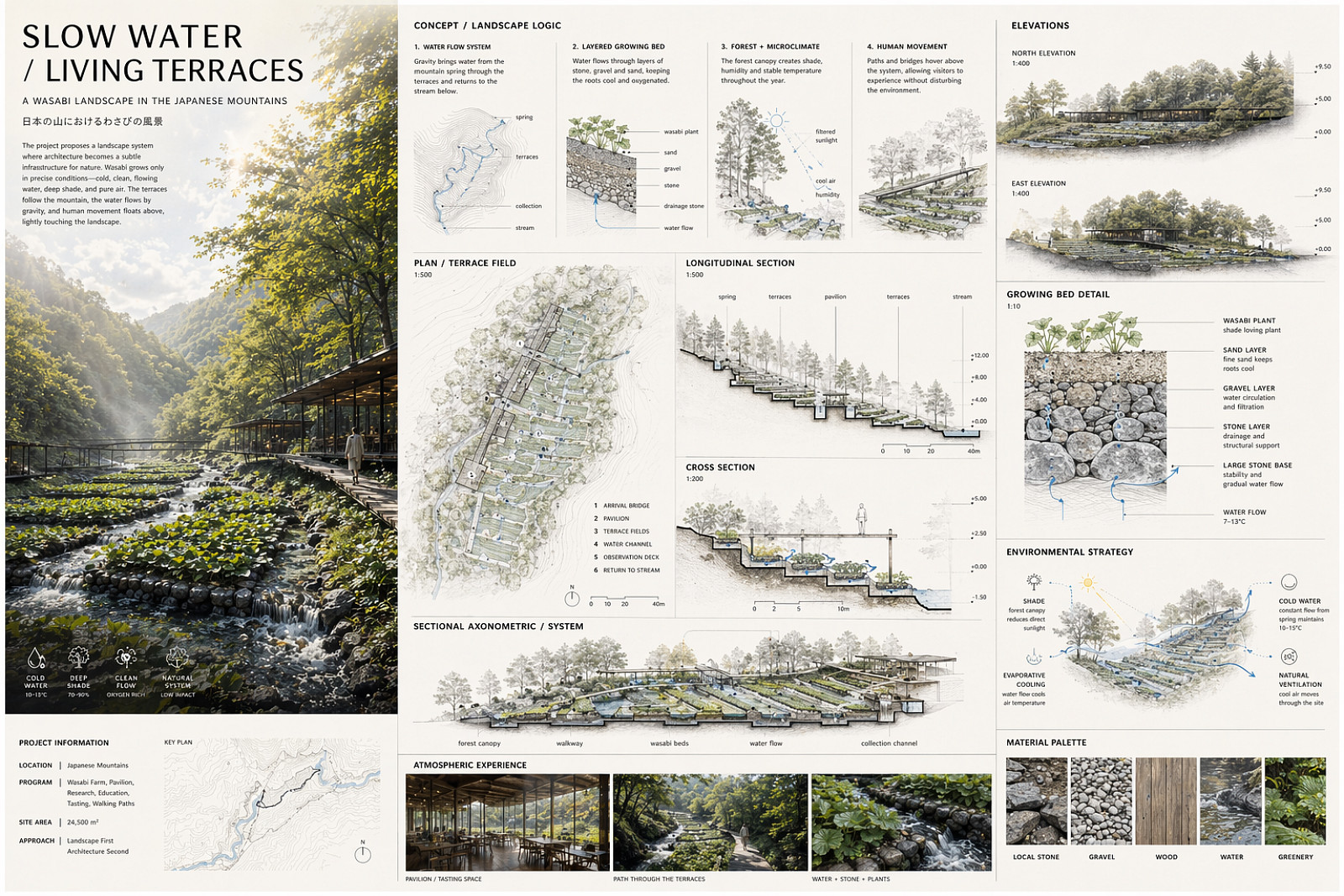
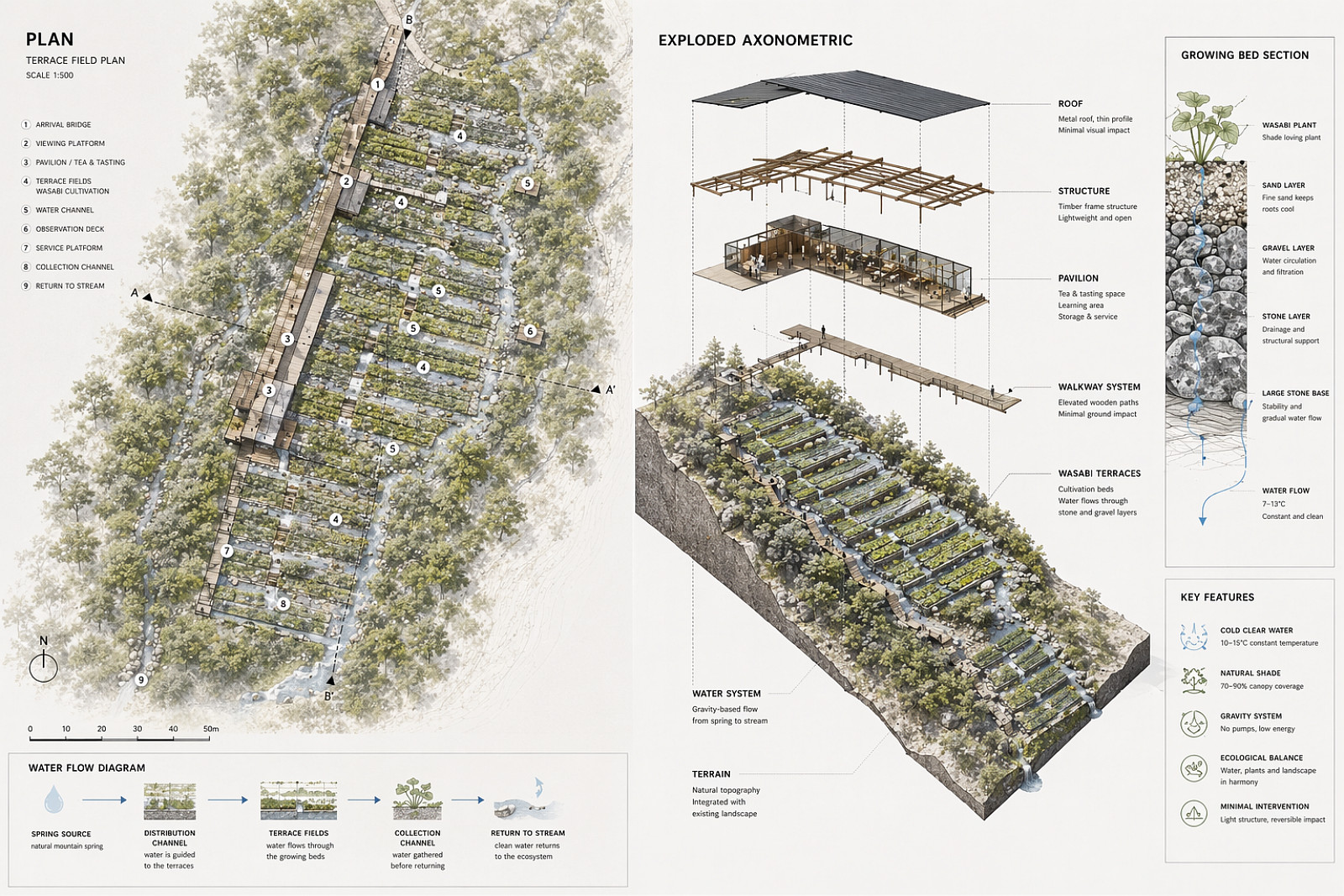
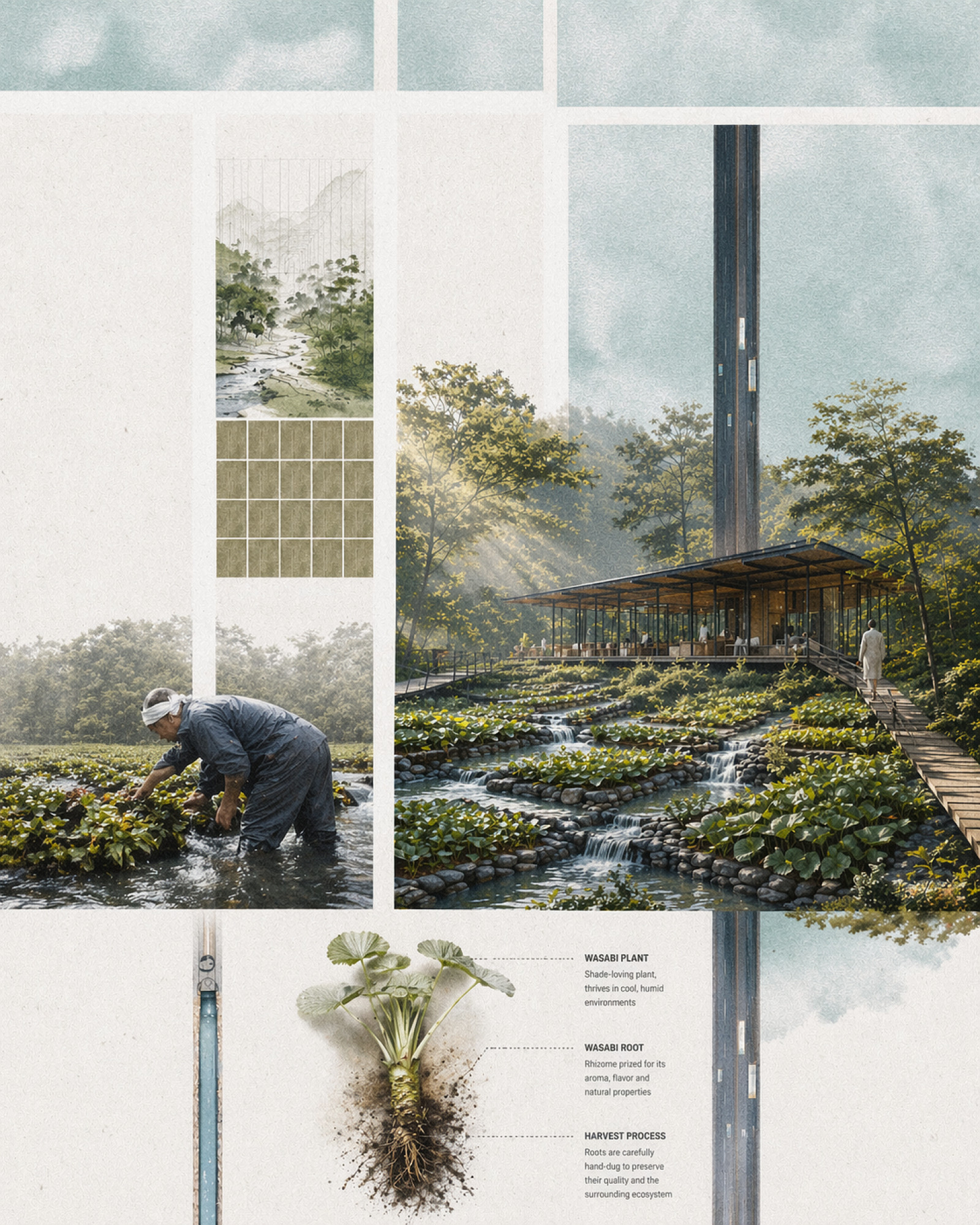
The project is organized as a terraced landscape system embedded within the mountain slope. Rather than reshaping the topography through heavy intervention, the proposal extends the existing logic of the site through a calibrated sequence of water terraces, filtration layers, planted zones, and lightweight paths. Each terrace is designed as an environmental instrument that slows water, cools it, oxygenates it, and distributes it across the landscape according to the needs of cultivation and ecological continuity.
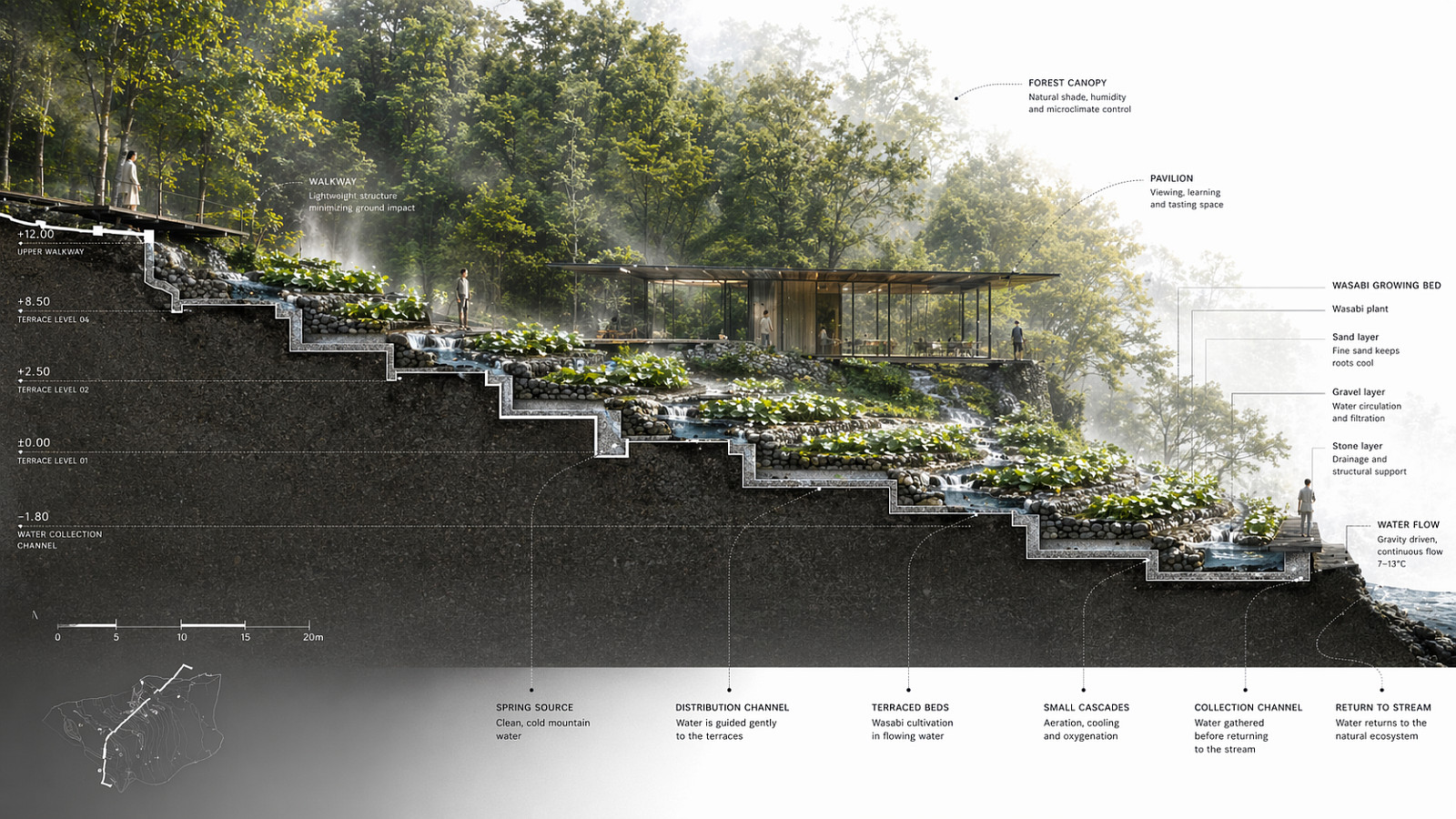
Architecture in the project is defined less by enclosure than by gradients of temperature, humidity, light, and flow. Stone, gravel, sand, root systems, and planted beds form a living section in which water movement and growth are intertwined. Human occupation is introduced carefully through raised paths, bridges, small platforms, and moments of pause that allow observation and movement without interrupting the landscape. These elements do not dominate the site but situate the visitor within its changing rhythm.
Slow Water / Living Terraces therefore proposes a form of architecture that is tuned rather than imposed. It translates between natural processes and human perception, creating a spatial field in which water, air, light, and plants are understood as active forces shaping the experience. The project argues for a form of permanence rooted not in mass or monumentality, but in balance, calibration, and sustained ecological performance.
Technical information
The project is designed as a layered landscape infrastructure composed of terraced water beds, stone retaining edges, gravel and sand filtration layers, planted cultivation zones, lightweight bridges, and minimal pavilions or platforms for access and observation. Its primary system is based on controlled water flow through gravity, allowing each level to regulate cooling, oxygenation, filtration, and distribution without aggressive mechanical intervention. The architecture works with the slope and hydrology of the site rather than replacing them.
Environmental performance is embedded in the section of the landscape. Water is slowed and guided through calibrated gradients that support cultivation, thermal moderation, and ecological continuity. The terraced system allows the ground to remain active as a living filter, while the combination of stone, soil, roots, and shallow flowing water stabilizes the microclimate required for growth. Human access is maintained through elevated paths and minimal structural interventions that reduce physical impact on the terrain. Materiality emphasizes stone, gravel, wood, planted earth, and water itself as the main architectural components.

Copyright © 2026 INSPIRELI | All rights reserved. Use of this website signifies your agreement to the Terms of Use, Privacy Policy, and use of cookies.
