
DUNE DWELLING


Project idea
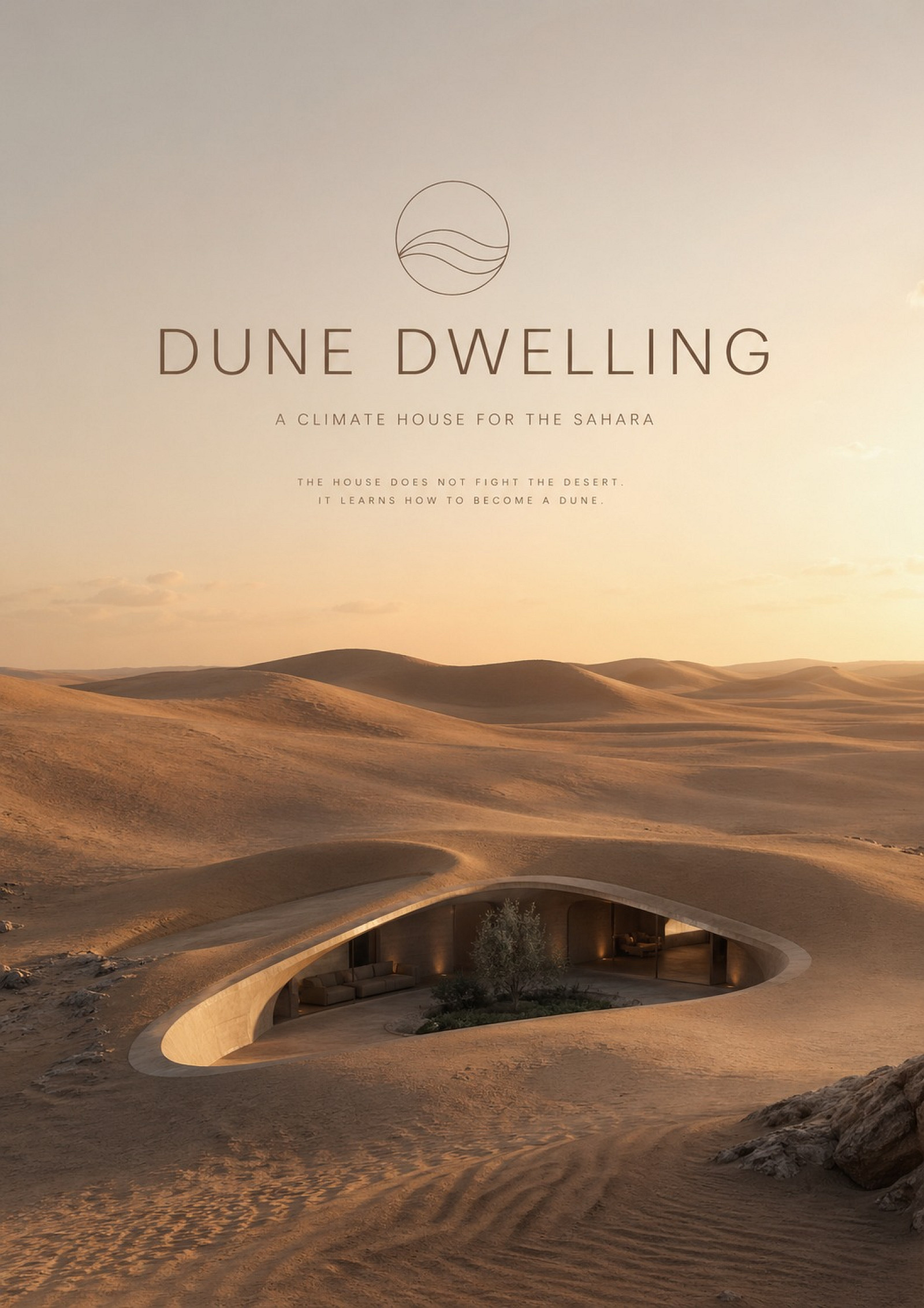
DUNE DWELLING begins from the understanding that in the desert, architecture cannot begin with form, but with forces. The Sahara is not a static landscape but a field of movement shaped by wind, heat, gravity, and time. The project therefore does not impose geometry onto the site, but derives its architectural logic from the behavior of sand, airflow, and climatic transformation.
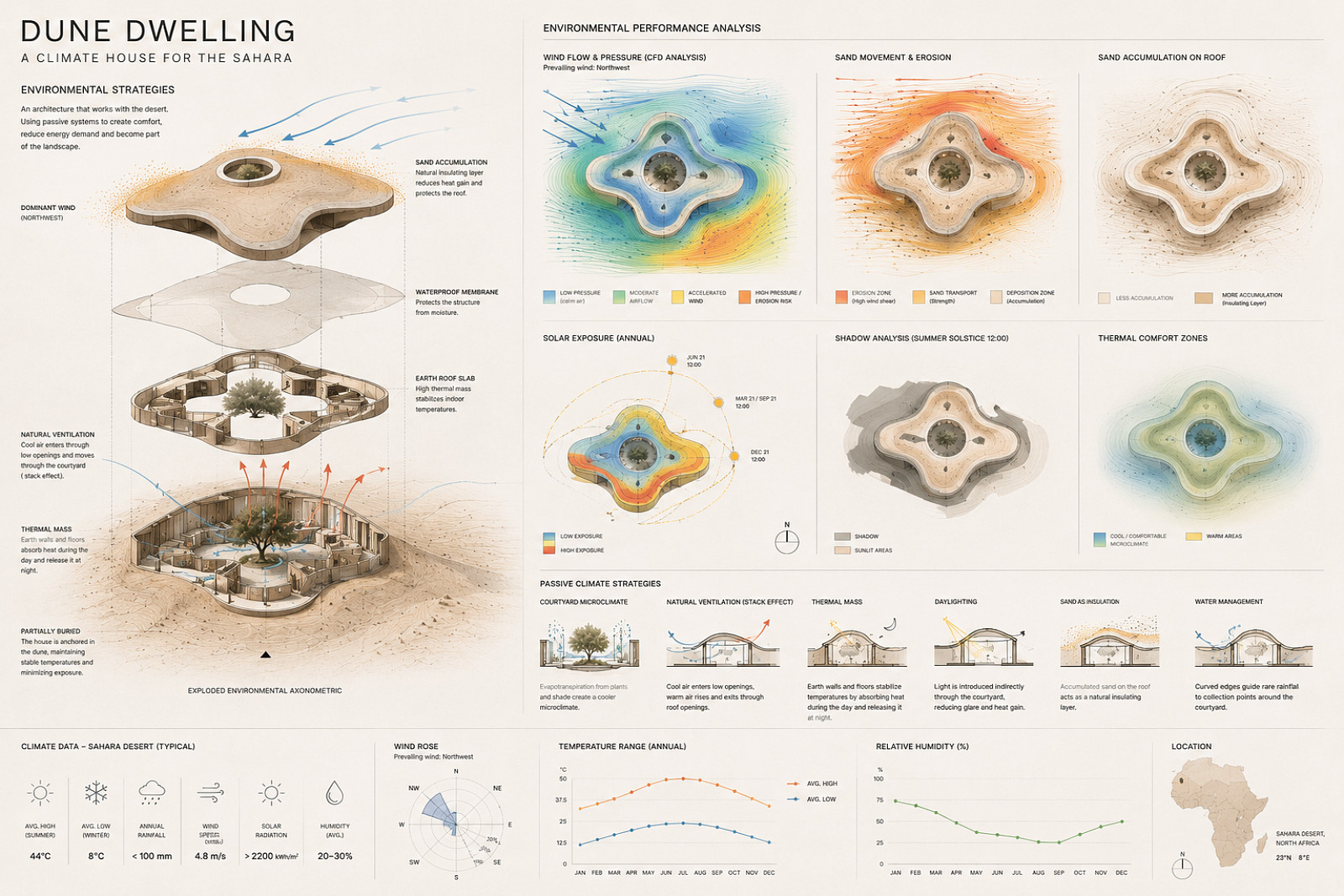
At the core of the proposal lies a radical shift: sand is no longer treated as a threat, but as an ally. The building is conceived as a responsive climatic system that captures deposition, adapts over time, and uses environmental change as part of its performance. The goal of the project is to propose a new model of desert inhabitation in which resilience is achieved not through resistance, but through adaptation.
Project description
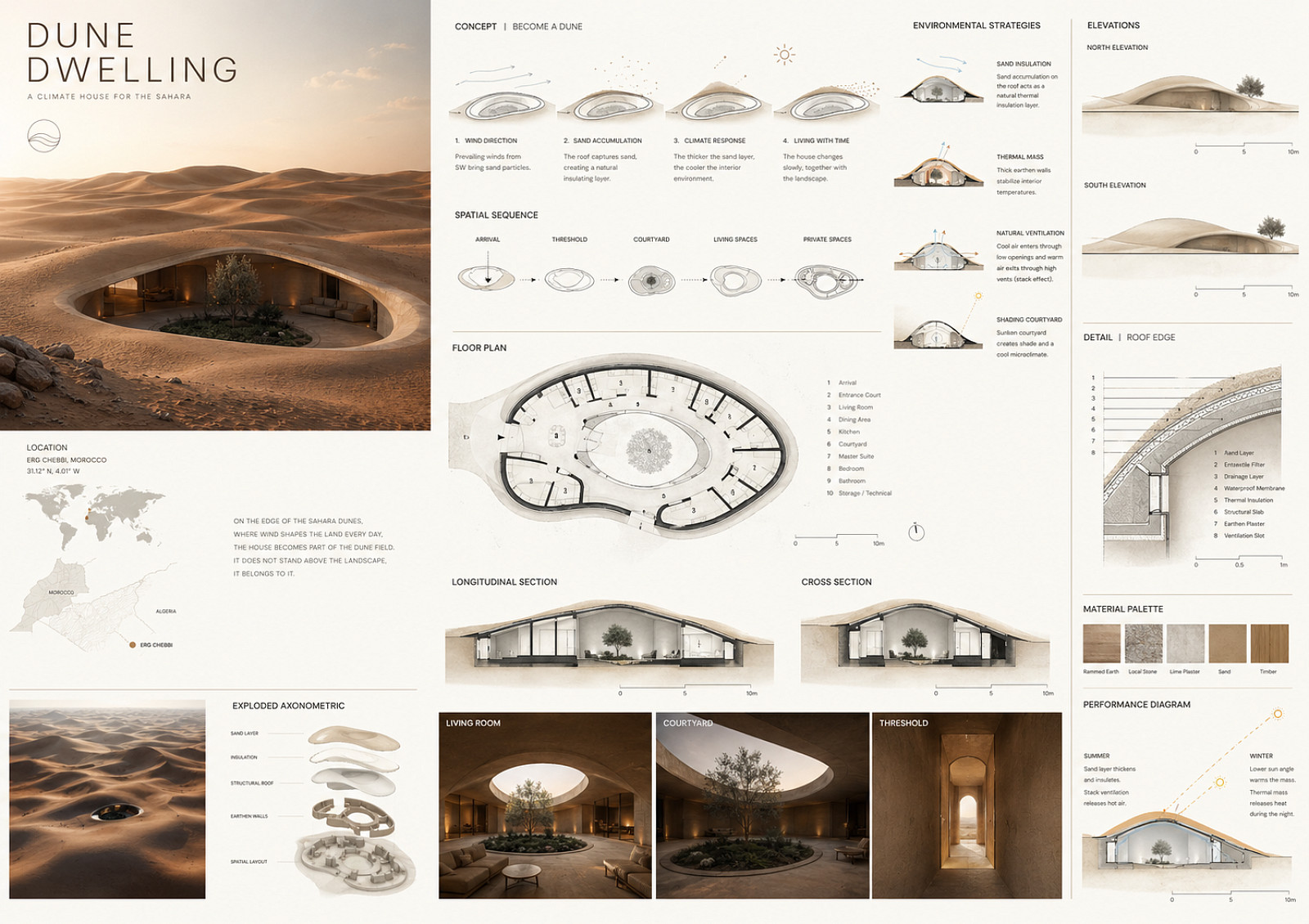
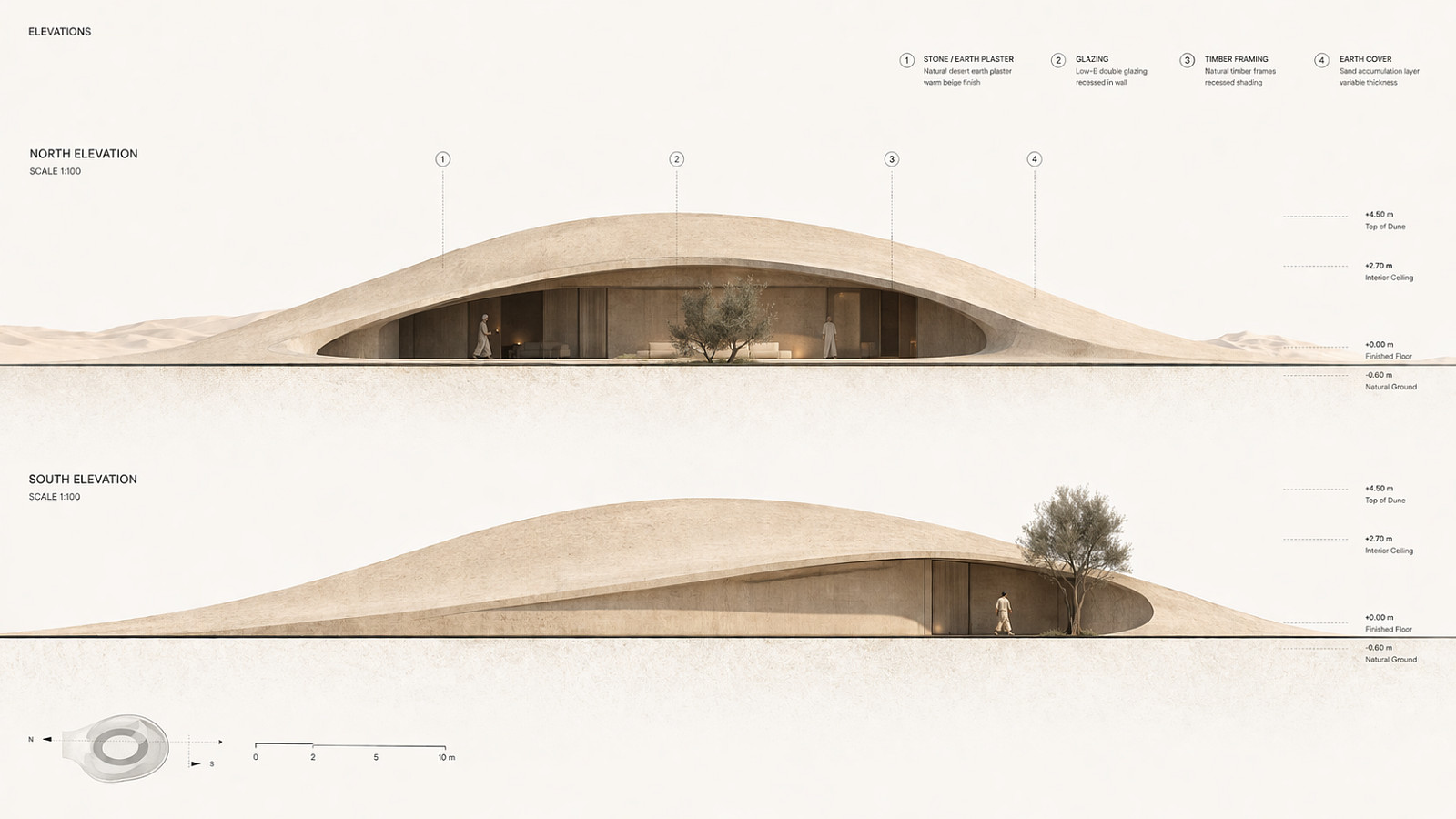
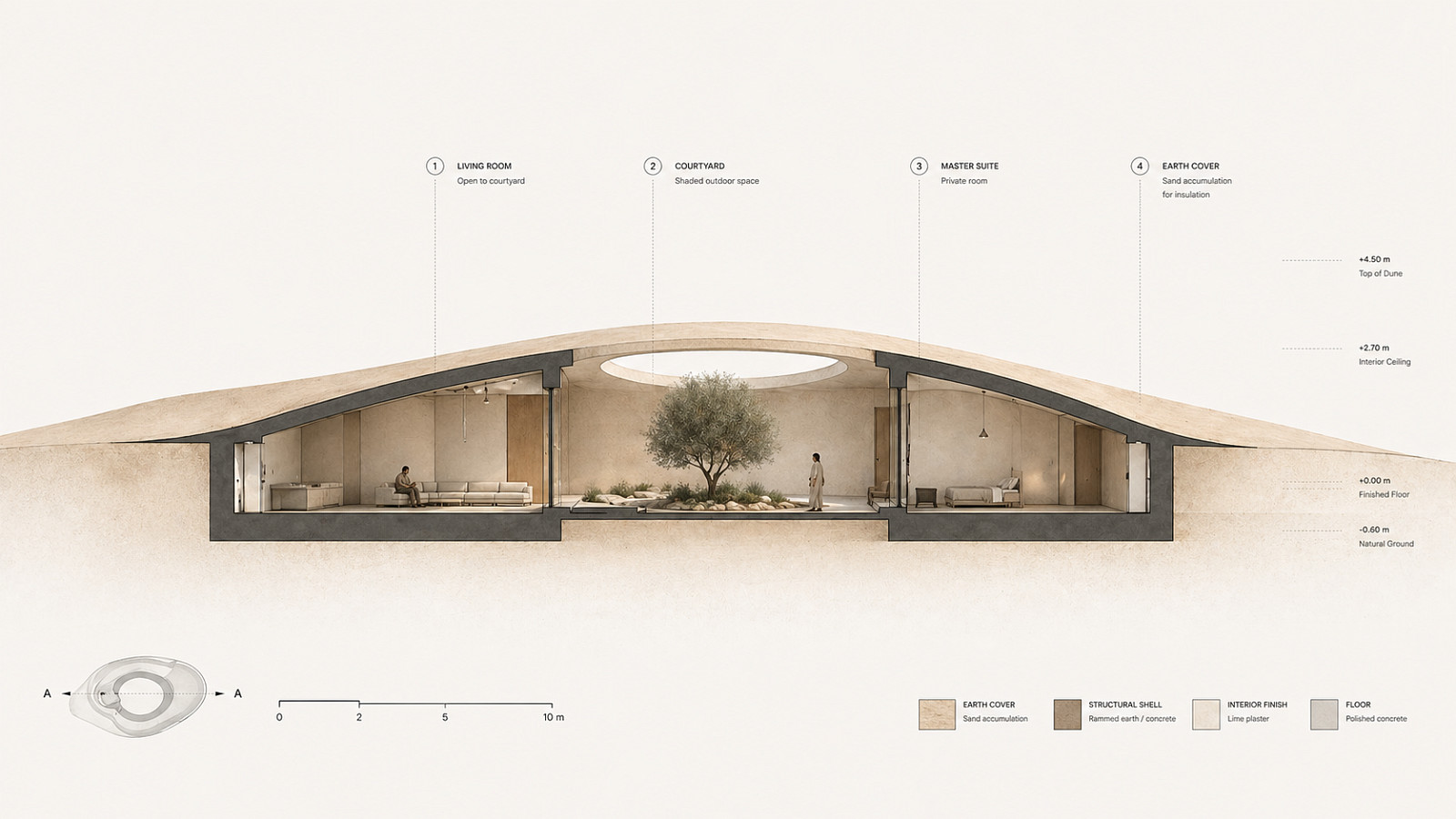
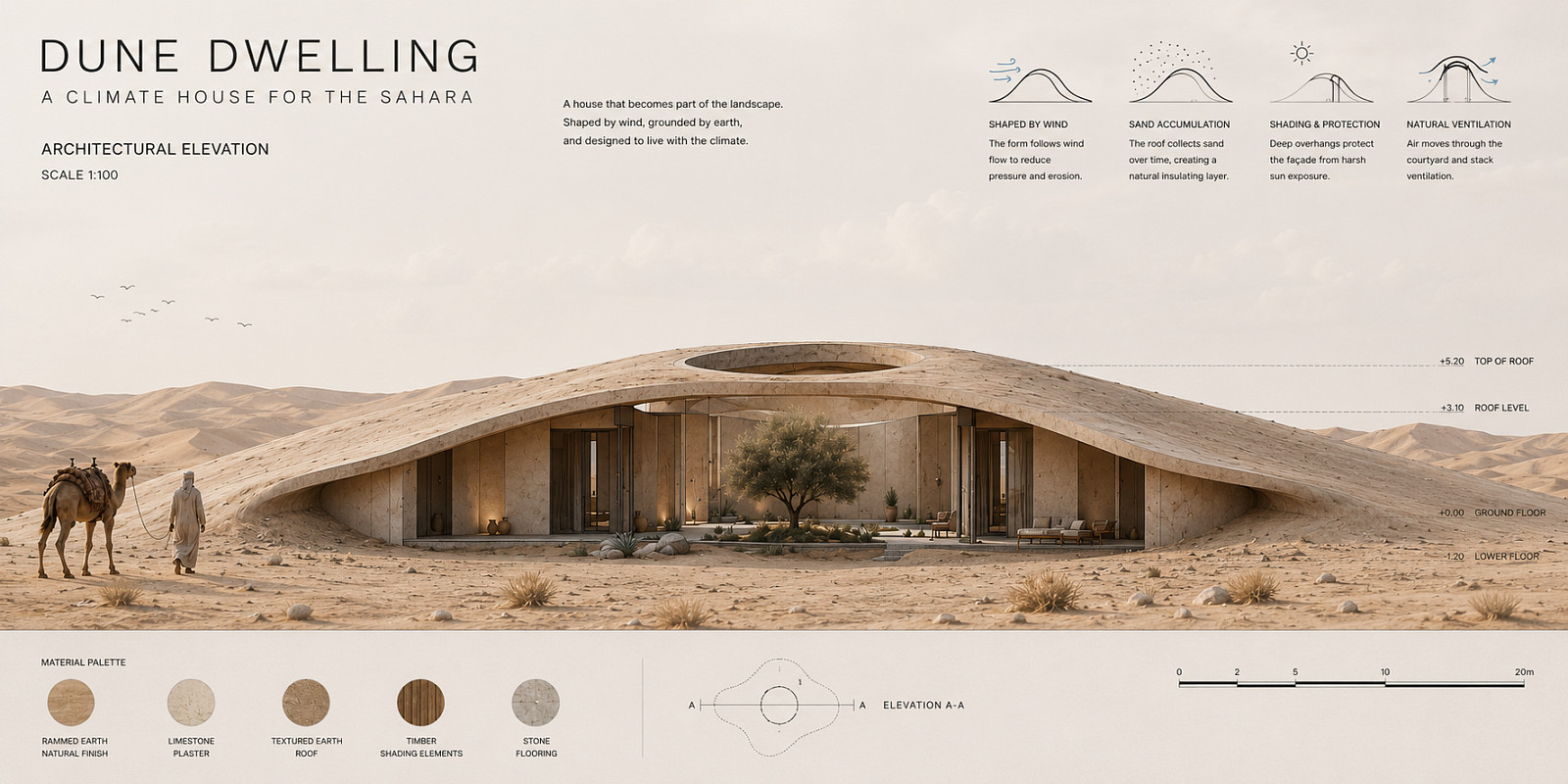
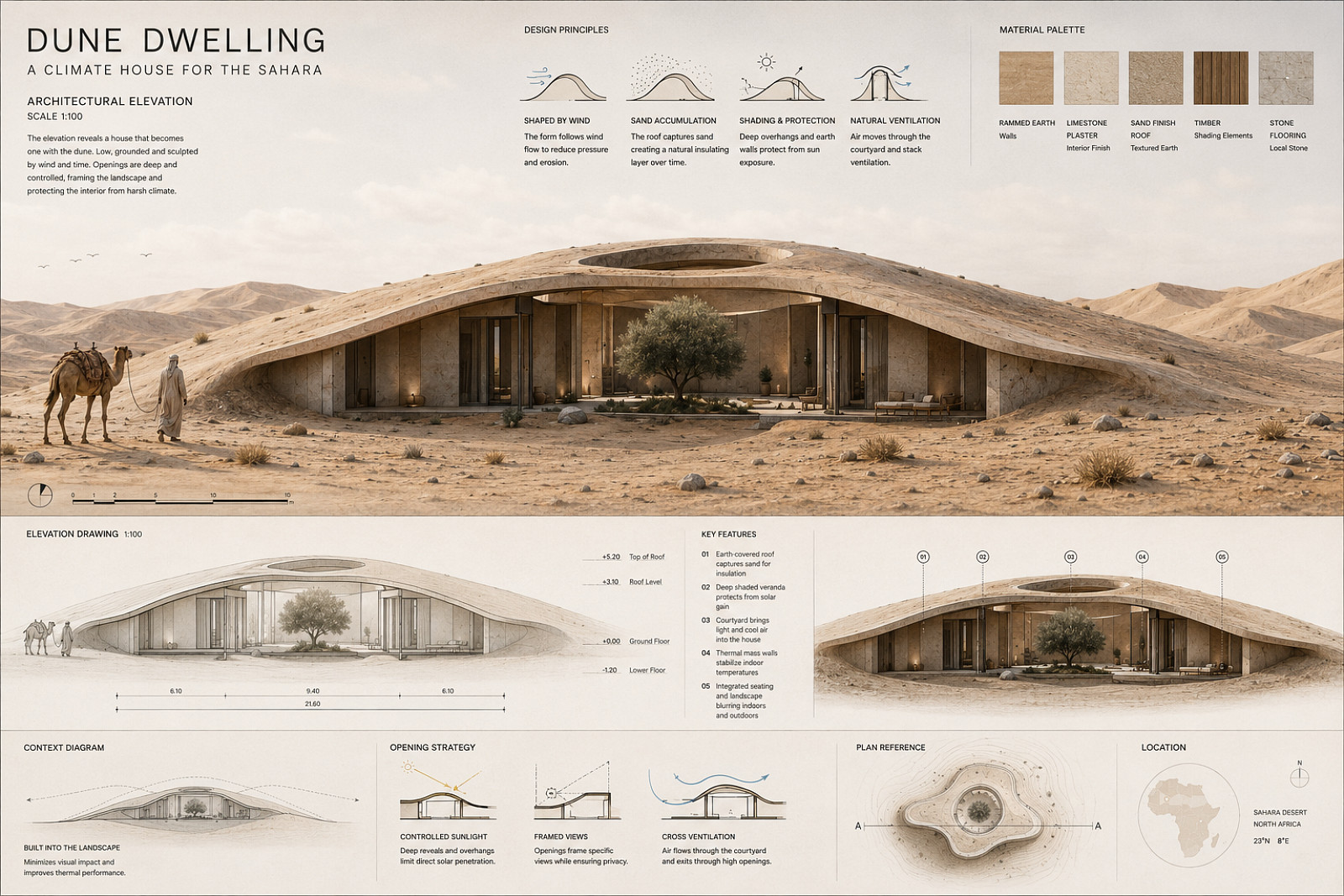
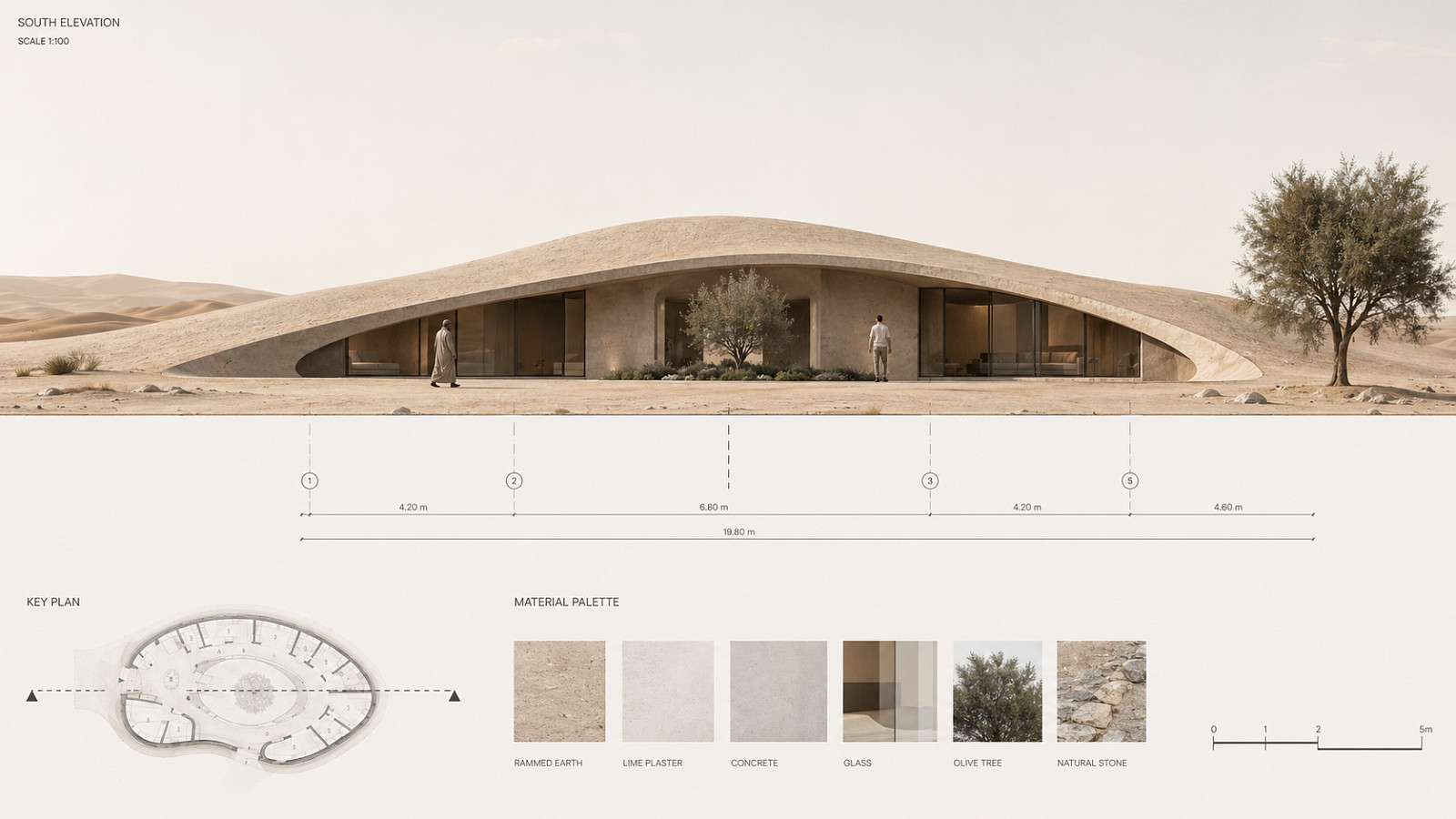
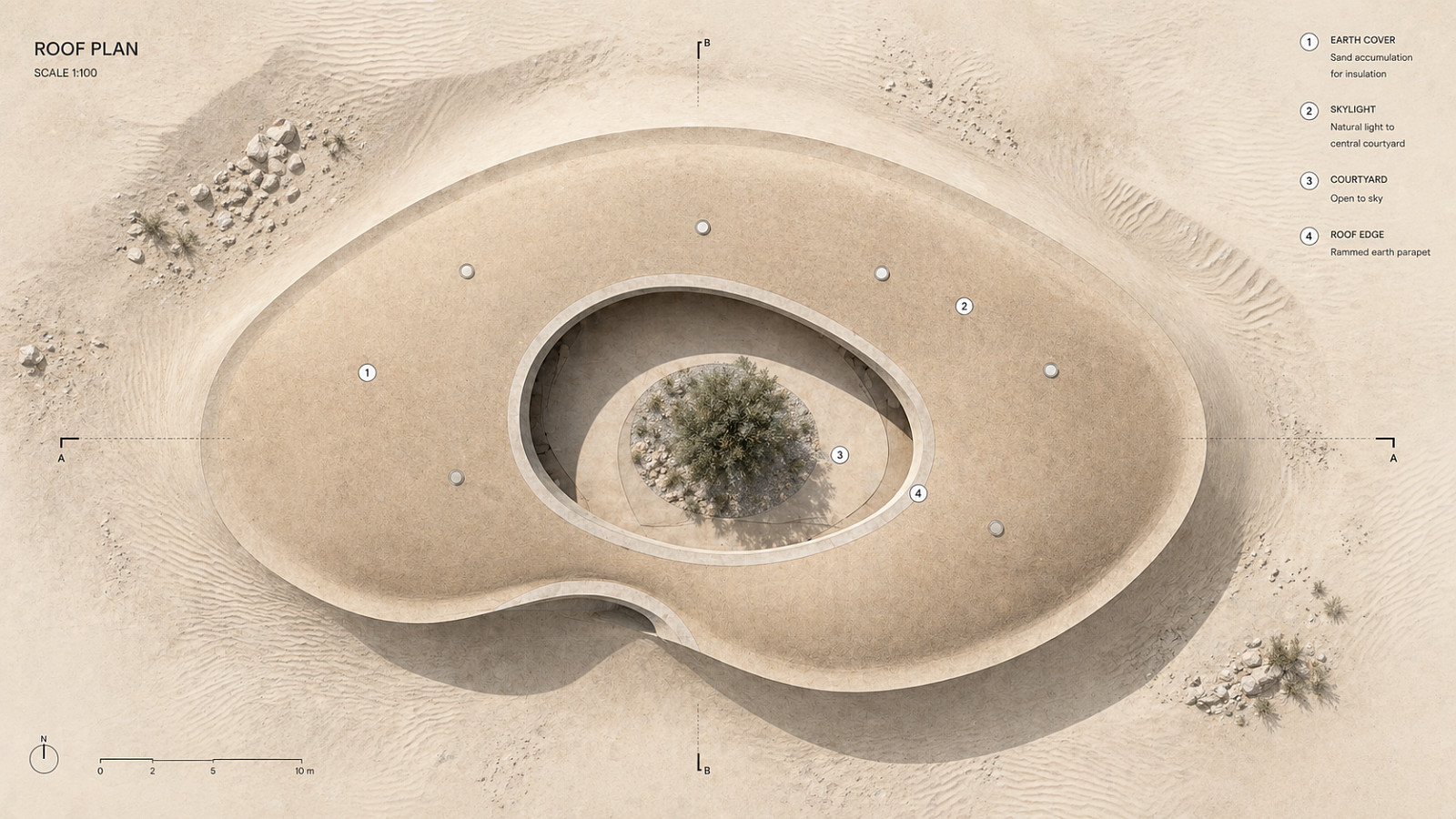
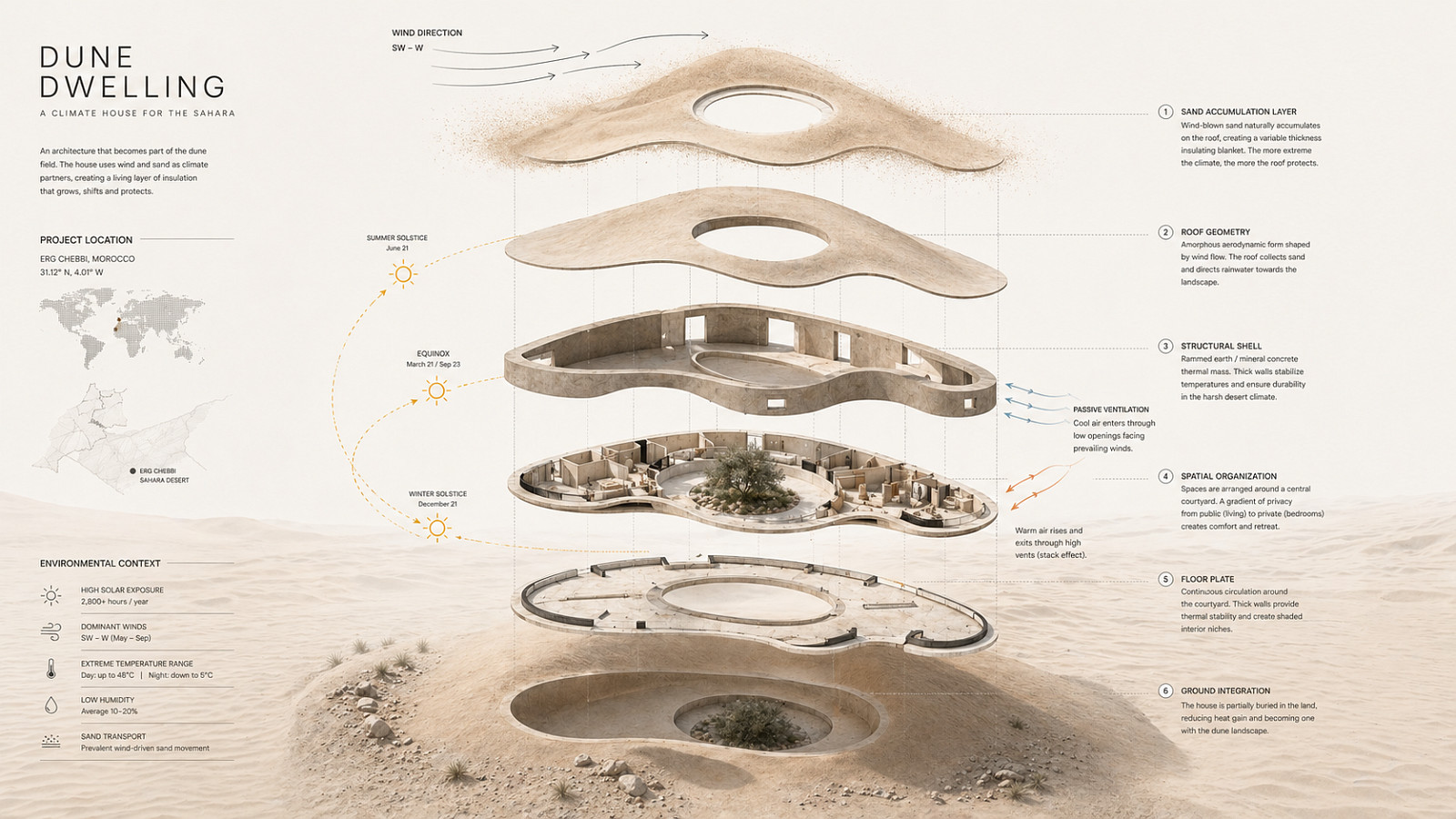
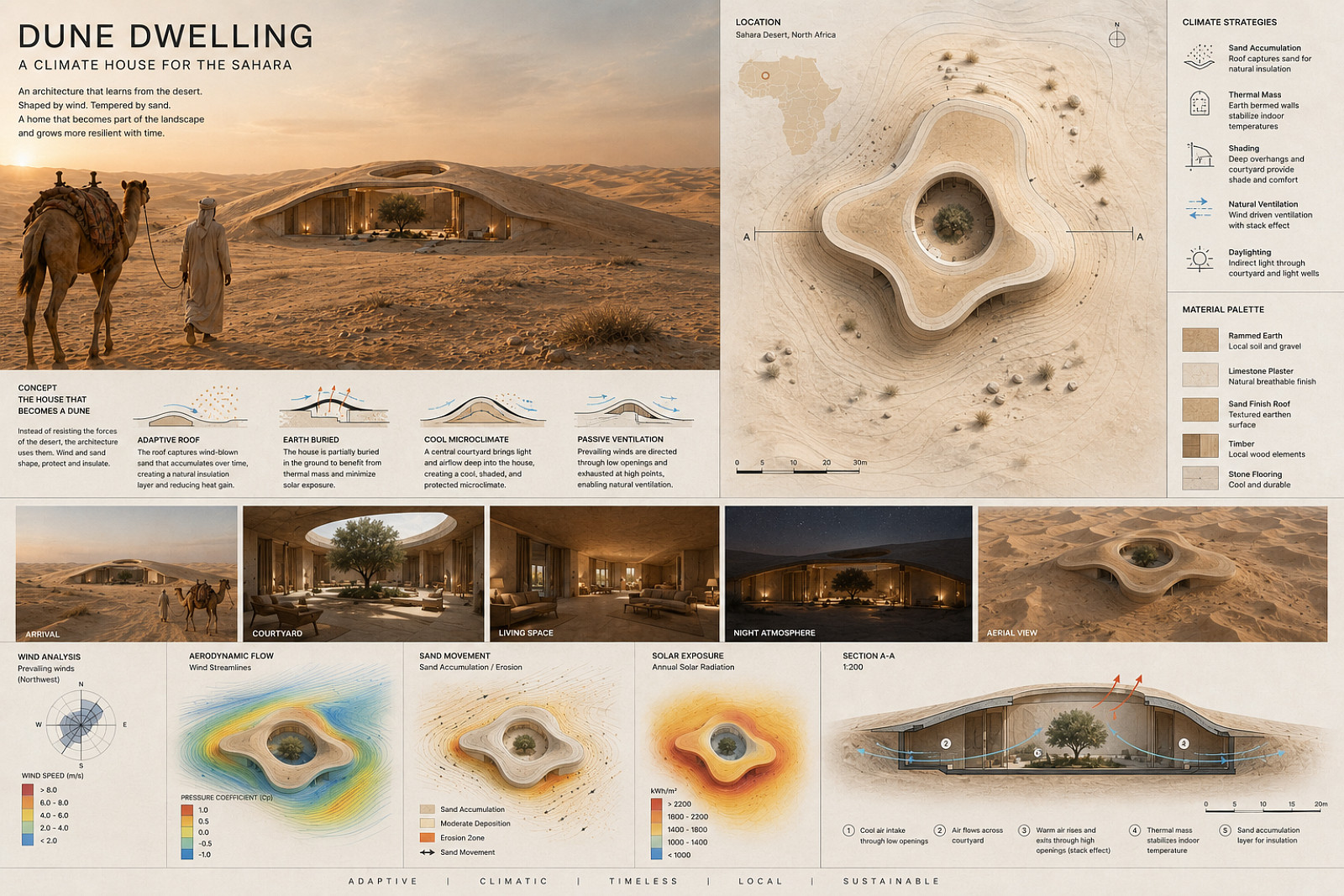
The project is organized as a dwelling partially embedded in the ground and covered by a soft, continuous roofscape that behaves as a calibrated topography. Rather than rejecting wind-blown sand, the architecture invites it. The roof captures airborne particles and allows them to settle, gradually forming a living thermal layer that thickens over time and improves protection from extreme solar exposure. In this way, the harsher the climate becomes, the more the building is able to protect itself.
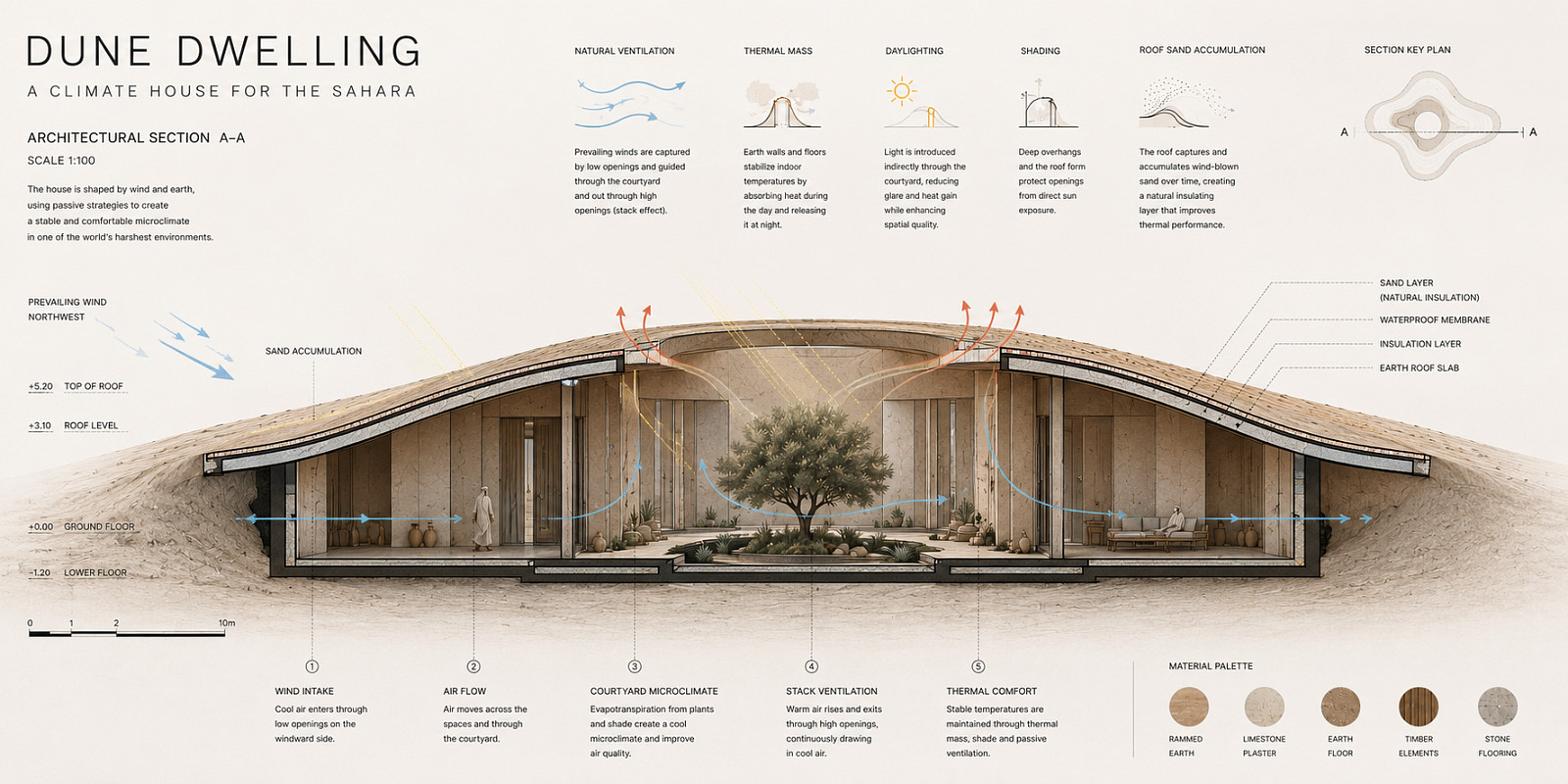
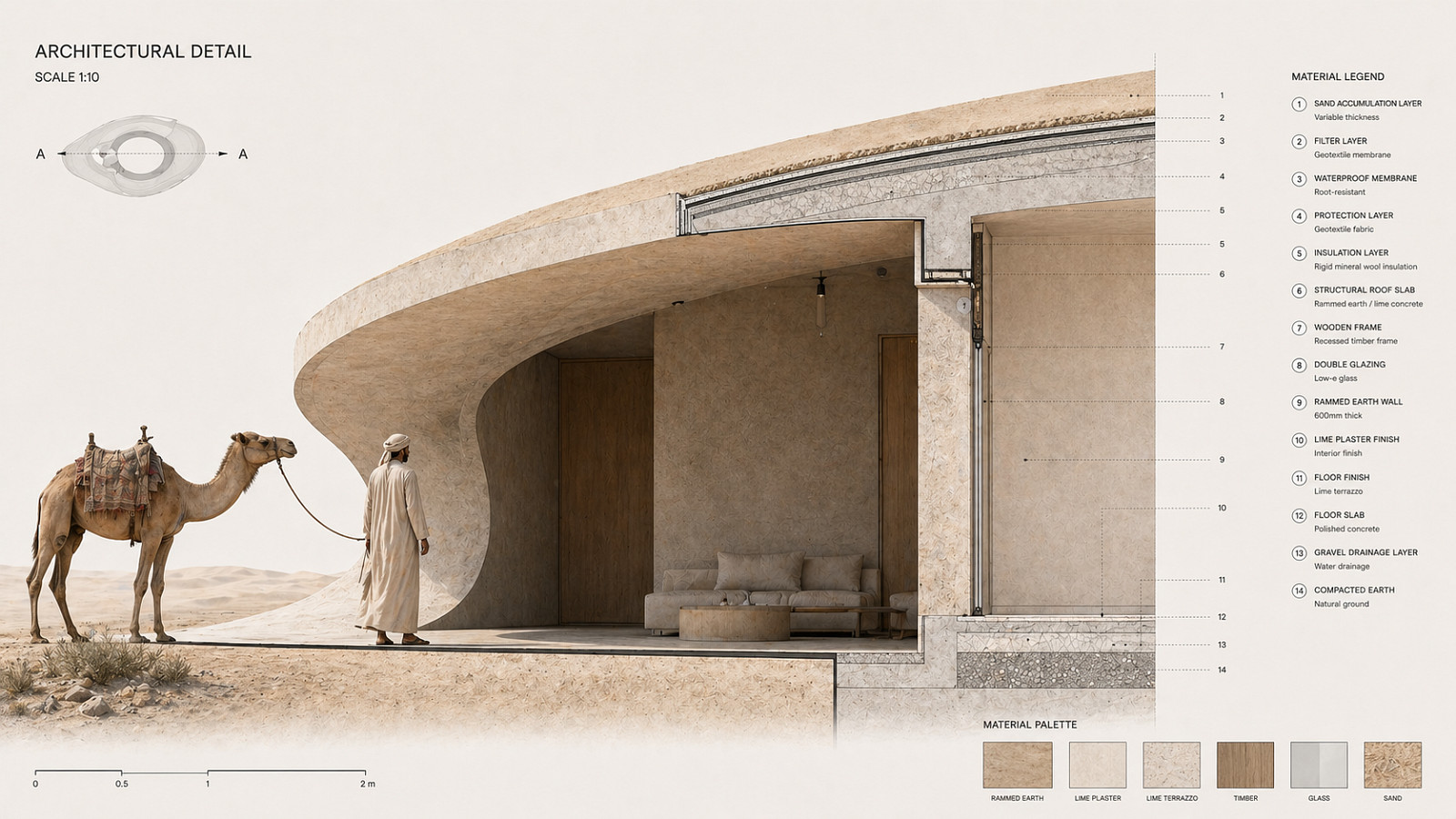
Beneath this shifting surface, the inhabitable spaces are carved into the ground as a protected world of shadow, mass, and silence. Thick mineral walls stabilize temperature through thermal inertia, while openings are recessed, controlled, and precise. Light enters indirectly, filtered and softened, and air is guided through pressure differences and vertical gradients to create passive cooling. The architecture therefore operates less as a fixed object and more as a climatic section shaped by environmental forces.
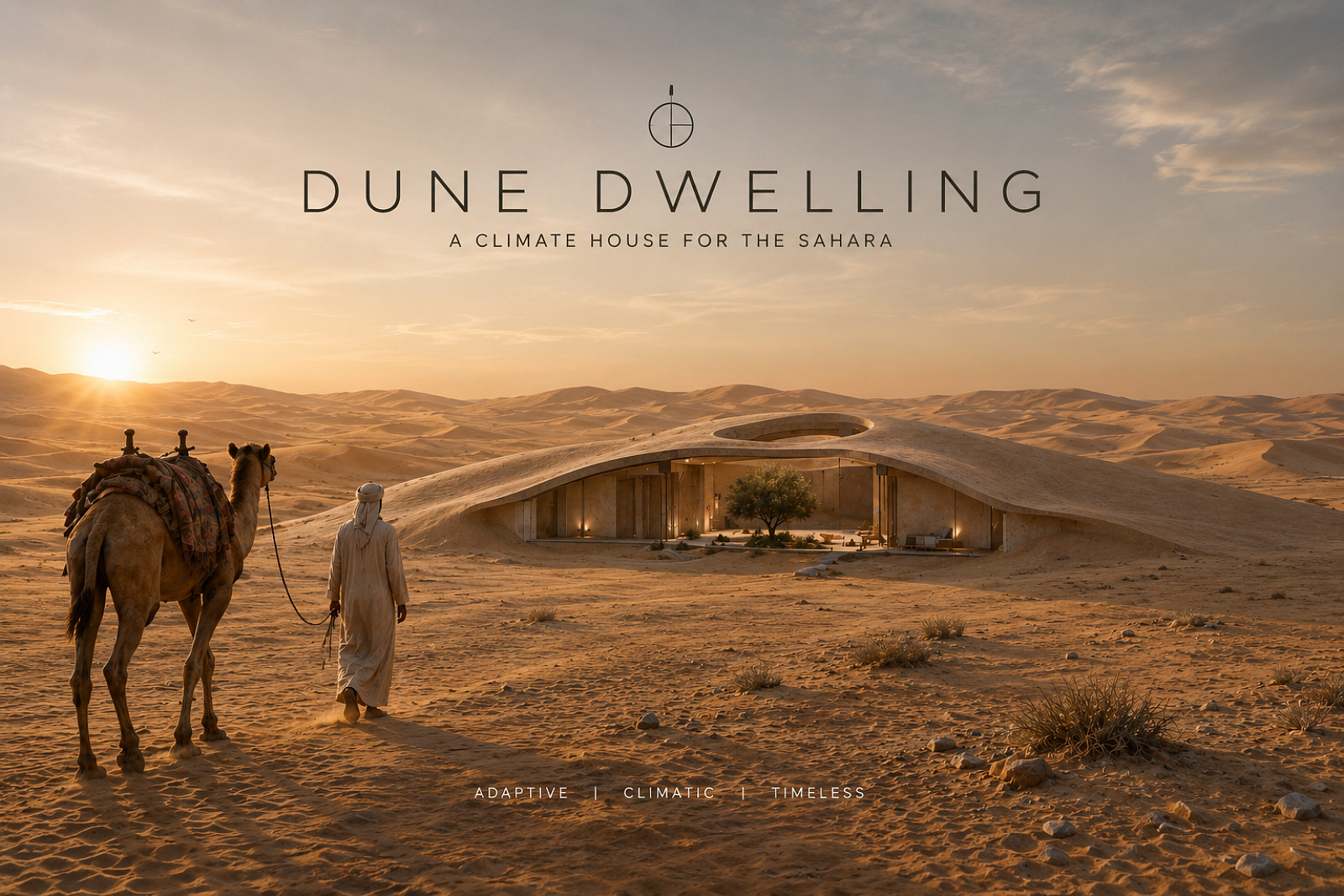
At the center of the house lies a courtyard open to the sky. This void acts as both a climatic regulator and the spatial heart of the dwelling, bringing together light, air, and everyday life. Movement through the project is gradual and intentional: from exposure to shelter, from brightness to shadow, and from heat to coolness. DUNE DWELLING dissolves the distinction between building and landscape. It is not placed on the dune; it becomes one. Over time, its edges blur, the roof merges with the terrain, and the horizon absorbs the architecture.
Technical information
The project is designed as a low-profile desert dwelling composed of an earth-integrated habitable base and an aerodynamic roof surface shaped to interact with wind and sand movement. Its architectural logic combines excavation, thermal mass, and environmental accretion. The lower structure uses thick mineral or earth-based walls to provide thermal stability, while the upper roofscape acts as a continuous climatic envelope that captures sand and gradually develops an insulating layer in response to the surrounding environment.
Environmental performance is central to the project. Passive cooling is achieved through ground contact, thermal inertia, recessed openings, controlled daylight, and air movement guided by pressure differences and vertical ventilation gradients. The central courtyard improves ventilation, introduces filtered light, and creates a protected microclimate at the heart of the dwelling. Materiality emphasizes earth, mineral mass, and durable desert-resistant construction, creating an architecture that is adaptive, low-tech, and deeply rooted in the logic of the Sahara landscape.

Copyright © 2026 INSPIRELI | All rights reserved. Use of this website signifies your agreement to the Terms of Use, Privacy Policy, and use of cookies.