El Pliegue de la Memoria


Project idea
EL PLIEGUE DE LA MEMORIA
Urban Regeneration Strategy – Active Memory Campus
Location: Tucumán, Argentina (Former Arsenal de Bajo)
1. PREAMBLE
This declaration outlines the vision, conceptual framework, and strategic objectives for the urban regeneration project titled "El Pliegue de la Memoria" (The Fold of Memory). The project aims to transform a historically closed military facility—a site of state repression during the 1976–1983 Argentine dictatorship—into a living, democratic, educational, and ecological campus. The fundamental purpose is to reclaim this scarred territory as a public space dedicated to human rights, justice, and civic responsibility.
Guiding Principle:
Memory is the Foundation. Education is the Bridge. Democracy is the Future.
2. HISTORICAL CONTEXT
The former Arenal de Bajo Arsenal in Tucumán operated as a clandestine center for detention, torture, and repression. It holds the memory of 980 individuals—workers, students, teachers, and citizens—who were murdered, disappeared, or forcibly separated from their families. For decades, this site remained walled off, hidden, and disconnected from the city, representing a wound in the collective conscience of Argentina. The project recognizes that the land holds memory, water heals, and the landscape remembers.
3. THE PROJECT IDEA: A FOLDED LANDSCAPE OF REMEMBRANCE
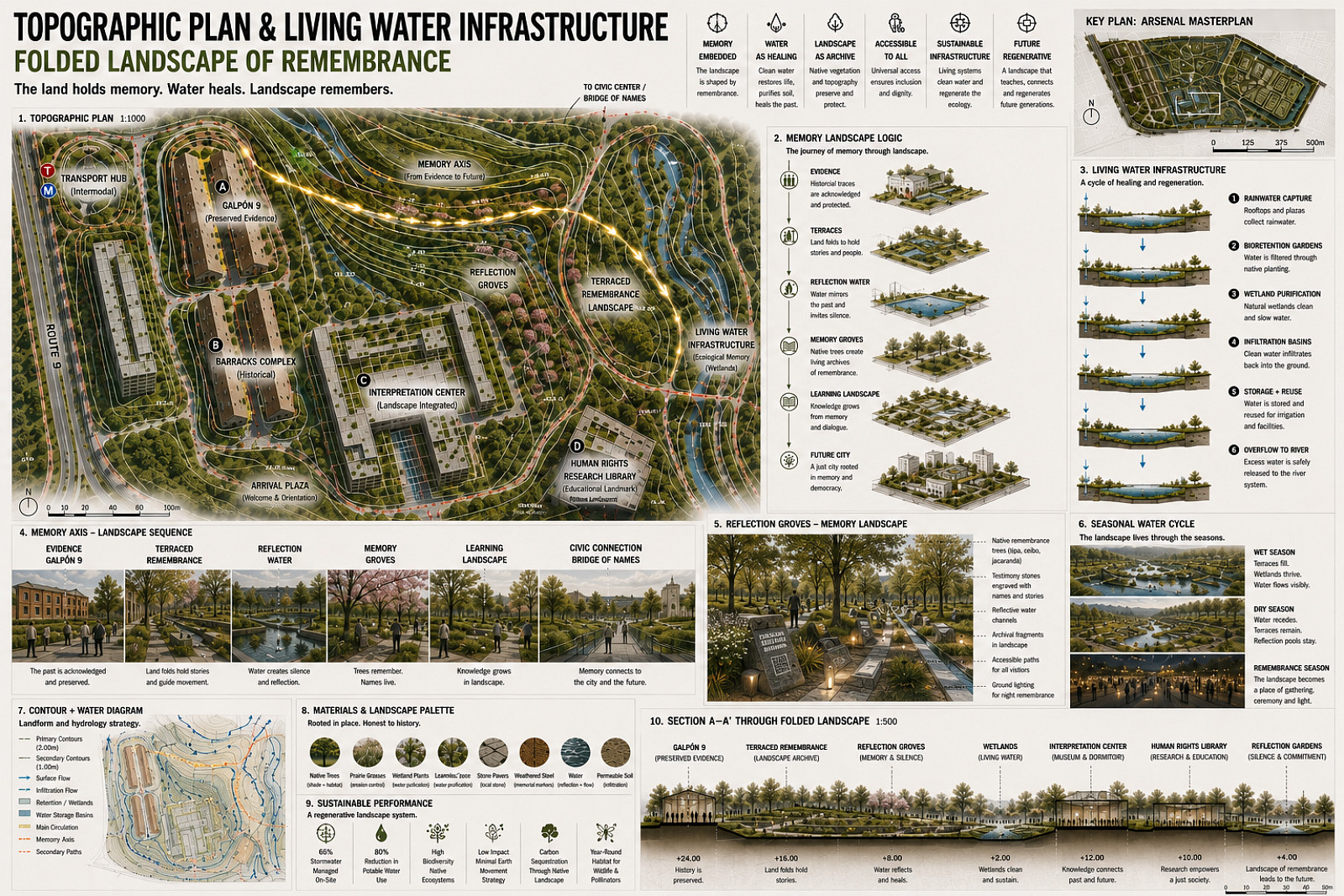
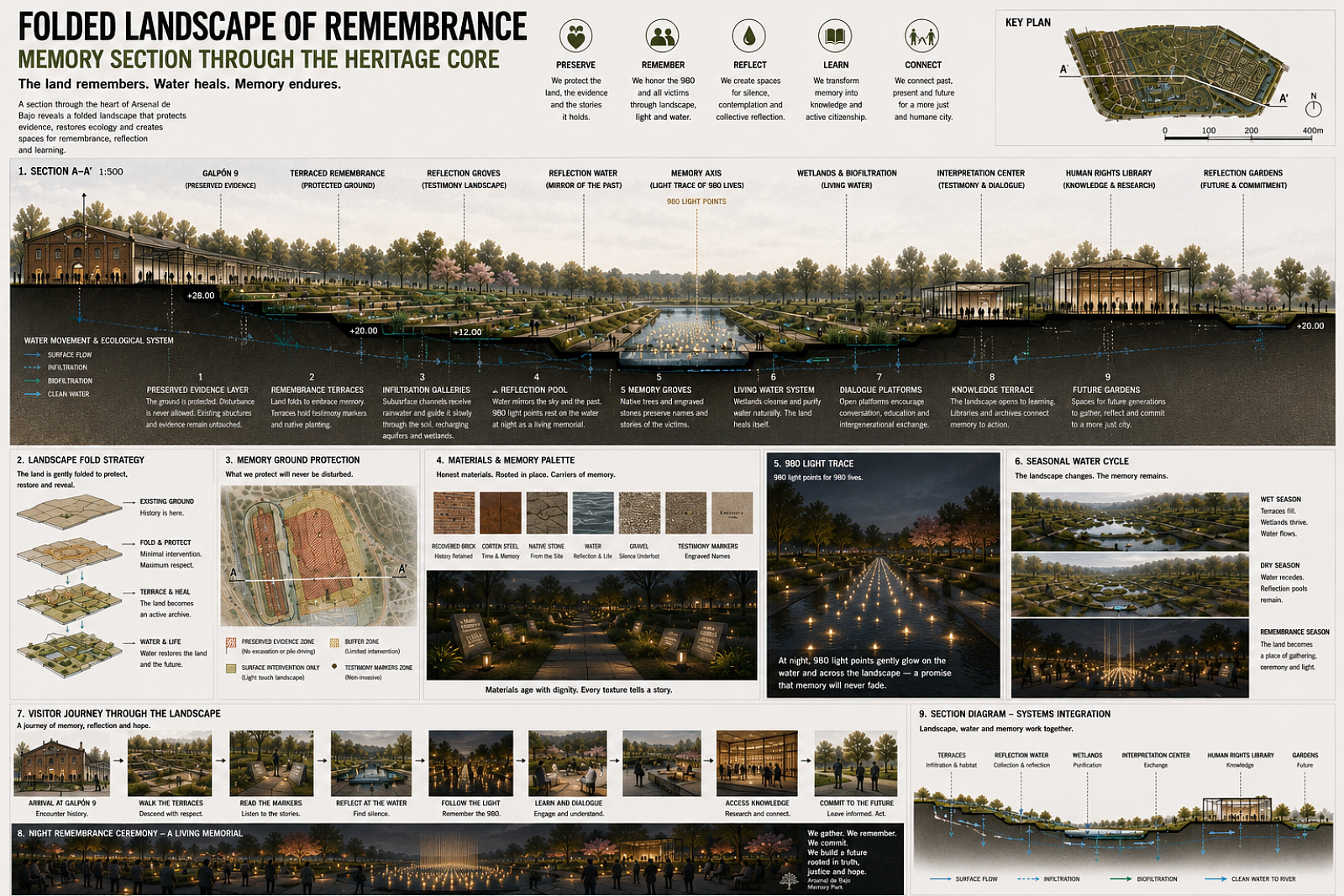
The core idea is to avoid erasing history or building over trauma. Instead, the project "folds" the landscape, weaving together the scars of the past with a future of hope. It is not a passive memorial park but an Active Memory Campus.
The design follows a continuous physical and emotional journey through three key phases:
Evidence → Memory: Preserving the physical remains of the original military site (Galpón 9 and Barracks Complex) to provide irrefutable testimony.
Memory → Knowledge: Guiding visitors through the "Dome of Ashes" and "Bridge of Learning" to transform emotion into understanding.
Knowledge → Democratic Responsibility: Fostering active citizenship through the Interpretation Center, Human Rights Library, and civic gathering spaces.
4. CORE ARCHITECTURAL & LANDSCAPE INTERVENTIONS
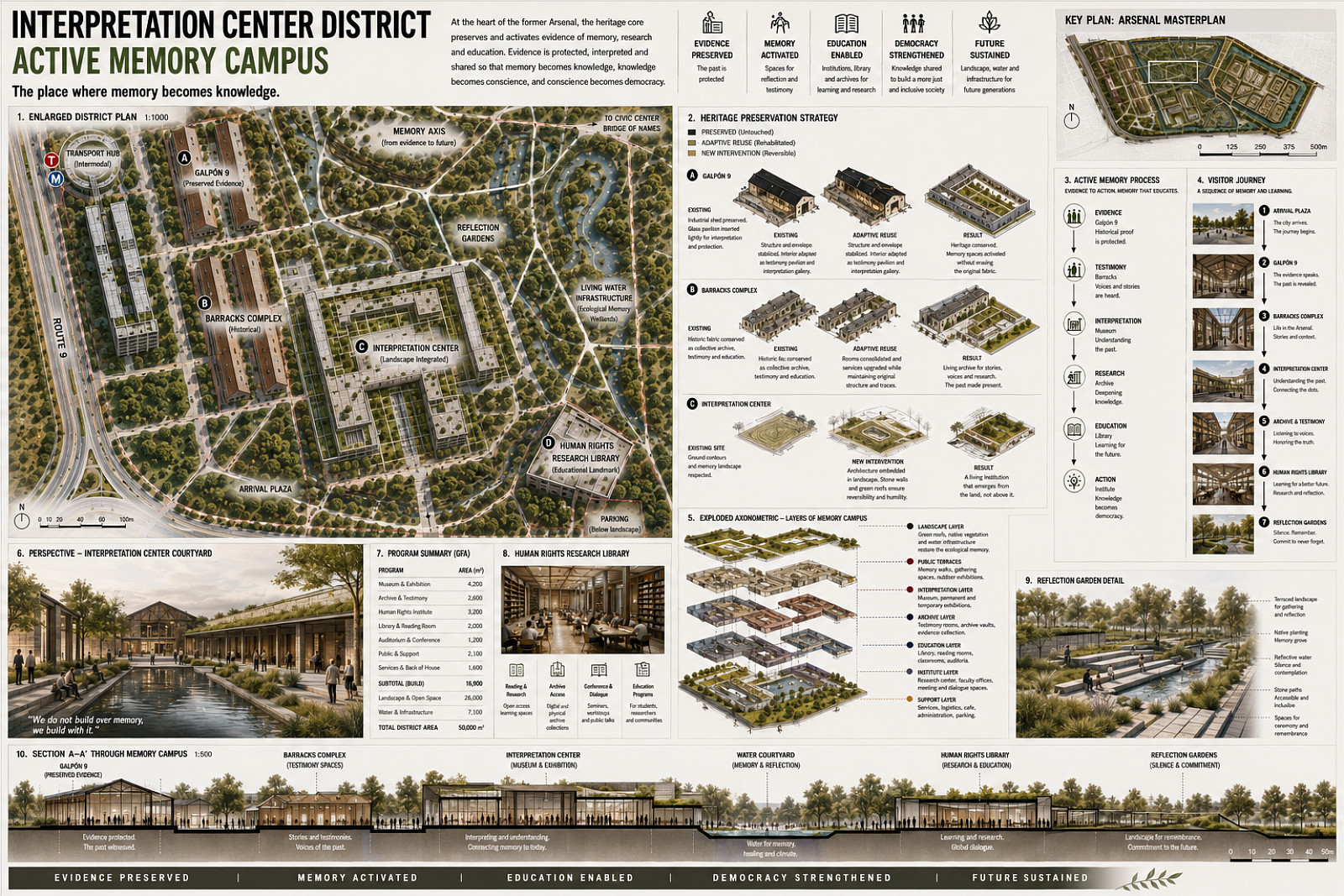
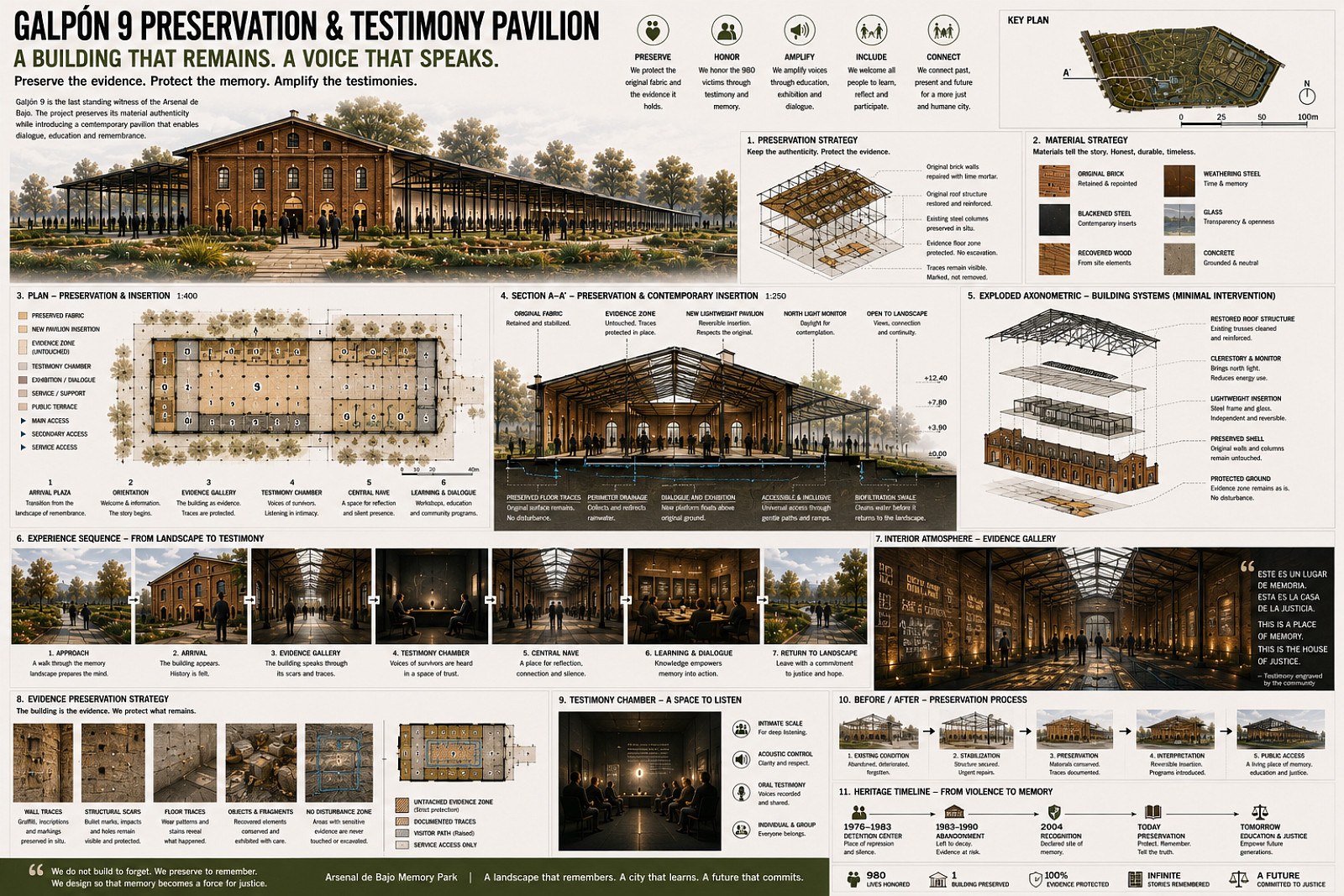
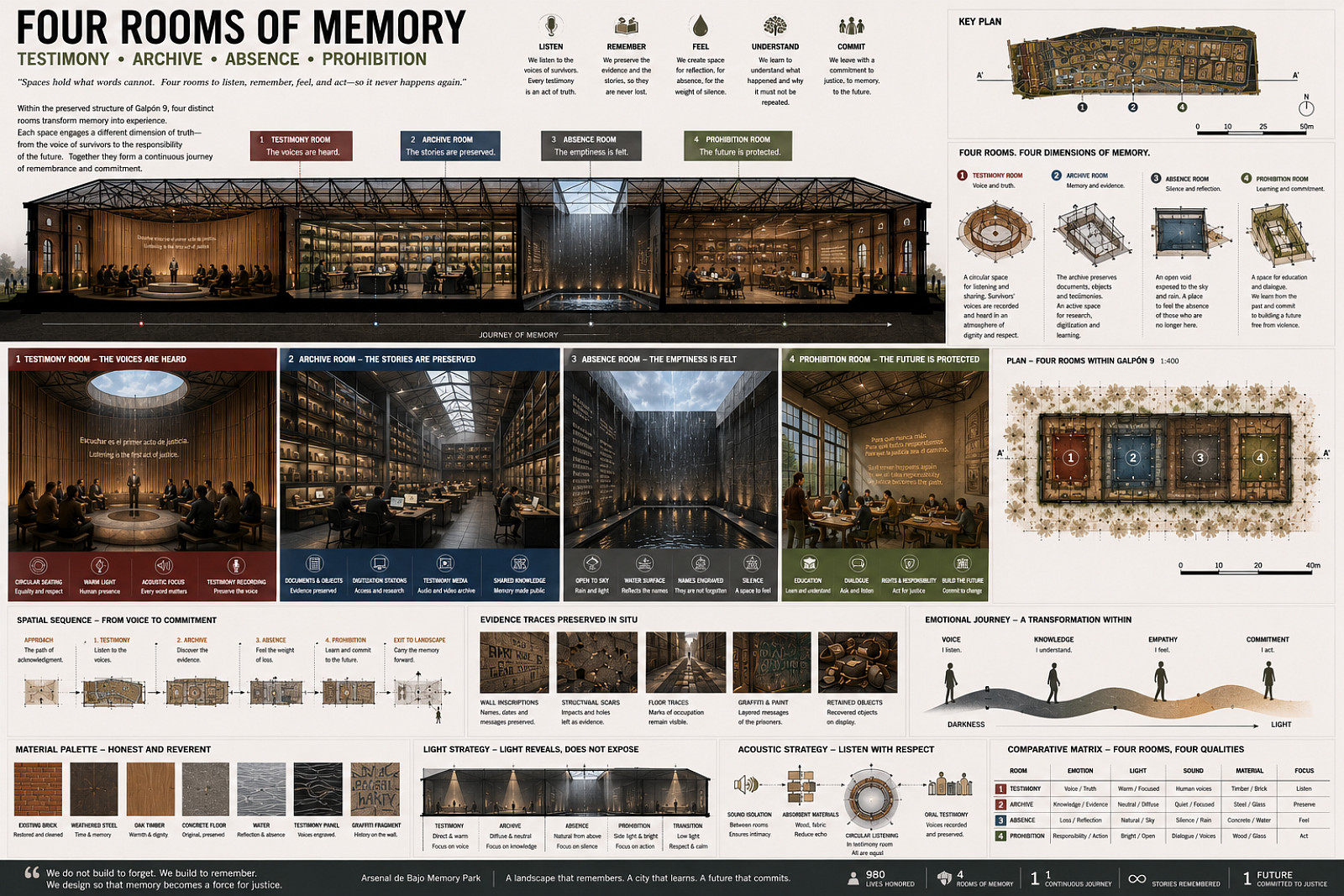
Galpón 9 (Preservation & Testimony Pavilion): The original brick warehouse is preserved as a "building that remains." Inside, it is divided into Four Rooms of Memory: Testimony, Archive, Absence, and Prohibition.
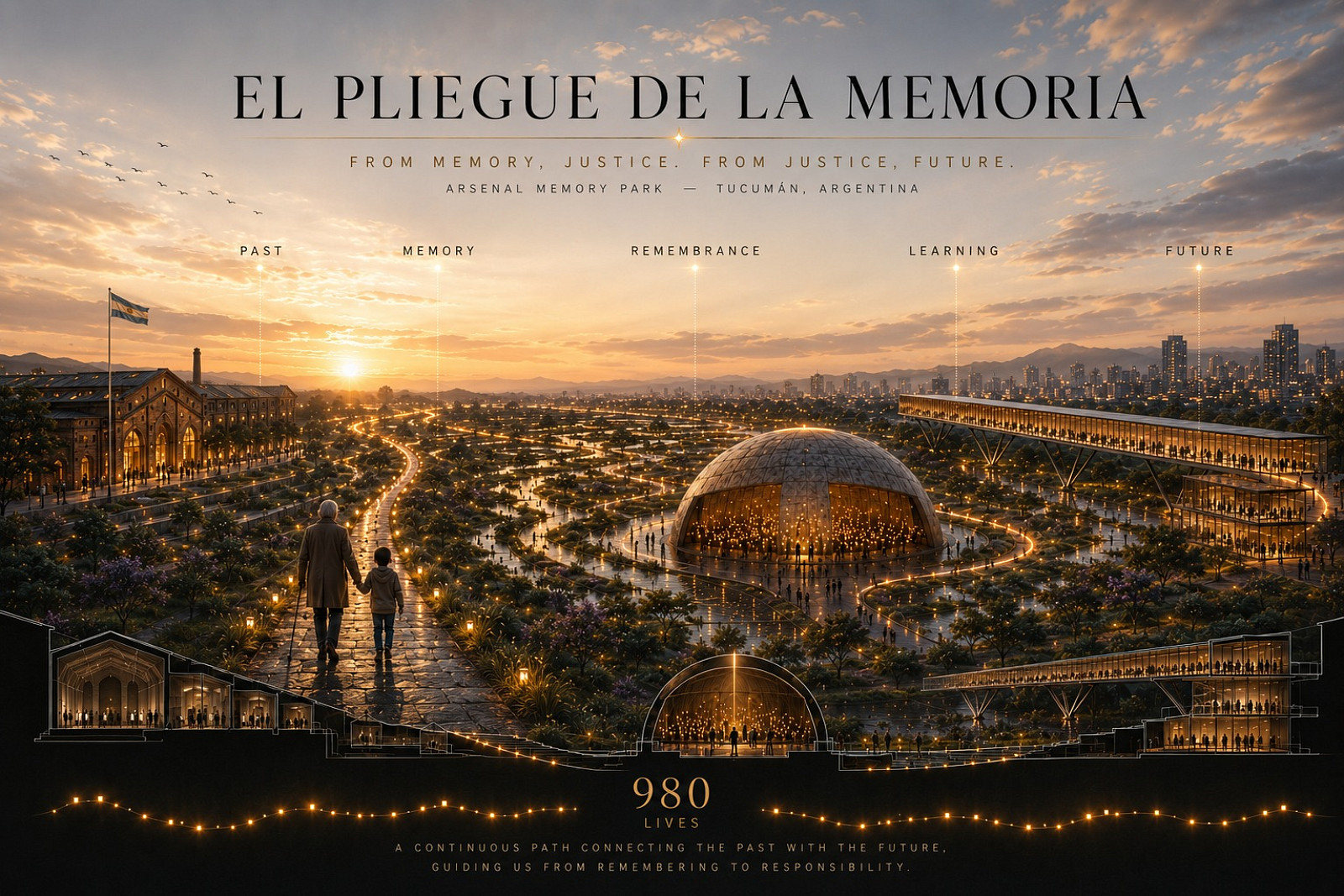
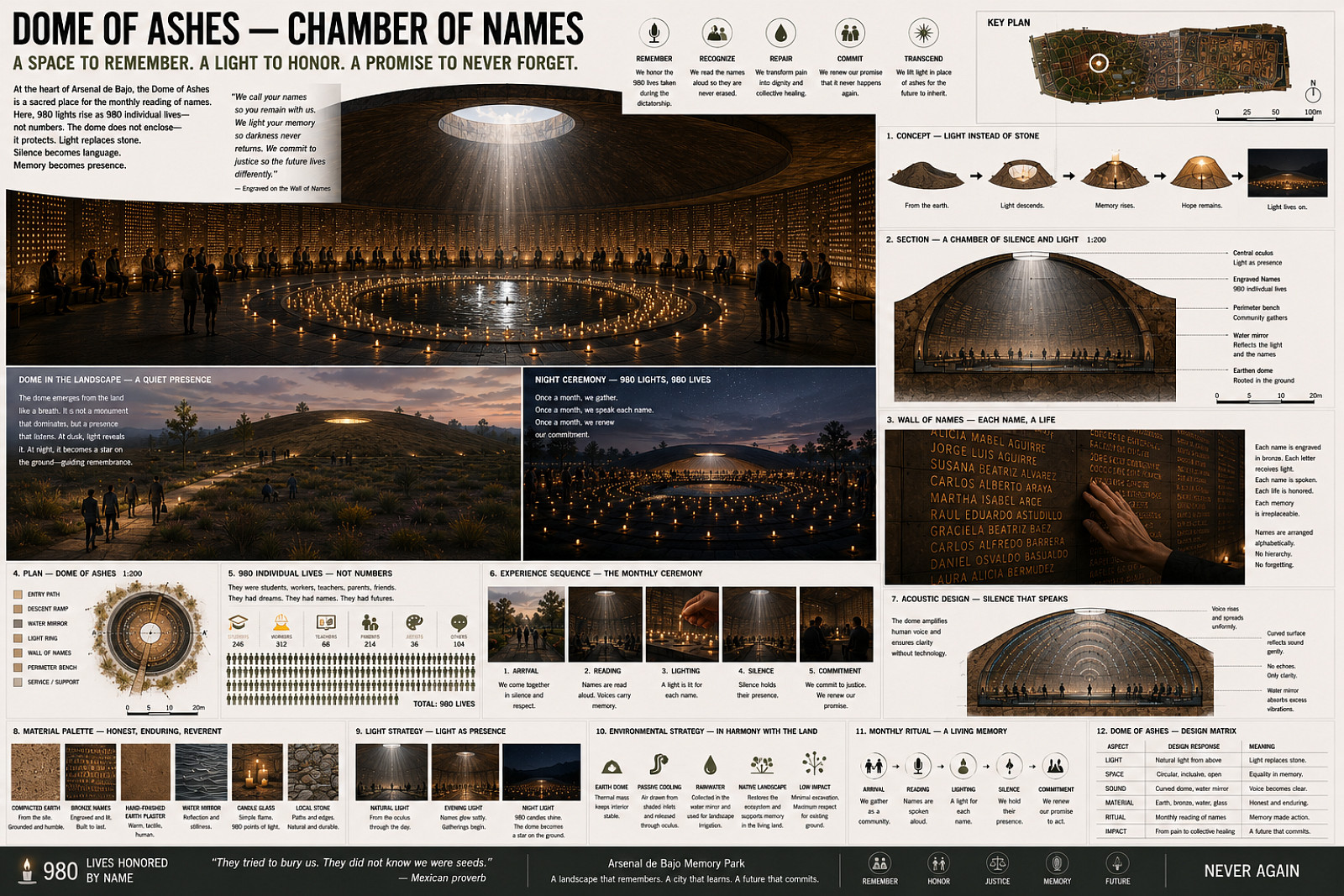
Dome of Ashes (Chamber of Names): A large, semi-submerged dome with an oculus. Inside, 980 points of light represent each lost life. "Light replaces stone. Silence becomes language."
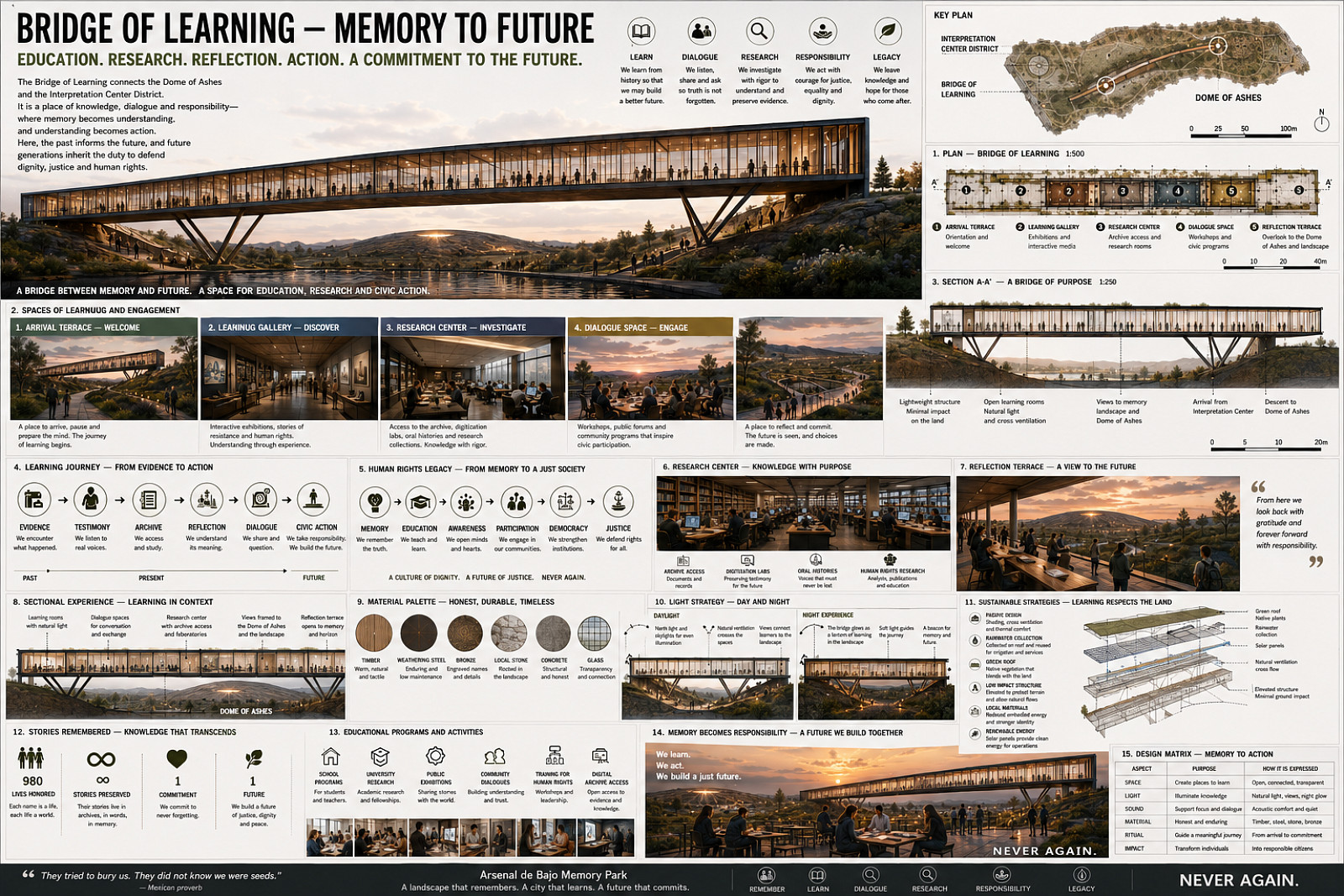
Bridge of Learning: An elevated pedestrian bridge physically connecting the Dome of Ashes (remembrance) to the Interpretation Center (future). It houses classrooms, a research center, and a reading room to ensure "Never Again."
Folded Landscape & Living Water Infrastructure: The topography is manipulated to create terraces that hold memory. A sustainable water system captures, filters, and purifies rainwater, symbolizing societal cleansing and healing.
5. GOALS & OBJECTIVES
Goal 1: Preserve and Testify
Protect the authentic architectural heritage of the former military arsenal.
Ensure physical evidence of state violence remains visible and accessible.
Honor the 980 victims by name through enduring spatial design.
Goal 2: Educate and Empower
Establish the campus as a leading center for human rights education in Latin America.
Utilize architecture as a pedagogical tool to provoke critical thinking about violence, justice, and democracy.
Provide research libraries and archival spaces for scholars and the public.
Goal 3: Heal and Restore
Reclaim the industrial site as a lush, ecological, and resilient public park.
Remediate contaminated soil and integrate "Living Water" systems for environmental regeneration.
Reconnect the site physically and socially with the surrounding city neighborhoods.
Goal 4: Foster Civic Action
Create spaces for community gathering, dialogue, and public events.
Empower future generations to take responsibility for defending democracy and human rights.
Transform a site of shame into a destination for inspiration and commitment.
6. CONCLUSION
El Pliegue de la Memoria is neither a tomb for the dead nor a relic of the past. It is a university for the living, a bridge between what was lost and what must be built. Through the honest use of materials (reclaimed brick, weathered steel, concrete, and wood) and the spiritual integration of light and water, this project asserts an unbreakable promise:
"We do not build over memory. We build with it. Never Again."
Project description
Scope of the Project Solution
The scope of "El Pliegue de la Memoria" extends far beyond traditional memorialization. It is a holistic urban regeneration strategy that transforms a 350-hectare, historically isolated military compound into a fully integrated, active, and living civic ecosystem. The solution is structured around four interconnected operational scopes:
1. Physical & Architectural Scope (Heritage & New Construction)
Preservation of Evidence: The complete preservation, stabilization, and adaptive reuse of the historic Galpón 9 (Testimony Pavilion) and the Barracks Complex. These structures are not demolished; they are treated as archaeological evidence.
New Memorial Landmarks: The construction of the Dome of Ashes (a subterranean chamber housing 980 lights representing the disappeared victims) and the Bridge of Learning (an elevated structure connecting the past to the future).
Civic Infrastructure: Development of the Interpretation Center, the Human Rights Research Library, and the Civic Center to serve as the programmatic heart of the campus.
Landscape Architecture: The creation of the "Folded Landscape" including Reflection Groves, Memory Groves, and Learning Landscapes that physically hold the history of the site.
2. Environmental & Ecological Scope (Living Water Infrastructure)
Stormwater Management: Implementation of a basin system to capture rainwater from the entire 350 ha site.
Water Purification: Integration of constructed wetlands and bioswales to naturally filter and clean water before it infiltrates back into the ground or is reused for irrigation.
Ecological Restoration: Reforestation with native species, soil remediation of the former industrial grounds, and the creation of a resilient, biodiverse park that heals the land.
3. Socio-Cultural Scope (Memory, Education & Justice)
Memory Protection: Housing the "Four Rooms of Memory" (Testimony, Archive, Absence, Prohibition) to ensure the 980 victims are never forgotten. The site will store over 7,000 documentary archives related to the dictatorship.
Educational Programs: Providing permanent facilities for 12,000+ students annually, university research, and international human rights seminars.
Community Engagement: Creating open, accessible public spaces for reflection, gathering, and civic dialogue. The site will directly generate 8,000+ jobs and serve an estimated 25,000+ new residents in the surrounding area.
4. Urban & Strategic Scope
Connectivity: Reopening the formerly walled-off Arsenal to the city via new transit nodes (BRT, subway, bike lanes) and pedestrian routes.
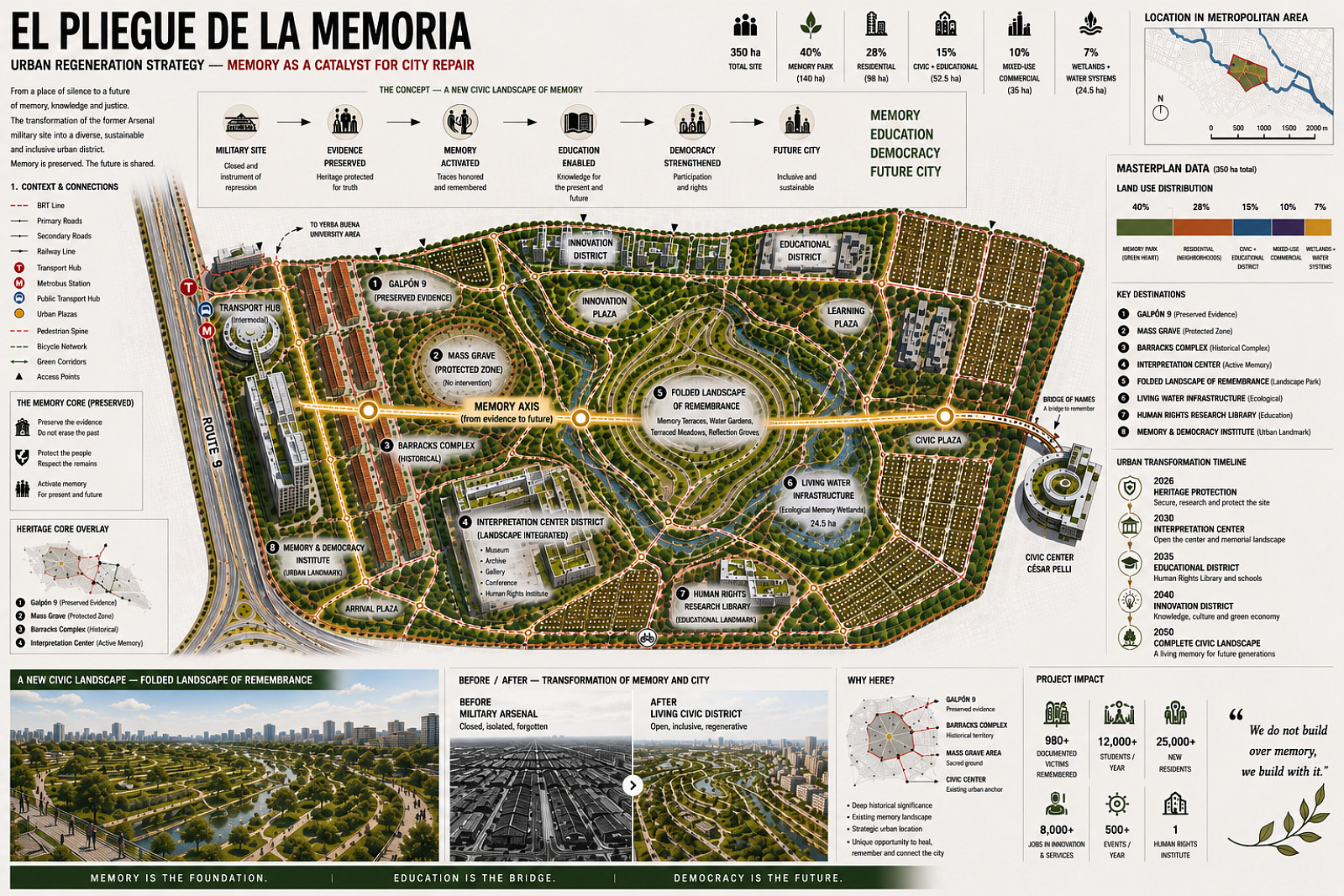
Phased Implementation: A structured timeline spanning from 2026 to 2030+ ensuring logical, sustainable development:
2026: Heritage Protection and Galpón 9 Pavilion
2028: Interpretation Center & Human Rights Library
2030: Educational District & Bridge of Learning
2030+: Civic Center & Urban Integration
Key Performance Indicators (KPIs) for the Scope
980 lives honored by name.
350 ha of urban land regenerated.
40% of the site dedicated to green memory landscape.
25,000+ new residents impacted.
100% water self-sufficiency through the Living Water Infrastructure.
Technical information
Site & Land Use Data
The total project site encompasses 350 hectares, organized into four primary land use categories. The largest portion, accounting for 140 hectares or 40% of the total area, is dedicated to the Memory Park and green landscape. The residential districts occupy 98 hectares (28%), followed by the educational district at 52.5 hectares (15%), and commercial or mixed-use areas covering 35 hectares (10%). The remaining 24.5 hectares (7%) are allocated to the Living Water Infrastructure, including retention basins and constructed wetlands.
Architectural & Structural Specifications
The project employs a dual strategy of heritage preservation and new construction. For the existing heritage structures, specifically Galpón 9 and the Barracks Complex, the technical approach prioritizes the retention of original industrial brick masonry façades and structural walls, dating from approximately 1900 to 1950. A new lightweight steel roof structure and independent internal floor plates are inserted within these shells, utilizing corrugated weathering steel (Corten) and translucent polycarbonate panels to provide natural daylight. Existing masonry is reinforced with carbon fiber strips where necessary, while new internal steel H-beams support the inserted floors.
The new memorial landmarks introduce distinct structural typologies. The Dome of Ashes (Chamber of Names) is designed as a semi-subterranean reinforced concrete shell with a double curvature. With an internal diameter of approximately 20 to 25 meters and a height of roughly 8 to 10 meters, it features a central oculus of 2.5 meters in diameter to channel natural light. The floor consists of polished concrete embedded with 980 discrete LED light points. The Bridge of Learning is an elevated pedestrian skywalk spanning approximately 180 meters in length and 6 to 8 meters in width. Its structure is a steel truss with a concrete deck, enclosed by high-performance low-E glass façades.
The Interpretation Center and Human Rights Library comprises a total built area of approximately 11,100 square meters. This includes 4,200 square meters for museum and exhibition spaces, 2,200 square meters for the human rights library, 1,000 square meters for a reading room, and supporting administrative and back-of-house services. The structure is a reinforced concrete frame with exposed weathering steel cladding.
Landscape & Living Water Infrastructure
The Living Water Infrastructure is a closed-loop, nature-based stormwater management system designed to achieve 100% self-sufficiency for park irrigation. The entire 350-hectare site is graded to channel rainwater into retention gardens and bioswales, which feed into constructed wetlands for natural filtration before discharging into infiltration basins for groundwater recharge. Storage cisterns hold surplus water for use during the dry season. The terrain itself is manipulated into a "folded landscape" featuring artificial terraces, ridges, and basins that create distinct memory zones, with elevation changes ranging from +5 meters to +15 meters above the base level. Biological treatment is applied on-site to remediate contaminated former industrial soil. The vegetation strategy employs native species of the Tucumán region, including Tipuana tipu, Ceiba speciosa, and Jacaranda mimosifolia. A total of 980 trees are planted within the Memory Groves, representing each victim, with vegetation covering approximately 60% of the park's total area.
Materials & Finishes
The material palette is selected for honesty, durability, and endurance. Reclaimed brick is used for the existing Galpón 9 façades and new paving. Weathering steel (Corten) serves as cladding, roofing, bridges, and structural elements. Exposed concrete forms the Dome of Ashes shell, paving, and foundations. Structural timber is used for accent structures and bridge decking, while natural stone is reserved for memorial walls and plazas. Recycled wood is applied to fencing and outdoor furniture, and high-performance low-E laminated glass is utilized for the bridge enclosure, skylights, and internal partitions.
Lighting Design
The lighting strategy prioritizes solemnity and restraint. Memorial lighting consists of 980 discrete warm white LED point lights (2700K) embedded in the Dome of Ashes floor and tracing the "Path of Light" across the park. To maintain a respectful atmosphere, the maximum illuminance in memorial zones is limited to 5 lux—equivalent to moonlight or starlight—to avoid visual pollution. Public spaces are lit with low-height bollard lights and pedestrian poles featuring cut-off optics to prevent glare. The guiding principle for lighting is: "Light reveals, does not expose."
Sustainability Targets
The project targets ambitious sustainability metrics. Net zero energy is achieved through rooftop photovoltaic panels on new buildings, estimated at 1,500 kW capacity. The water balance targets zero potable water use for landscape irrigation. The 980 memorial trees and wetland systems are projected to sequester approximately 1,200 tons of CO₂ per year. Over 40% of total construction materials, by weight, will come from recycled content. The project aims for "Living Building Challenge" or "EDGE" certification to validate its social and environmental performance.
Construction Phasing
The technical implementation follows a phased timeline. Phase 1 in 2026 focuses on heritage stabilization of Galpón 9, soil remediation, and the construction of initial wetland basins. Phase 2 in 2028 includes the completion of the Interpretation Center and Human Rights Library. Phase 3 in 2030 delivers the Educational District and the Bridge of Learning. Phase 4, from 2030 onward, completes the Civic Center and full urban integration, finalizing the transformation of the site.

Copyright © 2026 INSPIRELI | All rights reserved. Use of this website signifies your agreement to the Terms of Use, Privacy Policy, and use of cookies.