Terranga School
Project idea
A school design using local materials such as brick and timber, set in an African context, emphasizing inclusivity and community gathering spaces.
Project description
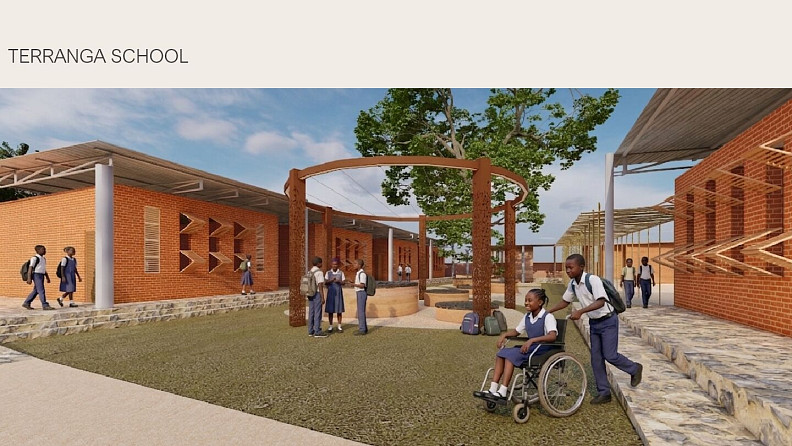
The Terranga School in Djilakh emerges as a bioclimatic manifest for rural Senegal, addressing critical infrastructure gaps through ecological design and socio-spatial inclusion. Conceived as a modular, climate-resilient learning environment, the project moves away from resource-heavy, imported materials in favor of a circular economy that celebrates regional craftsmanship and vernacular heritage. The architecture is structurally defined by single-story classroom blocks arranged around a vibrant, central community courtyard. Utilizing stabilized rammed earth (pisé) and clay bricks, the buildings maximize thermal mass to combat extreme Sahelian heat. To further optimize indoor comfort, an innovative Typha-based insulation system serves as a thermal buffer, while expansive, lightweight fly-roofs and adjustable timber brise-soleils facilitate continuous passive cross-ventilation. Beyond technical performance, the school acts as a living pedagogical tool. The landscape integrates circular agricultural basins where students actively practice sustainable gardening, fostering a deep connection to ecology and food security. Fully accessible pathways ensure that every child including those with reduced mobility can navigate the campus with dignity, making the Terranga School a holistic model for affordable, empowering, and context-adapted rural education. The Terranga School project features single-story brick buildings with large overhanging roofs supported by bamboo and steel structures. The campus is organized around a central courtyard with a prominent tree and circular steel structure serving as a gathering point. The architecture incorporates natural ventilation through decorative brick openwork patterns in the walls. The design is inclusive, accommodating wheelchair access throughout the campus grounds.
Technical information
Construction utilizes locally sourced brick masonry walls with stone base courses. Roof structures employ bamboo trusses with metal sheet roofing and generous overhangs for sun protection. Ventilation is achieved through patterned brick openings in walls. Pathways and ramps ensure accessibility. For bioclimatic insulation, local Typha reeds are processed into thermal panels integrated into ceiling and wall cavities, while an overhanging, double-skin corrugated metal fly-roof elevated on slender columns allows wind to sweep away accumulated heat before it reaches the interior. This extended roof profile forms deep, shaded exterior corridors that shield the earthen facades from direct sun. Natural ventilation is maximized by aligning window apertures across the modular classrooms to ensure continuous passive cross-ventilation, regulated by custom adjustable timber brise-soleil screens that eliminate glare without obstructing airflow. Finally, the campus integrates circular agricultural basins made of low-profile rammed earth rings for student-led vegetable cultivation, surrounded by permeable gravel and stone paths that facilitate immediate rainwater infiltration into the local water table.

Copyright © 2026 INSPIRELI | All rights reserved. Use of this website signifies your agreement to the Terms of Use, Privacy Policy, and use of cookies.