The Bambouti Hub
Project idea
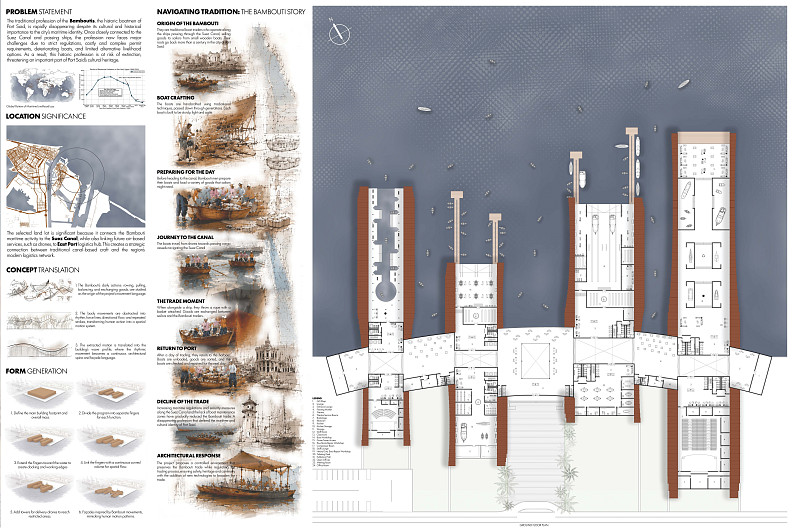
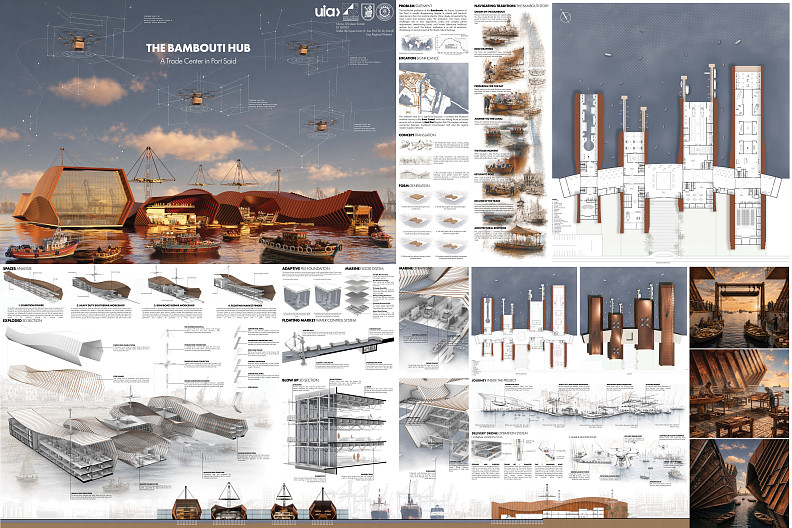
The idea of this project is to revive and protect the disappearing Bambouti tradition in Port Said. The Bambouti are a crucial part of Port Said’s maritime and cultural identity, as their work has historically connected the city, the Suez Canal, passing ships, and local trade through a unique boat-based profession. Today, this tradition is declining because of modern port regulations, safety restrictions, larger ships, and the loss of direct access between the Bambouti community and the canal. The project responds to this problem by proposing a new waterfront trade and cultural center that gives the Bambouti a legal, safe, and organized place to continue their work. The project is inspired by the Bambouti’s daily movement between land, water, boats, goods, and ships, and by the strong relationship between Port Said’s identity and the Suez Canal. The main objective is not only to preserve the Bambouti as a cultural memory, but to transform it into a living and sustainable profession. The project combines traditional boat trading, public education, craft preservation, boat repair, and modern delivery technologies such as drones. In this way, the project becomes a bridge between heritage and innovation, allowing the Bambouti tradition to survive within the future of maritime trade.
Project description
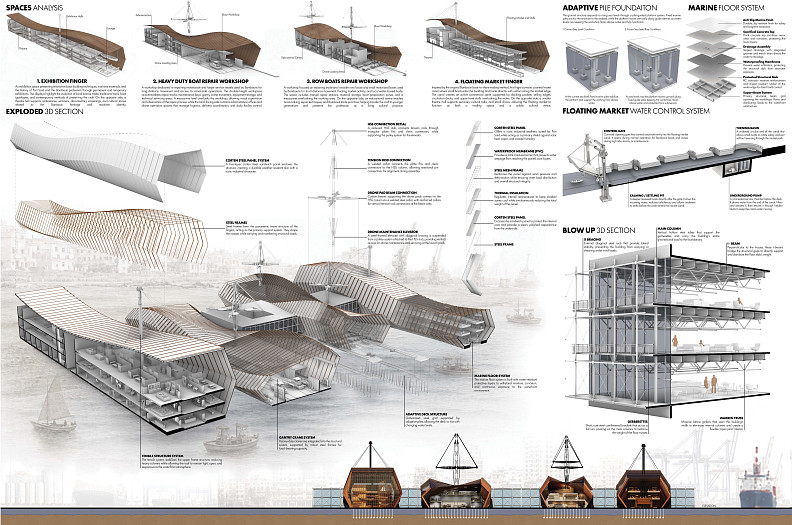
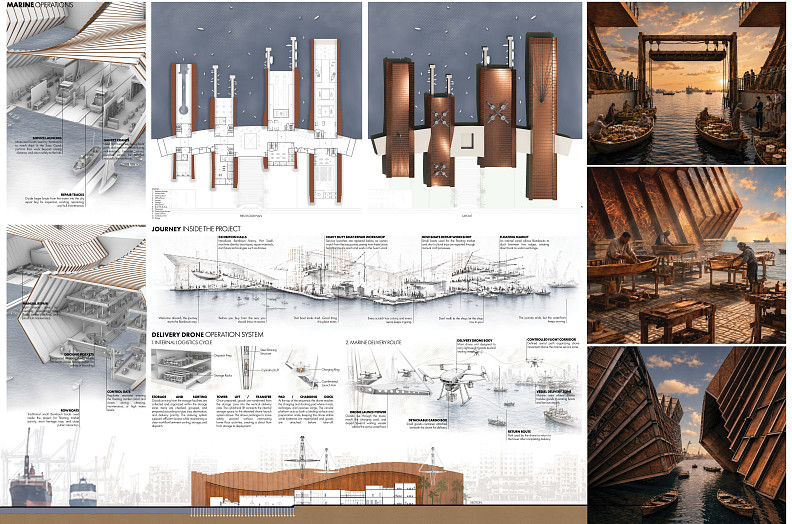
The project consists of a waterfront hub located in Port Said, designed as a trade center, cultural destination, and working base for the Bambouti community. The architectural layout is formed by several linear buildings extending toward the water like fingers, with canals between them that allow boats to enter the project. The main areas of the project include exhibition halls, boat repair workshops, a floating market, administration spaces, public waterfront zones, and drone operation areas. The exhibition halls present the history of the Bambouti, the maritime identity of Port Said, traditional boat crafting, and the development of trade along the Suez Canal. The heavy-duty boat repair workshop is designed for maintaining larger service boats and launches used by the Bambouti, while the small boat workshop supports row boats and light motor boats used in the floating market and local activities. Mezzanine levels allow visitors to observe the repair and crafting process without disturbing the workers. The floating market is the heart of the project. Water enters the building through controlled canals, allowing small boats to move inside and sell goods directly to visitors standing along both sides of the canal. This recreates the traditional Bambouti trading experience in a safer and more organized architectural setting. The project also introduces a drone delivery system that supports the Bambouti by reaching ships or areas that may be difficult or unsafe to access by boat. Through this combination of boats, canals, workshops, exhibitions, and drones, the project creates a complete system for preserving the profession while adapting it to contemporary port conditions.
Technical information
The project is designed for a marine waterfront environment and uses a structural and technical system suitable for water, boats, and changing sea conditions. The building is supported by a pile foundation system, with an adaptive pile concept that responds to future water-level changes and allows the project to remain connected to the sea. The main construction system is based on steel framing, which provides the large spans required for boat repair workshops and flexible interior spaces. The heavy-duty workshop requires a high internal clearance to accommodate larger service boats, while the smaller workshop is designed with lighter structural requirements for row boats and small motorized boats. The building envelope uses marine-resistant materials, including steel elements, glass openings, and corten-inspired cladding. The corten-like exterior gives the project an industrial maritime character that reflects the port context of Port Said, while also creating a strong visual identity for the waterfront. The floating market is supported by a controlled water-entry system. Gates regulate the movement of water and boats into the internal canals, while organized canal edges allow visitors and sellers to interact safely. Boat circulation and pedestrian circulation are separated to improve safety and clarity of movement. The drone operation system includes dedicated landing, charging, and control areas. The drones are used for small delivery operations and are integrated into the project without interrupting public movement or boat circulation. Environmental strategies include natural ventilation in the workshops, shaded public circulation, the cooling effect of water canals, and a foundation approach that respects the marine context. The project combines architecture, marine infrastructure, craft production, public experience, and technology into one integrated technical system.
Christeen Sameh
Cairo University, Faculty of Engineering Architecture Department.
Egypt
Arquitectura
Proyecto enviado
08. 06. 2026Etiqueta
- Bank
- Exhibition Center
- Office
- Pop Up
- Retail
- Shopping Mall
- Showroom
- Supermarket
- Cultural Center
- Gallery
- Hall/Theatre
- Memorial
- Observation Tower
- Pavillion
- Religious
- Scuplture
Consejo a estudiantes

Copyright © 2026 INSPIRELI | All rights reserved. Use of this website signifies your agreement to the Terms of Use, Privacy Policy, and use of cookies.