Portal Campo de los Alisos
Idea projektu
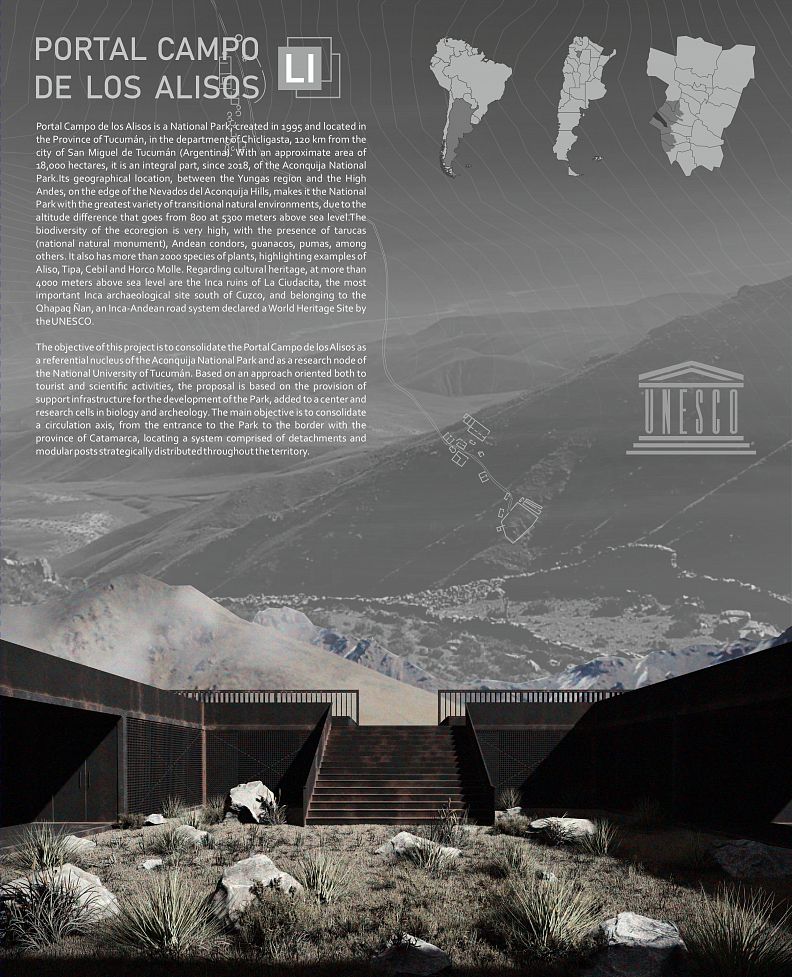
The project is located in the Aconquija National Park, that belongs to Las Yungas and Los Altos Andes region, on the edge of Los Cerros Nevados del Aconquija, Tucumán, Argentina. The main objective of the project is to strengthen the Campo Portal de los Alisos as a referential node of the Aconquija National Park and as a research node of the National University of Tucumán. The proposal presents an approach oriented to tourist and scientific activities. It is based on the provision of infrastructure for the development of the park in addition to a biology and archeology research center and cells. The purpose is to consolidate a main circulation axis, from the entrance to the park to the border with the province of Catamarca, locating a system comprised of detachments strategically distributed throughout the territory. Considering the diverse and extensive geography and bioclimatic environments, we decided to propose a type of architecture that is capable of containing diverse situations, organizing it based on a logic of binary opposites: black and white, light and shadow, warmth and coldness, on one hand, and full and empty places, unity and fragmentation, tectonicity and stereotomicity on the other hand. These are the pairs that, from the use of the mercator lattice as a neutral element of combination, are involved in the search of matching the different nuances that make up the project, characterized by the absence of references and anti-hierarchy.
Popis projektu
Starting from the module, as a basic unit of composition, and from the grid as a spatial matrix that gives rise to the different configurations, we propose a project where compositional logic is characterized by its flexibility, evolutivity, stageability, adaptability and correlation. Flexibility from the typological point of view, where the modules can be arranged in multiple ways, giving rise to different spatial structures and conformations. Evolutivity understood from growth or decrease through time, without altering the essence. Stadability from the constructive point of view, since it can be built progressively over time. Adaptability because it adjusts to the different topographic and environmental situations of the Park. Correlativity for proposing a type of architecture that, following the same guidelines, responds to different conditioning factors. From the use of the module we generate super modules, which imply different buildings. At the same time, the modules can be divided into sub-modules giving rise to internal circulations, interior partitions, furniture distribution and standardization of construction pieces. The design of the proposal was conceived in cubic meters and not square meters, taking into account the different possibilities of combining modules to arrive at spaces of different magnitude. In the definition of the spaces, the materialization of the vacuum made possible the inclusion of nature inside the buildings. In the energetic aspect, the provision of electrical energy is given from the use of photovoltaic panels located on the top of the modules. In addition, all the facilities, including La Ciudacita, have a supply of water from natural courses, which is purified for consumption. Sewage waste is derived to biodigester systems for the benefit of the environment. The constructive technology adopted for the proposal is based on dry construction from industrialized parts. In this way, we respond to the conditions for loading and transferring materials throughout the park. The implantation of the buildings is done in pre-existing vegetation clearings, following a criterion of preservation of the flora of the place. At the same time, they are oriented to take advantage of the ideal sunlight conditions. Considering the variety of environments and climatic conditions, we appeal to its exterior insulation from the use of metal panels with polyurethane inside, both in exterior vertical enclosures and in upper and lower horizontal enclosures. Following the conservation criteria for natural reserves, we seek to minimize the building impact on the ground by providing the arrival of only structural elements that support the natural soil, both in the buildings and on the walkways. The proposed building system is based on a logic of decreasing the number of places available for both scientific and tourist activities as one moves up the route. While the internal disposition of each detachment responds to research, tourism, and surveillance activities.
Technické informace
Project: Portal Campo de Los Alisos Location: Chicligasta, Province of Tucumán, Argentina. Year of realization: 2020 Area: 18000 hectares Group: - Alfredo Fleischmacher - Patricio Corbella
Alfredo Fleischmacher, Patricio Corbella
Universidad Nacional de Tucumán, Facultad de Arquitectura y Urbanismo, Tucumán
Argentina
Architektura
Projekt odevzdán
14. 07. 2021Tag
- Schools
- Nursery
- University
- Library
- Other
Rada studentům
Portal Campo de los Alisos

Copyright © 2026 INSPIRELI | All rights reserved. Use of this website signifies your agreement to the Terms of Use, Privacy Policy, and use of cookies.


