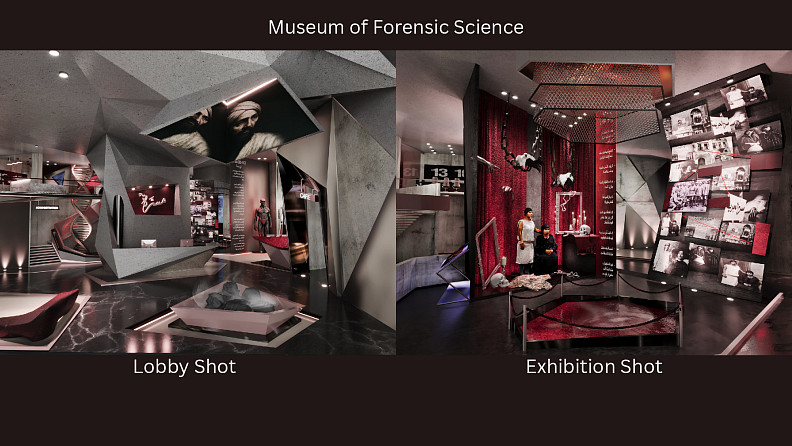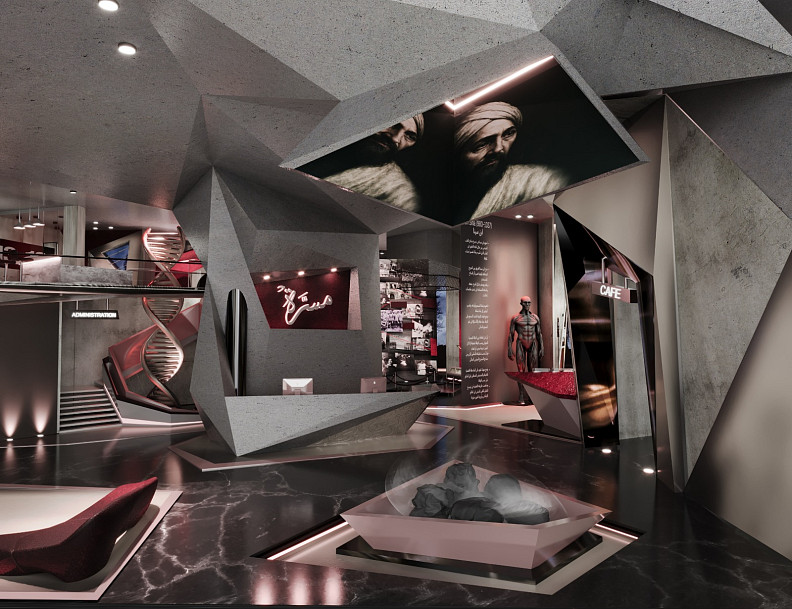
The presented project proposes an immersive museum interior structured around a chronological narrative that connects the history of forensic science with its contemporary developments. The concept of guiding visitors through a spatial sequence that reflects the transition from the era associated with Ibn Sina to modern scientific investigation is clearly articulated and provides a strong thematic framework for the exhibition. The gradual transformation of materials—from more organic textures and stone-like surfaces to glass, steel, and digitally integrated environments—serves as a symbolic representation of the historical evolution of medicine and forensic analysis.
The project also emphasizes experiential qualities by introducing a dynamic architectural language based on fragmented geometries, slanted partitions, and cantilevered elements. These design strategies aim to create a non-linear spatial journey that metaphorically reflects the investigative process of reconstructing evidence. The use of contrasting material finishes, ranging from rough concrete surfaces to highly polished elements, further reinforces the narrative of scientific development and technological advancement.
Visually, the design is characterized by a strong and expressive formal language. The interior employs dramatic geometries, integrated media displays, and contrasting lighting conditions to create a highly theatrical exhibition environment. The spatial composition seeks to engage visitors through multiple visual stimuli and immersive scenography, supporting the storytelling aspect of the museum narrative. The thematic focus on historical Egyptian criminals and their crimes introduces a distinctive cultural and historical layer within the exhibition structure.
From a technical perspective, the use of reinforced concrete and exposed steel as the primary structural system supports the ambitious spatial forms proposed in the design. The structural elements are not only functional but also play an important aesthetic role, contributing to the overall identity of the interior. The concept of jagged, deconstructed forms symbolizing fragmented evidence is clearly integrated into both the architectural language and the exhibition strategy.
Overall, the project presents a conceptually ambitious museum environment that attempts to combine historical narrative, symbolic architecture, and immersive exhibition design within a single spatial framework.
As a recommendation, it may be beneficial to further consider the balance between expressive architectural forms and the clarity of exhibition presentation. The current composition introduces many strong visual elements—complex geometries, dynamic lighting, and numerous exhibition components—which together create a highly intense spatial experience. A slight reduction or clearer hierarchy of visual elements could potentially improve the readability of the exhibition narrative and allow visitors to focus more easily on the displayed content. Strengthening the spatial hierarchy and simplifying selected areas might enhance orientation within the museum while maintaining the intended immersive character of the design.
Museum of Forensic Science
Idea projektu
The interior design follows a chronological immersive path, transitioning from warm, stone-textured galleries reflecting Ibn Sina’s era to sleek, glass-and-steel corridors representing the scientific shift to Europe. Minimalist white surfaces and integrated digital displays define the modern zones, using blue ambient lighting to symbolize DNA and digital forensics. By evolving materials from organic wood to industrial metals, the architecture physically mirrors the transition from ancient medicine to modern justice. The final gallery uses a reflective, open layout to facilitate a modern academic atmosphere focused on contemporary behavioral analysis.
Popis projektu
Main area is an area of Historical Egyptian Criminals and their crimes.
Technické informace
The museum’s construction features a High-Strength Reinforced Concrete and Exposed Steel skeleton, utilizing jagged, deconstructed geometries to symbolize the fragmented nature of criminal evidence. Slanted load-bearing partitions and cantilevered slabs create a non-linear path, forcing visitors to navigate the space like an investigator piecing together a complex case. The material palette transitions from Rough-Cast Concrete to Diamond-Polished surfaces, reflecting the evolution from ancient medicine to the clinical precision of modern justice.

Copyright © 2026 INSPIRELI | All rights reserved. Use of this website signifies your agreement to the Terms of Use, Privacy Policy, and use of cookies.