Oroborous
Project idea
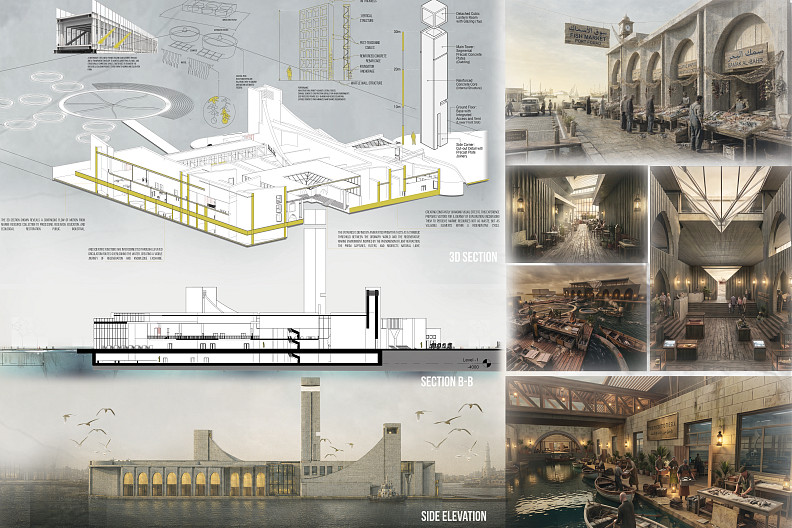
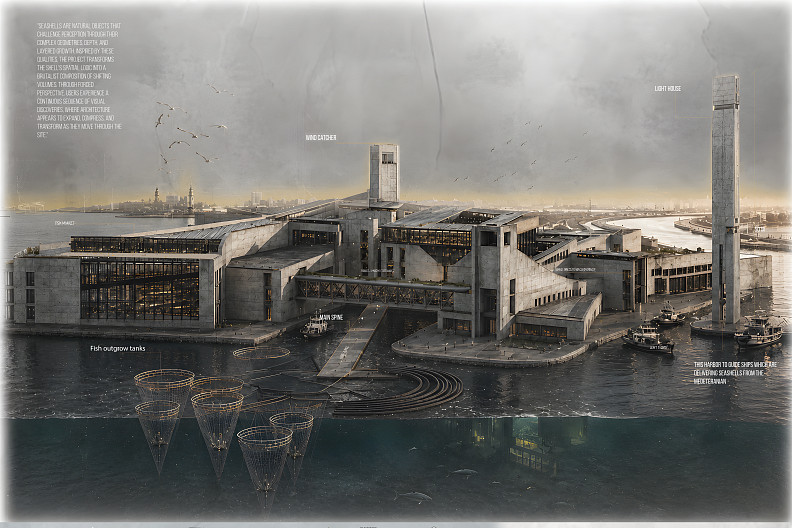
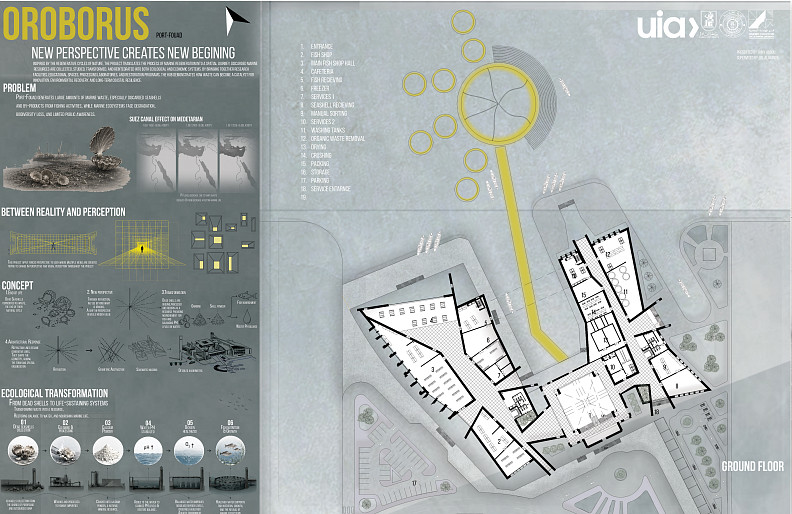
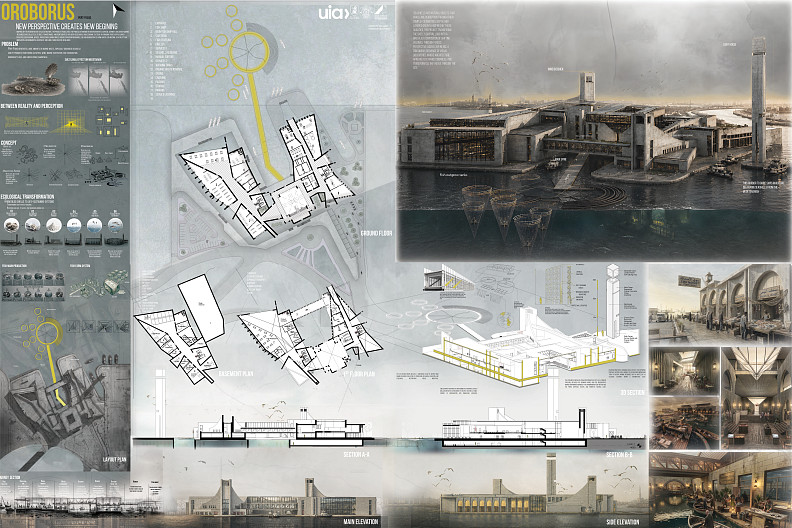
The Marine Regenerative Hub is a regenerative architectural project located in Port Fouad, Egypt, developed in response to the growing environmental challenges affecting the region's marine ecosystems. Pollution associated with maritime activities has contributed to biodiversity loss, degradation of aquatic habitats, and the decline of shellfish populations. Simultaneously, large quantities of discarded seashells are treated as waste despite their ecological potential. Inspired by the regenerative life cycle of seashells, the project transforms marine waste into a catalyst for environmental restoration, economic development, and community engagement. Seashells, rich in calcium carbonate, are collected and processed for use in water treatment and ecosystem rehabilitation, creating a continuous cycle of regeneration. The project integrates three interconnected functions: seashell collection and processing, aquaculture and ecosystem restoration facilities, and a community fish market. Together, these components establish a circular system that converts waste into environmental and economic value while strengthening local livelihoods. Architecturally, the design draws inspiration from the geometry, layering, and growth patterns of seashells. Through shifting perspectives, compression and expansion of spaces, and dynamic spatial sequences, the project encourages visitors to reconsider existing conditions and discover new possibilities. The architectural experience becomes a metaphor for transformation, reflecting the project's core belief that every ending can become a new beginning. The project aims to restore marine ecosystems, support sustainable food production, strengthen the local economy, and raise environmental awareness while demonstrating how architecture can actively participate in ecological regeneration.
Project description
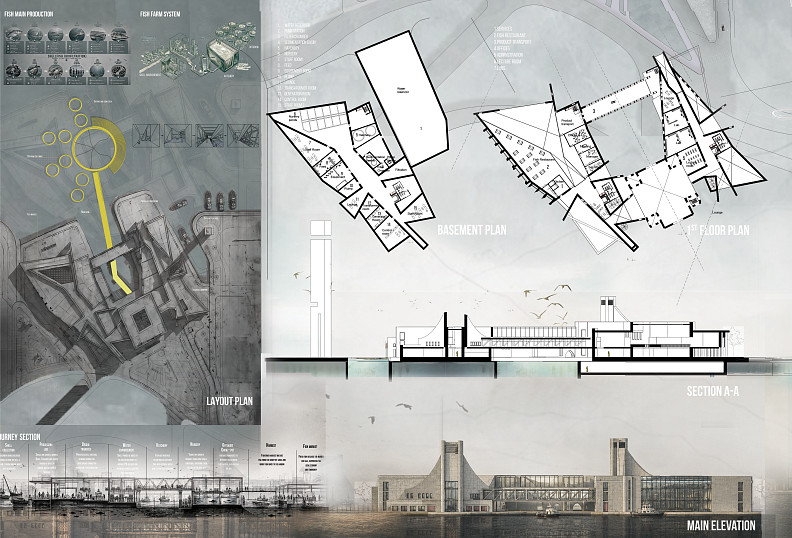
### Project Description The Marine Regenerative Hub is a multidisciplinary environmental and community-oriented facility designed to address marine pollution, ecosystem degradation, and the loss of biodiversity in Port Fouad, Egypt. The project proposes an integrated regenerative system that transforms discarded seashell waste into a valuable environmental resource while creating social and economic benefits for the local community. The project is organized into three primary functional zones. The first zone focuses on the collection, cleaning, processing, and refinement of discarded seashells. Through this process, shell waste is converted into calcium-rich material that can be utilized in water treatment systems and marine habitat restoration. The second zone consists of aquaculture and ecosystem restoration facilities dedicated to supporting fish production, improving water quality, restoring marine biodiversity, and strengthening aquatic food chains. These facilities operate as a living environmental laboratory where ecological regeneration and sustainable food production work together. The third zone is a public fish market and community space that connects local fishermen directly with consumers. This component supports the local economy, promotes sustainable fishing practices, and increases public awareness of environmental stewardship and marine conservation. The architectural design translates the regenerative cycle of seashells into a spatial experience. Inspired by shell geometry, growth patterns, and layered formations, the building creates a sequence of dynamic spaces that manipulate perception through changing viewpoints, compression and expansion, and forced perspectives. Visitors experience a continuous journey of discovery that symbolizes transformation and renewal. Structurally, the project utilizes an innovative load-bearing waffle wall system composed of reinforced concrete and integrated steel reinforcement. This hybrid system reduces the reliance on conventional column grids, improves environmental performance through natural ventilation, and creates flexible interior spaces suitable for research, production, public engagement, and community activities. The project ultimately establishes a complete regenerative cycle: Marine Waste → Shell Processing → Water Treatment → Ecosystem Restoration → Aquaculture Production → Fish Market → Community Development → Environmental Awareness By integrating environmental restoration, sustainable food production, public education, and economic development within a single architectural framework, the Marine Regenerative Hub demonstrates how architecture can become an active participant in ecological regeneration and long-term community resilience.
Technical information
The Marine Regenerative Hub is an integrated environmental and aquaculture facility in Port Fouad, Egypt, designed to transform discarded seashell waste into a resource for sustainable fish production and ecosystem restoration. The project begins with the collection, cleaning, and processing of seashells. The processed shells are utilized in fish feed production and environmental applications, creating a circular system that converts marine waste into value. The aquaculture facility operates through three main stages: **Hatchery, Nursery, and Outgrow**. The hatchery supports breeding and early fish development, the nursery raises juvenile fish under controlled conditions, and the outgrow phase produces market-ready fish. The system is supported by water treatment and environmental monitoring technologies that improve water quality and promote marine biodiversity. The project employs an innovative hybrid structural system based on reinforced concrete waffle load-bearing walls integrated with steel reinforcement. This system enhances structural efficiency, reduces the need for conventional columns, and improves natural ventilation and thermal performance. By combining seashell recycling, sustainable aquaculture, and environmental restoration, the project establishes a regenerative cycle that supports ecological recovery, food production, and local economic development.
Iriny Helito
Cairo University, Faculty of Engineering Architecture Department.
Egypt
Arquitectura
Proyecto enviado
16. 06. 2026Etiqueta
Consejo a estudiantes

Copyright © 2026 INSPIRELI | All rights reserved. Use of this website signifies your agreement to the Terms of Use, Privacy Policy, and use of cookies.