National Research Center for the development and preservation of Tunisian agricultural heritage, in Siliana (Tunisia)
Project idea
In this project, we dealt with the subject of Tunisian agricultural heritage, that faces today risks of extinction and degradation. This is due primarily to climate change and the risk of dependency on seed exporters worldwide. The objective of our center is twofold: Firstly, it aims to develop scientific research around local varieties and ancestral agricultural techniques and secondly, to spread awareness and encourage citizens to preserve this agricultural heritage. The project embodies a long term vision in order to ensure the sustainability of the agricultural sector and guarantee the country's food sovereignty. The project is located in the city of Siliana, which stands out for its natural potential. It holds the most fertile lands, and its local economy is based mainly on agriculture. The idea of the project starts from a natural concept. The design of the building is inspired by the shape and image of leaves, in fact we took reference of the leaf ramifications to treat the circulation space. The central rib that feeds the plant with nutrients and minerals is represented in our project by the central atrium, that connects and feeds the different units. The Atrium is characterized by natural properties of air treatment and good lighting. It creates as well a physical separation between research departments and public spaces but ensures at the same time a visual communication and creates a common space.
Project description
For the research departments: the spaces are spread over two levels. We have placed the laboratories on the ground floor, to facilitate access to experimental areas and greenhouses. On the first level, we have placed the administrative offices of each department as well as researchers' offices. Internal connections between departments is also possible thanks to a linking bridge inside the central atrium. The sensitization unit: houses the cafeteria, auditorium, administration and exhibition space on the ground floor. Upstairs we have placed the library to create a calmer environment.
Technical information
The atrium plays a major role in regulating the temperature inside the project. In fact, the building envelope, with automatic retractable glass roof, induces cooling airstream and provides natural sunlight. The green atrium design supports also the ventilation system by improving indoor air quality. It reflects as well the identity of the project that revolves around nature. The passive strategies implemented in the project can help reduce carbon footprint and promote sustainability.
Mohamed nejib Toumi
École Nationale d'Architecture et d'Urbanisme (ENAU) Tunis
Tunisia
Arquitectura
Proyecto enviado
26. 01. 2021Etiqueta
Consejo a estudiantes
Consejo a estudiantes
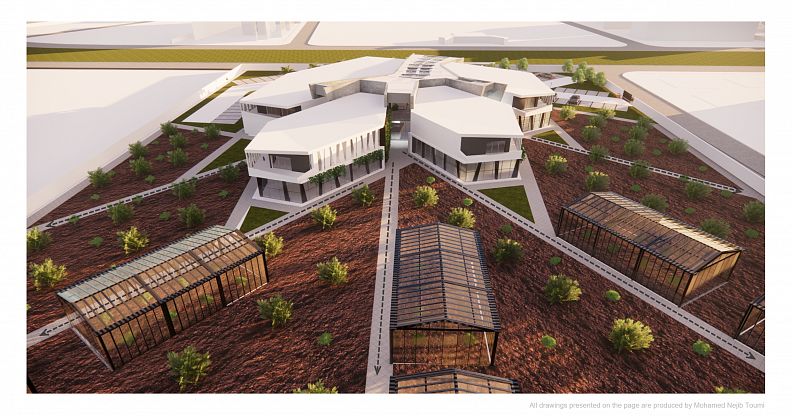
Centro Nacional de Investigación para el desarrollo y la conservación del patrimonio agrícola tunecino, en Siliana (Túnez).

Copyright © 2026 INSPIRELI | All rights reserved. Use of this website signifies your agreement to the Terms of Use, Privacy Policy, and use of cookies.


