Childhood in Campos Elíseos
Project idea
Space for childhood and community interaction
Project description
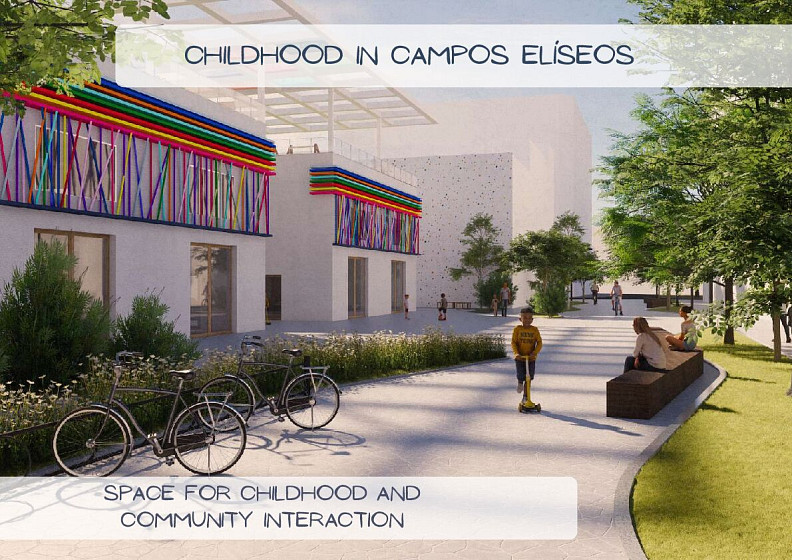
A community-oriented architectural project in Campos Elíseos designed to create spaces dedicated to childhood and community interaction. The building features colorful facade elements with vibrant railings and pergolas, a climbing wall, landscaped public spaces with seating, and pedestrian-friendly pathways surrounded by greenery.
Technical information
The proposal consists of the adaptive reuse of an existing commercial complex with the addition of new architectural interventions aimed at creating a Childhood and Community Center. The project occupies a 1,975 m² site, preserving approximately 540 m² of the original built area while enhancing its spatial and social performance through selective demolition and strategic additions. The design process begins by opening the existing building mass, creating a central pedestrian axis that improves permeability and establishes visual and physical connections across the site. Approximately 1,325 existing masonry blocks are removed, allowing the insertion of new programmatic volumes while reusing part of the demolished material in the construction of educational spaces, reinforcing principles of circular construction and material reuse. The intervention introduces two community cinema rooms (30 m² each) and one multipurpose cinema space (90 m²), conceived as cultural facilities that promote education, social interaction, and collective activities. The new volumes are interconnected through elevated walkways and transitional spaces that strengthen circulation and spatial continuity. Green roofs are incorporated throughout the complex, improving thermal performance, rainwater retention, and environmental quality while creating accessible recreational areas for children and the local community. A lightweight timber canopy covers the central courtyard, providing solar protection, natural ventilation, and a flexible space for educational and recreational activities. The landscape strategy extends the program beyond the building envelope by integrating playgrounds, gardens, public plazas, and pedestrian pathways into a continuous open-space system. This configuration blurs the boundary between architecture and the city, encouraging free movement, social interaction, and the appropriation of public space. The project combines adaptive reuse, sustainable construction strategies, passive environmental design, and community-oriented public spaces, transforming an underutilized urban block into an inclusive environment dedicated to childhood development, education, culture, and neighborhood integration.
DEBORA TAMIRES SOUZA SILVA
Mackenzie Presbyterian University, UPM, Faculty of Architecture and Urbanism, Sao Paulo
Brazil
Arquitectura
Proyecto enviado
15. 06. 2026Etiqueta
Consejo a estudiantes

Copyright © 2026 INSPIRELI | All rights reserved. Use of this website signifies your agreement to the Terms of Use, Privacy Policy, and use of cookies.