Arsenales Urban Park
Project idea
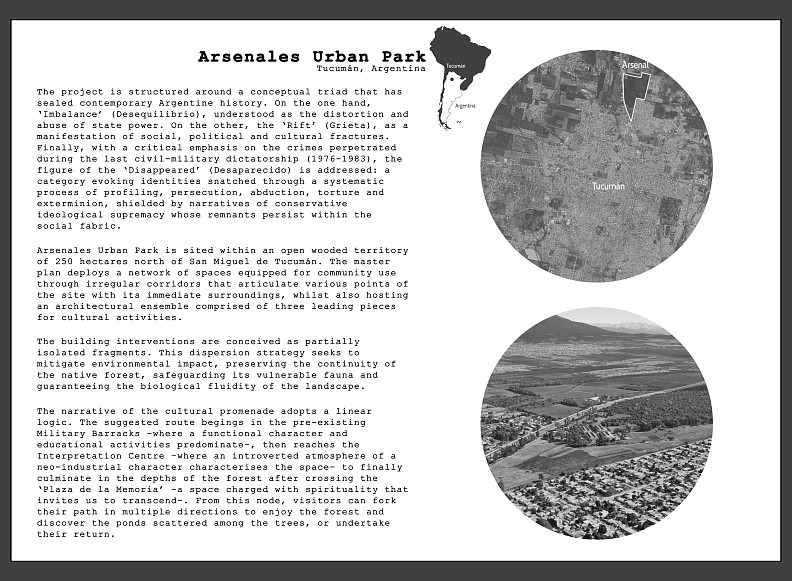
The project is structured around a conceptual triad that has sealed contemporary Argentine history. On the one hand, ‘Imbalance’ (Desequilibrio), understood as the distortion and abuse of state power. On the other, the ‘Rift’ (Grieta), as a manifestation of social, political and cultural fractures. Finally, with a critical emphasis on the crimes perpetrated during the last civil-military dictatorship (1976-1983), the figure of the ‘Disappeared’ (Desaparecido) is addressed: a category evoking identities snatched through a systematic process of profiling, persecution, abduction, torture and exterminion, shielded by narratives of conservative ideological supremacy whose remnants persist within the social fabric.
Project description
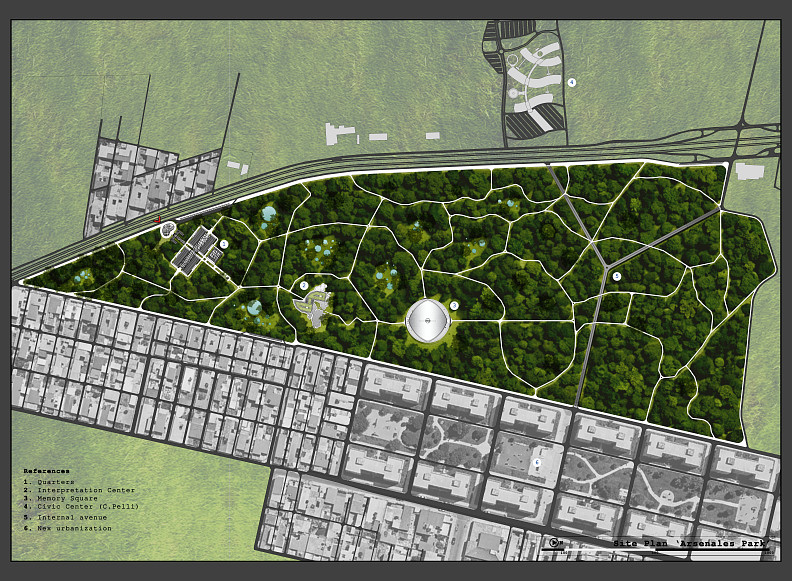
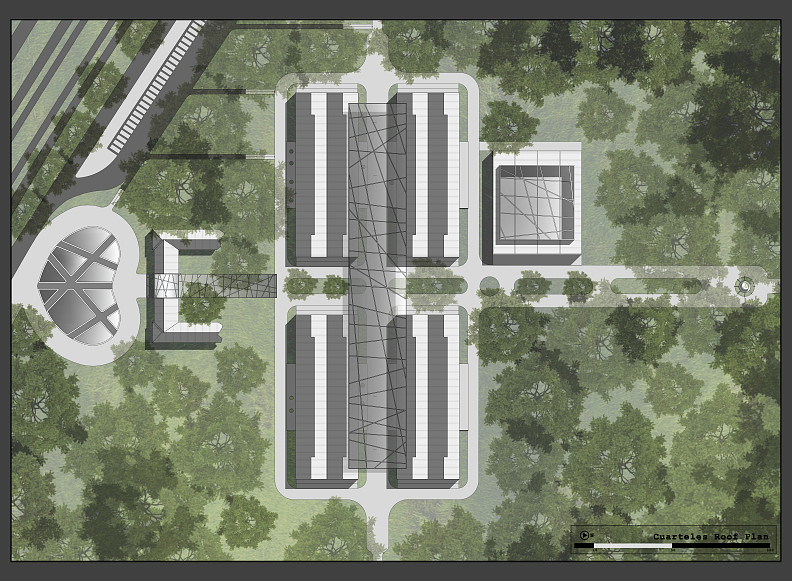
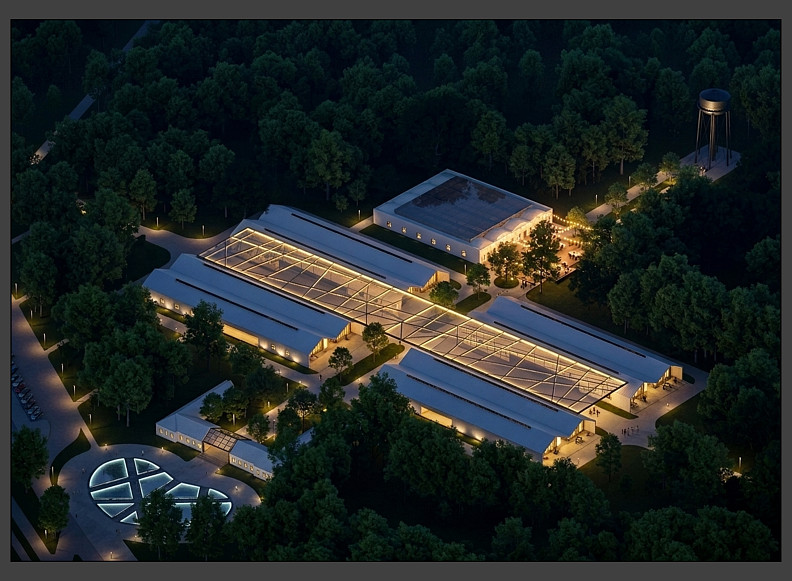
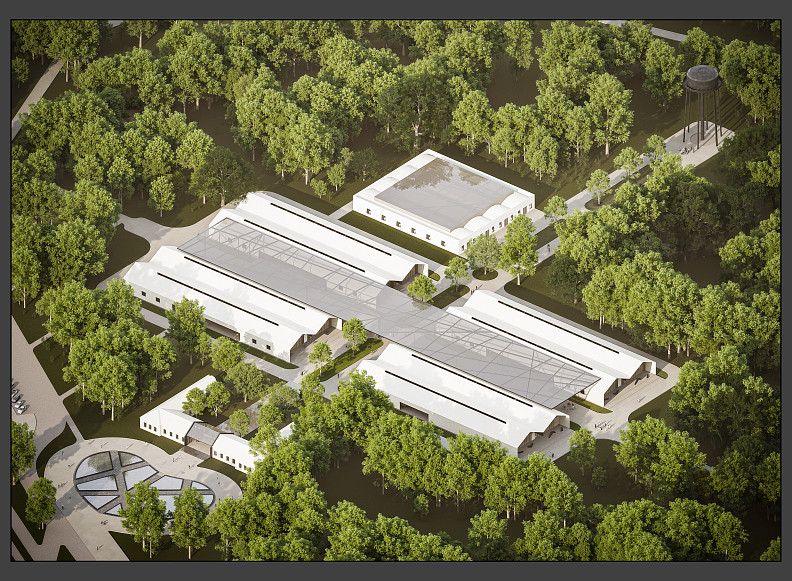
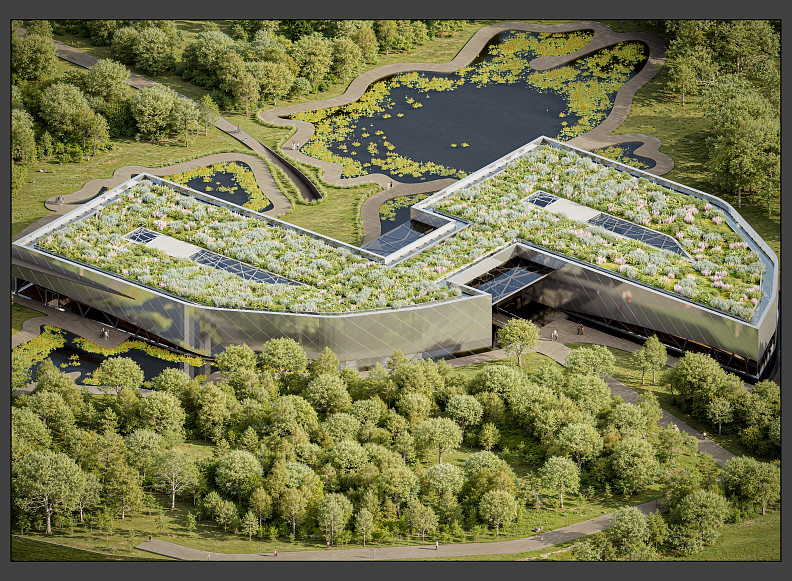
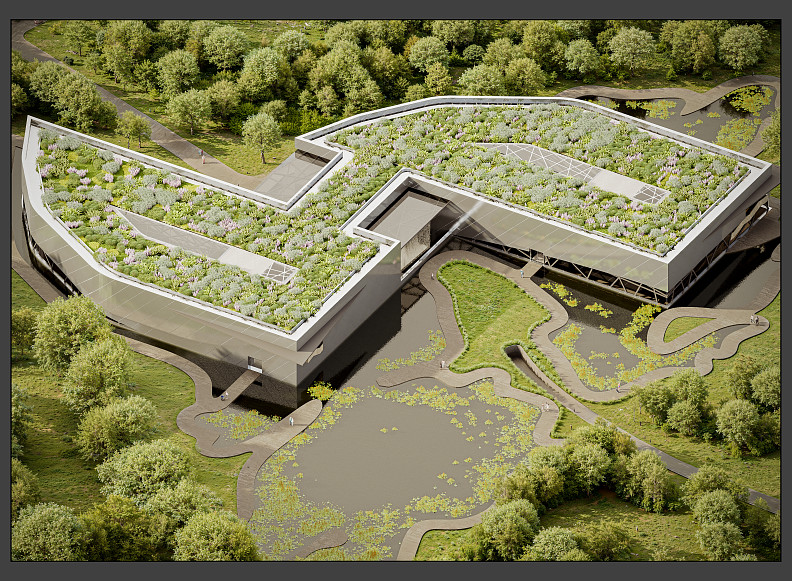
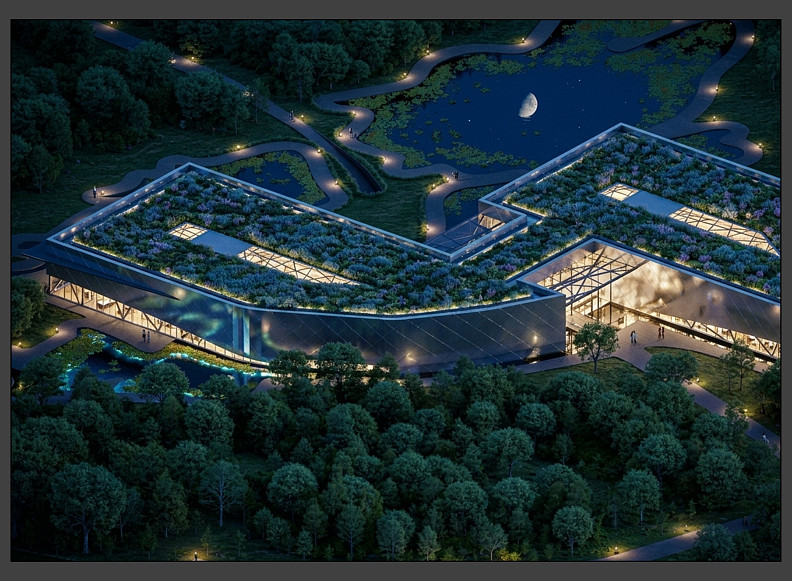
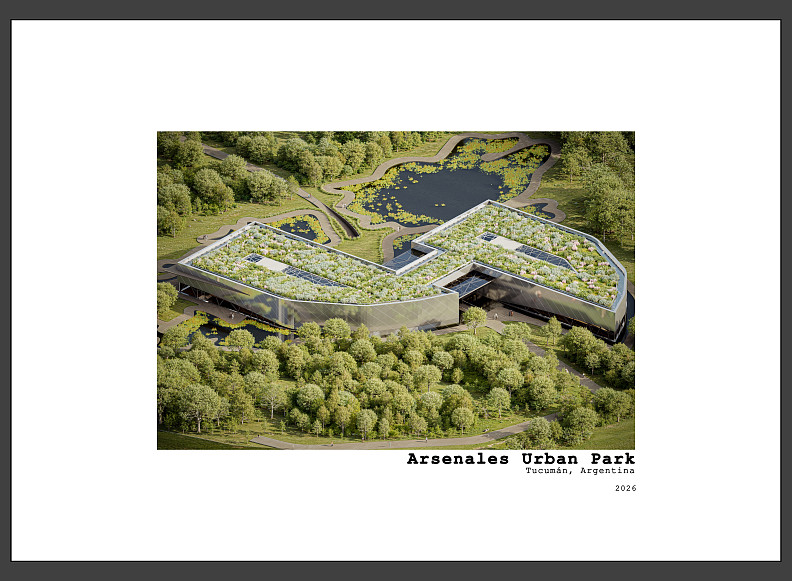
Arsenales Urban Park is sited within an open wooded territory of 250 hectares north of San Miguel de Tucumán. The master plan deploys a network of spaces equipped for community use through irregular corridors that articulate various points of the site with its immediate surroundings, whilst also hosting an architectural ensemble comprised of three leading pieces for cultural activities. The building interventions are conceived as partially isolated fragments. This dispersion strategy seeks to mitigate environmental impact, preserving the continuity of the native forest, safeguarding its vulnerable fauna and guaranteeing the biological fluidity of the landscape. The narrative of the cultural promenade adopts a linear logic. The suggested route begings in the pre-existing Military Barracks –where a functional character and educational activities predominate–, then reaches the Interpretation Centre –where an introverted atmosphere of a neo-industrial character characterises the space– to finally culminate in the depths of the forest after crossing the ‘Plaza de la Memoria’ –a space charged with spirituality that invites us to transcend–. From this node, visitors can fork their path in multiple directions to enjoy the forest and discover the ponds scattered among the trees, or undertake their return.
Technical information
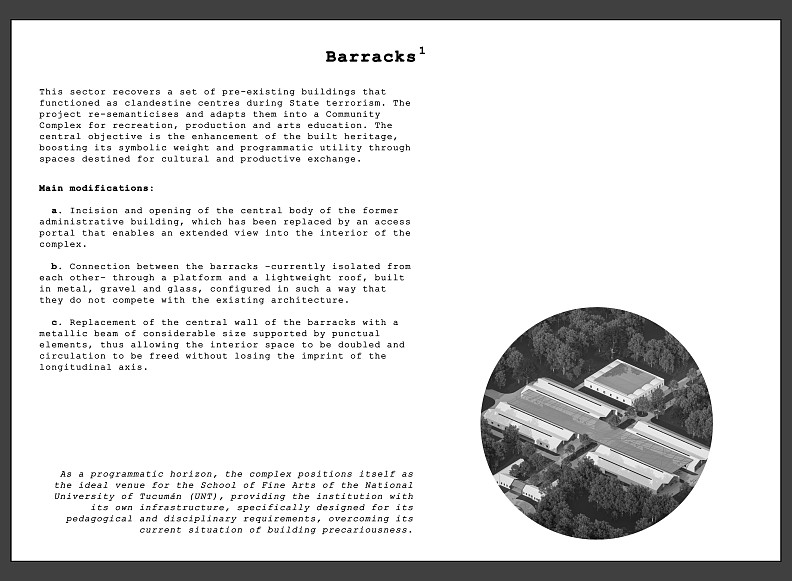
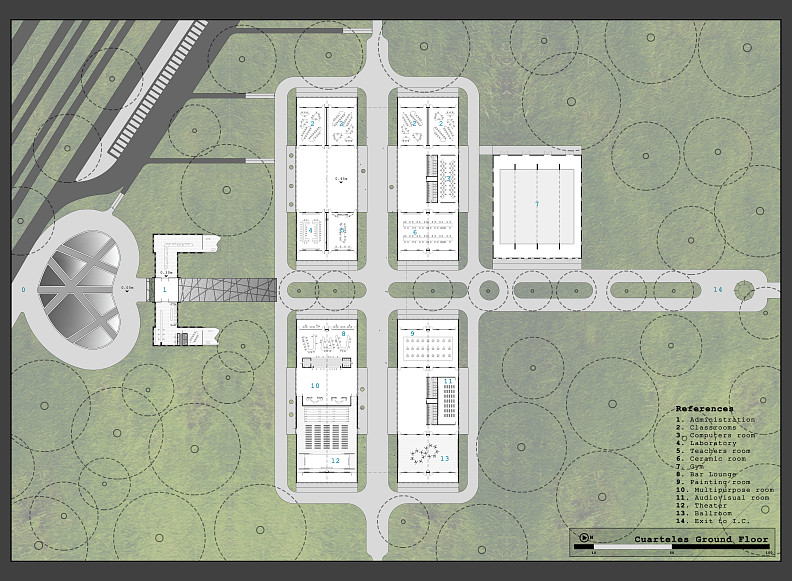
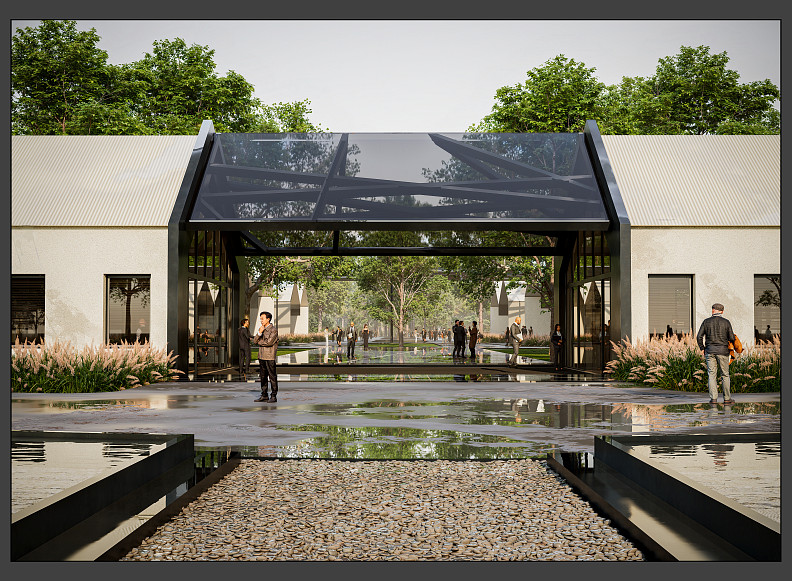
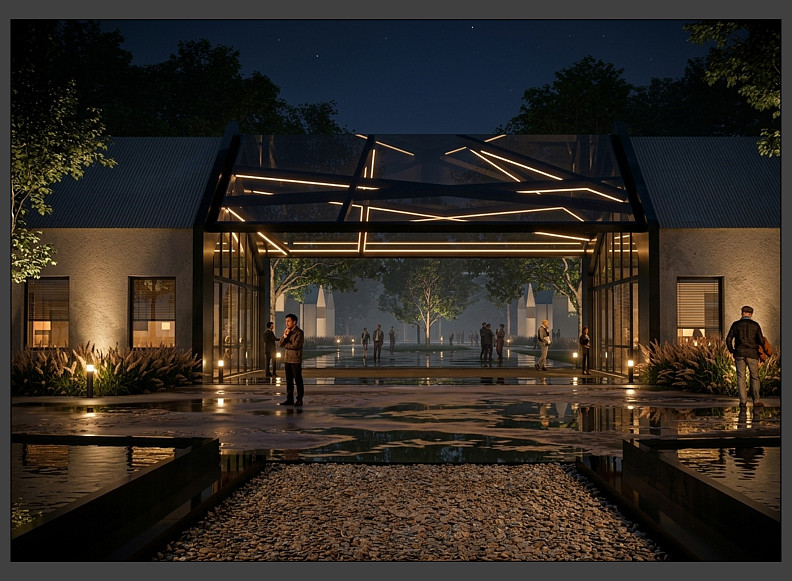
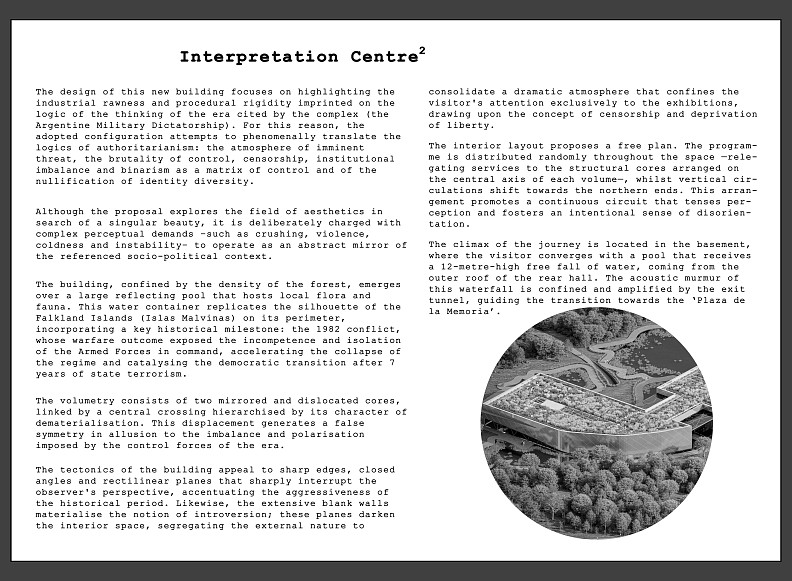
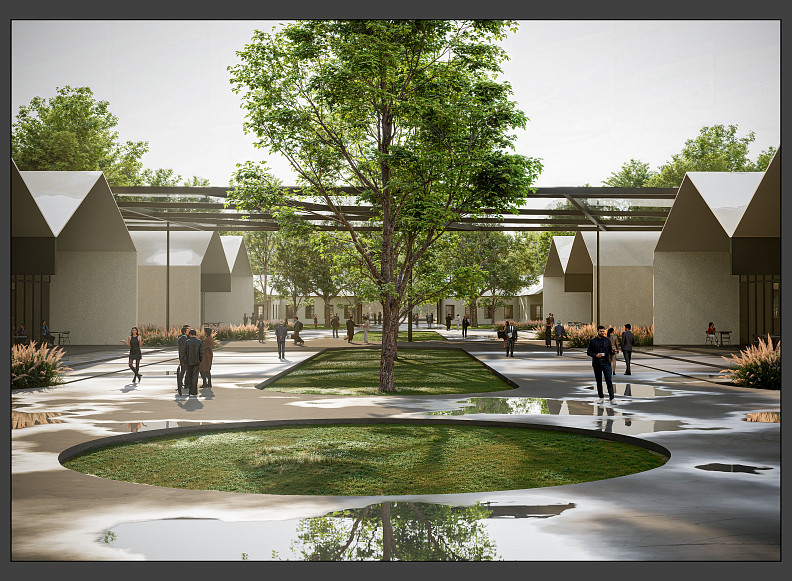
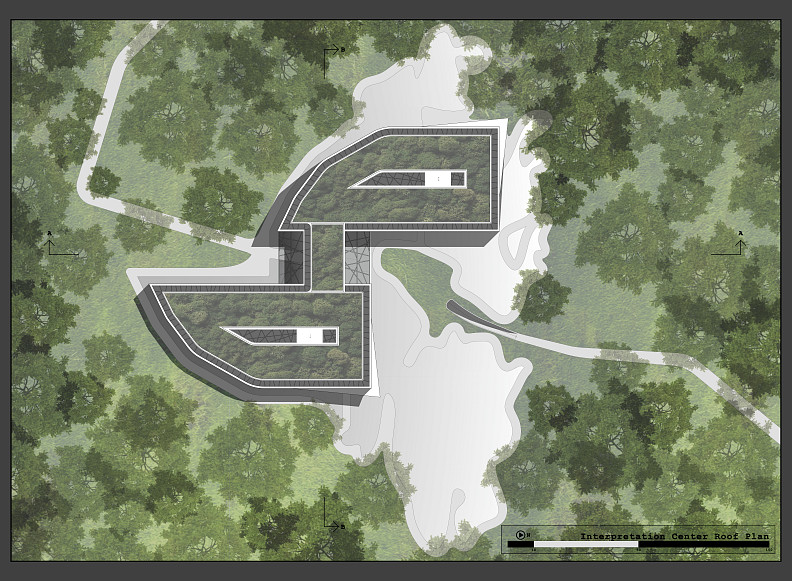
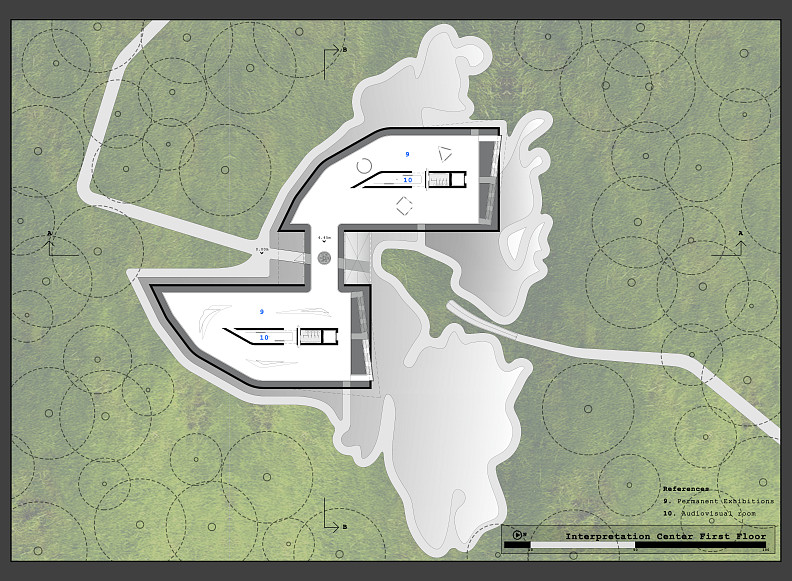
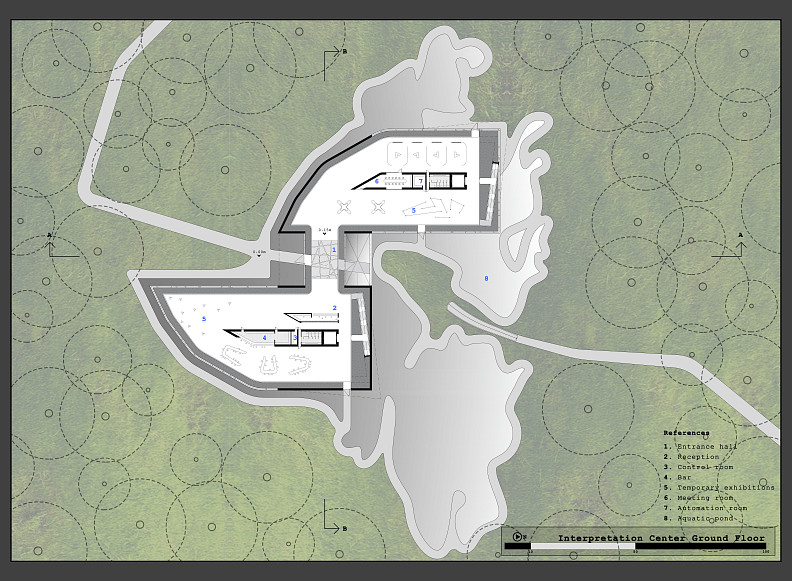
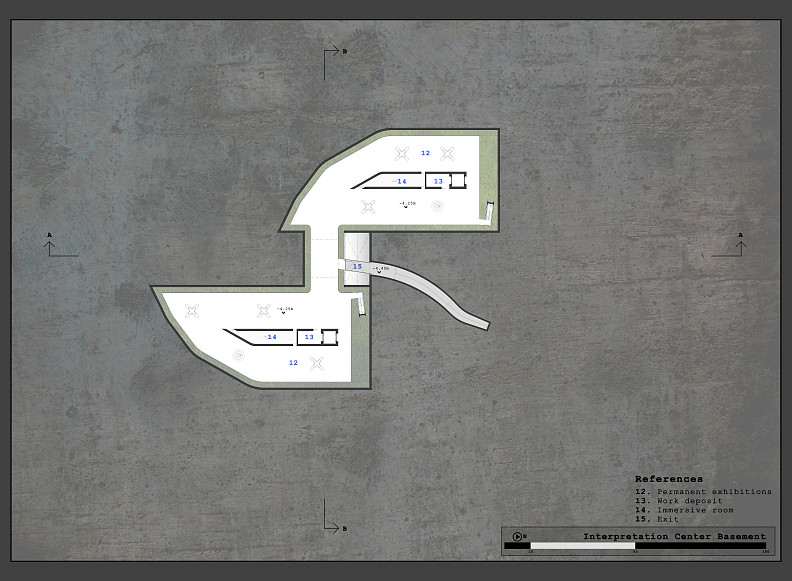
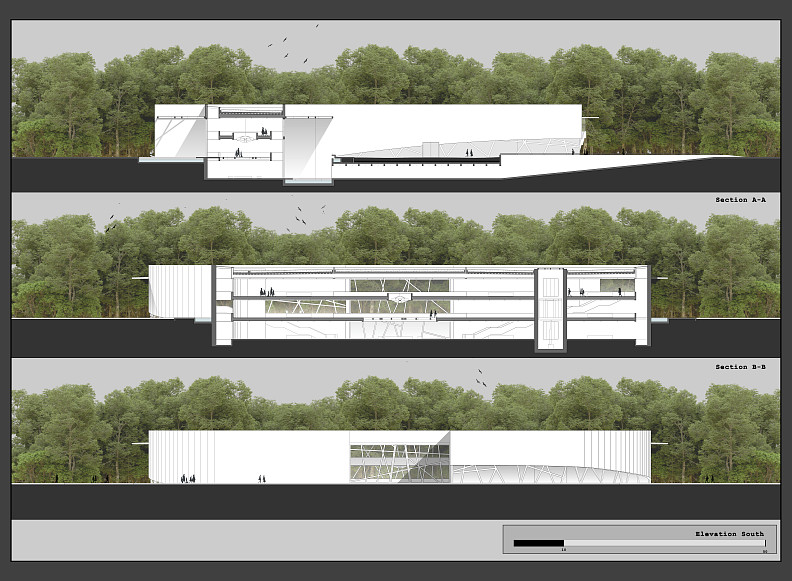
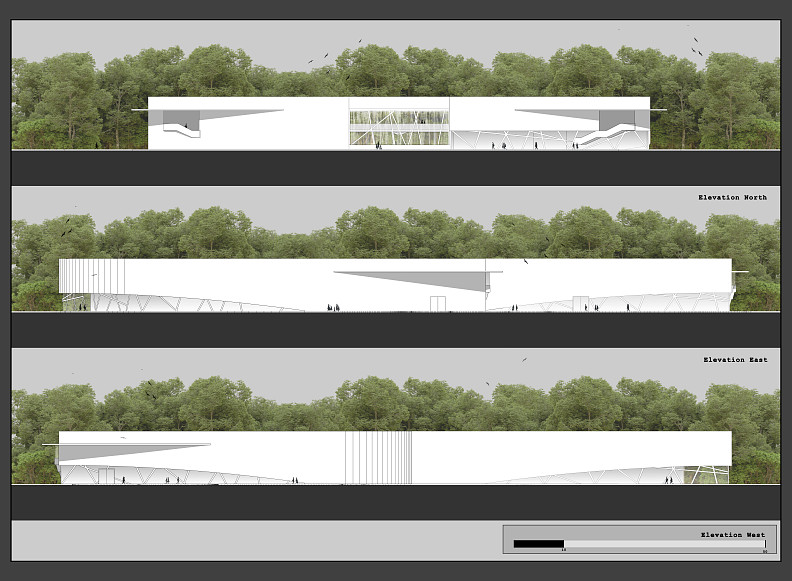
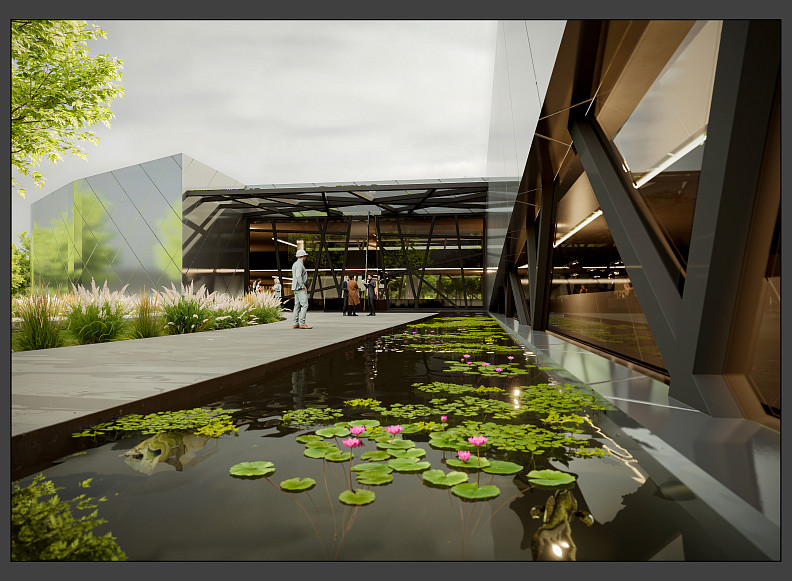
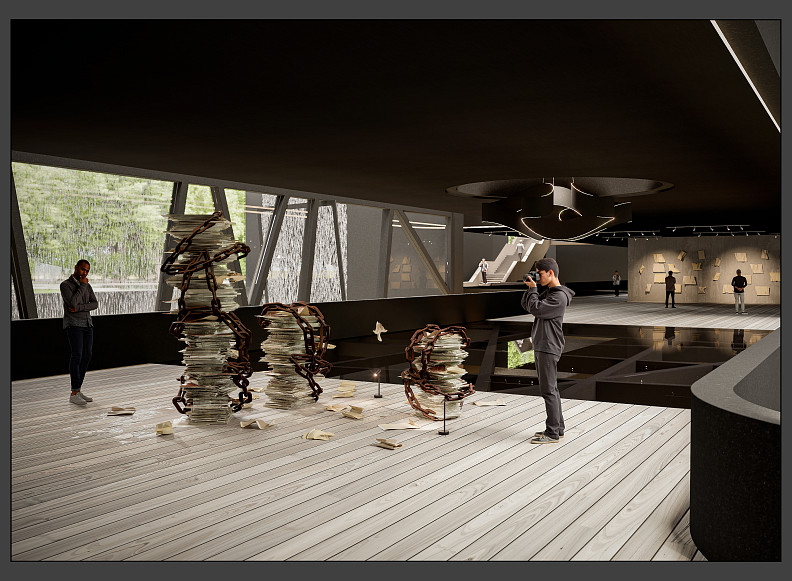
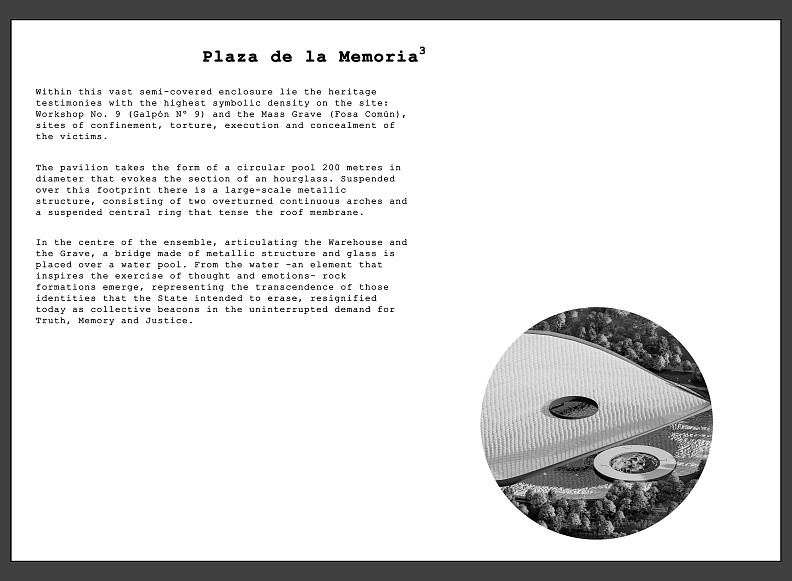
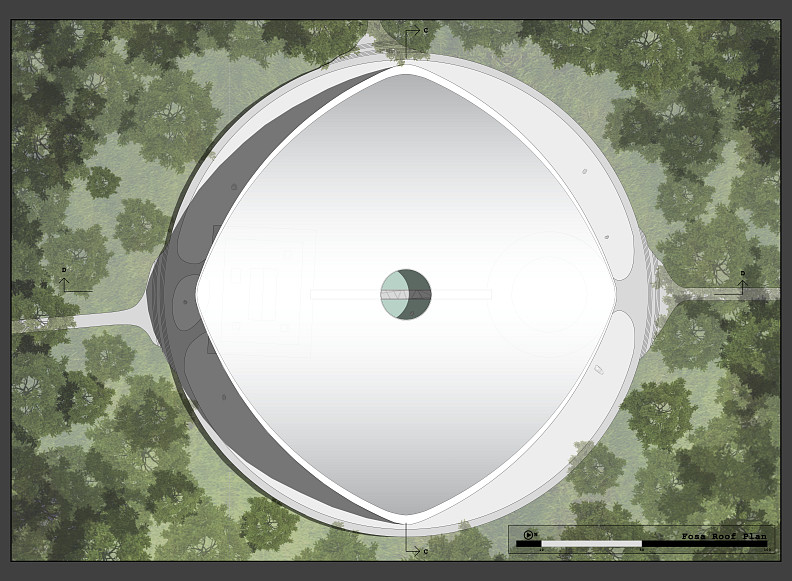
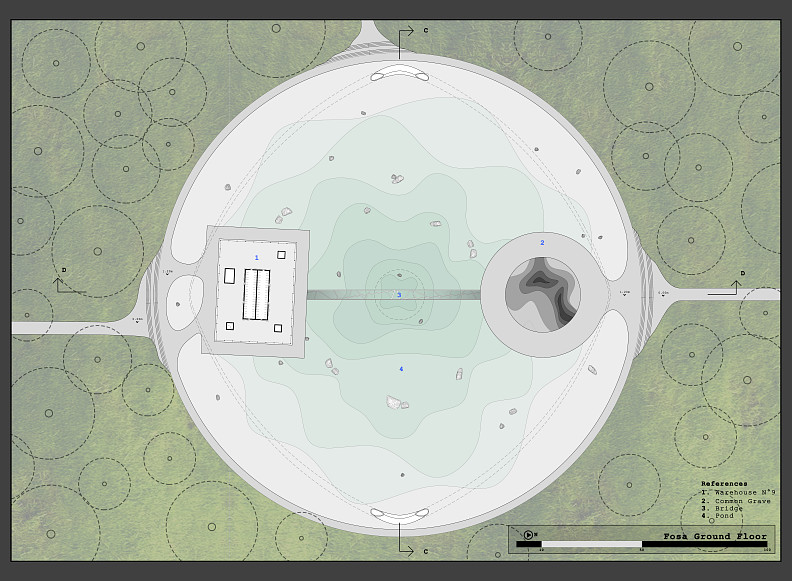
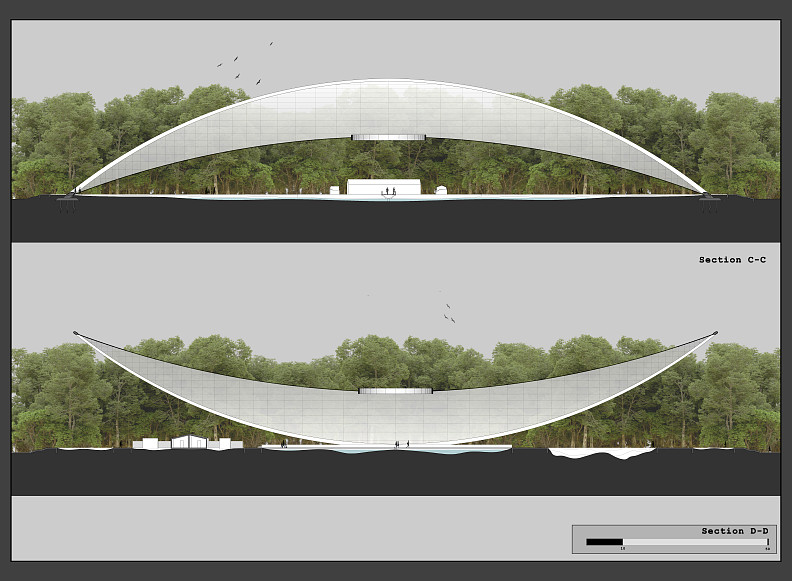
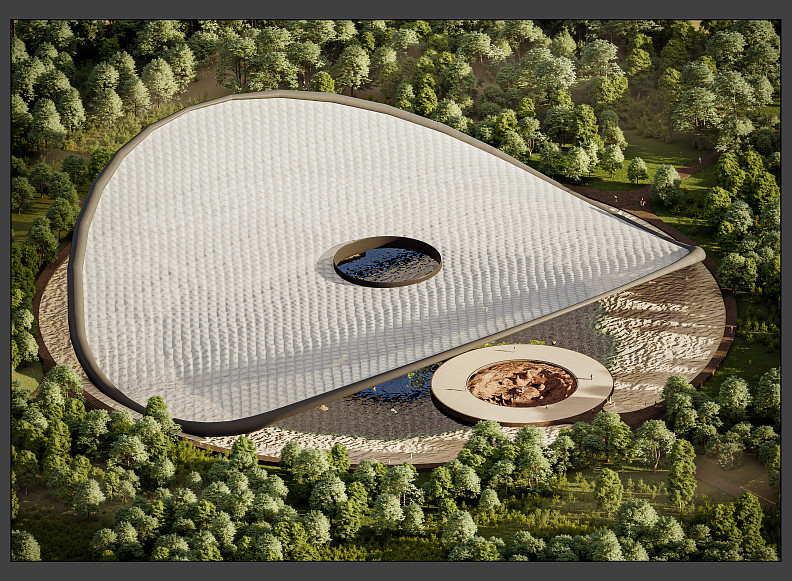
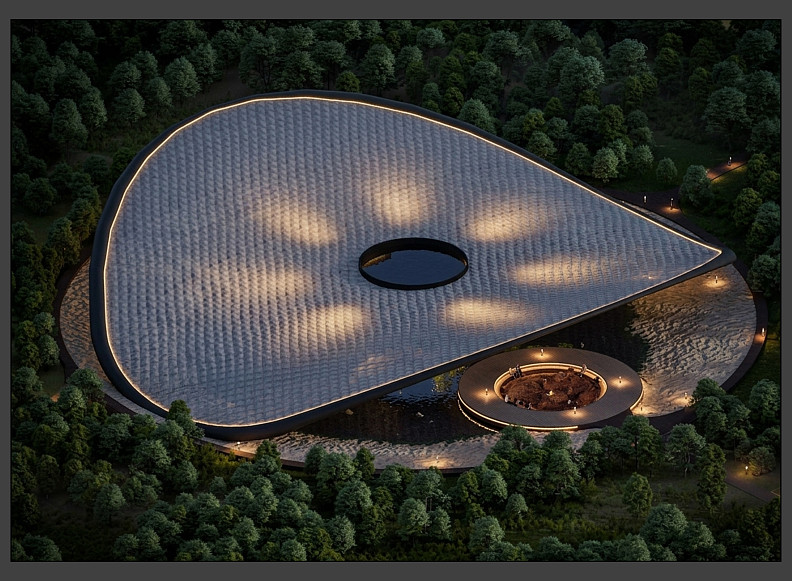
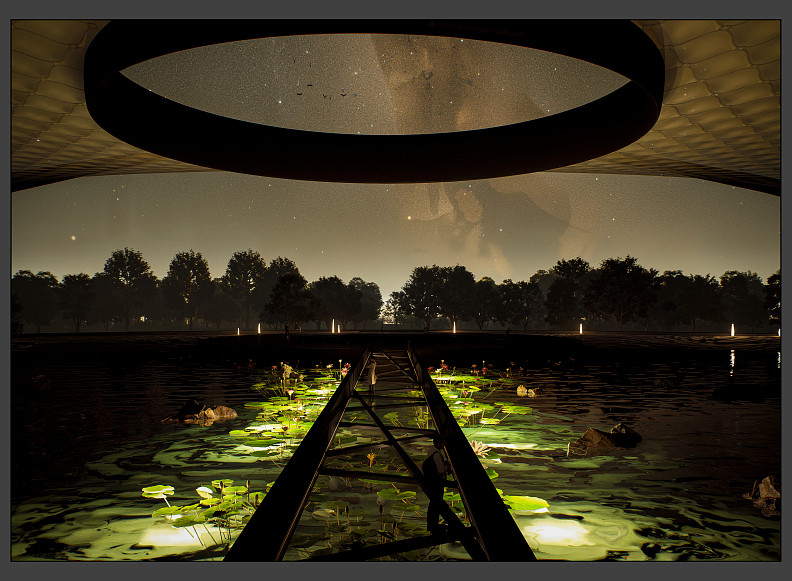
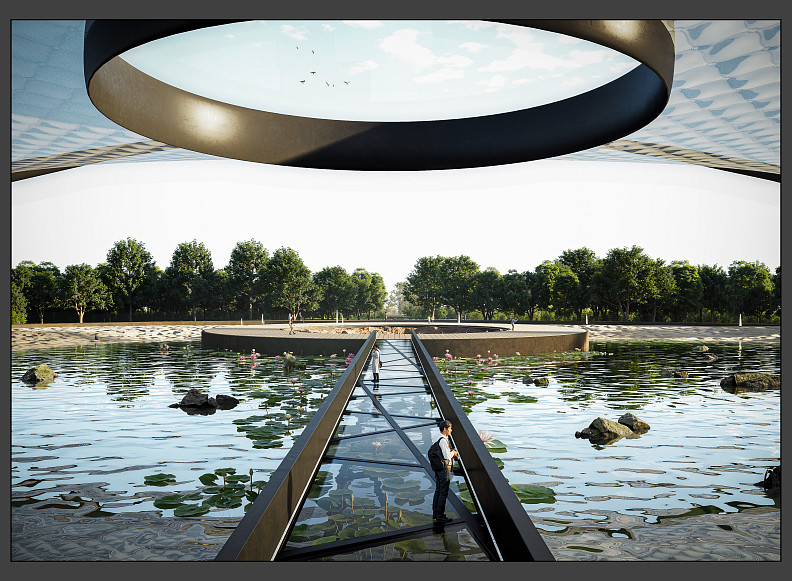
1. Barracks This sector recovers a set of pre-existing buildings that functioned as clandestine centres during State terrorism. The project re-semanticises and adapts them into a Community Complex for recreation, production and arts education. The central objective is the enhancement of the built heritage, boosting its symbolic weight and programmatic utility through spaces destined for cultural and productive exchange. Main modifications: a. Incision and opening of the central body of the former administrative building, which has been replaced by an access portal that enables an extended view into the interior of the complex. b. Connection between the barracks –currently isolated from each other– through a platform and a lightweight roof, built in metal, gravel and glass, configured in such a way that they do not compete with the existing architecture. c. Replacement of the central wall of the barracks with a metallic beam of considerable size supported by punctual elements, thus allowing the interior space to be doubled and circulation to be freed without losing the imprint of the longitudinal axis. As a programmatic horizon, the complex positions itself as the ideal venue for the School of Fine Arts of the National University of Tucumán (UNT), providing the institution with its own infrastructure, specifically designed for its pedagogical and disciplinary requirements, overcoming its current situation of building precariousness. 2. Interpretation Centre The design of this new building focuses on highlighting the industrial rawness and procedural rigidity imprinted on the logic of the thinking of the era cited by the complex (the Argentine Military Dictatorship). For this reason, the adopted configuration attempts to phenomenally translate the logics of authoritarianism: the atmosphere of imminent threat, the brutality of control, censorship, institutional imbalance and binarism as a matrix of control and of the nullification of identity diversity. Although the proposal explores the field of aesthetics in search of a singular beauty, it is deliberately charged with complex perceptual demands –such as crushing, violence, coldness and instability– to operate as an abstract mirror of the referenced socio-political context. The building, confined by the density of the forest, emerges over a large reflecting pool that hosts local flora and fauna. This water container replicates the silhouette of the Falkland Islands (Islas Malvinas) on its perimeter, incorporating a key historical milestone: the 1982 conflict, whose warfare outcome exposed the incompetence and isolation of the Armed Forces in command, accelerating the collapse of the regime and catalysing the democratic transition after 7 years of state terrorism. The volumetry consists of two mirrored and dislocated cores, linked by a central crossing hierarchised by its character of dematerialisation. This displacement generates a false symmetry in allusion to the imbalance and polarisation imposed by the control forces of the era. The tectonics of the building appeal to sharp edges, closed angles and rectilinear planes that sharply interrupt the observer's perspective, accentuating the aggressiveness of the historical period. Likewise, the extensive blank walls materialise the notion of introversion; these planes darken the interior space, segregating the external nature to consolidate a dramatic atmosphere that confines the visitor's attention exclusively to the exhibitions, drawing upon the concept of censorship and deprivation of liberty. The interior layout proposes a free plan. The programme is distributed randomly throughout the space —relegating services to the structural cores arranged on the central axis of each volume—, whilst vertical circulations shift towards the northern ends. This arrangement promotes a continuous circuit that tenses perception and fosters an intentional sense of disorientation. The climax of the journey is located in the basement, where the visitor converges with a pool that receives a 12-metre-high free fall of water, coming from the outer roof of the rear hall. The acoustic murmur of this waterfall is confined and amplified by the exit tunnel, guiding the transition towards the ‘Plaza de la Memoria’. 3. Plaza de la Memoria Within this vast semi-covered enclosure lie the heritage testimonies with the highest symbolic density on the site: Workshop No. 9 (Galpón Nº 9) and the Mass Grave (Fosa Común), sites of confinement, torture, execution and concealment of the victims. The pavilion takes the form of a circular pool 200 metres in diameter that evokes the section of an hourglass. Suspended over this footprint there is a large-scale metallic structure, consisting of two overturned continuous arches and a suspended central ring that tense the roof membrane. In the centre of the ensemble, articulating the Warehouse and the Grave, a bridge made of metallic structure and glass is placed over a water pool. From the water –an element that inspires the exercise of thought and emotions– rock formations emerge, representing the transcendence of those identities that the State intended to erase, resignified today as collective beacons in the uninterrupted demand for Truth, Memory and Justice.
Mercado Goni
Universidad Nacional de Tucumán, Facultad de Arquitectura y Urbanismo, Tucumán
Argentina
Arquitectura
Proyecto enviado
15. 06. 2026Etiqueta
- Cultural Center
- Gallery
- Hall/Theatre
- Memorial
- Observation Tower
- Pavillion
- Religious
- Scuplture
Consejo a estudiantes

Copyright © 2026 INSPIRELI | All rights reserved. Use of this website signifies your agreement to the Terms of Use, Privacy Policy, and use of cookies.