NODE
Project idea
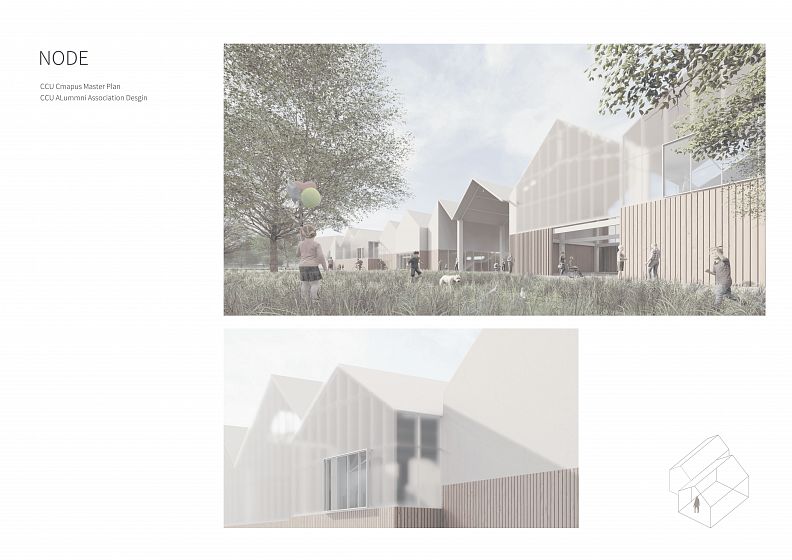
The site is located in the open space beside the American military dormitory at the Taiwan Chinese Cultural University. This open space is located at the entrance of the base. At the same time, it has a rich natural ecological environment, and the design is mainly based on the original undeveloped building base. The site is close to the residents’ living circle. So in the original idea is to respect the facades and the forms of the surrounding buildings. At the same time, the design puts the accent on public space for residents, ensuring the use of the large green space of the original site. And also focus on learning in the function setting, so that the elderly, residents, and students have created more learning opportunities. In the early stages of the design, a large number of abandoned buildings were added with many new functions. Therefore, the imagery of the design is like the resting space of the relay station, rather than the important landmark in the base. The purpose is not to let the building become the protagonist in the base too abruptly, but to make the surrounding historical buildings visible In order to develop together with this alumni club. It can become a complementary role, activating the potential of the entire area.
Project description
The internal of the building is based on the open space as the main axis, and at the same time is equipped with a large number of resting and learning spaces. Inside the main building, it is configured as multiple flexible spaces, which can be configured differently depending on the business requirements of the functional space. On the second floor is a large open classroom, which provides a variety of equipment and courses. Let residents participate freely, and at the same time, there are professionals that can help students understand the operation of the equipment, and how to use and other professional knowledge. The open space of the adjoining building is configured to resemble a semi-open pavilion space. On the first floor, there is an open space for foot bathing and rest. The upper floor is a more private pavilion space, is also linked to the open outdoor exhibit space and the large tree atrium, enabling the environment, lets users can naturally enter this resting space. The final part of the building is the dormitory, designed to provide artists involved in activities and students who require short-term housing. So the layout of the space is most concise and practical. The second and third floors also have internal and external social interaction facilities.
Technical information
In order to make the building more modern and lighter, the materials are different from the original US military dormitory. On the one hand, it presents modern architectural styles in a different way; on the other hand, it clearly distinguishes traditional architectural styles. It provides a different sense of modern architecture. The interior is a coherent open space, also use the rooftop space to make dormers improve natural lighting.
HO YI MAO
Chinese Culture University, College of Environmental Design, Department of Architecture and Urban Design, Taipei
Taiwan, Province of China
Arquitectura
Proyecto enviado
14. 07. 2021Etiqueta
Consejo a estudiantes
Consejo a estudiantes
NODO

Copyright © 2026 INSPIRELI | All rights reserved. Use of this website signifies your agreement to the Terms of Use, Privacy Policy, and use of cookies.


