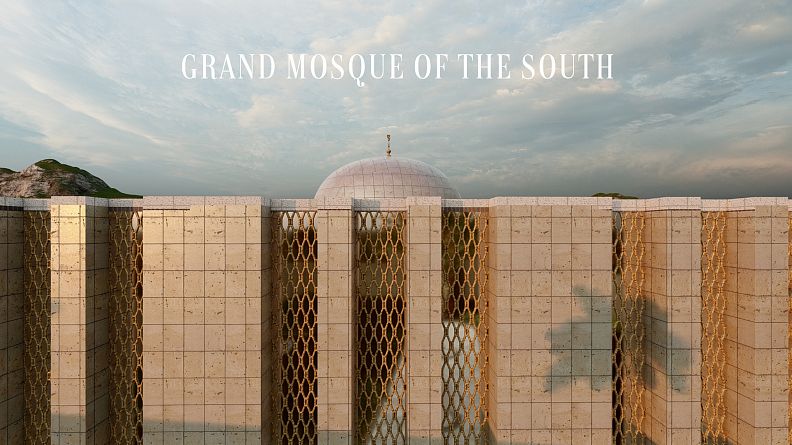
GRAND MOSQUE OF THE SOUTH "Masjid Aljanub Alkabir": A Proposed Grand Mosque

Idea projektu

GRAND MOSQUE OF THE SOUTH Is a major plate in our subject, History of Architecture III wherein we tackled the emphasis of Islam Architecture from their roots up until it evolved with modern qualities and design style. Designing A mosque is truly an inspiring way to get to know a part of the Muslim's culture and religion. The goal of this design is to evolve their own heritage into something modern but the purpose of the structure remains. Mosques are the house of worship. Every Muslims are dedicated to Allah, in serving Allah and in devoting their whole soul to Islam. Designing a structure that could uplift more of their spiritual qualities and mindset, even their dedication, not just for a small community but for everyone within the vicinity of Cotabato.

Popis projektu

In the heart of Koronadal City, South Cotabato, The Grand Mosque of the South lies within the vicinity of the surrounding municipalities of Timog Cotabato. A total of 49,678 Muslims are populated within the area. The locations has total of 7100 sqm covered. The prayer hall has a 1890 sqm total with 1000 Pax of Muslims that can fully pray inside during the normal days. Assuming that during their religious holidays or Ramadan, an allotted courtyard which measures 800 sqm can be used as an additional space for them.

Technické informácie

Grand Mosque of the South symbolizes the different symbols and cultures dedicated to the Muslims living within the area. Materials such as stones and marbles are used with the touch of white and brown finishes as it symbolizes peace and purity in their culture and religion. A contrast of green as part of the landscape garden surrounding the structure that symbolizes as an entry to paradise according to their Quran. Various patterns called Arabesques are incorporated to represent nature and objects by their spiritual qualities.

Rady študentom

GRAND MOSQUE OF THE SOUTH "Masjid Aljanub Alkabir": A Proposed Grand Mosque

Dear Michaela, Thank you for proposing this very interesting project. The subject you are addressing brings us back to various questions and urges us to think long and deeply to offer the most relevant architectural project. In this regard, I advise you to expand your description of the project by focusing more on a problem. In this regard, it is necessary to make the difference between your objectives (to express Islamic architecture modern ) and the reflexive basis on which you intend to develop your project. For example, you can explore the question of spatiality: can the space of the mosque be expressed by other than its classical configuration? Because that's what we discover through your plans: an arrangement, a spatialization, connections, dimensions, almost immutable constants of the space of the mosque. However, if you want your practice of architecture to be constructive and to bring added value to the thought of contemporary design, you must be able to go further by linking spaces to practices but also to the senses. I recommend that you approach your layout of spaces through scenography, thinking more about dynamic routes rather than presenting frozen images where you can assume an interest given to constructive details rather than to impress.  Speaking of details, the visual effect of your porticoes leaning on mushroom columns is quite interesting, but you could be criticized for taking over common places in architecture for free, but beware of gratuitous gestures of architecture. Please review these two references: 1-The Johson Wax company whose hypostyle room recalls what you are offering [https://images.app.goo.gl/qC2ghskDSAPi9eUe8] 2—The great mosque of Algiers whose porticoes are identical to yours. [https://images.app.goo.gl/KaiJqHtvmLWRJd7s9] We are clearly not inventing anything and that architecture is made only of mimicry, but a well-done project is a project where the designer manages to develop a new problem and tries to respond to it with ingenious solutions. To this end, I recommend that you re-examine the constructive and structural feasibility of the load-bearing elements that you propose, 1 - in terms of sizing related to the choice of materials: your columns give the impression of being too thin and unachievable if the choice had to be marble or not judicious if it was necessary to opt for another material and then disguise it in marble! 2-In terms of layout: a single row of slender columns to hold the openwork porticoes seems weak. 3 - in terms of stereotomy or texture: To this, I give you a single indication, that the interior of your dome takes up (in a somewhat lazy way) the texture of the walls. 4 - in terms of vegetation/mineral/hydraulic alliance: You know the role of water and vegetation in Islamic architecture. You should exploit the absence of urban constraints (if I guessed correctly from your perspective) to explore new types of spaces, offering themselves not only to practitioners but also to anyone wishing to gather and enjoy positive architecture. Here, I don't want to burden you with remarks too, these are more than enough to resume a targeted reflection. This does not mean that you must worry and try to respond to all my comments. However, I would like you to ask yourself several questions from now on before tackling any architectural project to manage to design serenely with the feeling of a job well done. Finally, the last problem with a philosophical dimension: you claim that the mosque is a sacred and essential place for all Muslims and that all Muslims are devoted to Allah. I also advise you to approach the building from a purely secular viewpoint, thus proposing it as work devoid of any proselytizing image, addressing all users. A mosque that you visit outside of prayer times would be much more interesting!
20.03.2026

Nabil ROUBAI CHORFI

Kategória

Copyright © 2026 INSPIRELI | All rights reserved. Use of this website signifies your agreement to the Terms of Use, Privacy Policy, and use of cookies.