Aeolian Sudr
Project idea
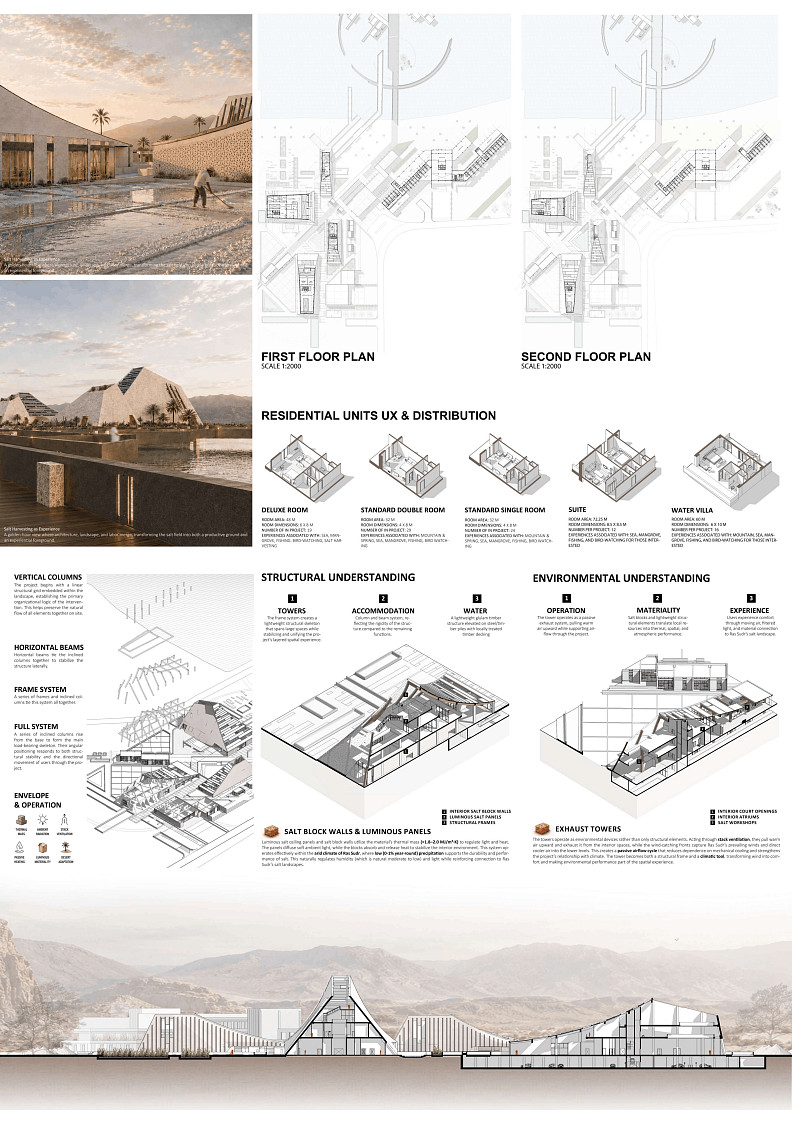
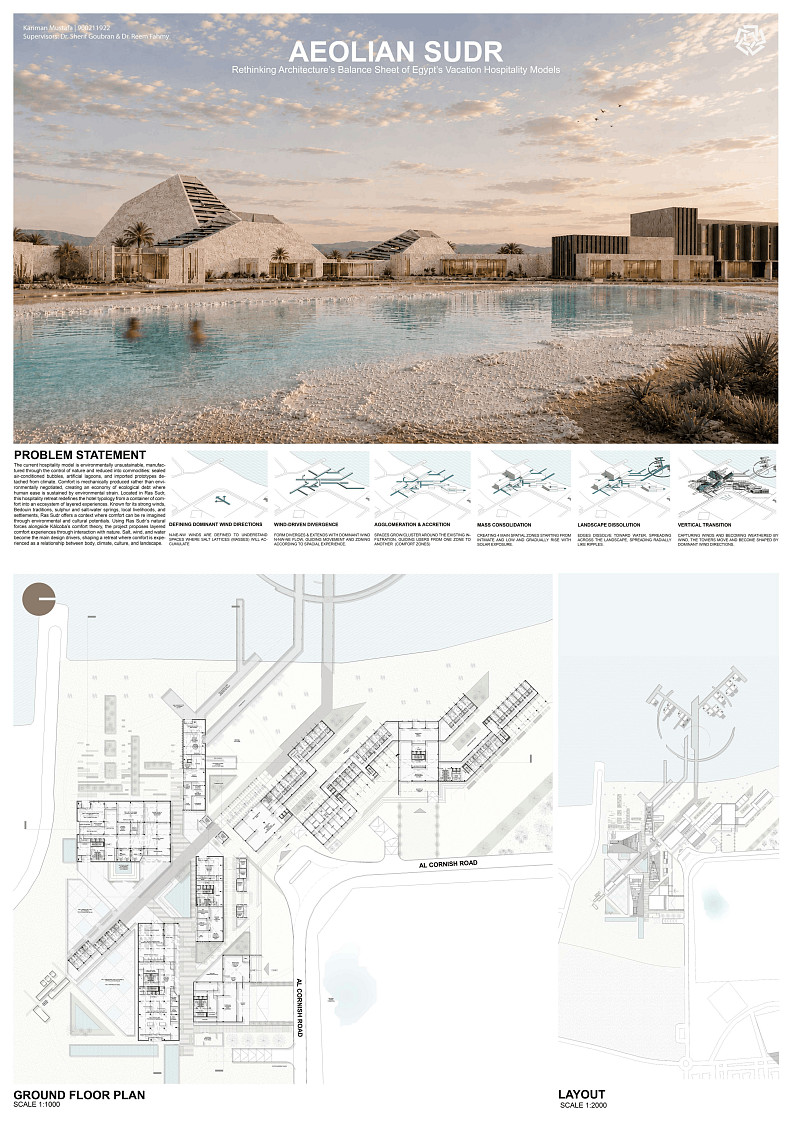
Rem Koolhaas described junkspaces as “what remains after modernization has run its course...a seamless envelope of comfort.” This is where my thesis begins: if junkspaces are built on comfort, are they true comfort, or only the illusion of it? Egyptians sought comfort through many mediums, one of which is “Masayef” (Vacation); that being through shade, breezes, proximity to the sea, or simply being together outside the city. However, over time, comfort changed in every aspect of our lives: in how we move, how we eat, and how we gather. Egyptian vacation hospitality models have reduced comfort into a standardized commodity: sealed air-conditioned bubbles that are visually packaged through imported prototypes. These prototypes prioritize convenience and marketability over climate, culture, and lived experience, producing junkspaces that consume excessive energy, privatize the landscape, and disconnect users from their environment. Comfort is no longer something felt or shared; it is engineered, sold, and environmentally indebted. My thesis redefines comfort as an experiential and adaptive condition rather than a technical standard to generate more resilient, meaningful, and environmentally responsive hospitality models. Ras Sudr lies at a threshold before the cycle of overdevelopment takes hold. Unlike Sokhna or Sahel, its environment remains underexplored, with a strong cultural and environmental grounding, shaped by cultural continuity and environmental negotiation through Bedouin settlements, strong winds, and saline-rich lands rather than sealed resort enclaves. This directly informs spatial openness, porosity, and cooling strategies, turning environmental pressure into a comfort-producing force. Choosing Ras Sudr is therefore a preventive act, an opportunity to test alternative comfort models before the landscape is locked into extractive, high-consumption hospitality patterns. This sets up my architectural intent & sustainable approach: an interconnected hospitality resort/retreat complex, where a wind-oriented spine anchors the project, giving rise to branching salt-inspired formations that accumulate, diverge, and dissolve toward the sea, reinforcing the site’s identity and informing material choices/massing. Drawing from Kalcoba’s Comfort Theory, grounded, porous orthogonal volumes establish a state of relief, while wind-driven branches guide users into zones of ease, shaping the psychospiritual, physical, environmental, and sociocultural differences between the porous passages and spatial transitions. As the architecture approaches water, the form softens and opens, dissolving into decks, mangrove sanctuaries, and dwellings, embodying a gradual transition toward transcendence. The complex manifests the interaction of salt, wind, and water as a continuous spatial journey of comfort. The project thus positions sustainability not as a corrective measure, but as an architectural behavior.
Project description
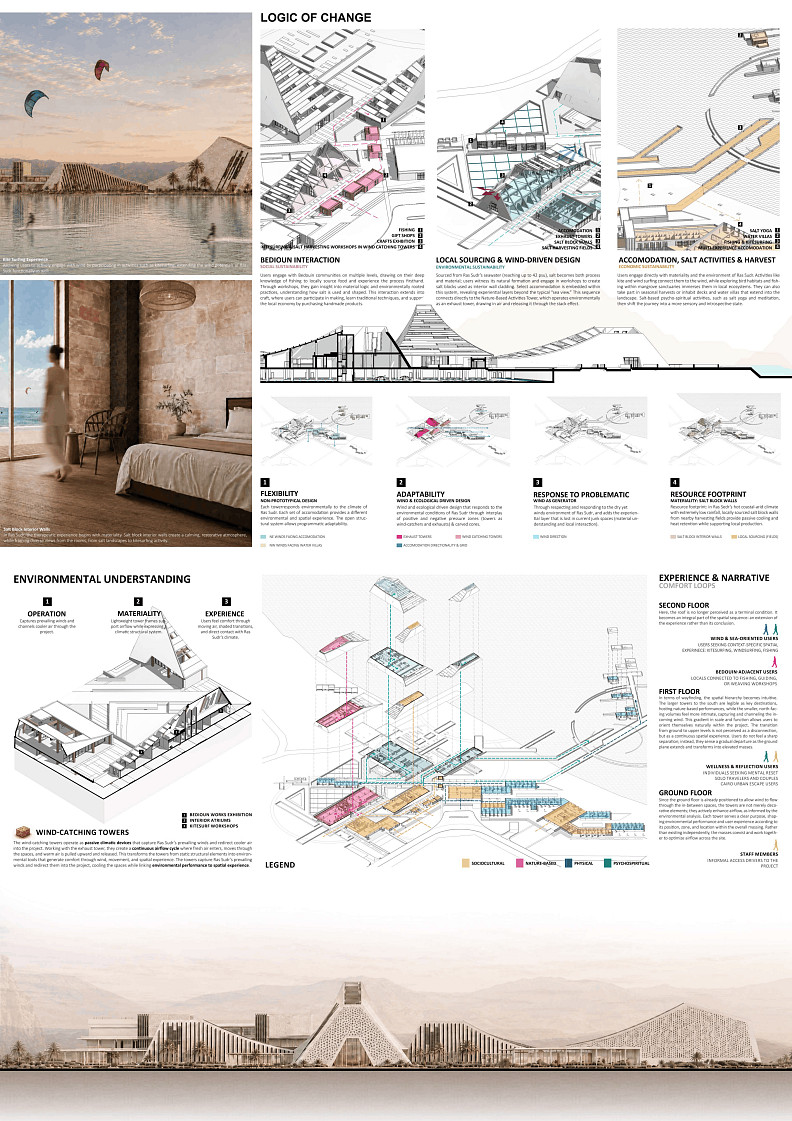
The project proposes an environmentally responsive hospitality retreat complex in Ras Sudr that redefines comfort through passive design, climatic adaptation, and cultural integration. The scope includes hospitality accommodations, communal gathering spaces, wellness and retreat facilities, waterfront decks, mangrove conservation areas, and interconnected outdoor environments. The design utilizes a wind-oriented spatial framework, porous architectural forms, passive cooling strategies, and landscape integration to create a sustainable alternative to conventional resort developments. The project addresses environmental, sociocultural, physical, and psychospiritual dimensions of comfort while promoting resilient tourism and responsible coastal development. A wind-oriented spatial framework forms the backbone of the project, transforming the site's strong prevailing winds from an environmental challenge into a comfort-generating resource. Frontal wind towers positioned along the northern edge capture and channel prevailing northern winds through the development, while southern towers function as exhaust structures that facilitate continuous airflow and natural ventilation. This passive cooling system reduces reliance on mechanical conditioning while enhancing thermal comfort throughout the complex.
Technical information
The project is conceived as an interconnected hospitality retreat complex that employs passive environmental systems and locally responsive material strategies to generate comfort. The primary architectural masses are constructed using salt-based wall systems inspired by the saline-rich landscape of Ras Sudr. These thick salt walls act as thermal buffers, slowing heat transfer through their thermal mass properties, reducing indoor temperature fluctuations, and contributing to passive cooling. In addition to their environmental performance, the salt surfaces provide therapeutic benefits associated with halotherapy, improving air quality and creating restorative sensory environments. This is mainly used on the interior walls of the building. The environmental strategy is centered around a wind-driven ventilation network. Northern wind-catching towers capture prevailing sea breezes and channel them through the development, while southern salt towers operate as passive exhaust structures, utilizing stack-effect ventilation to extract warm air and maintain continuous airflow. Together, these systems reduce dependence on mechanical air conditioning while enhancing thermal comfort. Various room experiences are provided in this retreat to provide diverse experiences for different users. In addition to the traditional sea view and mountain view units, mangrove dwellings are positioned adjacent to protected mangrove sanctuaries, offering immersive views into coastal ecosystems, bird habitats, and ecological restoration zones. Elevated foundations minimize environmental disturbance while shaded decks encourage passive engagement with the landscape. Fishing and kitesurfing units overlook traditional fishing and kitesurfing areas, connecting guests with Ras Sudr's maritime culture and daily rhythms. Open terraces and framed views strengthen the visual relationship between habitation and local livelihood practices. Salt harvesting field retreat units engage users in the harvesting experience and integrate salt-based wall systems and therapeutic spaces where the material's thermal, sensory, and restorative qualities contribute to physical and psychological well-being.

Copyright © 2026 INSPIRELI | All rights reserved. Use of this website signifies your agreement to the Terms of Use, Privacy Policy, and use of cookies.