PLANT ARTIFACT
Idea projektu
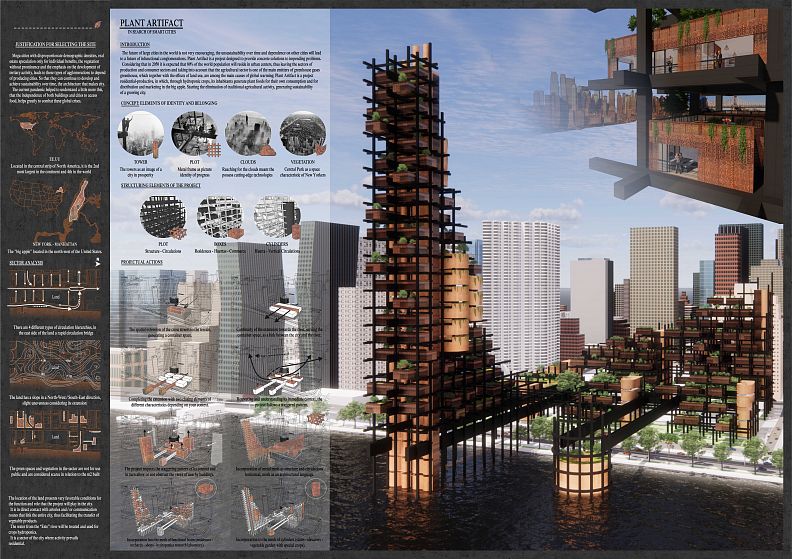
Mega-cities with disproportionate demographic densities, real estate speculation only for individual benefits, the vegetation without prominence and the emphasis on the development of tertiary activity, leads to these types of agglomerations to depend of producing cities. So that they can continue to develop and achieve sustainability over time, the architecture that makes city. The current pandemic helped to understand a little more this, that the independence of both buildings and cities to access food, helps greatly to combat these global crises.
Popis projektu
The future of large cities in the world is not very encouraging, the unsustainability over time and dependence on other cities will lead to a future of infunctional conglomerations. Plant Artifact is a project designed to provide concrete solutions to impending problems. Considering that in 2050 it is expected that 80% of the world population will reside in urban centers, thus leaving the sectors of production and consumer sectors and taking into account that the agricultural sector is one of the main emitters of greenhouse gases greenhouse, which together with the effects of land use, are among the main causes of global warming; Plant Artifact is a project residential-productive, in which, through hydroponic crops, its inhabitants generate plant foods for their own consumption and for distribution and marketing in the big apple. Starting the elimination of traditional agricultural activity, generating sustainability of a growing city.
Technické informace
The use of the metal frame and the divisions of the circulation cores allows to generate that the project is evolutionary, where it can begin to inhabit and produce from its initial stages. With the different ways of ordering the boxes (residences or gardens) such as cylinders (orchards) and adding to this the staggering of its composition, a project is obtained where the concept of "type plant" disappears. The residences were designed considering the variations and the different types of families that exist in the actuality. These are flexible and of evolutionary growth where the only rigid element are the services and the staircase that leads to the green terrace. The preconceived residential designs were insufficient to face this current crisis. This new Post-pandemic typology proposes a new way of living where “staying at home” is a most viable experience. The orchards adapt the same typology of the residences, where the laying of the hydroponic systems They are located on a free floor. For functional reasons, unlike residences, this can evolve 2 to 3 times from its initial stage.
Leandro Cosentino dimani
Universidad Nacional de Tucumán, Facultad de Arquitectura y Urbanismo, Tucumán
Argentina
Architektura
Projekt odevzdán
12. 07. 2021Tag
- Playground
- Parks
- Public spaces
- Gardens
- Waterway
- Cemetery
- Apartment
- Multi Unit Housing
- Private House
- Student Housing
Rada studentům
PLANT ARTIFACT

Copyright © 2026 INSPIRELI | All rights reserved. Use of this website signifies your agreement to the Terms of Use, Privacy Policy, and use of cookies.
