Nexus
Project idea
The Nexus Cotton Research Centre is conceived as an integrated research, education, and agricultural innovation facility located within the agricultural landscape of Tanta, Egypt. The project responds to the growing environmental challenges affecting cotton cultivation, particularly water scarcity, increasing pressure on freshwater resources, and the need for more sustainable agricultural practices within the Nile Delta. The primary objective of the project is to establish a multidisciplinary platform where scientific research, environmental experimentation, and public engagement can operate within a unified architectural framework. Through the integration of laboratories, experimental cultivation facilities, water treatment systems, educational spaces, and agricultural testing fields, the centre aims to support the development of innovative solutions for the future of cotton production. A central research goal of the project is the development and testing of drought-resistant cotton breeds that require significantly less water while maintaining productivity and crop quality. To achieve this, the centre investigates cultivation methods using both freshwater and treated greywater, enabling comparative research into irrigation efficiency, plant performance, and long-term environmental sustainability. The architectural concept reflects the continuous relationship between research, cultivation, and environmental management. Building systems, landscape elements, and circulation networks are designed to reveal the processes of water recycling, agricultural experimentation, and scientific discovery, transforming the facility into both a research institution and a living educational environment. Ultimately, the Nexus Cotton Research Centre seeks to contribute to the resilience of Egypt's agricultural sector by advancing sustainable cotton cultivation, promoting responsible water use, and supporting the development of innovative agricultural technologies capable of addressing future environmental challenges.
Project description
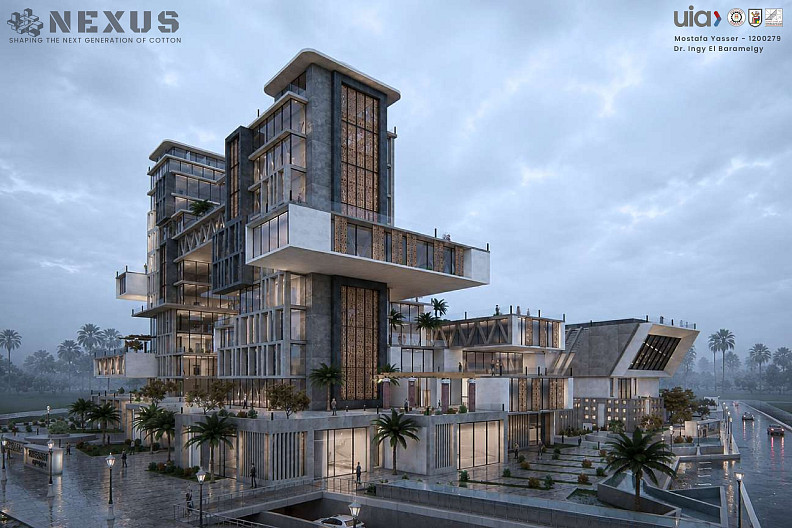
The Nexus Cotton Research Centre is an integrated research, education, and agricultural innovation facility located within the agricultural landscape of Tanta, Egypt. The project addresses the environmental challenges facing cotton cultivation, particularly water scarcity and the increasing pressure on freshwater resources in the Nile Delta. The centre combines research laboratories, experimental laboratories, vertical farming towers, educational facilities, workshops, exhibition spaces, administration offices, greywater treatment systems, and outdoor agricultural testing fields within a single environmental framework. Its primary objective is to develop and test drought-resistant cotton breeds that require less water while maintaining productivity and crop quality. The project operates through a dual experimental system comparing cotton cultivation using freshwater and treated greywater, enabling research into irrigation efficiency, sustainable agriculture, and water recycling. Public exhibition and educational spaces allow visitors to engage with the research process while promoting environmental awareness and innovation in cotton production.
Technical information
The project utilizes a reinforced concrete structural system for the podium levels, consisting of beam-and-column construction that provides the primary load-bearing framework. Reinforced concrete cores accommodate vertical circulation, service shafts, and mechanical systems while acting as the main lateral stability elements. The vertical farming towers employ a three-dimensional steel space truss system that distributes gravity and lateral loads through triangulated steel members, ensuring structural rigidity and efficiency. Cantilevered building sections are supported by steel transfer girders and deep truss members integrated within the floor structure, while the skybridge is supported by steel space trusses connected to the primary tower structures. The building envelope combines exposed concrete, glass curtain walls, stone cladding, and perforated Mashrabiya-inspired louvre screens. These materials enhance durability, daylight performance, solar control, privacy, and environmental efficiency while responding to the climatic conditions of Tanta. Sustainable features include greywater recycling systems, vertical farming units, shaded outdoor circulation, water features, and landscape-integrated environmental strategies.

Copyright © 2026 INSPIRELI | All rights reserved. Use of this website signifies your agreement to the Terms of Use, Privacy Policy, and use of cookies.