Architectural Project - Kiyami Children's Center
Project idea
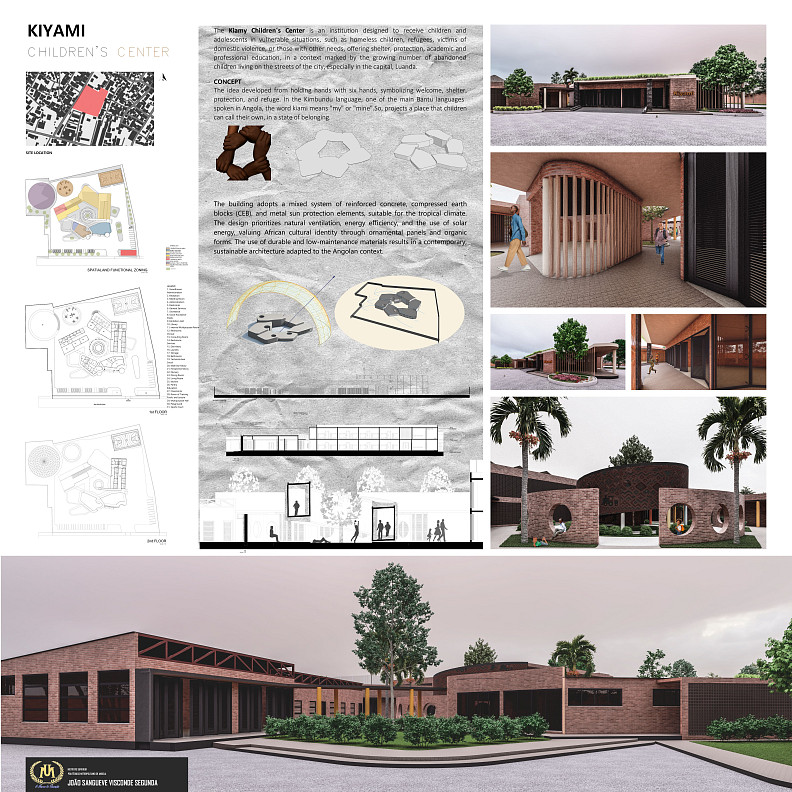
The Kiamy Children´s Center is an institution designed to receive children and adolescents in vulnerable situations, such as homeless children, refugees, victims of domestic violence, or those with other needs, offering shelter, protection, academic and professional education, in a context marked by the growing number of abandoned children living on the streets of the city, especially in the capital, Luanda. The idea developed from holding hands with six hands, symbolizing welcome, shelter, protection, and refuge. In the Kimbundu language, one of the main Bantu languages spoken in Angola, the word kiami means "my" or "mine".So, projects a place that children can call their own, in a state of belonging.
Project description
The project consists of creating a Multifunctional Community Center for Shelter and Protection, designed to serve children and adolescents in situations of social vulnerability, abandonment, neglect, violence, and social exclusion, providing a safe, dignified, and favorable environment for their integral development. The infrastructure is organized into different functional sectors: Administrative Sector (reception, secretariat, administration, and meeting room), responsible for the management and coordination of activities; Social and Clinical Sector (social assistance, consulting room, and service spaces), intended for psychosocial support and basic health care; Educational Sector (classrooms and training), focused on academic reinforcement and skills development; Cultural and Community Sector (library, exhibition hall, and multipurpose spaces), promoting learning, culture, and social integration; Residential Sector (male and female dormitories, nursery, living room, and dining room), ensuring adequate shelter conditions; Service Sector (kitchen, pantry, laundry, storage, and technical areas), ensuring operational support; The Leisure and Sports Sector (multipurpose hall, playground, and multi-sports field) is designed for the physical, recreational, and social development of its users. The solution was conceived to promote the protection, social inclusion, education, health, well-being, and family and community reintegration of the beneficiaries. The project adopts sustainability principles through the use of reinforced concrete, compressed earth blocks (CEB), natural ventilation, passive solar protection, and photovoltaic energy, resulting in a contemporary, efficient, humanized architecture suitable for the Angolan context.
Technical information
The building adopts a mixed system of reinforced concrete, compressed earth blocks (CEB), and metal sun protection elements, suitable for the tropical climate. The design prioritizes natural ventilation, energy efficiency, and the use of solar energy, valuing African cultural identity through ornamental panels and organic forms. The use of durable and low-maintenance materials results in a contemporary, sustainable architecture adapted to the Angolan context.
João Sangueve Visconde Segunda
Instituto Superior Politécnico Metropolitano de Angola
Angola
Architecture
Project submitted
16. 06. 2026Tag
- Aging Facility
- City Hall
- Community Center
- Consulate / Embassy
- Court
- Post Office
- Fire/Police/Military
- Hospital, Medical Facility

Copyright © 2026 INSPIRELI | All rights reserved. Use of this website signifies your agreement to the Terms of Use, Privacy Policy, and use of cookies.