CENTER
Project idea
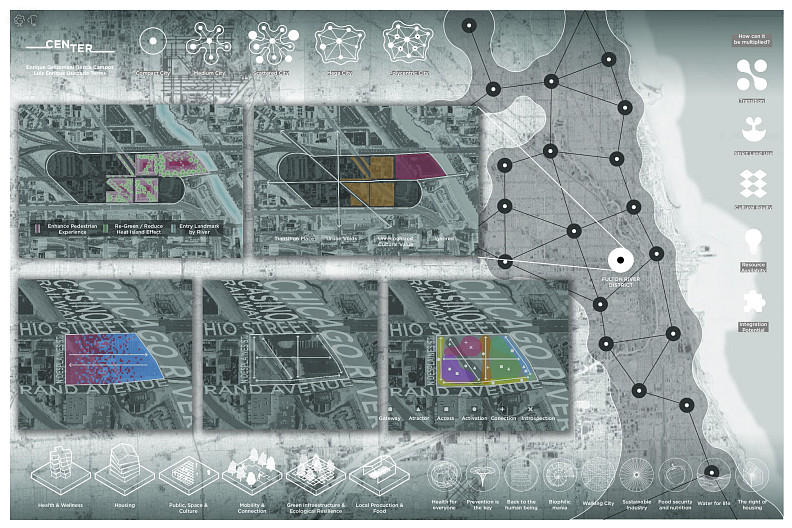
The concept of the project emerged from our studio's focus on Climate, Health, and Well-being within the framework of participatory architecture. From the beginning, we explored how architecture, landscape, and urban design could work together to promote healthier lifestyles, strengthen communities, and respond to environmental challenges. Our main objective was to foster a stronger sense of collectivity by integrating health and well-being into every scale of the project. We understood health not only as a physical condition, but also as a social and emotional experience shaped by the spaces we inhabit. Through urban interventions, public spaces, and architectural strategies, the project seeks to encourage interaction, accessibility, and a greater connection between people and their environment. At the same time, the proposal addresses climate-related challenges by incorporating sustainable design principles that reduce environmental impact while creating comfortable and resilient spaces. We also focused on well-being by designing environments that promote safety, comfort, and a sense of belonging, recognizing the important role architecture plays in shaping human experiences and emotions. The project was guided by a manifesto composed of several key principles: Health for Everyone and Everywhere, Prevention is the Key, Back to the Human Being, Biophilic Mania, Walking City, Sustainable Industry, Food Security and Nutrition for Everyone, Water for Life, and The Right to Housing. Rather than focusing on only one of these themes, we aimed to address all of them, as we believe that health and well-being are inherently multidisciplinary concepts. Given the scale and conditions of the site, a comprehensive approach was necessary, allowing us to integrate a diverse range of programs and strategies that respond to social, environmental, and urban needs simultaneously.
Project description
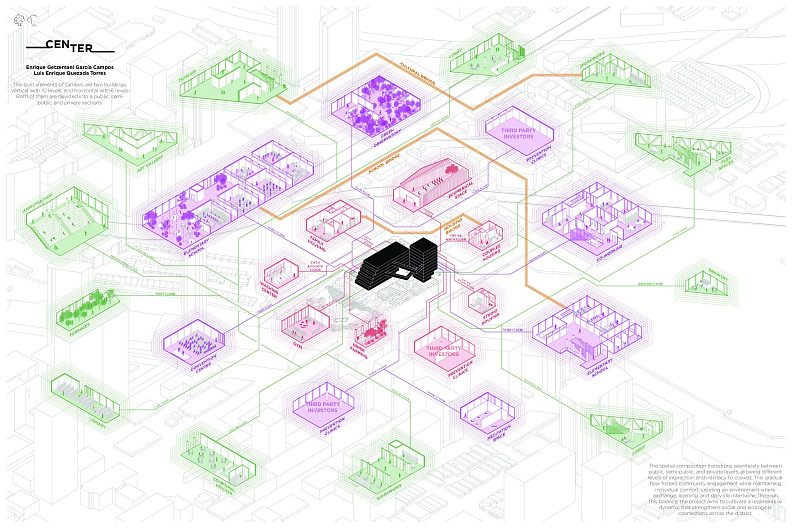
CENTER is located in the Fulton River District, one of Chicago’s most rapidly transforming urban areas. Conceived through the principles of the polycentric city, the project aims to become a strategic urban node that enhances connectivity, strengthens local identity, and redefines the relationship between architecture and public life. Rather than functioning as a single-purpose building, CENTER operates as an integrated urban ecosystem, bringing together cultural, educational, productive, and recreational programs within a single complex. The project responds to the growing need for decentralized urban destinations by concentrating diverse activities that encourage social interaction, knowledge exchange, and economic vitality. Through a network of interconnected public spaces, terraces, and communal platforms, CENTER promotes accessibility and interaction across different user groups and scales of occupation. By incorporating public space into the building itself, the project blurs the boundaries between the city and architecture, between the vertical and the urban. This integration transforms the building into an extension of the public realm, creating opportunities for encounter, participation, and collective experience. As a result, CENTER proposes a new model of urban coexistence that reinforces Chicago’s polycentric structure while fostering a more connected, vibrant, and resilient city.
Technical information
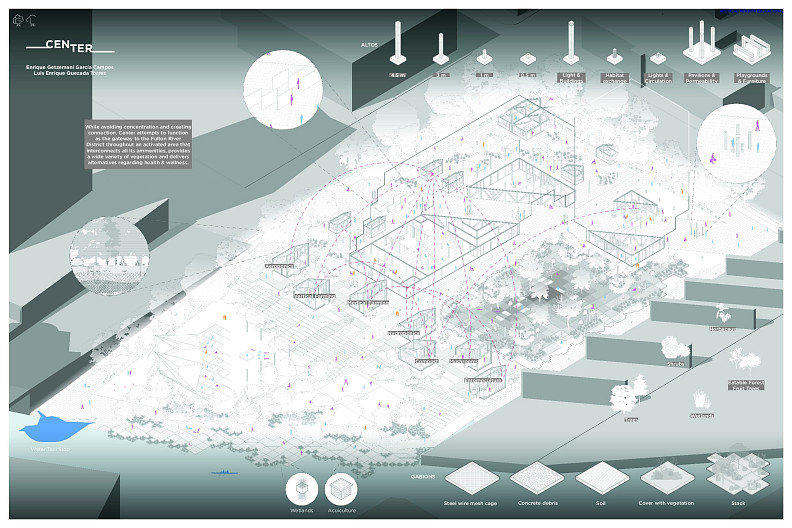
The project consists of two mixed-use buildings, one rising six stories and the other ten stories, both supported by a foundation system of reinforced concrete piles. The primary structural system is composed of glulam timber framing combined with prefabricated concrete floor slabs, creating a balance between structural efficiency, sustainability, and construction speed. The buildings are enclosed by an ETFE façade system, a high-performance thermoplastic material known for its exceptional durability, lightweight properties, and resistance to UV radiation. This envelope provides effective thermal insulation and environmental protection against Chicago's extreme climatic conditions while allowing natural light to penetrate the interior spaces. Throughout the surrounding public realm, glulam timber is extended beyond the buildings as a recognizable design element, reinforcing the project's architectural identity. Permeable paving systems are incorporated to promote rainwater infiltration and reduce surface runoff. The landscape strategy utilizes gabion structures constructed with recycled concrete sourced from the existing site, transforming demolition material into functional public spaces and green areas while minimizing waste and supporting a circular approach to construction.
Getzemani Garcia, Luis Enrique Quezada
Tecnológico de Monterrey (ITESM), dep. of architecture
Mexico
Architecture
Project submitted
11. 06. 2026Tag

Copyright © 2026 INSPIRELI | All rights reserved. Use of this website signifies your agreement to the Terms of Use, Privacy Policy, and use of cookies.