Edifício Híbrido
Project idea
A hybrid building combining multiple uses within a single architectural complex.
Project description
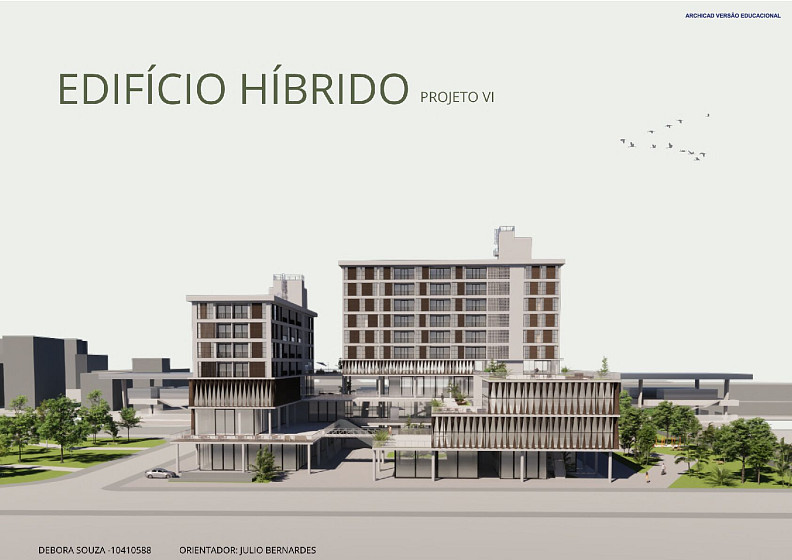
The project proposes a hybrid building (Edifício Híbrido) as part of a Project VI studio exercise. The design features a multi-story mixed-use complex with distinct volumetric compositions, including a taller residential or hotel tower and lower commercial/public-use podium levels. The facade treatment incorporates a rhythmic pattern of solid and void elements with wooden-toned panels and glazing, while the ground level features a colonnade with V-shaped or angled structural columns creating a permeable public interface with landscaped surroundings.
Technical information
The proposed development is conceived as a mixed-use urban complex that integrates residential, commercial, service, and public functions within a single architectural composition. The project is based on the principles of urban permeability, functional diversity, and spatial continuity, promoting an active relationship between the building and the surrounding city. Located adjacent to the Estudantes Train Station and one of the main access avenues of Mogi das Cruzes, the design responds to the site's intense pedestrian and vehicular flows by creating a porous ground level, allowing public circulation through the plot while establishing visual and physical connections between the surrounding streets. The architectural massing is organized into distinct volumes connected by elevated plazas, bridges, and landscaped terraces, generating intermediate spaces that encourage social interaction and urban activity. This configuration reduces the perception of a single large block while creating a dynamic composition of solids and voids. The project adopts the concept of an active podium, where commercial spaces and public amenities activate the street frontage, strengthening the urban experience throughout the day. Above this base, the residential towers rise as independent volumes, ensuring privacy while maintaining strong visual integration with the public spaces below. Environmental performance is enhanced through vertical shading devices (brise-soleils), extensive glazing for natural daylighting, green roofs, and landscaped terraces, contributing to thermal comfort and reducing solar heat gain. The elevated open spaces also improve natural ventilation and create opportunities for outdoor leisure and community use. The building embraces the principles of the Compact City, concentrating multiple urban functions within walking distance and reducing dependence on private vehicles. By combining housing, commerce, services, and public open spaces, the project reinforces urban vitality and contributes to a more sustainable and connected urban environment. Overall, the proposal transforms the site into a multifunctional urban hub, where architecture acts as an extension of the public realm, promoting accessibility, social interaction, and a continuous dialogue between the built environment and the city.
Debora Souza
Mackenzie Presbyterian University, UPM, Faculty of Architecture and Urbanism, Sao Paulo
Brazil
Architecture
Project submitted
15. 06. 2026Tag
- Bank
- Exhibition Center
- Office
- Pop Up
- Retail
- Shopping Mall
- Showroom
- Supermarket

Copyright © 2026 INSPIRELI | All rights reserved. Use of this website signifies your agreement to the Terms of Use, Privacy Policy, and use of cookies.