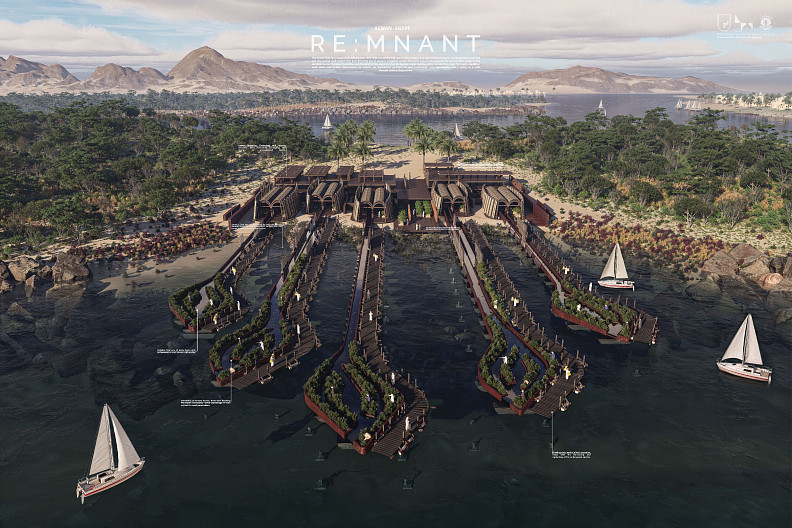
RE:MNANT
Project idea
Flood the land that used to flood
Project description
The Aswan High Dam did not destroy the First Cataract's riparian forest. It removed the instruction that told it how to survive. For millennia, the annual Nile flood performed four irreplaceable functions on Saluga and Ghazal Islands — recharging the water table, flushing accumulated salts, depositing nutritive silt, and delivering to each native species the precise duration of inundation its seeds required to break dormancy and germinate. These were not passive benefits. They were the biological operating system of a gallery forest that had evolved over four million years in direct dependency on a seasonal pulse of water. When the High Dam regulated the Nile to a constant level in 1970, it did not flood the forest. It silenced it. What remains today is 0.5 square kilometres of acacia gallery forest on two granite islands — the last surviving fragment of a riparian ecosystem that once lined the entire First Cataract island chain. Over 100 plant species. 15 mammal species. 135 bird species. Five native plant species whose locally-adapted Nile Valley seed stock has never been banked, whose germination requirements are specific to conditions that exist nowhere else, and which are one fire away from permanent genetic loss. Four fires have already occurred since 2003. The 2011 fire destroyed 60% of remaining plant cover. The reserve receives $19 per square kilometre per year in management funding. One ranger. No vehicle. No baseline. No regeneration. Re:mnant is not a response to the fire. It is a response to the silence. The architecture is built on a single ecological finding: flood duration, not depth, is the primary germination trigger for Nilotic dryland species. This distinction is everything. It means the building does not need pumps, pipes, timers, or any mechanical water management system to replicate the function the flood once performed. It needs only topography and a notch cut into a stone wall. Five granite rubble basins, staggered by elevation across the island's existing topography, flood independently as the Nile rises seasonally to each basin's floor level. The drainage notch in each basin wall — its width controlling flood duration, its height controlling maximum water depth — is the single most critical design element in the project. Basin 01 at +100mm elevation holds water for six to eight weeks: the hydroperiod of Glinus lotoides. Basin 05 at +650mm floods for three to five days: the hydroperiod of Maerua crassifolia. The Nile does the timing. The stone does the calibration. The seed does the rest. The building that follows is a linear production chain — basin to propagation hall to seed vault to felucca dock — generating three outputs that address three compounding crises simultaneously. Transplantable Balanites aegyptiaca seedlings go to Aswan's irrigation canal banks, where their saponin-rich fruits leach molluscicidal compounds into canal water at concentrations that suppress the Bulinus snail intermediate host of Bilharzia — a disease infecting 25% of Aswan's irrigated villages with no existing botanical intervention programme. Banked seed stock goes to a below-grade granite vault and a duplicate at South Valley University — the first conservation record of these Nile Valley ecotypes in existence. Processed fodder — Vachellia nilotica silage and Balanites kernel meal — goes by felucca to Aswan livestock farmers who need dry-season feed and in doing so become the economic partners of the reserve's recovery. The Nubian families who farm 12 feddans inside the reserve boundary — displaced from this land by the same dam that created the ecological crisis — are not managed out of the programme. They are the programme. Formalised as a stewardship cooperative, employed as basin monitors, seedling handlers, felucca crew, and craft producers, they become the most qualified stewards of an ecosystem whose destruction their displacement helped to accelerate. This is not a beneficiary model. It is a political argument made spatial: the people who lost the most to the dam are given the institutional role of repairing what the dam broke. The building operates entirely off-grid. No mechanical systems. No mains power. No grid connection. Heavy timber post and beam structure, open to cross-ventilation from the prevailing Nile north wind. Terracotta brise-soleil louvers at 54 degrees filtering the desert sun to 60% intensity inside the propagation bays. Below-grade seed vault using granite bedrock thermal mass to maintain 20–22 degrees without refrigeration. Composting toilets. Grey water reed bed. The building earns its authority by replicating the flood's logic — not by importing a foreign system, but by reading what the landscape already knew how to do and building the instrument that allows it to do it again. The colon in Re:mnant is not punctuation. It is a command. What remains — rebuilds.
Technical information
The building doesnt have a repetative structural system, there are different types to deliver certain functions effectively, high thermal mass for seed banks, double vaulted wooden structure, wodden structure for upper floors, perforated concrete basins, pontoon steel structure for the floating basins

Copyright © 2026 INSPIRELI | All rights reserved. Use of this website signifies your agreement to the Terms of Use, Privacy Policy, and use of cookies.