Ce projet démontre une grande créativité et originalité en combinant le respect de la nature avec une compréhension du potentiel du contexte local, un design innovant et l'utilisation correcte des matériaux.
Je vous félicite pour ce design complet, durable et pratique.
Je le recommande vivement.
Cordialement.
Le projet est fantastique, je vous souhaite tous mes vœux de succès, et il répond à toutes les normes requises.
Second-level Music School in Szczecin's Nowe Miasto with Acoustic Climate modeling Elements
Project idea
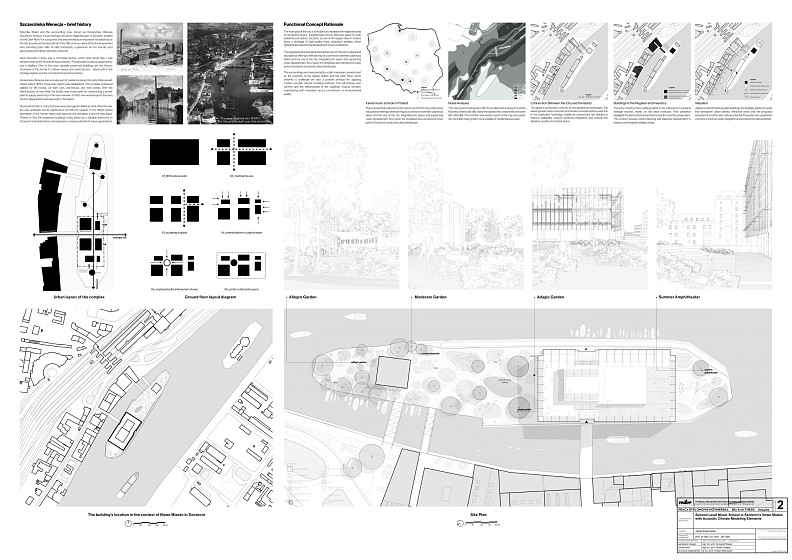
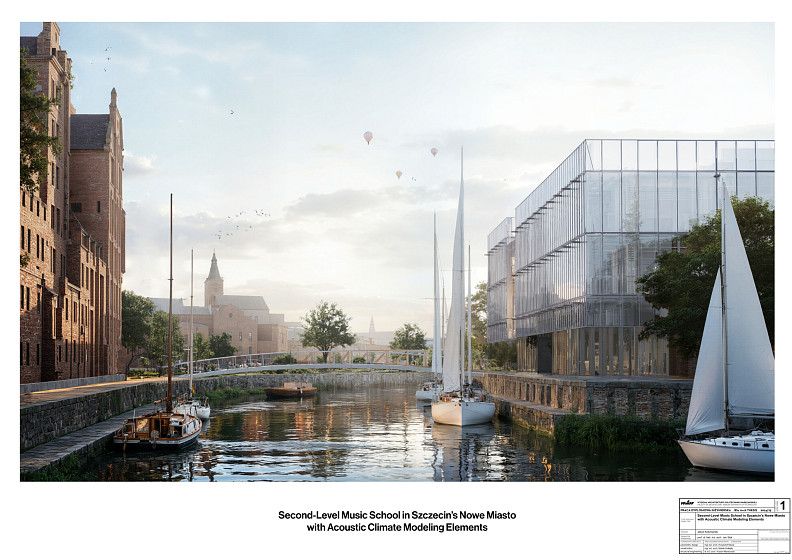
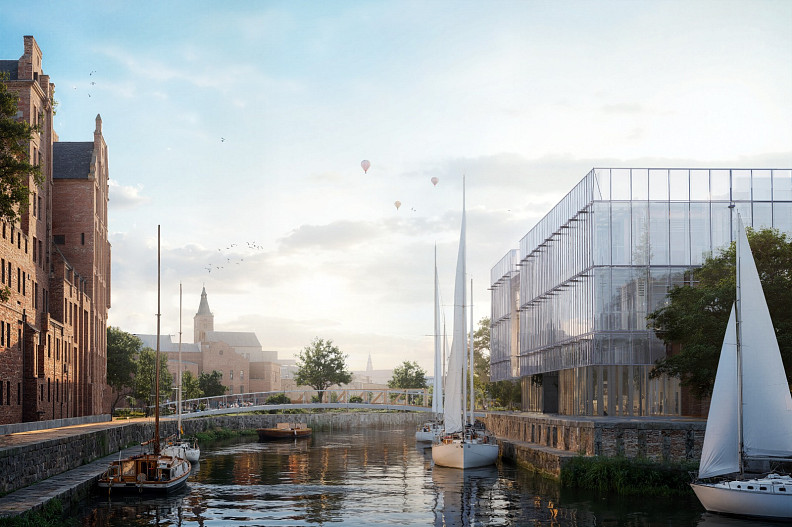
The project is a design of Secnd-Level Music School located on Jaskółcza Island in Szczecin, conceived as both an educational facility and an urban attractor. The concept emerges from a multi-layered analytical study of the site, including historical, spatial, functional, environmental, acoustic, and transportation contexts. The project responds to three identified issues: severe urban noise conditions, shortage of music education infrastructure in Szczecin, and the social and spatial degradation of the post-industrial waterfront district. The design objective is to create an acoustically optimized learning and performance environment while restoring the cultural value of “Szczecin’s Venice” and reintegrating the island into the city’s public life. The project treats the school not only as an educational building but as a catalyst for urban revitalization, providing public cultural services, social integration spaces, and program flexibility throughout the day and year. The guiding approach is analytical and evidence-based, using environmental mapping, user behavior modelling, historical heritage assessment, and advanced acoustic optimization in the design of practice rooms and structural solutions.
Project description
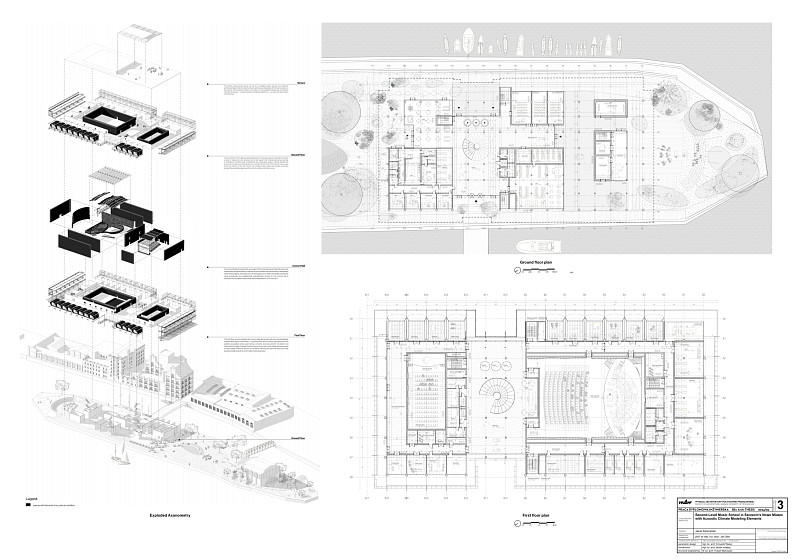
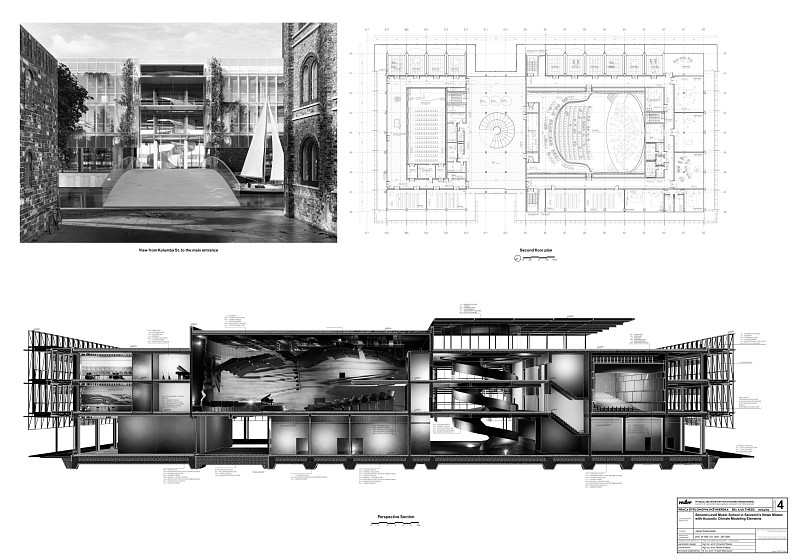
Le projet consiste en une proposition architecturale et urbaine pour un Lycée Musical et ses espaces publics environnants sur l'île Jaskółcza. Le programme comprend une grande salle de concert, une petite salle de concert, des salles de pratique, des studios d'enregistrement, des salles de classe, une administration, des espaces d'exposition, une audiothèque, un café, une terrasse panoramique et des jardins thématiques organisés le long de l'île. Le concept spatial découle des conclusions des analyses du site plutôt que de la seule composition formelle. Le projet intègre : la réutilisation adaptative d'une île post-industrielle délaissée, la protection et la réinterprétation des structures patrimoniales classées, le zonage fonctionnel basé sur l'utilisation du bâtiment en fonction du temps, l'accessibilité publique grâce à une stratégie de rez-de-chaussée ouvert, la transformation écologique du paysage en jardins à thème musical, la revitalisation du front d'eau et des connexions piétonnes. Le bâtiment est intentionnellement programmé pour fonctionner selon différents cycles temporels. Les fonctions commerciales et culturelles activent le bâtiment le matin et en début d'après-midi, tandis que le programme scolaire domine les heures suivantes, assurant une utilisation continue et économiquement viable. Cette stratégie temporelle et fonctionnelle résulte directement d'une investigation analytique des groupes d'utilisateurs potentiels, des schémas de mobilité, des variations saisonnières et des conditions d'exposition acoustique à travers le site. La salle de concert est positionnée comme le « noyau » central du bâtiment, entourée de fonctions techniques, des coulisses et de répétition, tandis que la façade à double peau et les salles de pratique en tube acoustique représentent une synthèse de la conception architecturale avec l'analyse environnementale et de performance.
Technical information
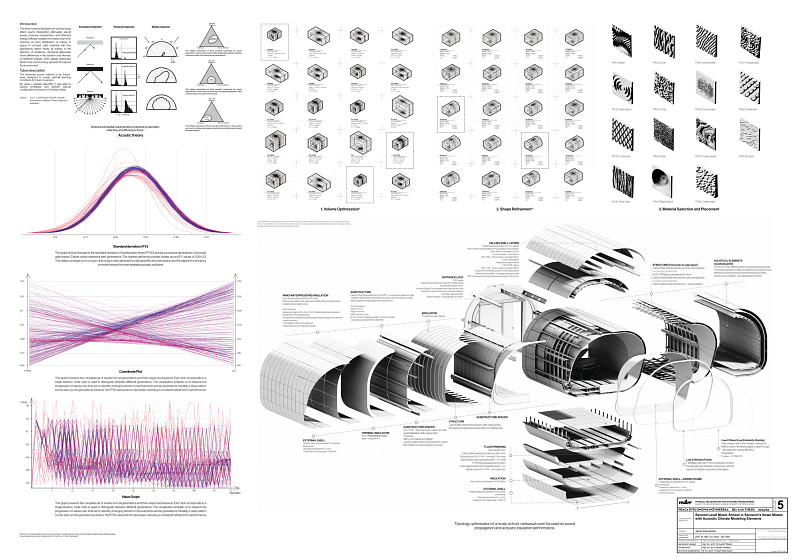
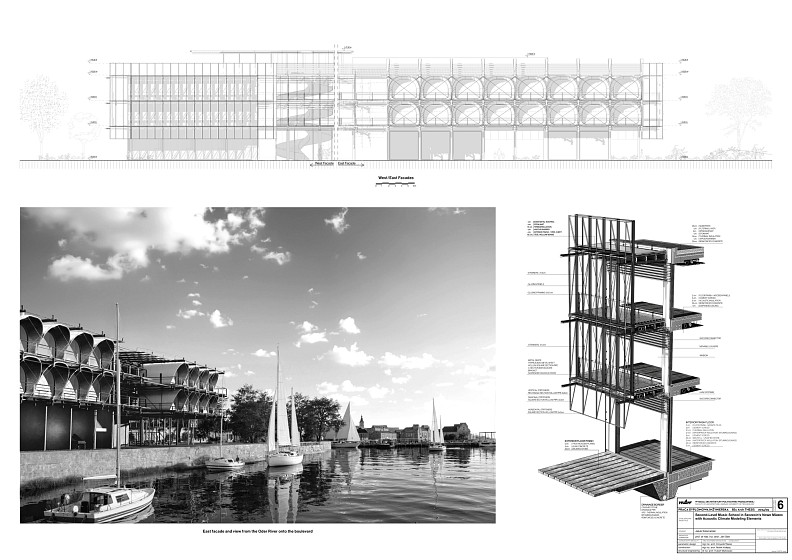
The project applies a rigorously analytical technical approach, integrating geotechnical, structural, acoustic, climatic, and spatial performance data into the design process. Key technical features include: Structural system: mixed reinforced-concrete wall-and-column system with steel box trusses over concert halls, dimensioned for high live loads, suspended acoustic equipment, and balcony structures. Foundation strategy: reinforced concrete foundation slab adapted to wet, marshy ground and uncertain groundwater conditions, with drainage and flood-risk mitigation through island edge reinforcement and Larsen piling. Double-skin façade system: external steel frame acting as thermal and acoustic buffer against railway and river noise, improving energy efficiency and interior acoustic comfort. Acoustic optimization: practice rooms designed as prefabricated tube structures optimized using genetic algorithms to improve sound diffusion, minimize standing waves, and prevent sound transmission between rooms. Roof and slab design: locally thickened slabs in high-load and anchoring zones, green roof areas, and reinforced surfaces in concert and foyer zones. Building services: mechanical ventilation with heat recovery, air-conditioning, BMS coordination infrastructure, sprinkler and hydrant fire-safety systems, and accessibility-oriented circulation design. Across all technical layers, decisions are derived from prior analytical assessments: transport exposure, hydrological risk, acoustic pollution, structural load distribution, user circulation, and temporal building use. The project treats technical solutions not as add-ons but as outcomes of a systematic, research-based design methodology.
Jakub Kołomański
Warsaw University of Technology, (Politechnika Warszawska), Faculty of Architecture, Warszawa
Poland
Architektura
Projekt odovzdaný
29. 12. 2025Tag
Architektura
Hall/Theatre
Educational
- Schools
- Nursery
- University
- Library
- Other
Rada studentům
École de Musique de Deuxième Niveau à Nowe Miasto de Szczecin avec Éléments de Modélisation du Climat Acoustique
20.03.2026

Copyright © 2026 INSPIRELI | All rights reserved. Use of this website signifies your agreement to the Terms of Use, Privacy Policy, and use of cookies.