Na:Cl
Project idea
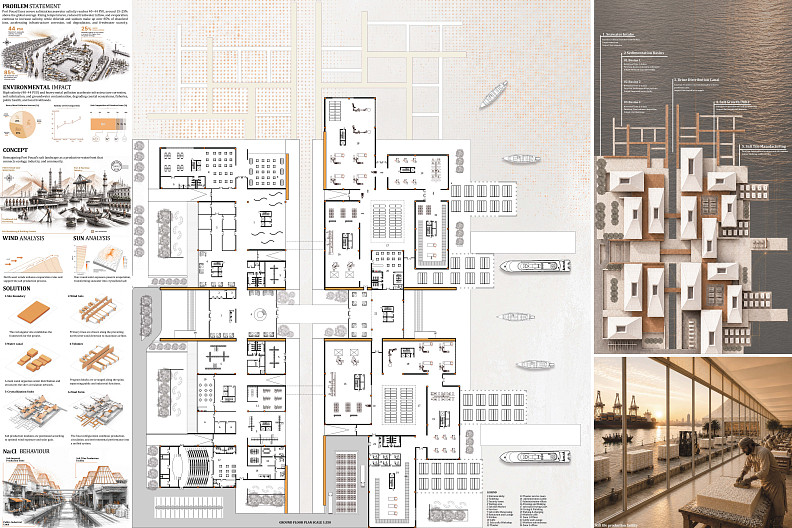
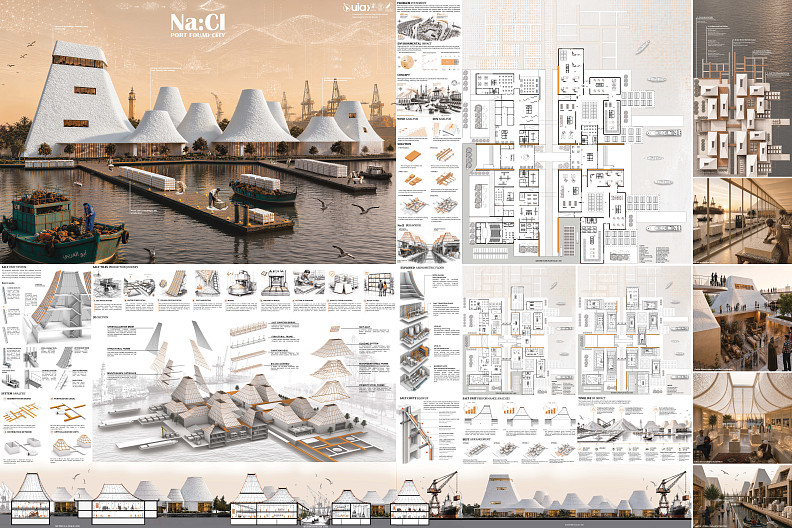
Na:Cl, Port Found City, Egypt transforms one of Port Said’s greatest environmental challenges into an architectural opportunity. In a region where salinity levels are estimated to be 15–20% higher than average coastal conditions, increasing coastal erosion and environmental degradation continue to threaten the shoreline. At the same time, traditional salt production relies on extensive flat evaporation fields that consume large areas of land and require lengthy harvesting periods, resulting in an inefficient production process with limited economic value. Rooted in Port Fouad’s unique relationship with salt, its coastal landscape, and its strategic location along the Suez Canal, the project reimagines salt as more than a raw material for export. Instead, it becomes a catalyst for architecture, material innovation, and sustainable economic growth. Inspired by the processes of crystallization and accumulation, and by the salt mountains that have become a distinctive landmark of the region, the architectural form emerges directly from the morphology of salt itself, creating a strong connection between the built environment, the landscape, and the industry it serves. The project proposes a contemporary model for salt production that shifts the industry from extraction to transformation. Through an integrated system of harvesting, research, processing, and manufacturing, salt is converted into value-added products that contribute to both local industry and architectural innovation. This approach establishes a more efficient production cycle while creating new opportunities for economic development within Port Said. A key objective of the project is the development of salt-based construction materials, including architectural tiles, façade systems, and innovative building components designed for coastal environments. By connecting material research with environmental performance, the project explores how locally sourced salt can contribute to shoreline protection and erosion mitigation, positioning architecture as a tool for both production and resilience.
Project description
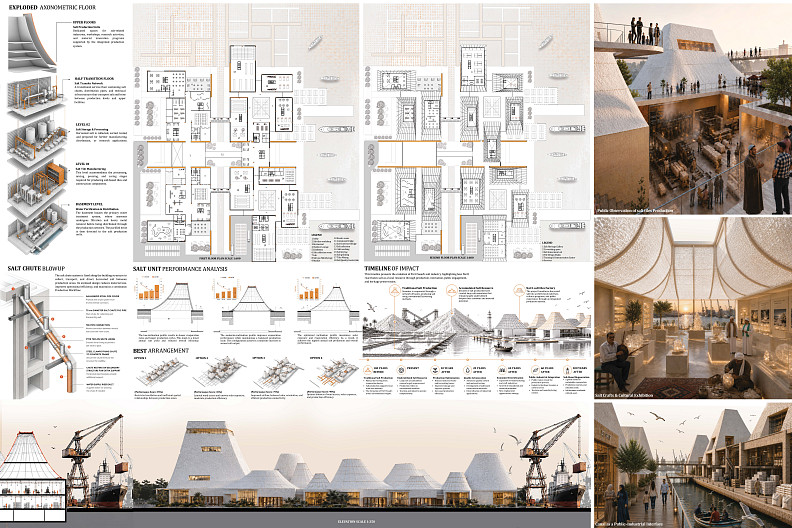
Na:Cl is an integrated architectural complex that combines industrial production, research, education, and public engagement within a single framework. The project is organized into two primary sectors: a public sector connected to the city and an industrial sector connected to the port and the Suez Canal. This separation ensures operational efficiency while maintaining visual connections between visitors and the production process. The public sector accommodates exhibition spaces, research centers, educational facilities, workshops, observation platforms, and community spaces that communicate the environmental and industrial significance of salt. The industrial sector contains the operational components of the project, including water treatment facilities, salt production units, storage areas, manufacturing spaces, and distribution zones. The project operates through two interconnected production cycles. The first cycle focuses on seawater treatment, salt harvesting, crystallization, processing, and storage. The second cycle transforms refined salt into architectural products such as tiles, façade systems, and construction components. Together, these cycles establish a complete value chain that expands the role of salt from a natural resource into an architectural material. The architectural composition is formed through a series of clustered volumes inspired by salt formations and crystallization patterns. These interconnected masses accommodate public, industrial, and research functions while creating a distinctive architectural identity that reflects Port Said’s coastal landscape and industrial heritage.
Technical information
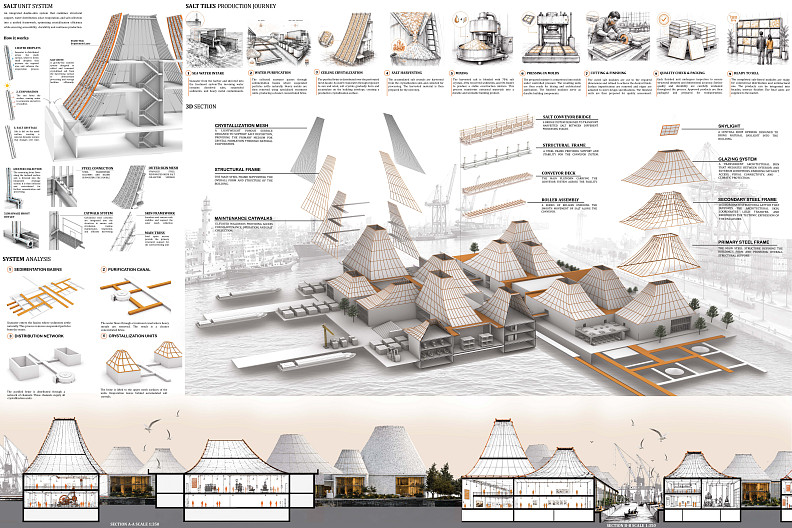
The project utilizes a reinforced concrete substructure combined with a steel structural framework capable of accommodating large-span industrial halls, research facilities, and public spaces. The building envelope incorporates a double-skin façade system consisting of an external aluminum mesh layer and an inner insulated envelope. This system reduces solar heat gain, improves natural ventilation, filters daylight, and enhances environmental performance within the harsh coastal climate of Port Said. The production process begins with seawater intake from the surrounding water bodies. Water first enters sedimentation basins where suspended particles settle naturally before passing through a sequence of filtration and treatment stages designed to remove heavy metals and contaminants. The purified water is then distributed to salt production units, where controlled evaporation and crystallization processes generate harvested salt for further processing and manufacturing. The building is organized around two vertically integrated production systems. The upper levels accommodate the salt production cycle, including harvesting, processing, storage, and research facilities. The lower levels contain the tile production cycle, where refined salt is transformed into architectural tiles, façade systems, and innovative construction materials through dedicated manufacturing and experimentation spaces. Movement throughout the project is structured through two independent circulation networks. The industrial circulation system connects directly to the port and the Suez Canal, supporting logistics, transportation, and material distribution, while the public circulation system connects to the city and guides visitors through exhibitions, observation points, and educational spaces. Together with water recycling systems, passive ventilation strategies, skylights, and material innovation laboratories, these systems create an integrated architectural framework that combines production, research, environmental performance, and coastal resilience.
Sandra Ehab
Cairo Univerisity, Faculty of Engineering, Architectural Engineering and Technology Program
Egypt
Arquitetura
Projeto submetido
14. 06. 2026Etiqueta
Conselho a estudantes

Copyright © 2026 INSPIRELI | All rights reserved. Use of this website signifies your agreement to the Terms of Use, Privacy Policy, and use of cookies.