The Water Veil
Project idea
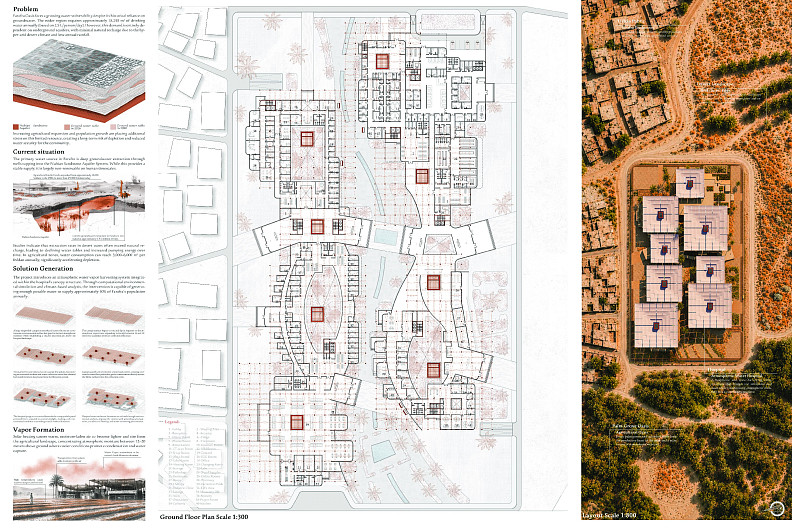
Atmospheric Water Hospital – Farafra Oasis, Egypt The project responds to the growing challenge of groundwater depletion within Farafra Oasis by reimagining the hospital as both a healthcare facility and a productive environmental infrastructure. Historically, the oasis depended on naturally pressurized groundwater emerging through springs connected to the Nubian Sandstone Aquifer. Increasing agricultural expansion and continuous groundwater extraction have accelerated the decline of these water resources, creating an urgent need for alternative and sustainable water strategies. The proposal introduces a decentralized atmospheric water harvesting system integrated directly into the architecture of the hospital. Rather than relying solely on extraction from the aquifer, the project captures atmospheric moisture generated through evapotranspiration from surrounding agricultural lands and palm groves. A network of elevated tensile canopies positioned within the local vapor zone condenses moisture and channels it toward a series of collection towers where water is filtered, stored, and redistributed. The project establishes a symbiotic relationship between healthcare, landscape, and water infrastructure. The hospital not only provides medical services but also contributes to the environmental resilience of the oasis by generating a renewable water source, reducing pressure on groundwater reserves, and creating educational and social spaces centered around water awareness. Through this integration, the building becomes a catalyst for ecological regeneration, community engagement, and long-term sustainability within one of Egypt's most water-sensitive environments.
Project description
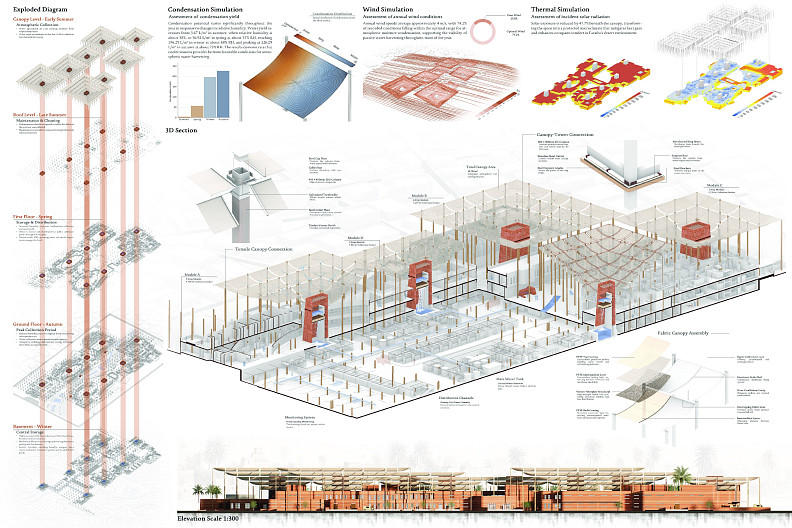
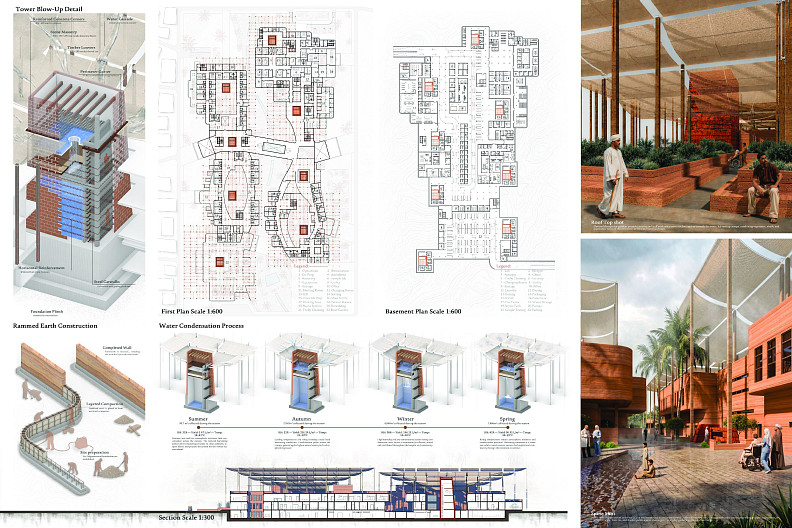
The project occupies a strategic location at the interface between the dense urban fabric of Farafra and the agricultural oasis that surrounds it. This position allows the hospital to function as both a healthcare destination and a mediator between the settlement and the productive landscape that sustains it. The development is organized around a central public spine that acts as the primary circulation route, social space, and environmental corridor. Running through the heart of the project, this spine accommodates movement, gathering, public water collection, shaded resting areas, and water features that celebrate the presence of harvested water within an otherwise water-scarce environment. The spine transforms the movement through the hospital into a public experience centered around water, community, and healing. The hospital accommodates a comprehensive healthcare program designed to serve the needs of the oasis community. The ground floor contains the emergency department, radiology and imaging facilities, diagnostic laboratories, outpatient clinics, physical therapy and rehabilitation spaces, waiting areas, public services, and direct connections to the community water collection points distributed throughout the spine. The first floor houses operating theatres, intensive care units, sterile processing facilities, inpatient wards, staff support spaces, and clinical support functions. Above, therapeutic roof gardens provide restorative outdoor environments for patients, visitors, and healthcare staff, offering shaded spaces that overlook the oasis landscape while remaining integrated with the water harvesting infrastructure. The basement level contains the water treatment systems, storage reservoirs, laundry facilities, mechanical and electrical services, maintenance areas, storage spaces, and the morgue, creating a concealed operational layer that supports both the healthcare and environmental systems of the project. The defining architectural feature of the project is the atmospheric water harvesting canopy that extends across the site. Covering approximately 24,704 square meters, the canopy functions simultaneously as a climatic modifier, a shading device, and a water harvesting surface. Positioned within the atmospheric vapor zone occurring between approximately 12 and 20 meters above ground level, the canopy captures moisture through condensation and directs collected water toward a distributed network of collection towers. These towers act as environmental landmarks throughout the development and contain the infrastructure required for sedimentation, filtration, storage, maintenance, and water distribution. Together, the canopy and towers establish a decentralized water network integrated directly into the architecture, transforming the hospital into a productive environmental system capable of generating a significant portion of the community's water demand.
Technical information
The project combines passive environmental design strategies with an integrated atmospheric water harvesting system. The primary harvesting infrastructure consists of a tensile canopy network with a total collection area of approximately 24,704 square meters distributed across four primary canopy modules. Module A provides a collection surface of 4,712 square meters, Module B covers 3,200 square meters, Module C provides 2,328 square meters, and Module D contributes 1,024 square meters, collectively forming a distributed harvesting system that spans the site. The canopy is positioned within the local atmospheric moisture layer where humidity accumulates above the oasis landscape. Moisture generated through evapotranspiration from agricultural fields and palm groves rises into this zone and condenses on the canopy surfaces during periods of favorable temperature and humidity. Environmental simulations indicate an annual water production of approximately 11,935 cubic meters. Seasonal analysis demonstrates significant variation in harvesting performance throughout the year. During summer, condensation yield reaches approximately 3.67 liters per square meter, generating approximately 90.7 cubic meters of water. Spring conditions produce approximately 56.92 liters per square meter, generating approximately 1,406 cubic meters. Winter performance increases significantly to approximately 196.25 liters per square meter, generating approximately 4,848 cubic meters. The highest annual performance occurs during autumn, when yields reach approximately 226.29 liters per square meter and generate approximately 5,585 cubic meters of water. Collectively, these outputs allow the system to provide approximately 65.4 percent of the annual water demand of the local population, demonstrating the viability of atmospheric harvesting as a supplementary water source within the oasis. Water collected from the canopy is transferred through an integrated gutter network into a series of collection towers distributed across the site. Each tower incorporates a sedimentation chamber where suspended particles settle before entering a slow sand filtration system. The filtration assembly consists of layered sand and gravel media supported by perforated collection screens, allowing water to be naturally purified before entering storage reservoirs. Each tower provides an approximate storage capacity of 672 cubic meters while also accommodating maintenance platforms, inspection areas, service circulation, filtration infrastructure, and water distribution systems. Filtered water is subsequently directed toward public collection points, landscape irrigation systems, water features, and central storage facilities located within the basement level of the hospital. The hospital structure is primarily composed of reinforced concrete frames, slabs, and shear walls designed to accommodate the complex spatial requirements of healthcare facilities. The atmospheric water harvesting towers are constructed from locally sourced Farafra limestone masonry reinforced by concealed 400 × 400 millimeter reinforced concrete corner columns and horizontal steel reinforcement integrated within the masonry courses. These structural elements provide lateral stability and wind resistance while preserving the appearance of monolithic stone construction. Maintenance cores and service shafts are constructed from reinforced concrete and support catwalks, maintenance platforms, and filtration infrastructure throughout the tower height. The canopy structure is supported by a tensile steel system consisting of steel SHS columns, galvanized steel tension cables, turnbuckles, cable stops, pad-eye connections, welded ring plates, and aluminum keder rail assemblies. The membrane system utilizes a double-layer fabric arrangement separated by a 50-centimeter ventilated air cavity. The upper layer functions as the primary condensation surface, while the lower layer provides shading and thermal protection to occupied spaces below. Water collected from the membrane is directed through perimeter gutters attached to reinforced ring beams at the tower heads, where integrated brackets, collection rods, and support angles transfer structural loads while facilitating water collection. The building envelope combines rammed earth construction, local limestone masonry, high-performance glazing systems, and passive shading devices. Rammed earth walls provide thermal mass capable of moderating indoor temperature fluctuations, while local limestone reinforces the project's connection to the material traditions of Farafra. Roof gardens integrated throughout the upper levels contribute to microclimatic cooling, therapeutic healing environments, and biodiversity enhancement. Environmental analysis indicates that the canopy reduces annual incident solar radiation by approximately 47.7 percent, significantly improving outdoor thermal comfort and reducing heat gain throughout the public spine and surrounding open spaces. Through the integration of atmospheric water harvesting, passive climatic control, local construction materials, therapeutic landscapes, and advanced healthcare facilities, the project establishes a comprehensive environmental and social infrastructure. Rather than treating water, healthcare, and architecture as separate systems, the proposal merges them into a single resilient framework capable of addressing the environmental, social, and medical challenges facing Farafra Oasis while contributing to its long-term sustainability and resilience.
Youssef Haroun
Cairo University, Faculty of Engineering Architecture Department.
Egypt
Arquitetura
Projeto submetido
14. 06. 2026Etiqueta
Conselho a estudantes

Copyright © 2026 INSPIRELI | All rights reserved. Use of this website signifies your agreement to the Terms of Use, Privacy Policy, and use of cookies.