Flax Retting Town
Project idea
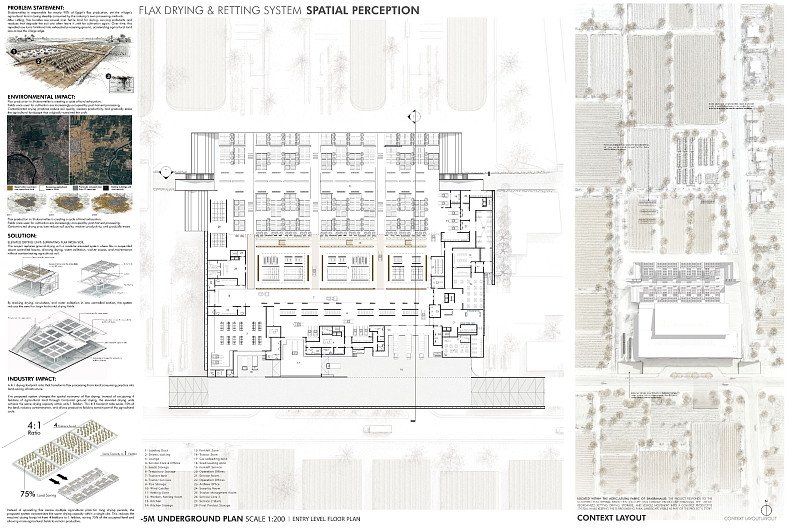
The project is a rural productive infrastructure for the flax industry in Shbramallis, a village in Egypt known for its seasonal flax cultivation, retting, drying, and trading activities. The project responds to the environmental, spatial, and social problems created by the traditional flax-processing methods currently taking place across scattered agricultural lands. In the existing condition, flax production depends heavily on open fields, informal water basins, and temporary ground-based drying areas. These practices occupy large areas of fertile farmland, damage the soil, interrupt agricultural productivity, and create uncontrolled water and waste conditions. During the flax season, agricultural plots are transformed into storage, drying, and retting zones, while during the rest of the year many of these spaces lose their productive or civic value. The project proposes a compact, organized, and seasonally adaptive flax-processing system. Instead of spreading the process horizontally across valuable farmland, the project reorganizes it vertically and linearly. Retting, drying, storage, circulation, workers’ movement, visitors’ access, and water management are combined into one integrated architectural system. The main idea is to transform flax production from an informal land-consuming process into a controlled rural infrastructure that protects farmland, improves production efficiency, and creates a public community platform during the off-season. The project is not only a factory. It is a seasonal civic machine. During the production season, it operates as a flax retting and drying facility. During the rest of the year, parts of the same structure transform into a market, exhibition space, rural gathering platform, and educational space for visitors and the local community. This gives the building a continuous role throughout the year instead of limiting it to a short industrial season. The architectural concept is based on the relationship between agriculture, air, water, time, and land. The project treats time as a spatial problem: the longer flax takes to dry, the more land is occupied. By improving ventilation, lifting the flax above the ground, and organizing the drying process in a controlled system, the project reduces the need for scattered ground storage and frees surrounding agricultural land from seasonal occupation. Main Goals The project aims to protect agricultural land from the damage caused by traditional flax drying and retting methods. It aims to reduce the spatial footprint of flax processing by replacing scattered ground drying areas with a compact elevated drying system. It aims to organize the flax production sequence into a clear architectural process, from receiving and retting to drying, storage, movement, and seasonal reuse. It aims to improve airflow around the flax bundles in order to accelerate drying and reduce the amount of land needed for temporary storage. It aims to contain the retting process inside controlled basins instead of allowing water to be absorbed directly by agricultural soil. It aims to separate industrial movement from public movement, allowing trucks, workers, visitors, and community users to move safely without conflict. It aims to create a year-round civic building that supports the village socially and economically beyond the flax season. It aims to preserve the identity of Shbramallis as a flax-producing village while improving the environmental and spatial conditions of the industry.
Project description
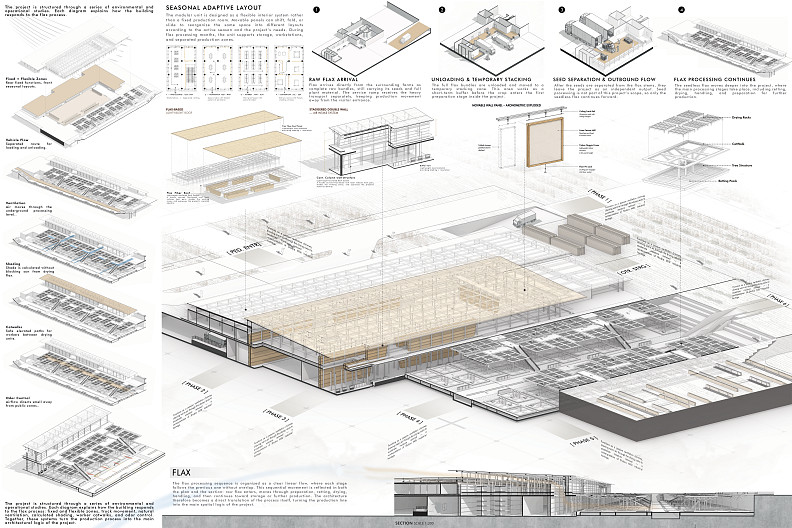
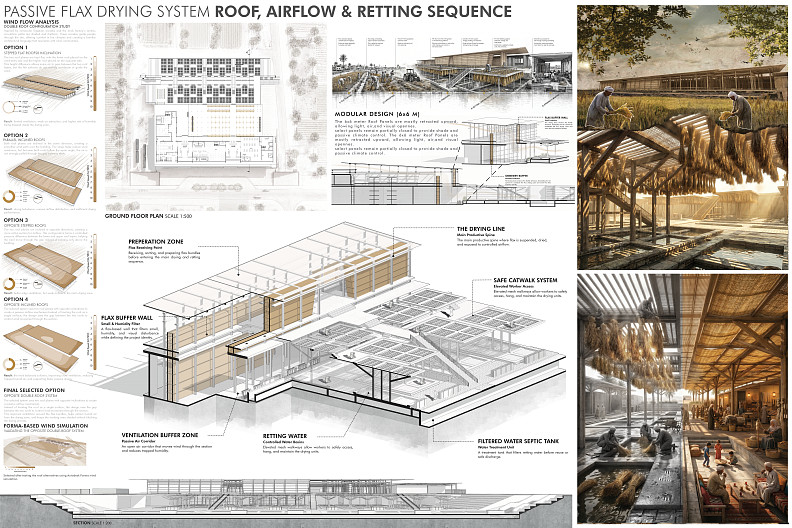
The project is a flax-processing and community infrastructure located within an agricultural context in Shbramallis. It is designed to receive flax from surrounding farms, organize its processing, reduce its environmental impact, and transform the seasonal industrial activity into a permanent architectural and social asset. The project solution is based on dividing the flax process into a clear linear sequence. The flax enters the project through a service route separated from the main visitor entrance. Trucks move down through dedicated ramps to the production level, where the flax is unloaded, sorted, prepared, retted, dried, stored, and moved through the site in a controlled way. This separation allows the production process to happen efficiently while keeping the public areas safe and accessible. The underground or lower level contains the heavier industrial functions, especially the retting basins, water-handling areas, storage zones, service circulation, and truck access. Locating these functions below or partially below ground reduces their visual impact and separates wet industrial work from the public ground level. Above the retting basins, the project introduces elevated drying units. Flax bundles are suspended instead of being spread directly on agricultural soil. This allows air to pass around the flax from different directions and reduces contact with the ground. The elevated system also saves land because drying no longer depends on occupying large open fields. Between the drying units, metal mesh catwalks allow workers to access the suspended flax bundles safely. These catwalks are lightweight and permeable, allowing air and light to pass through while supporting workers during hanging, checking, and removing the flax bundles. The catwalks also emphasize the technical character of the project, showing the relationship between the worker, the crop, the structure, and the air movement. The project includes controlled retting basins below the drying system. These basins collect and contain the water used in the retting process. Instead of allowing retting water to be absorbed by farmland, the water is contained inside defined basins. The water is not fully chemically purified for reuse in the retting process, because bacterial activity is necessary for retting and heavily treated water may prevent this natural biological process. Instead, the project focuses on containing the water, separating solid waste, and managing discharge through controlled removal and connection to agricultural drainage systems when required. The architectural form is also shaped by environmental performance. Air movement is treated as a main design factor. The building uses open structures, raised drying platforms, mesh walkways, buffer walls, roof openings, and controlled gaps to allow ventilation to pass through the flax bundles. Shading is designed carefully so that the structure protects workers and circulation paths without preventing sunlight from reaching the flax where drying is required. The project also has a strong seasonal strategy. During the flax production season, the flexible units are used for hanging, drying, storing, and handling flax. During the off-season, these same spaces can be converted into a rural market, exhibition space, workshop zone, or community platform. The retting basins and storage zones can be covered, reinterpreted, or used as spatial elements that support temporary activities. This seasonal transformation allows the project to stay active even when flax processing is not happening. The public part of the project includes a main visitor entrance, reception, security, market spaces, exhibition areas, administration, community areas, and circulation paths that allow people to understand the flax process without interfering with the industrial workflow. The project therefore becomes both a production facility and an educational public space that tells the story of flax in Shbramallis. Main Areas of the Project 1. Arrival and Public Entrance Zone This area receives visitors, local residents, buyers, and community users. It is separated from the industrial truck entrance to ensure safety and clarity. It may include reception, security, information points, and access to the public market or exhibition spaces. 2. Truck Access and Service Ramp A dedicated service route allows trucks to enter the production zone without crossing the public entrance. The ramp system connects the surrounding road level to the lower industrial level, allowing flax to be unloaded directly into the production sequence. 3. Loading and Unloading Deck This area is designed for receiving flax bundles from trucks. It allows workers and machinery such as forklifts or small transport vehicles to move flax efficiently from trucks to storage, retting, or preparation zones. 4. Flax Preparation and Sorting Area Before retting or drying, flax bundles can be sorted, tied, grouped, and prepared. This area supports the first step of the production process and helps organize the movement of material inside the project. 5. Retting Basins The retting basins are controlled water basins used to soak flax bundles. Their role is to contain the retting process and prevent uncontrolled water absorption into agricultural soil. They form the wet industrial core of the project. 6. Water and Solid-Waste Management Area This area manages the water used in retting. The system focuses on separating solid materials and controlling the movement of water. Water can be removed by suction trucks or discharged in a controlled way to agricultural drainage, depending on the operation strategy. 7. Elevated Drying Units The drying units are the main architectural and environmental feature of the project. Flax bundles are suspended above the retting level, allowing air to move around them and reducing the need for open-field ground drying. 8. Worker Catwalks Mesh catwalks allow workers to access the drying units. They are designed as lightweight industrial walkways that do not block air or light. They support maintenance, monitoring, hanging, and removing flax bundles. 9. Storage Units Storage areas are used for flax bundles, tools, stones, bricks, tying materials, and seasonal equipment. Some storage units can hold the weights used to keep flax submerged during retting. 10. Flexible Seasonal Platform This is the transformable part of the project. During the flax season, it supports industrial activities. During the off-season, it becomes a market, exhibition space, community event area, or rural public platform. 11. Market and Exhibition Area The project includes spaces for selling flax products, fabrics, handmade goods, agricultural products, and local crafts. The exhibition area can explain the history, process, and importance of flax production in Shbramallis. 12. Administration and Control Area Administrative spaces support management, coordination, supervision, and documentation of the production process. They may include offices, staff rooms, meeting spaces, and monitoring points. 13. Workers’ Facilities The project may include lockers, rest areas, toilets, changing rooms, washing areas, and shaded gathering spaces for workers involved in the production process. 14. Buffer Zone and Landscape A planted buffer zone separates the productive infrastructure from surrounding agricultural land and village edges. It improves the environmental quality of the project, softens its industrial character, and creates a transition between the building and the rural landscape.
Technical information
The project is made of a combination of heavy permanent elements and lightweight adaptable elements. The lower industrial level is designed as a durable concrete system that can resist water, soil pressure, and heavy use. The upper drying and public levels are designed as a lighter modular structure that supports flexibility, ventilation, and seasonal transformation. Structural System The lower level is mainly composed of reinforced concrete retaining walls, slabs, ramps, basins, and service platforms. This concrete base supports the wet and heavy industrial functions of the project, including retting basins, truck movement, water containment, and storage. The upper level is composed of a modular steel structure. Steel columns, beams, trusses, and frames support the elevated drying units, catwalks, roof elements, and seasonal platforms. The steel system allows large spans, repeated modules, and future adaptability. The drying units are designed as repeated structural bays. Each bay can hold suspended flax bundles and can be accessed by workers through mesh walkways. The repetition of these units creates a clear industrial rhythm and allows the project to expand or adapt if needed. Materials The project uses reinforced concrete for the underground level, retaining walls, water basins, ramps, loading areas, and structural base. It uses steel for the elevated structural frame, columns, beams, catwalk supports, drying racks, handrails, and modular connections. It uses metal mesh for catwalk floors and selected platforms to allow air, light, and visibility to pass through. It uses timber, reed, straw, bamboo, or lightweight natural materials for shading elements, roof layers, screens, and architectural finishes that connect the building to the rural character of Shbramallis. It uses permeable surfaces, compacted earth, gravel, agricultural soil, and planted areas in the landscape and buffer zones. Retting System The retting process is placed inside controlled basins rather than informal pits or agricultural fields. The basins are designed to hold water and flax bundles during the retting period. They prevent direct uncontrolled contact between retting water and agricultural soil. The basins may include drainage points, access edges, maintenance paths, and removable covers or platforms for off-season use. Stones or bricks used to keep flax submerged can be stored in adjacent storage units when not in use. The water system is based on containment and solid separation rather than full chemical purification. This is important because retting depends on bacterial action. If water is chemically treated with substances such as chlorine, the biological process required for retting may be interrupted. Therefore, the project manages the water by controlling where it goes, separating solid particles, and removing or discharging it through controlled methods. Drying System The drying system is elevated above the retting level. Flax bundles are tied and suspended from drying racks, ropes, rails, or light structural frames. This allows air to pass around the bundles more effectively than traditional ground drying. The system reduces the area needed for drying because the flax is organized vertically and linearly rather than being spread horizontally across fields. The drying units also make the process easier to monitor, maintain, and repeat. The drying structure is open and breathable. It avoids heavy closed walls that would trap humidity. The form is shaped to allow cross-ventilation, stack effect, and controlled exposure to sunlight. Ventilation Strategy Air movement is one of the main technical drivers of the project. The design uses open facades, mesh floors, elevated racks, roof gaps, double walls, and buffer zones to guide air through the drying areas. The building is designed to improve natural ventilation around the flax bundles. Better airflow can reduce drying time, and reducing drying time can increase the capacity of the project without expanding its land footprint. The double wall or buffer wall system helps control air direction, protect the process from direct external disturbance, and create a transition between the industrial process and the surrounding agricultural context. Sunlight and Shading Strategy The project balances shade and sun exposure. Workers and circulation paths require shade, but flax drying requires sunlight and airflow. Therefore, shading elements are placed carefully to protect people without blocking the drying process. The roof is designed as a light protective layer rather than a heavy closed cover. It may include reed, straw, timber, or perforated materials that create filtered light and allow the building to remain connected to the agricultural atmosphere. Circulation System The project has two main circulation systems: industrial circulation and public circulation. Industrial circulation is designed for trucks, workers, forklifts, flax bundles, water maintenance, and service access. It is connected to the lower production level through ramps and loading platforms. Public circulation is designed for visitors, local residents, buyers, and exhibition users. It enters from a separate main entrance and connects to the market, exhibition, community spaces, and selected viewing points. This separation reduces conflict between heavy production and public use. It also allows the project to operate as both a factory and a civic space. Seasonal Transformation System The project is designed to change according to the agricultural calendar. During the flax season, the drying units, retting basins, storage areas, and service routes operate as a production system. During the off-season, the project can transform into a community market, exhibition, workshop area, event platform, or educational space. Some industrial elements remain visible as part of the architectural identity of the project, allowing people to understand the flax process even when production is not active. Movable partitions, modular furniture, temporary covers, hanging systems, and adaptable storage units can support this transformation. Environmental Strategy The project reduces pressure on surrounding farmland by concentrating flax processing inside one organized site. It protects soil by preventing flax bundles and retting water from directly occupying agricultural plots. It reduces visual and environmental disorder by replacing scattered informal processing areas with a clear productive infrastructure. It uses passive environmental strategies such as natural ventilation, controlled sunlight, shading, buffer planting, and material permeability. It turns waste and water management into part of the architectural system rather than leaving them as uncontrolled external problems. Architectural Character The architectural language of the project combines rural materiality with industrial clarity. The concrete base expresses permanence, containment, and infrastructure. The steel upper structure expresses lightness, repetition, productivity, and adaptability. The natural roof and shading materials connect the building to the agricultural landscape. The project’s form is not decorative. It is generated by the flax process itself: water below, air above, workers moving between, and the village surrounding it. The building becomes a visible section of the flax industry, showing how the crop moves from field to retting, drying, storage, market, and community life.
Ahmed Ayyad
Cairo University, Faculty of Engineering Architecture Department.
Egypt
Arquitetura
Projeto submetido
14. 06. 2026Etiqueta
Conselho a estudantes

Copyright © 2026 INSPIRELI | All rights reserved. Use of this website signifies your agreement to the Terms of Use, Privacy Policy, and use of cookies.