AGRISPIRE
Project idea
The Egyptian identity has been rooted in agricultural practices for many years, providing stability and food security for families across the country. On the Nile Delta lies the city of Rashid, widely known for its agricultural land used to harvest food that covered around 55-60% of the food needs of the county. However, many forces such as urban expansion, environmental degradation, and loss of the value of education, act together to deteriorate the importance of agricultural practices within Rashid. heavy industrialization and urbanization have caused heavy pollution of the Nile water that the agricultural activity in Rashid is heavily reliant on, which in turn has caused farming practices to become less sustainable further damaging the land responsible for maintaining Rashid's economic stability and food security. Not only is the practice unsustainable due to the heavy use of chemical fertilizers, but also due to the overconsumption of water and the wastage of it while using these methods of farming. In Rashid, it is reported that about 85% of the water source is used in agriculture, this statistic puts into perspective the strain on the water security of Egypt, which already is at risk of water scarcity.
Project description
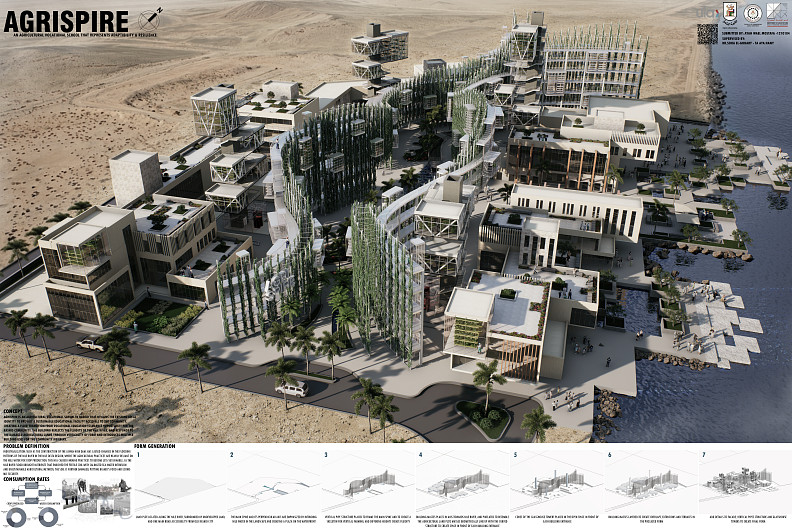
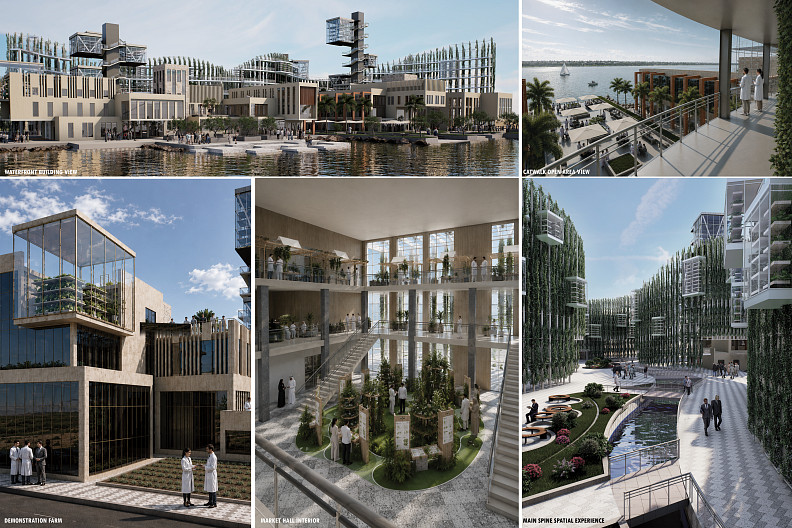
Agrispire is an educational vocational school that enables sustainable education and makes it accessible to the community. It acts as a closed loop, including a circular flow of activities that interact and rely on each other. The project responds to the gap in the education to labor market issue by including different functions, education, harvest and market, which reflects the fluidity of the agricultural process. This creates a space that is reliant on itself, providing opportunities for all community members to engage and be included in activities that shape their identity. The building form responds to the threats of damaged agricultural lands by creating a sense of verticality through the use of vertical farm structures and glasshouse towers.
Technical information
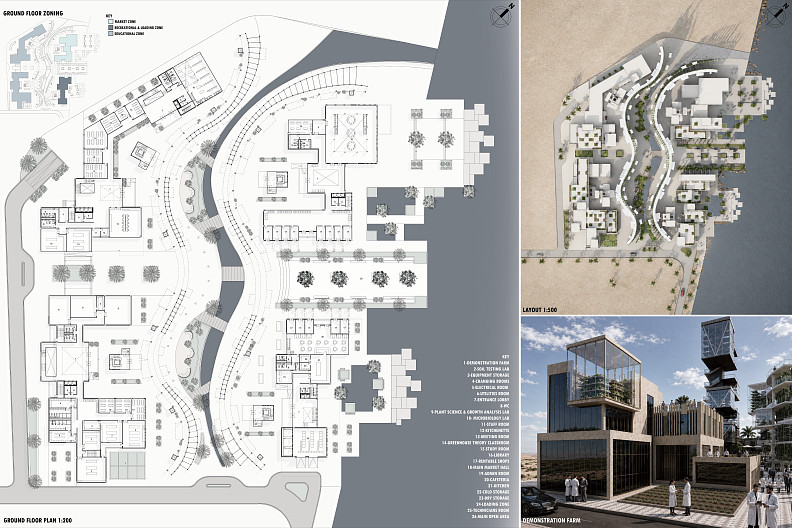
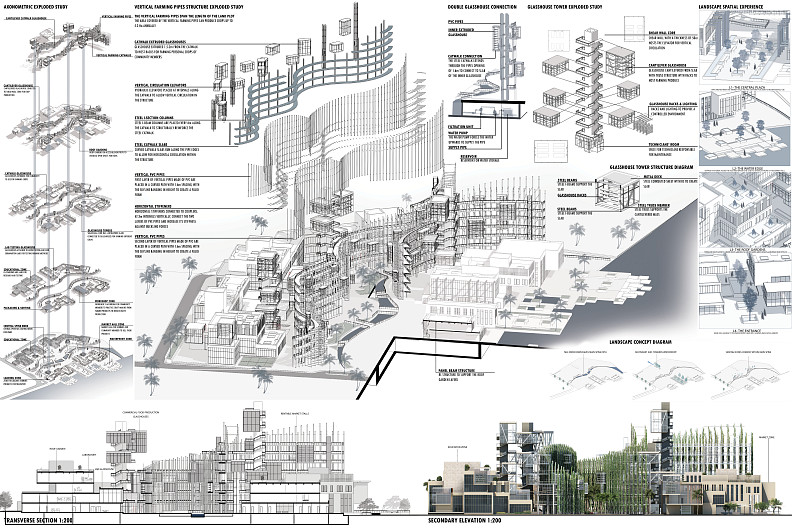
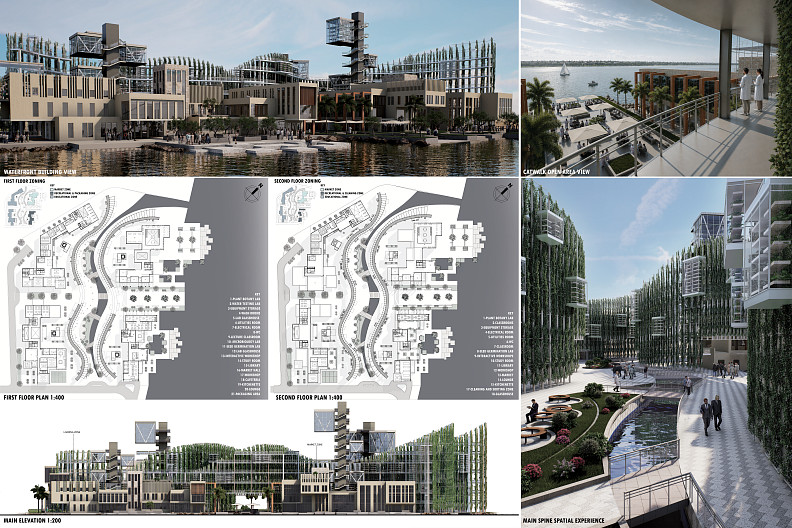
Vertical Farming Structure - Resilient Adaptation for Food Security The main spine of the project is framed by vertical farming pipes, made from PVC, to create a host for planting and harvesting food. The structure includes stiffener rods along the spine every 3m to prevent buckling and to hold the pipes together. The pipes have steel catwalks, supported by steel I-beams every 6m, along one side to allow for maintenance and circulation horizontally, while hydraulic elevators are placed at intervals along the catwalk to enable vertical circulation. The water system used relies on the Nile water, however a drip method is used within the pipes to reduce the water consumption by almost 92%. The green spine has extruded glasshouses that can be accessed through the catwalks, and the glasshouses can be rented by community members so they can take part in their own food production, further enhancing community engagement. This green spine not only creates a unique architectural form, but also represents the resilience of agricultural practice in Rashid. Glasshouse Tower- Rising Above Environmental Threat The glasshouse towers that lie along the project enhance the verticality of the project's form. The glasshouses structures along the main core fall into three categories; 1. Densely packed crops: the spacing of the racks allows for crops that don't require deep roots to grow and be harvested, such as leafy greens. 2.Medium packed crops: the spacing of the racks allows for growing of crops that require slightly deeper roots, such as tomatoes and peppers. 3. Sparsely packed crops: the spacing of the racks allows for deep-rooted crops to grow and have their required space. All these considerations are visible in the formation of three differently sized glasshouse structures to host the needs of each type of crop. Post Harvest and Processing - Enhancing Local Production The project includes a space for disposal, post-harvest processing and packaging of the harvested crops and food to be transported towards local markets. This creates a space for an integral part of the agricultural process. Not only that, but it also provides job opportunities for community members, which better enhances the local economy. Marketplace - Creating a Closed Loop The marketplace zone in the project creates a closed system, where the full agricultural process, from planting through harvest to selling, is completed. The zone hosts a main market hall where multiple vendors can sell their produce. Along with the main market hall, rentable market stalls can also be used by community members to sell their produce or crafts created from the harvested plants.
Ayah Wael Mostafa Sayed
Cairo University, Faculty of Engineering Architecture Department.
Egypt
Arquitetura
Projeto submetido
14. 06. 2026Etiqueta
- Schools
- Nursery
- University
- Library
- Other
Conselho a estudantes

Copyright © 2026 INSPIRELI | All rights reserved. Use of this website signifies your agreement to the Terms of Use, Privacy Policy, and use of cookies.