Re-use the fallen Church
Project idea
Is it possible to bring back to life one of the most important religious buildings of Southern Italy? We tride to answer this quastion in our architectural project that was choosen for our project of the year in our university. Chiesa Diruta is a catholic church built in Grottole in the 15th century, in order to host the local community of clergymen and to become one the most important churches of the bishopric. It suffered a lot of damages due to earthquakes, fires, and building issues so it was soon abandoned. The main aim was to reuse this space of this abandoned Church as a Concert Hall.
Project description
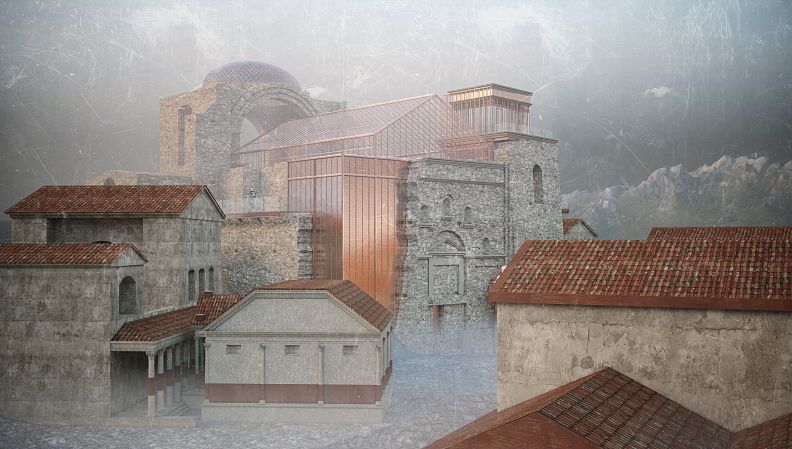
In our project we tried to carefully regenerate architectural structure of the church, as well as reorganize an interior space by choosing not a traditional way of preparing design. This project was created with the intent to preserve the link between architecture and nature throughout the time. The idea consists of regenerating the space and preserving the spirit of the place of the Italian town. We chose the method of devizualization of the new architecture, using translucent and reflective planars. They complete the look of the church, by standing in the background and giving all the attention to the authentic church. Thus, the new construction become a "ghost building" because of using glass to create the effect of dissolving into space, and filling the pause in the context of the urban space. Applying the Gestalt philosophy of "no presence "or" presence of absence", we preserve the impact of nature on the building, not only by the "ghost" forms, but also by not removing plants from the facades, to continue this theme of the thematic incorporation of the architecture and nature. All the main ruined parts - the roof, the walls, vaults, and arches became visible again but now only in the glass and copper to show the contrast of old and new but in the same time to save the essence of “genius loci”. In our project, we decided to regenerate the dilapidated tower, and because of that we could make view platforms outside the walls of the church on both sides. In addition to that the common space of the apse will become a great viewpoint to watch sunsets. All in all our project of regeneration of the fallen church is based on the method of devizualization of the new structures and on the thematic incorporation of the architecture and nature to save the essence of “genius loci”.
Technical information
The main feature of the redevelopment was a radical change in the orientation of functional spaces. For a long period of time we had been thinking about how to accommodate everything in the most convenient way and finally went from the method "how it cannot be". In this version, the main entrance is organized from the apse, and the narthex is given to the artists ' rooms. Café is situated on the ground floor. In addition to the main hall, there is also a small lecture hall on the first floor. Copper became the main material in this project, as well as glass. The existence abundance of greenery shows that nature always prevails over the people creations, but at the same time it forms the dynamic of the space and give us a sense of calm.
Alena Kokueva, Silviya Al Ubed
Yaroslavl State Technical University
Russian Federation
Arquitectura
Proyecto enviado
14. 07. 2021Etiqueta
Consejo a estudiantes
Consejo a estudiantes
Reutilizar la Iglesia caída

Copyright © 2026 INSPIRELI | All rights reserved. Use of this website signifies your agreement to the Terms of Use, Privacy Policy, and use of cookies.


